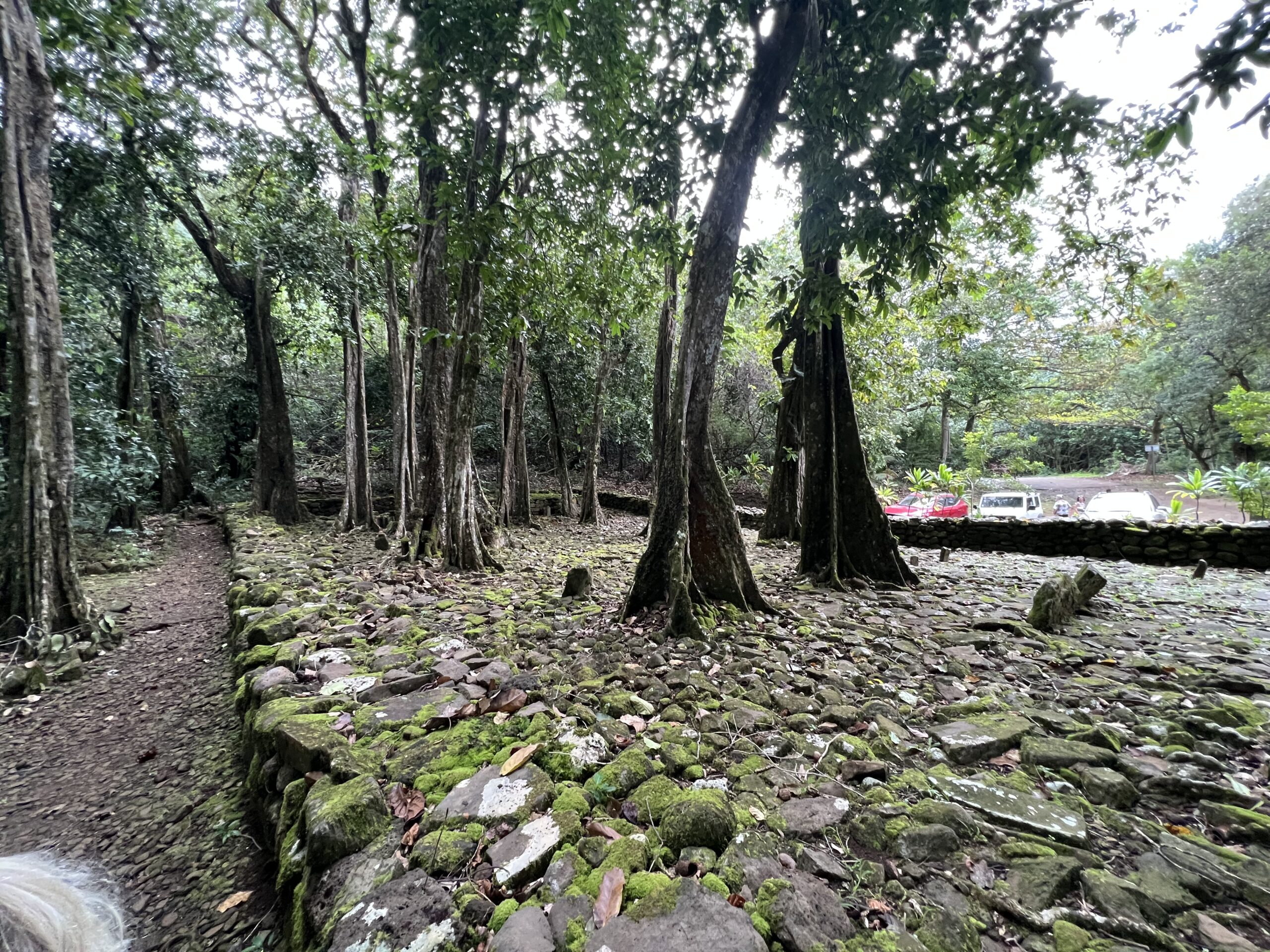
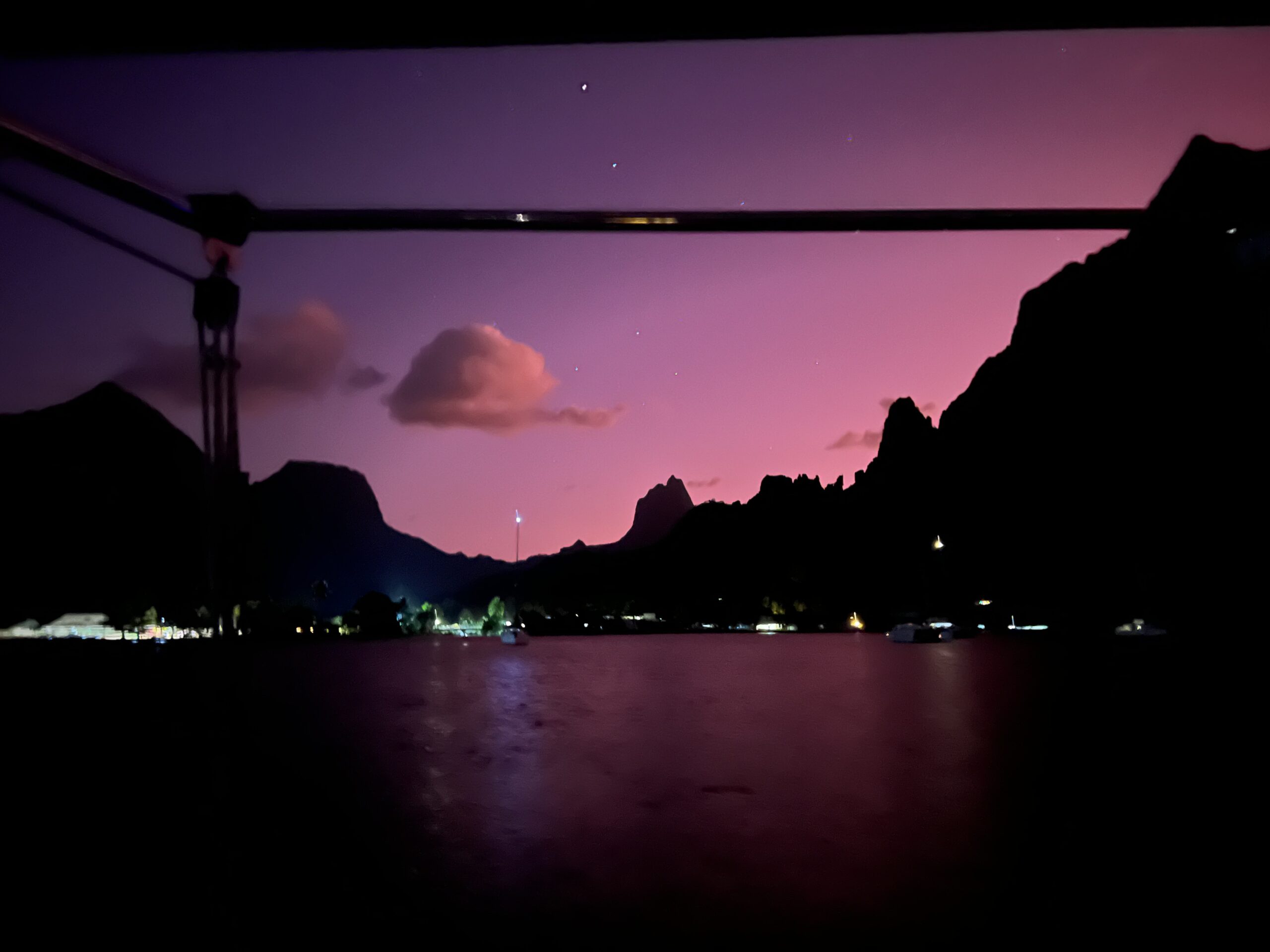
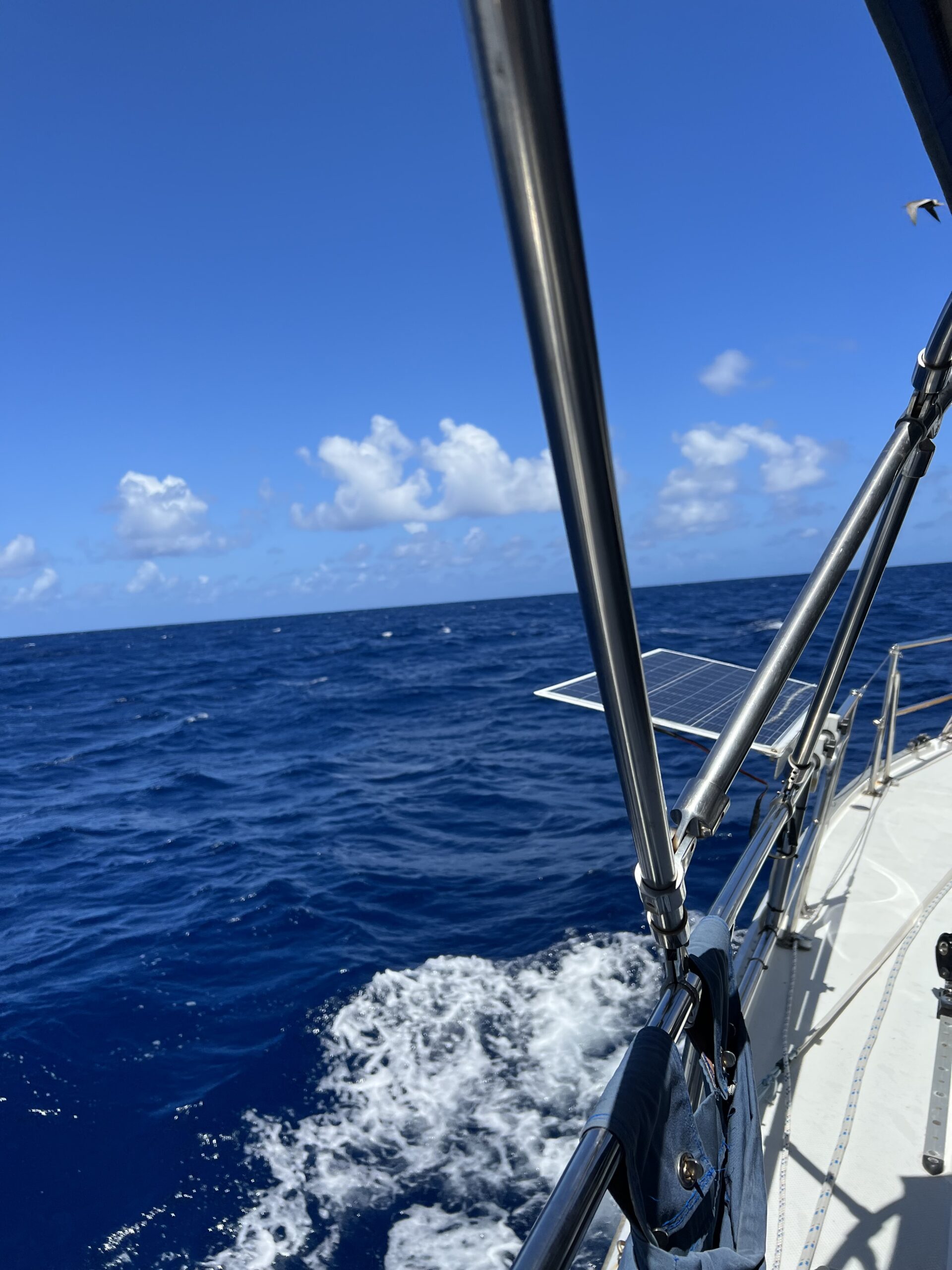
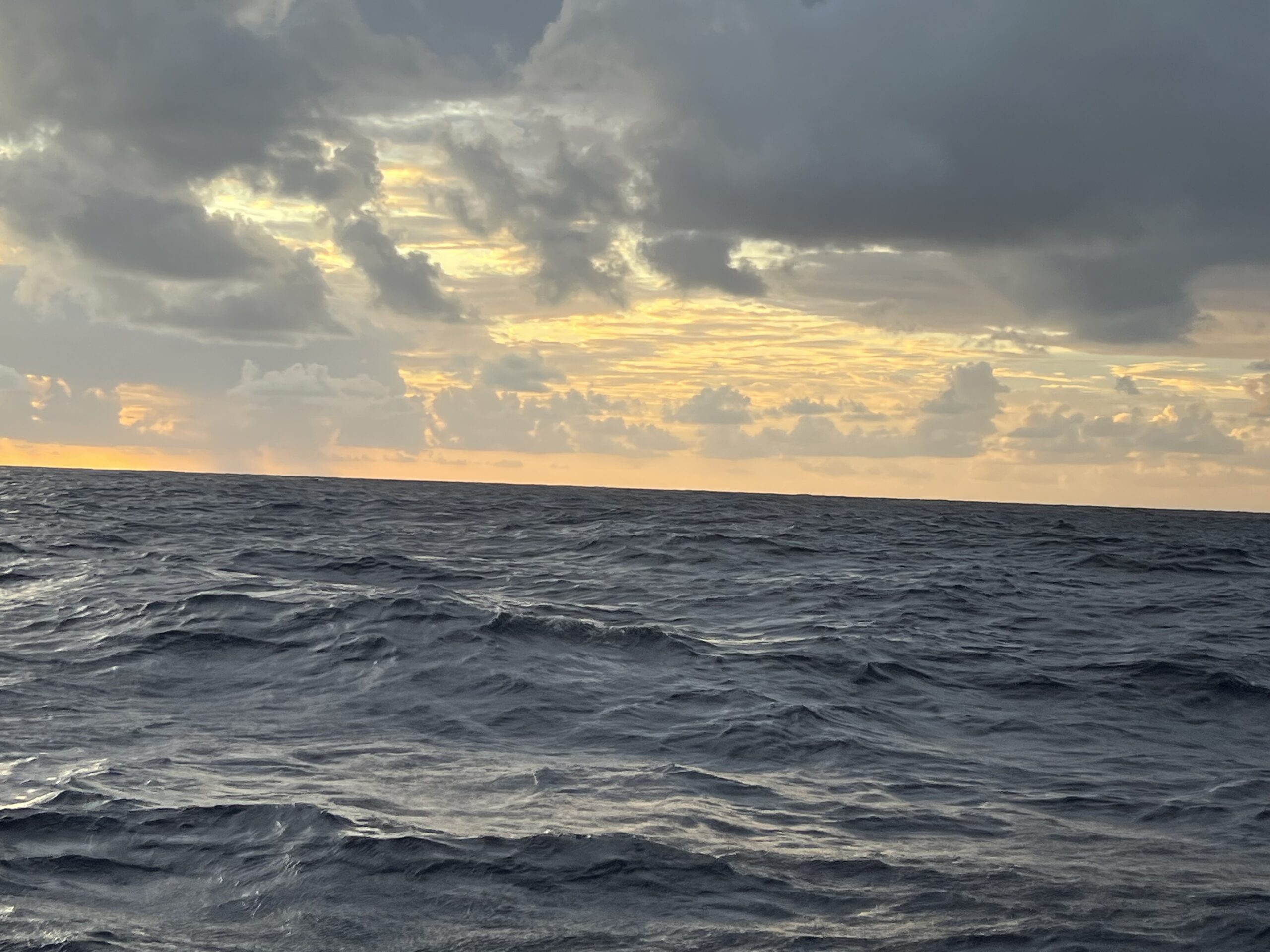
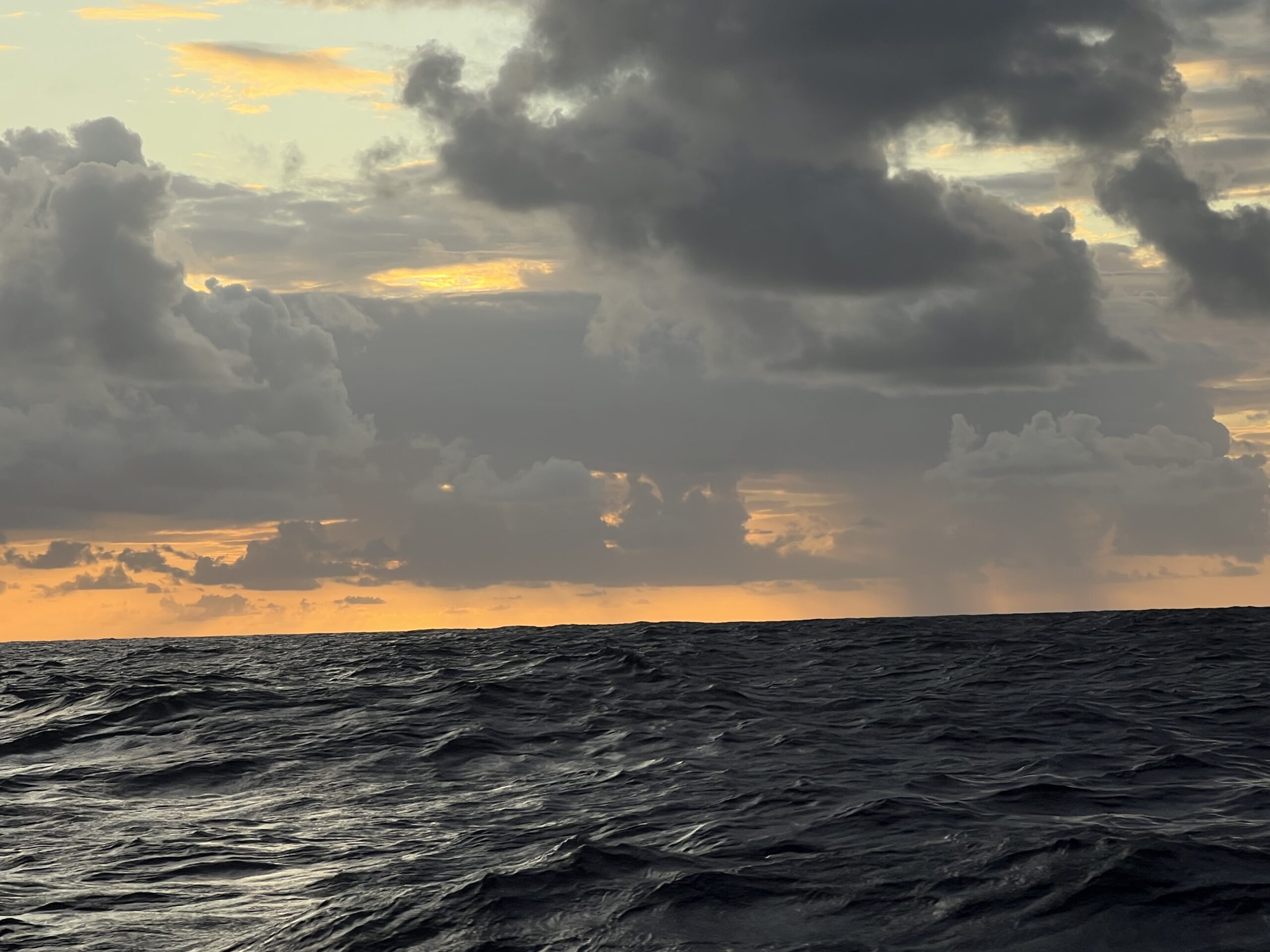
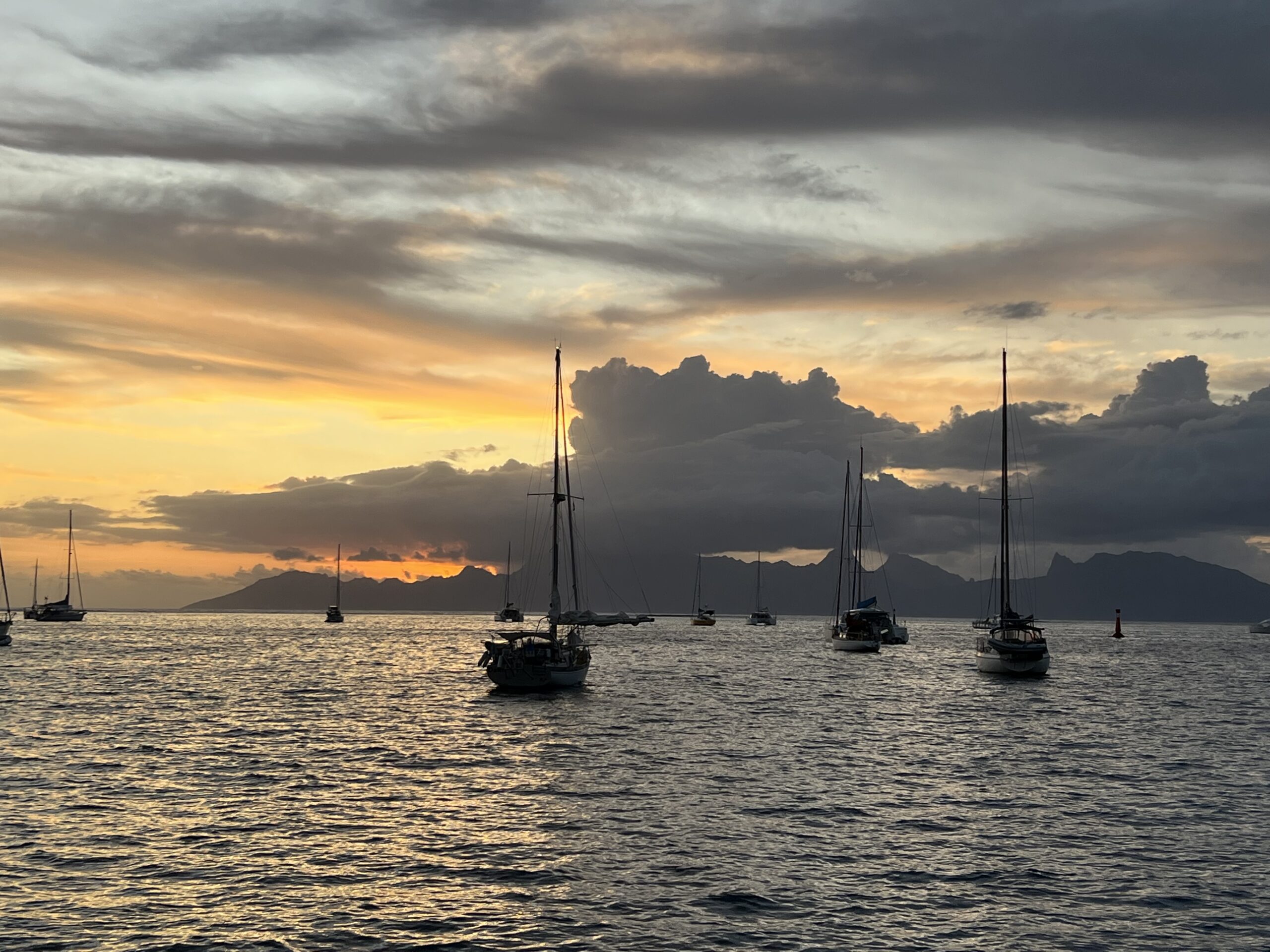
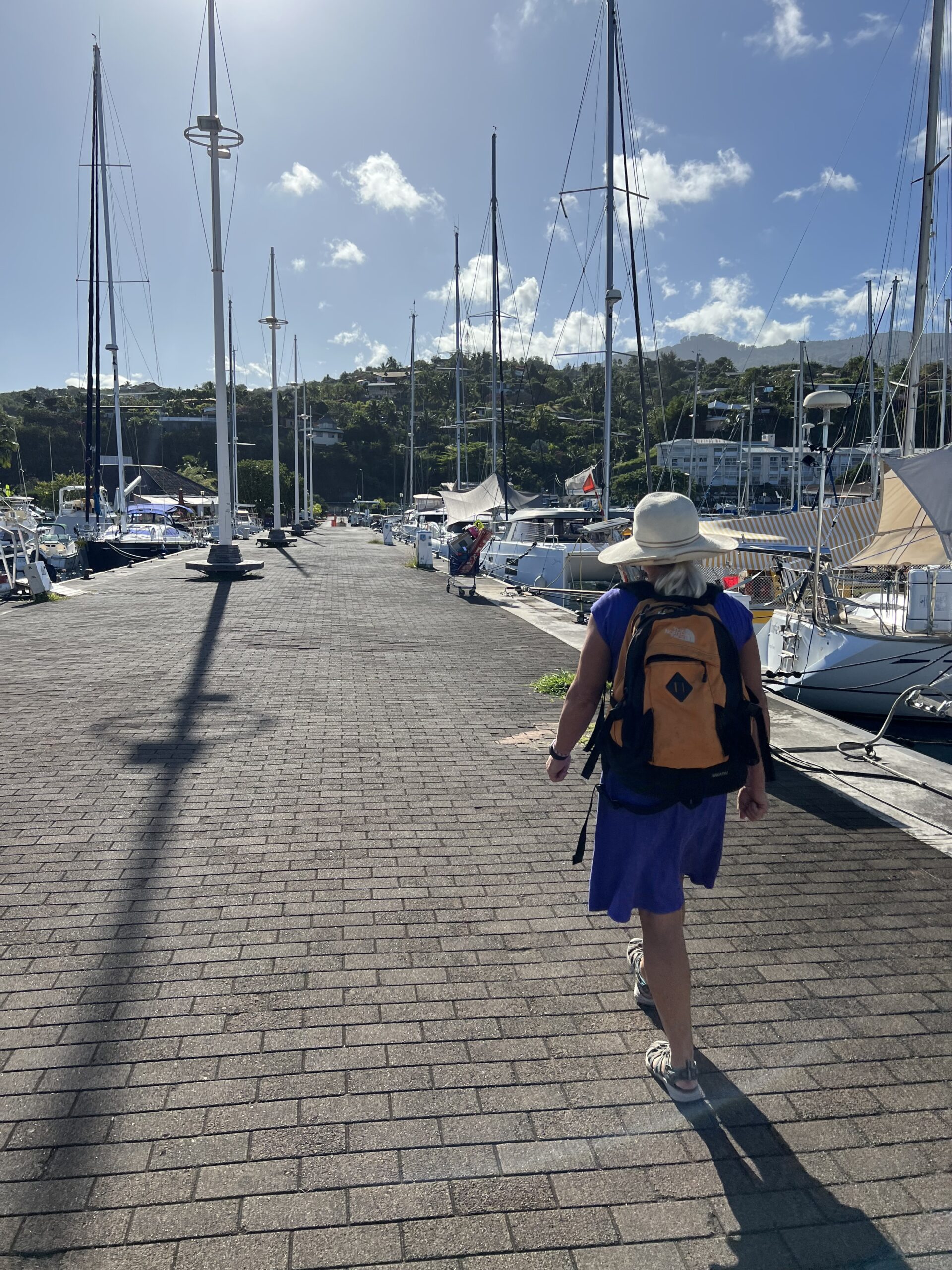
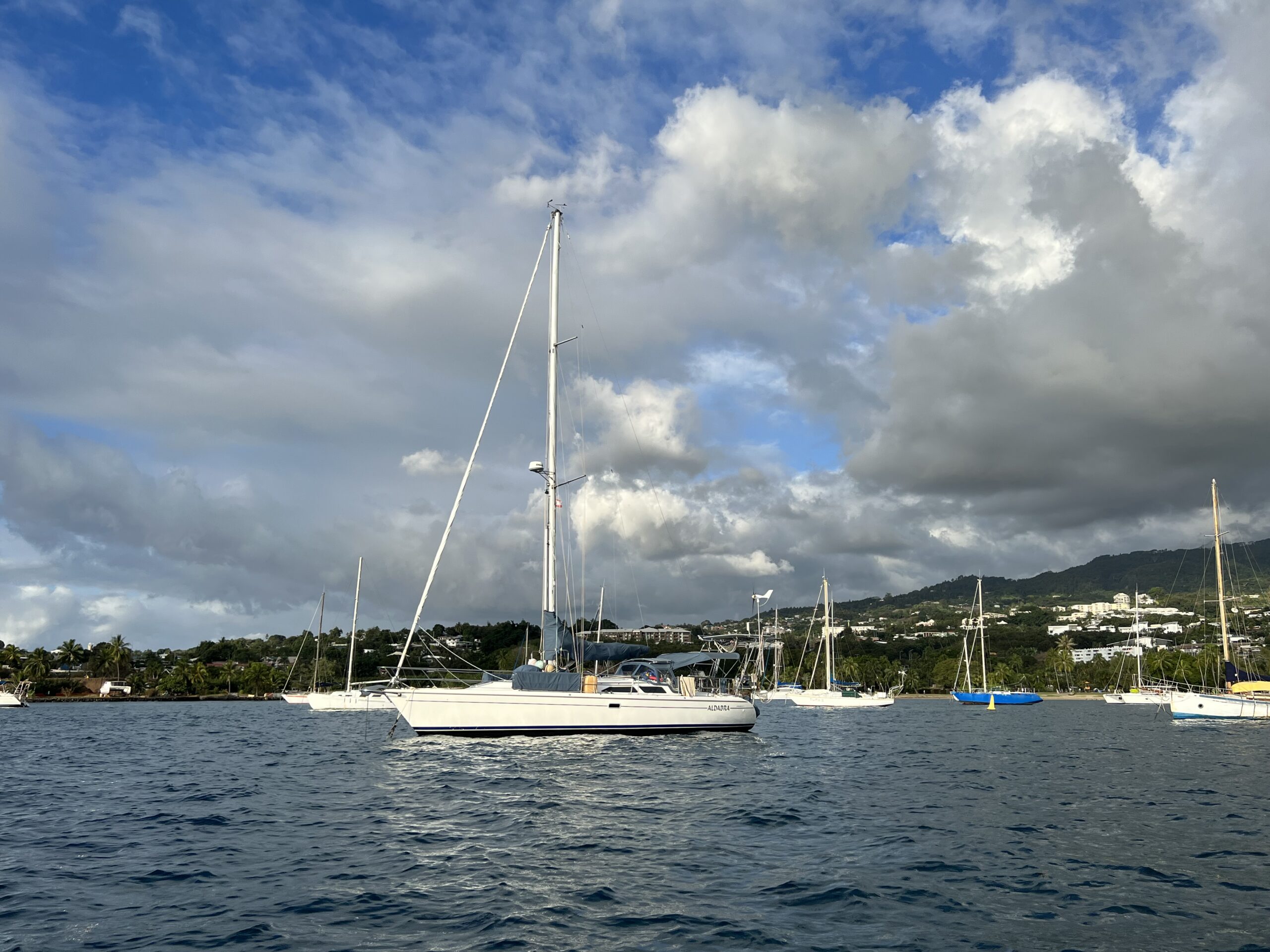
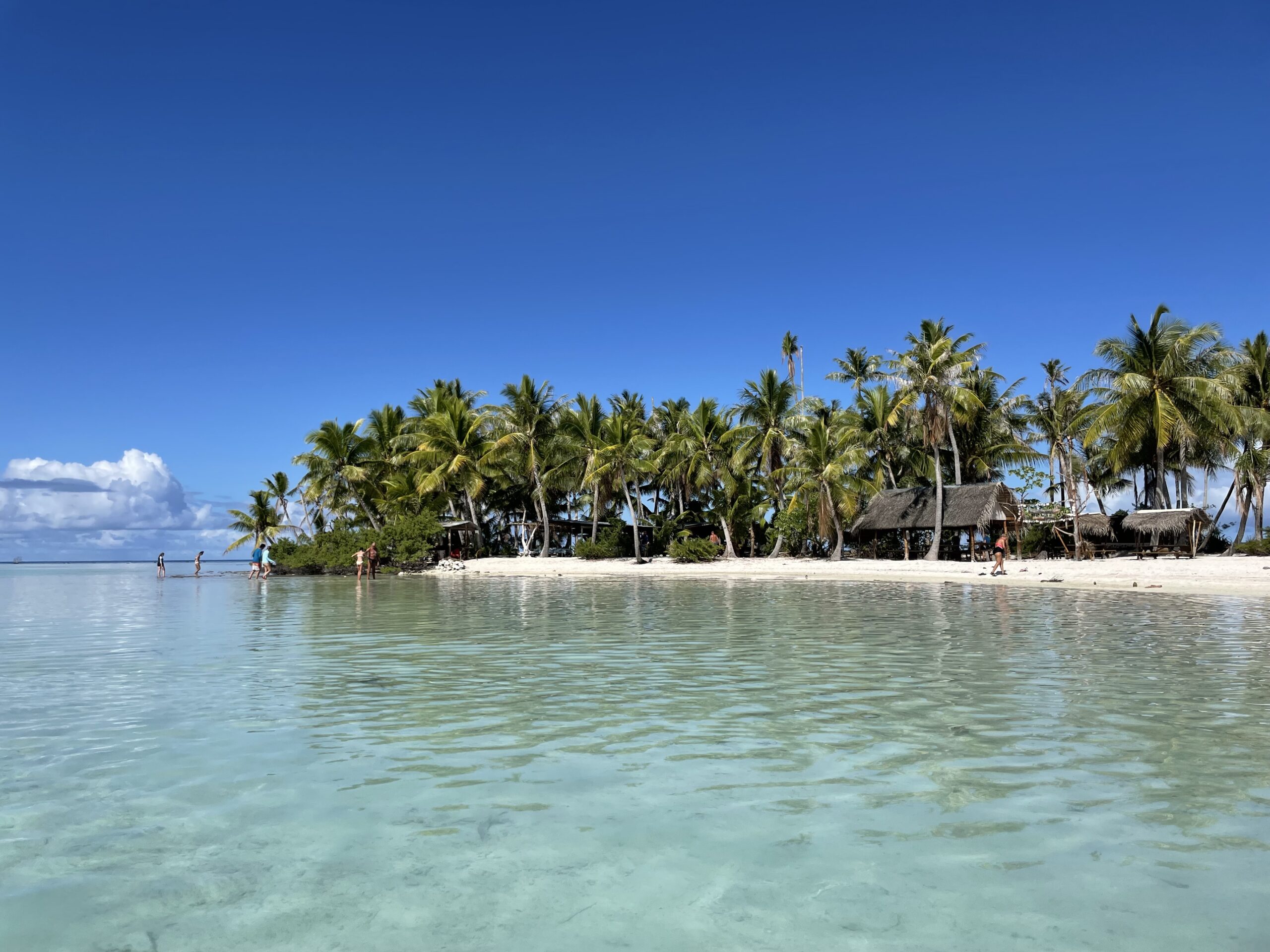
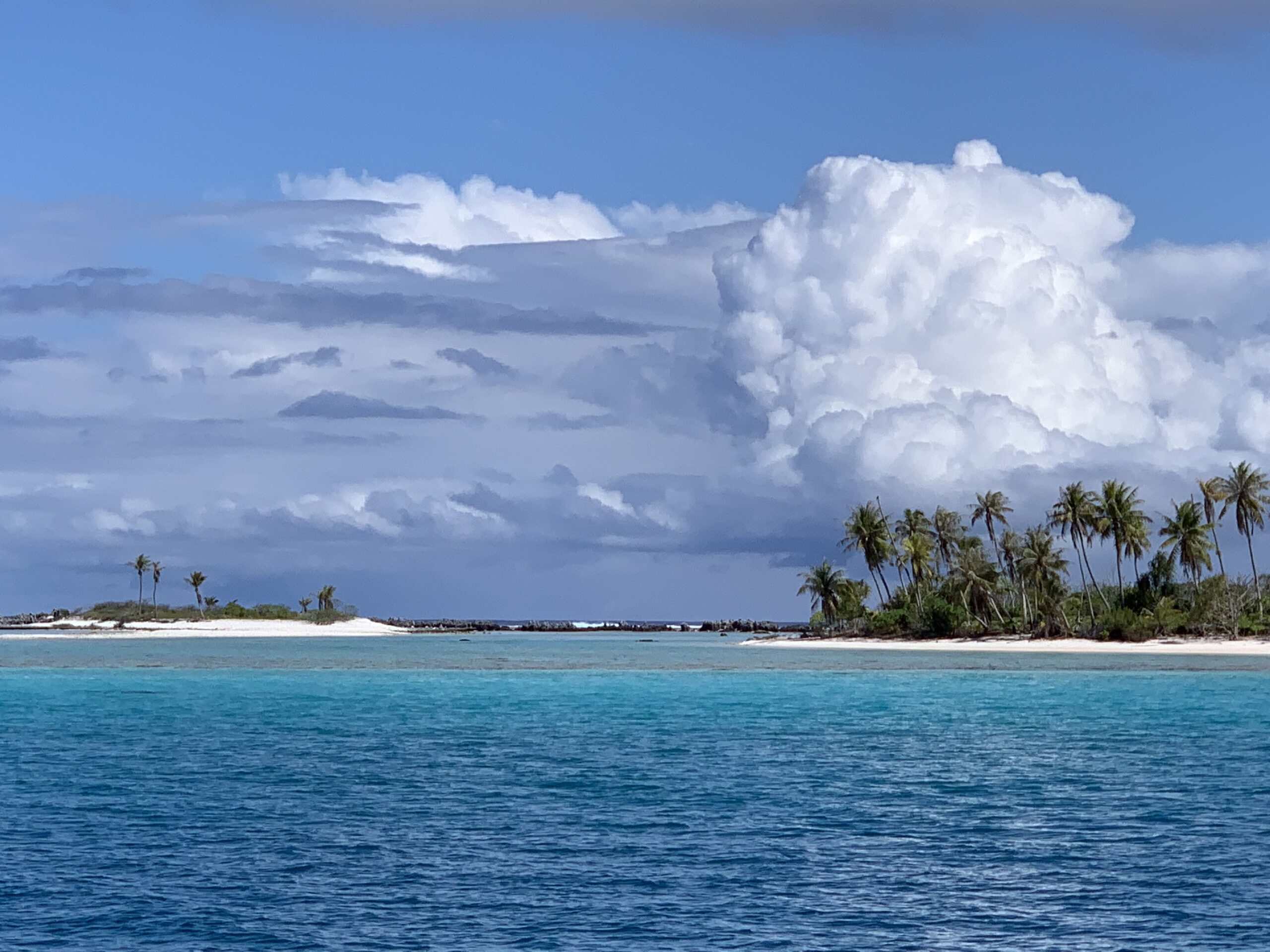
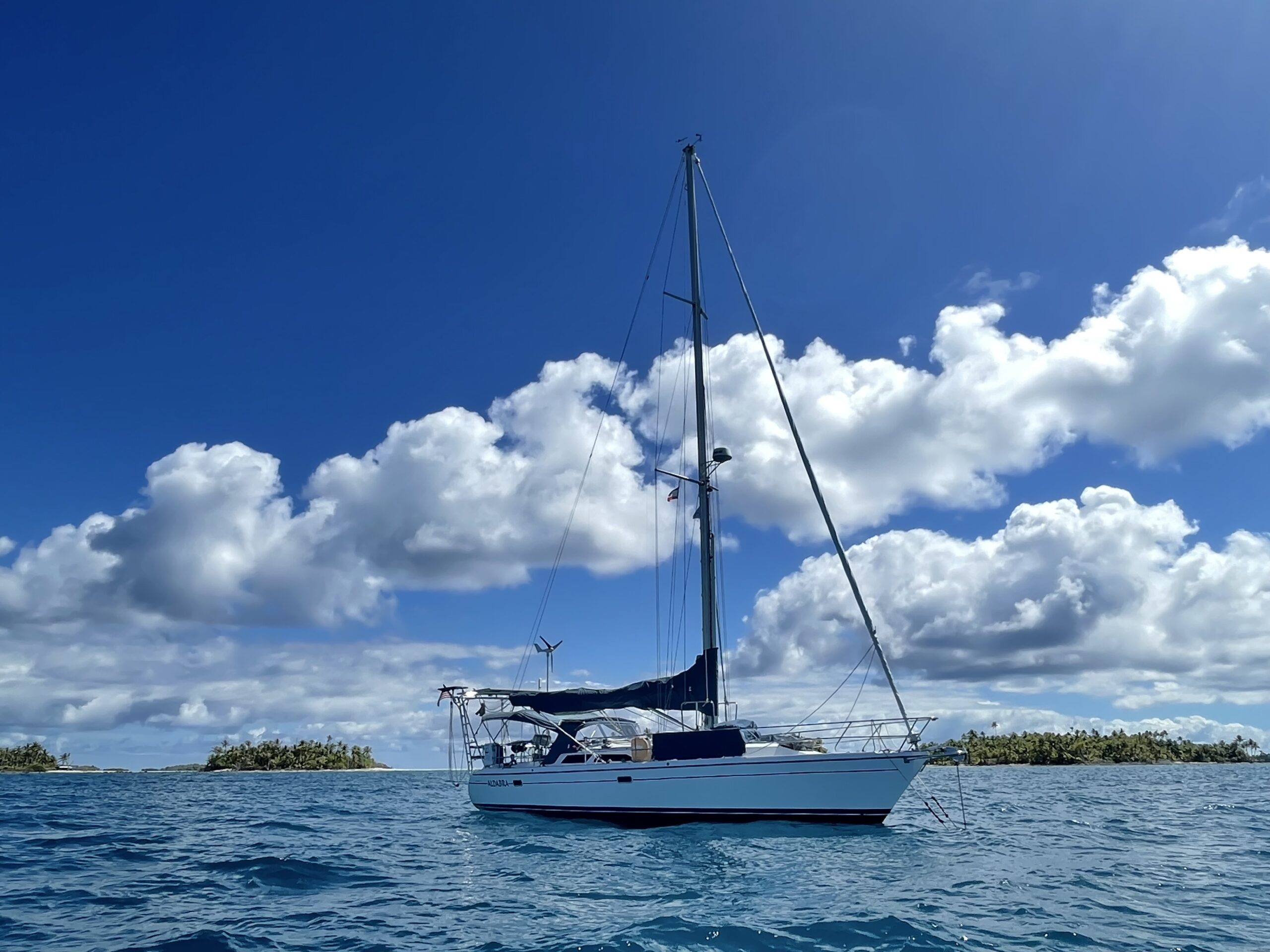
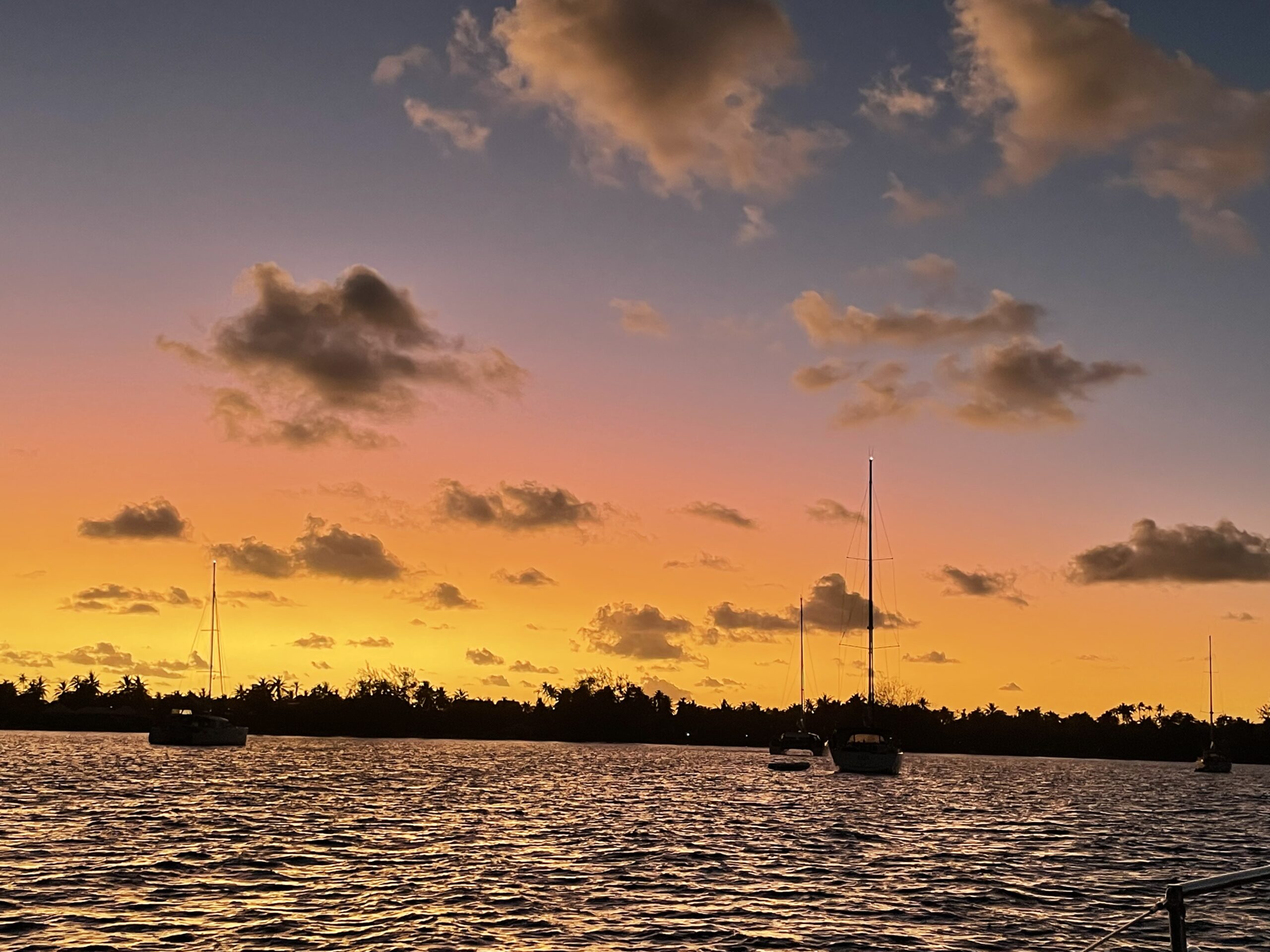
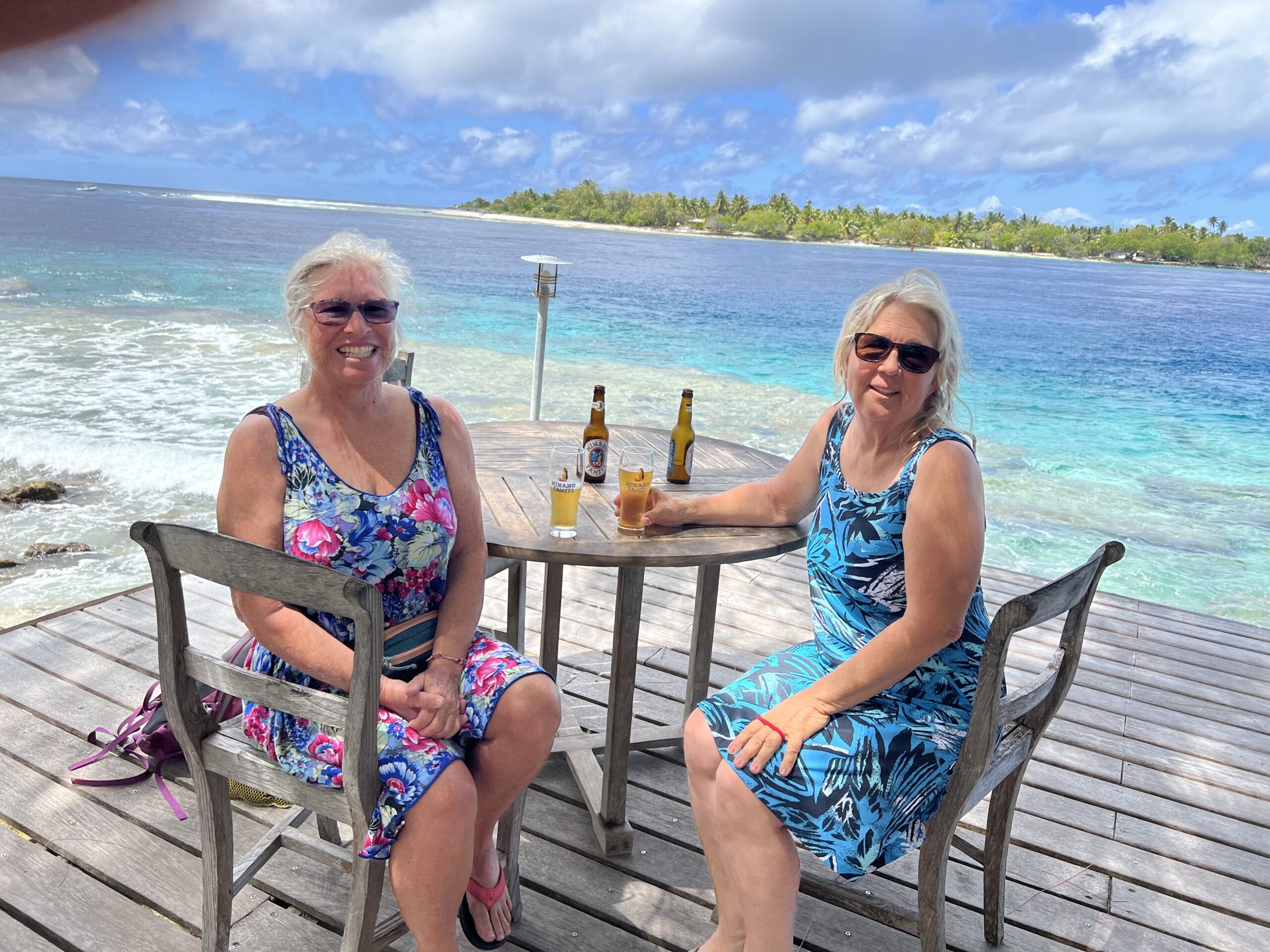
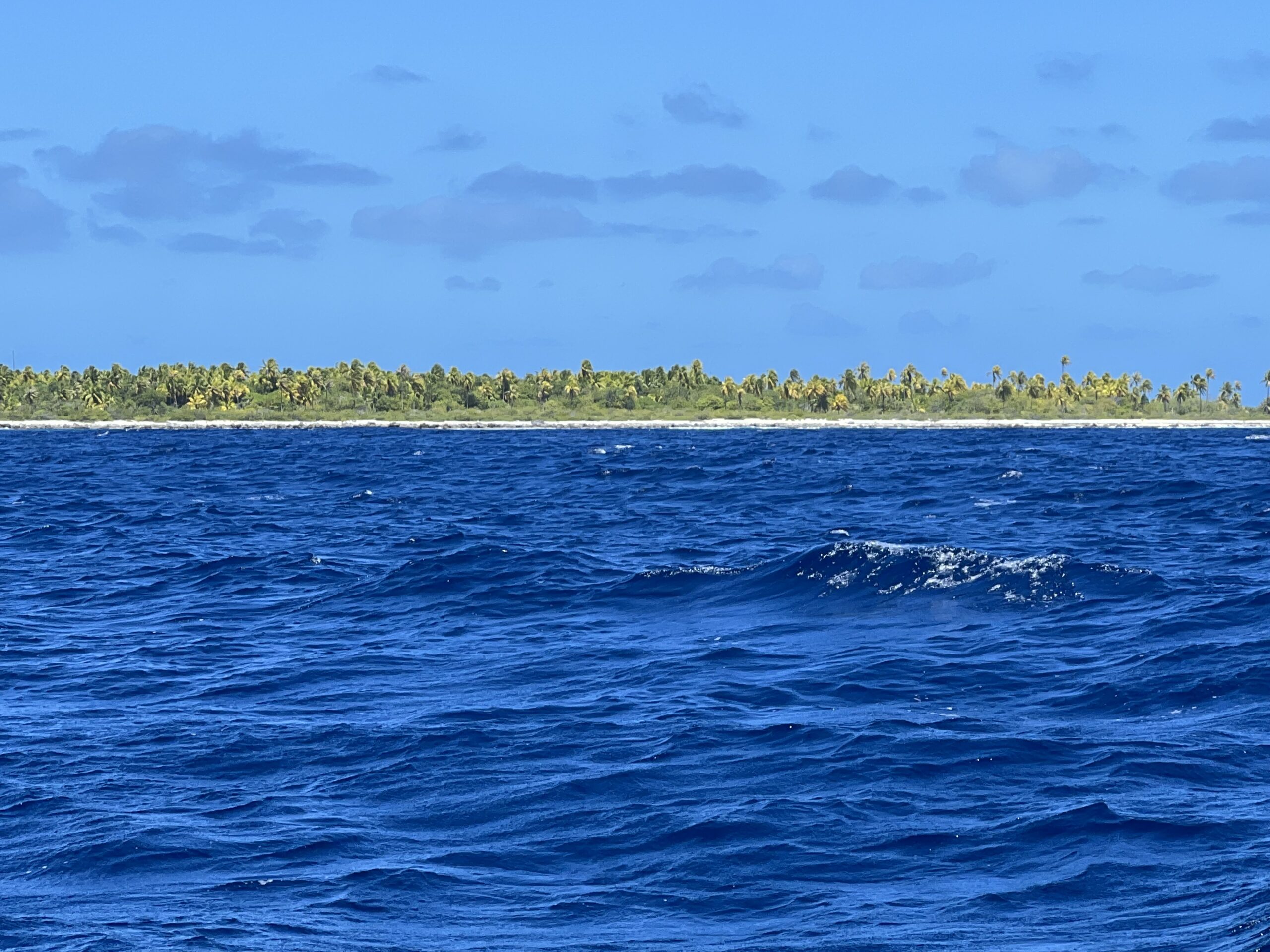
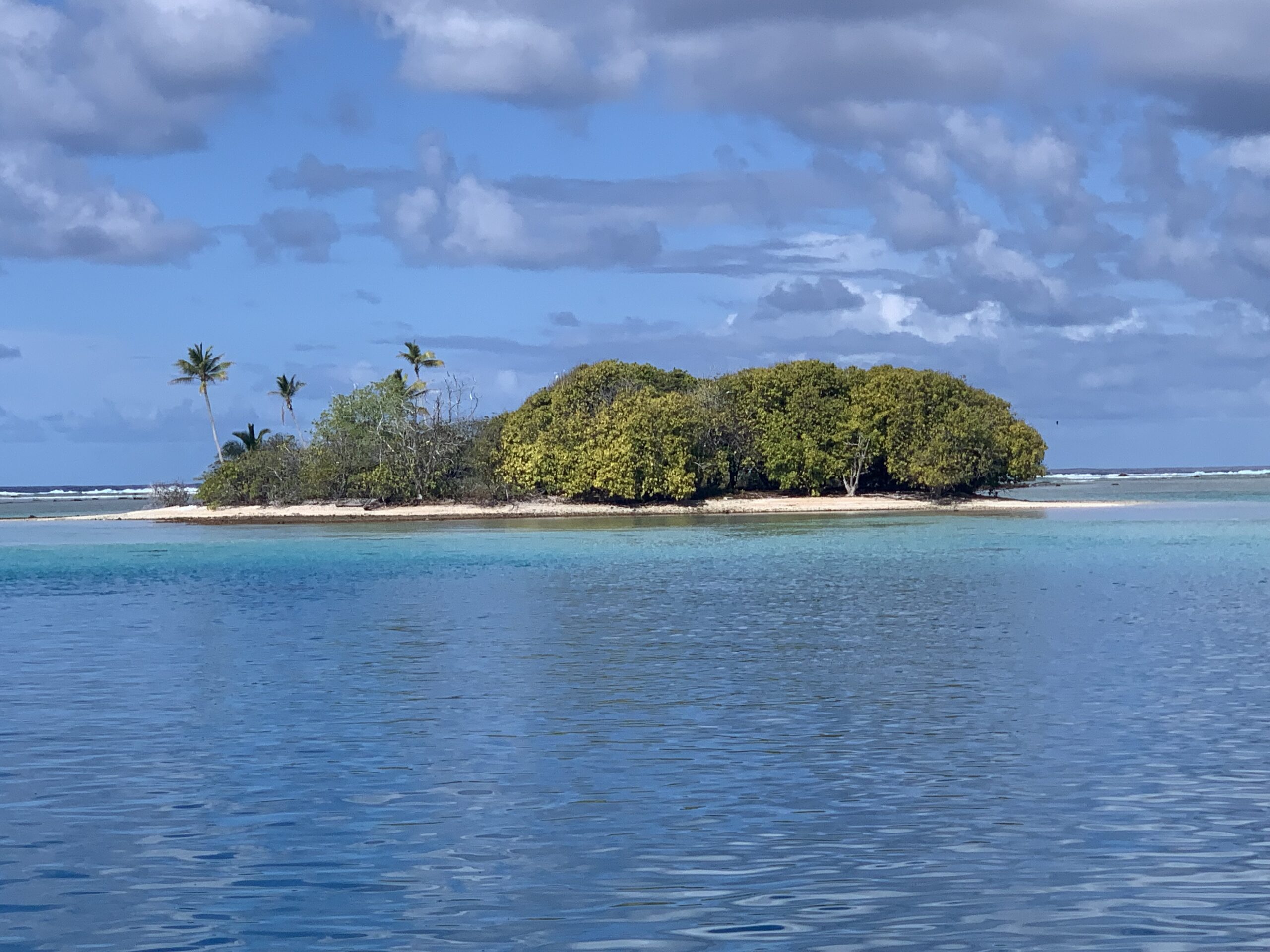
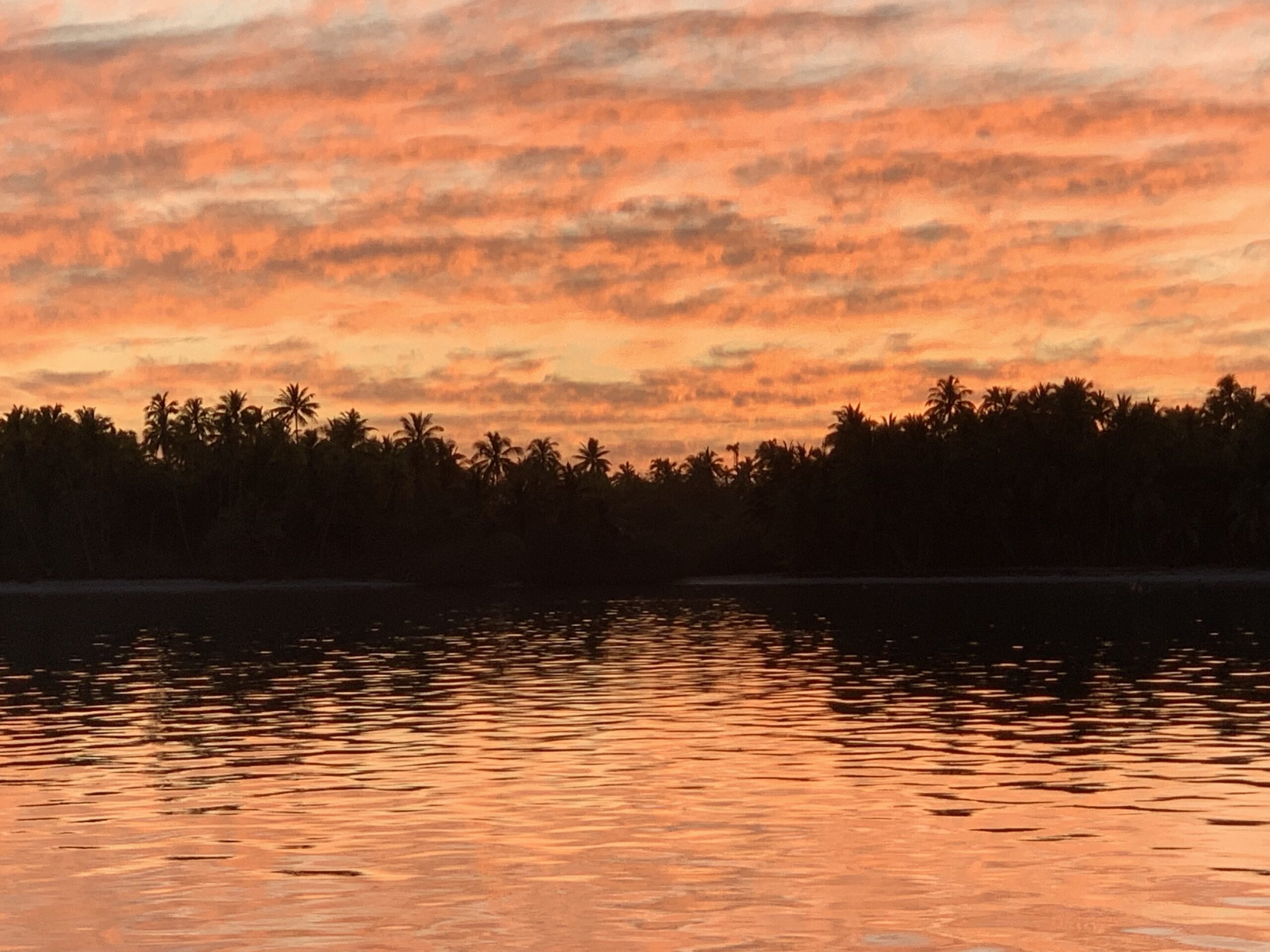
We pulled up the anchor in Cook’s Bay about 6:00 a.m. and headed out the pass. All was nice and calm and we had a good sail at first with a single reef in the main and partial reef in the jib. The seas were big but it was fine. Once we rounded the southwest point of Tahiti, we had winds on the nose in the low twenties. With the seas also big, we were making very little headway, even with a motor assist. Eventually we took down all sails and motored into the wind at between 2 and 4 knots. It seemed like it would take forever, and we were looking at other options to anchor in case we couldn’t get to Port Phaeton before dark. In retrospect, we should have broken the trip into two days, stopping first at the airport anchorage in Tahiti and then moving on to Port Phaeton the next day.
We kept up the slog all afternoon, staying outside the reefs with large waves crashing over them and finally made it to what seemed like a tiny little pass between reefs with large breaking waves. We followed our charts and our eyeballs and made it into Port Phaeton just before dark and dropped the anchor behind the other boats in the bay. A tough day but the bay was calm and it was easy to sleep.
On Tuesday, September 20, we contacted Marc Bordas, who watches boats in Port Phaeton. He showed us where our mooring ball was and we moved onto it that morning, after the owners departed for Papeete for some repairs. We also visited with Sarah and Bob on Rhapsody who were occupying the mooring ball that the owners would return to. Sarah and Bob helped us understand the general area. Later we had sundowners on their boat as they prepared to leave the next morning for Papeete. Sarah and Bob had left their boat in Port Phaeton under Marc’s care for several weeks while they went to Oregon to meet their new grandson.
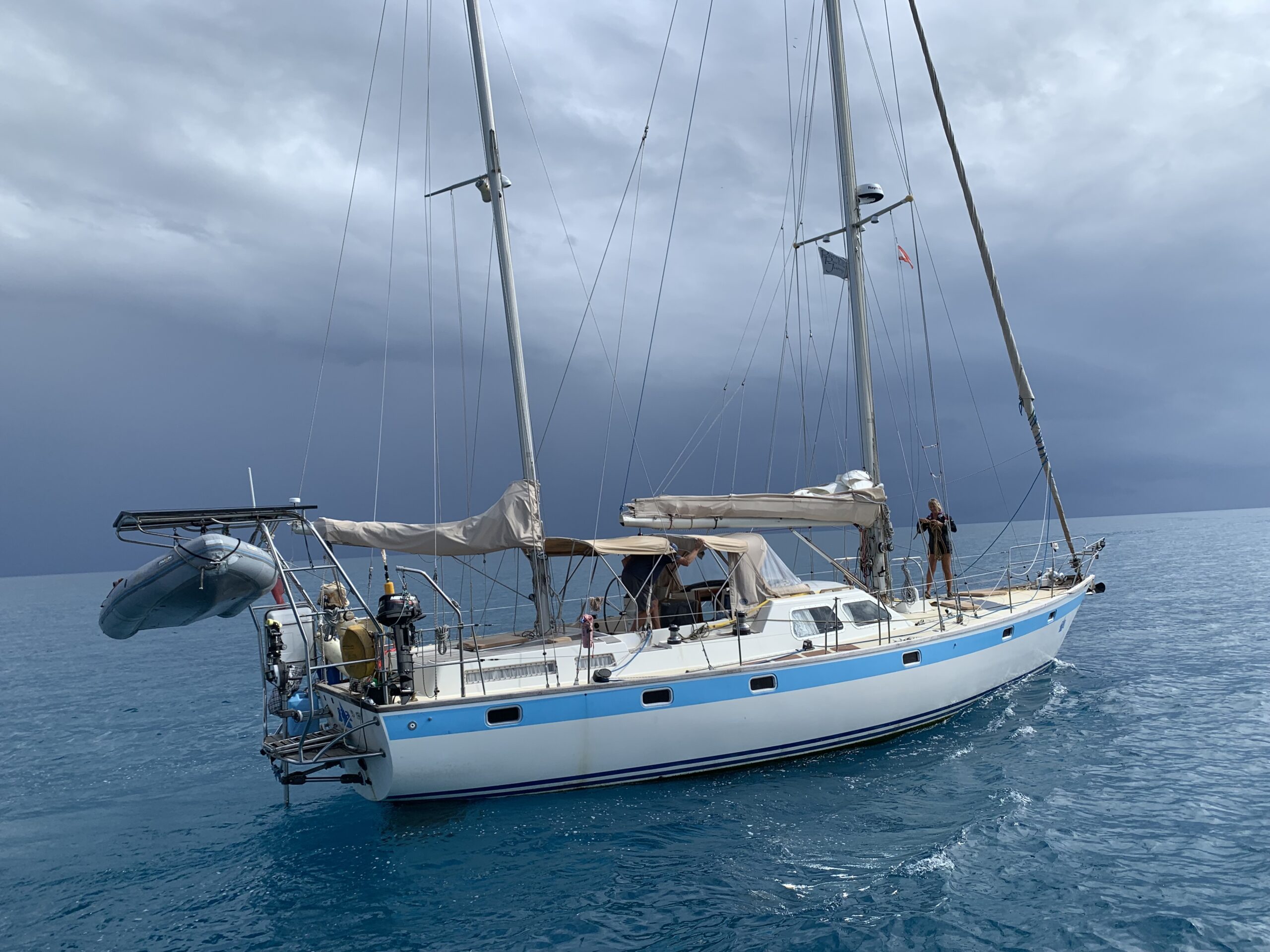
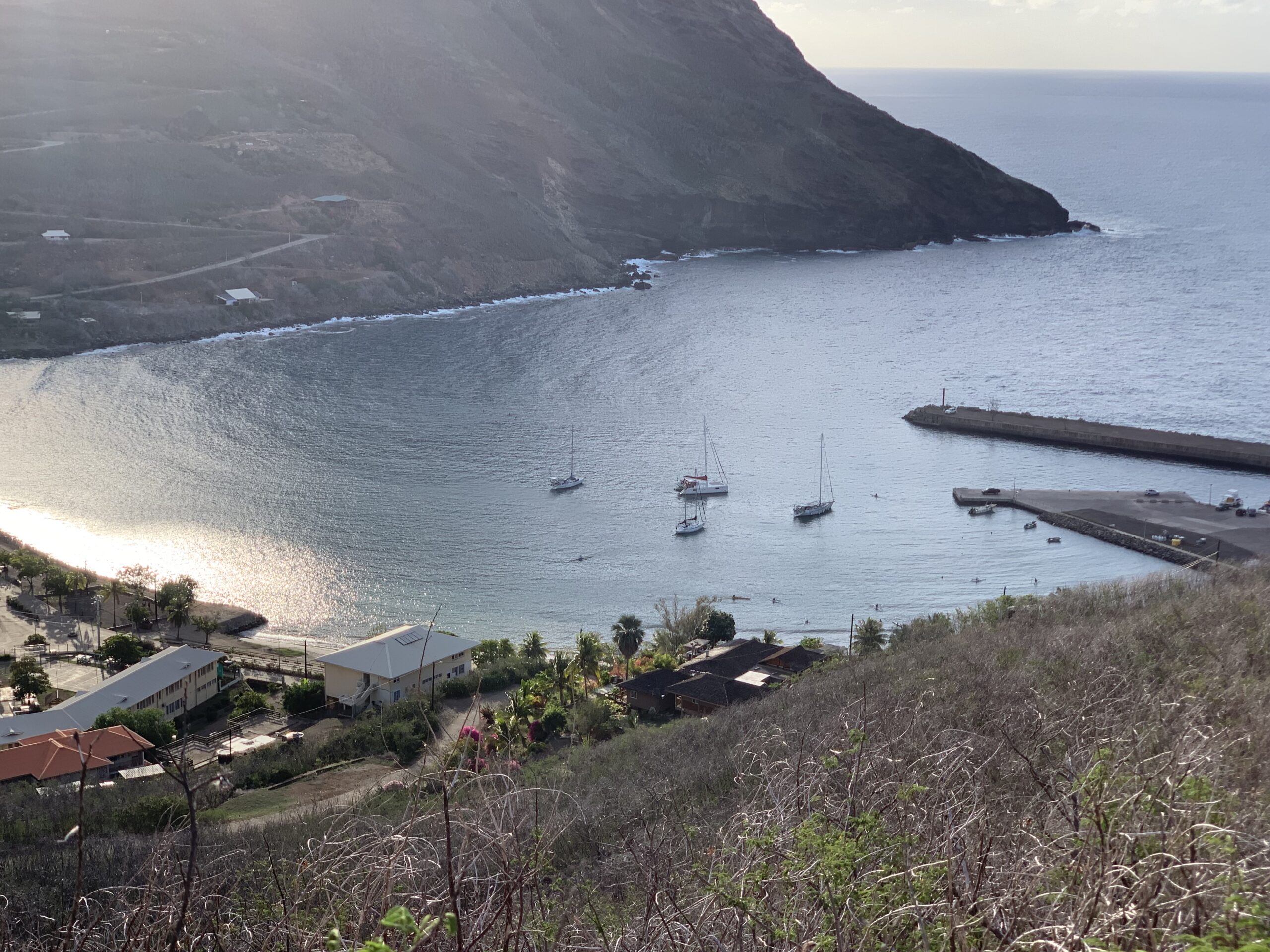
Port Phaeton is very remote and quiet, away from the zillions of boats anchored on the west side of Tahiti. It is to be Aldabra’s home during the upcoming cyclone season, on a mooring ball under the watchful eye of Marc Bordas. I only wish I could find a 12-volt dehumidifier because it will be rainy here. But they seem to be out of stock.
During that first afternoon, Linda and I tied the dinghy up to a tree and walked up a dirt road to the main road, coming face to face with a large Carrefour super market. We were overwhelmed with the selection of good food after being in the Tuamotus and Moorea. It is all very expensive, but I’ve become used to that.
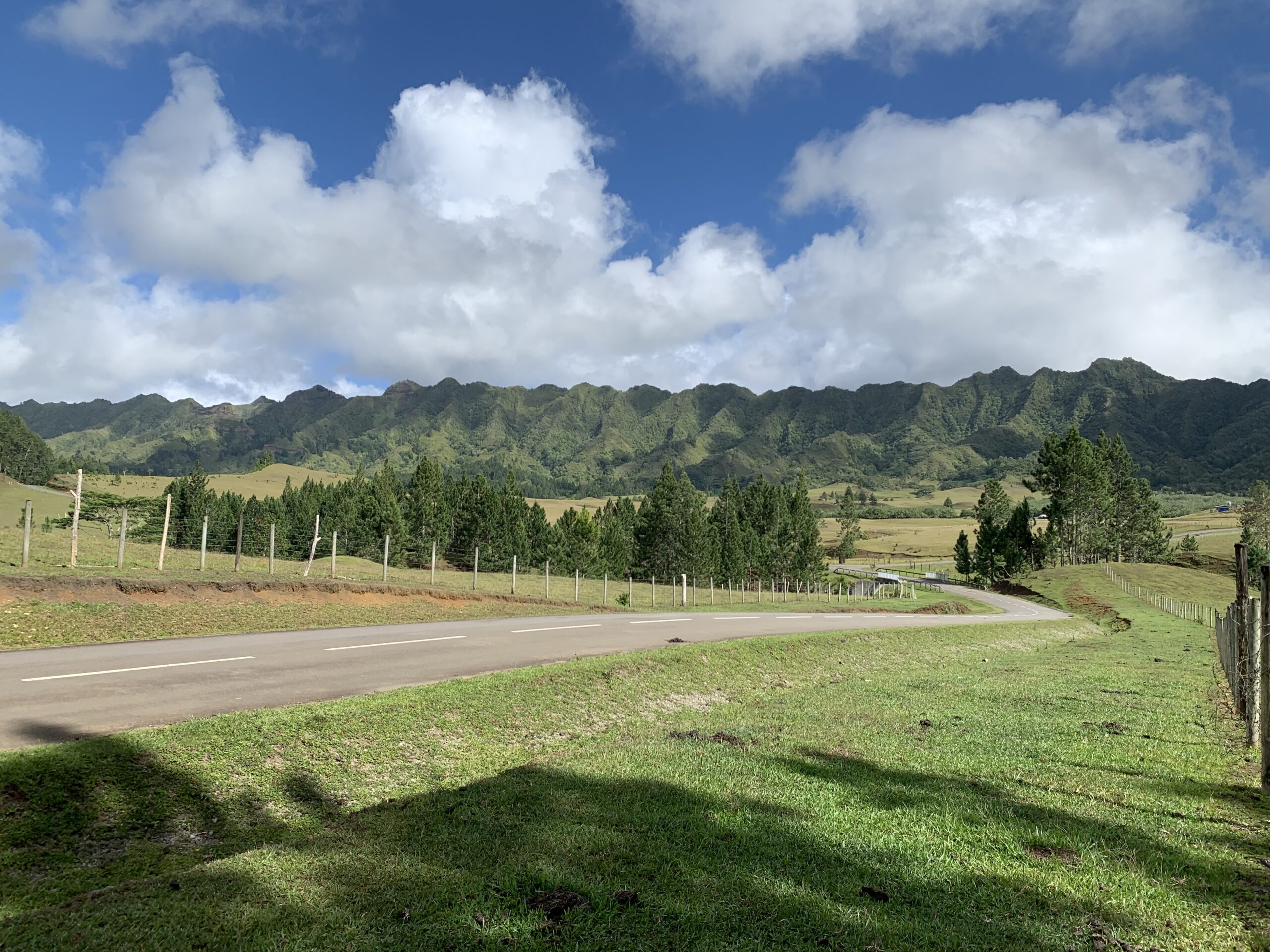
On Wednesday, September 21, we walked about a half mile to pick up a rental car from an auto repair shop. We toured around Tahiti Iti, visiting the famous Teahupoo surf break and driving up to the top of the Belvedere hill for an amazing view of both sides of the island. We continued around Tahiti on the east side and ended up at Point Venus for a fun lunch. Our circumnavigation continued as we drove along the west side of Tahiti back to Port Phaeton. A long day but fun to survey both islands.
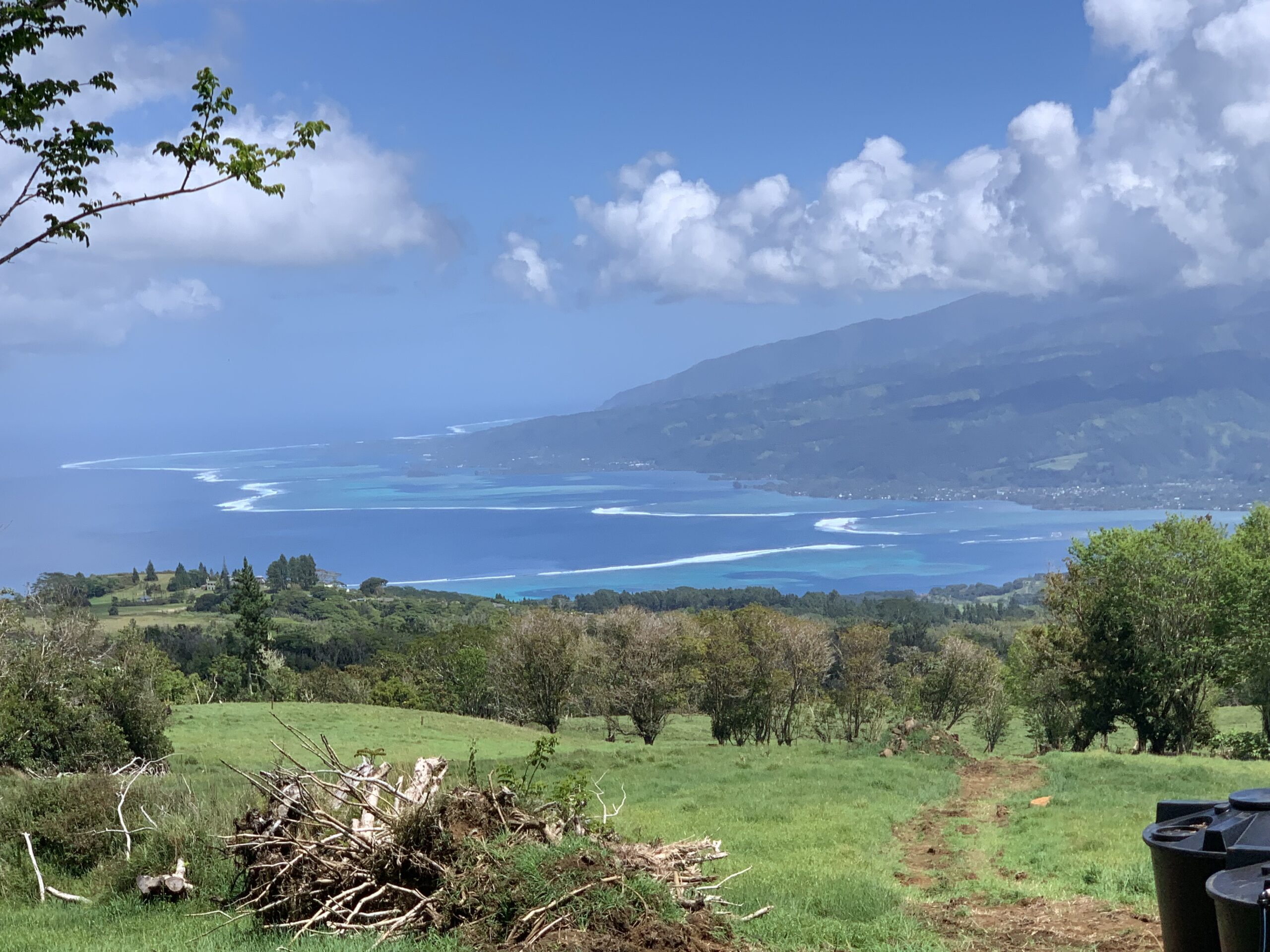
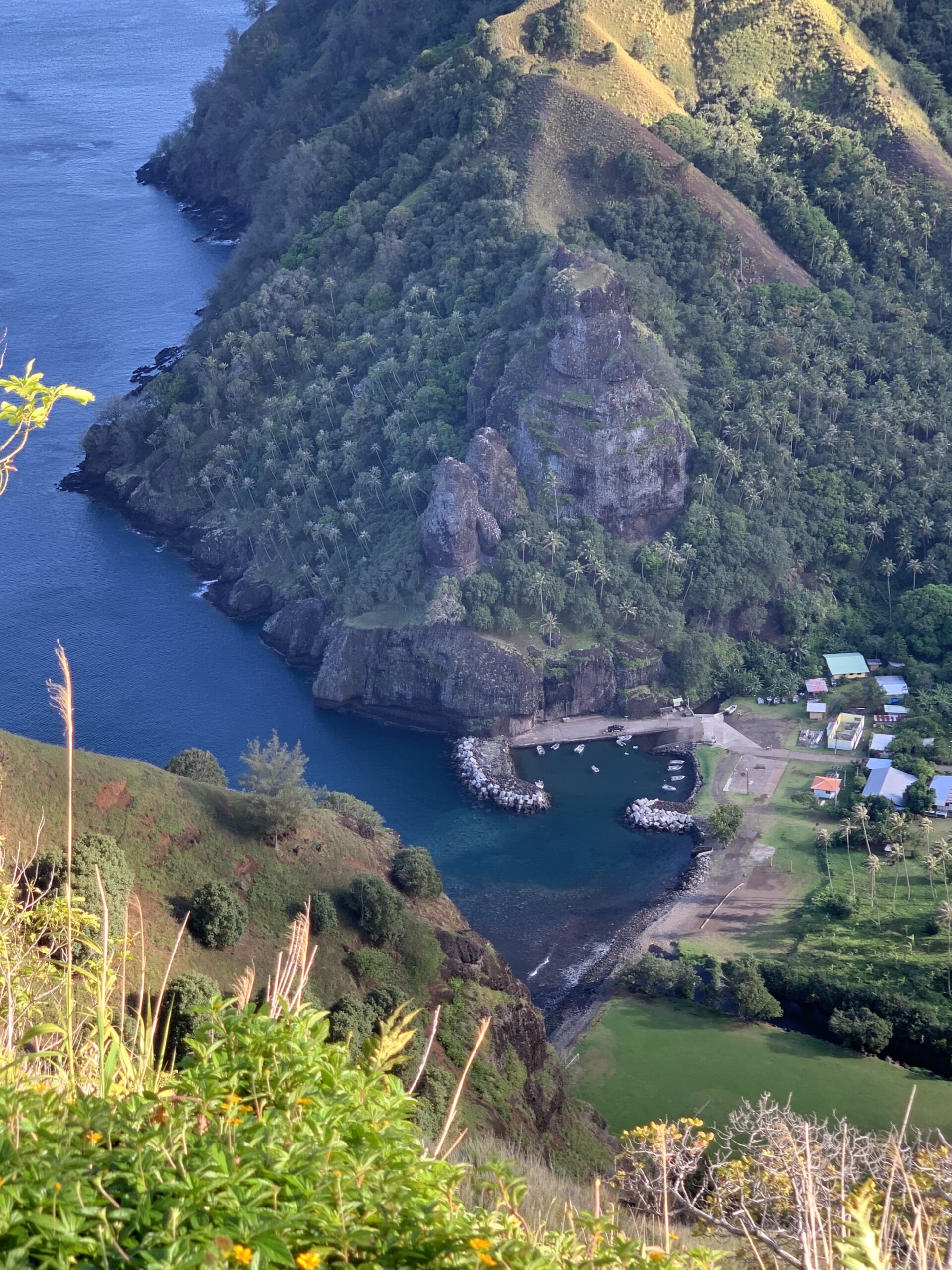
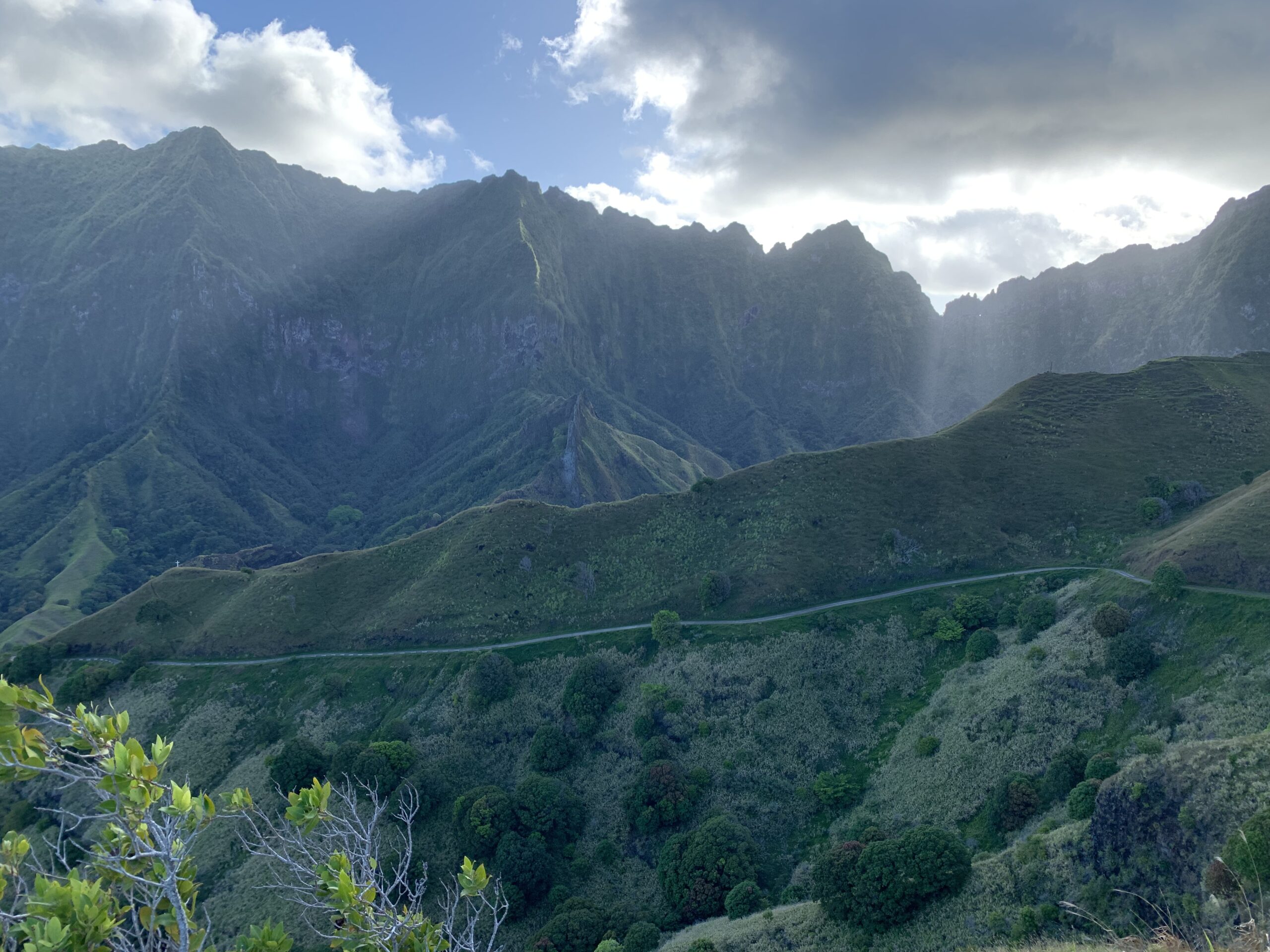
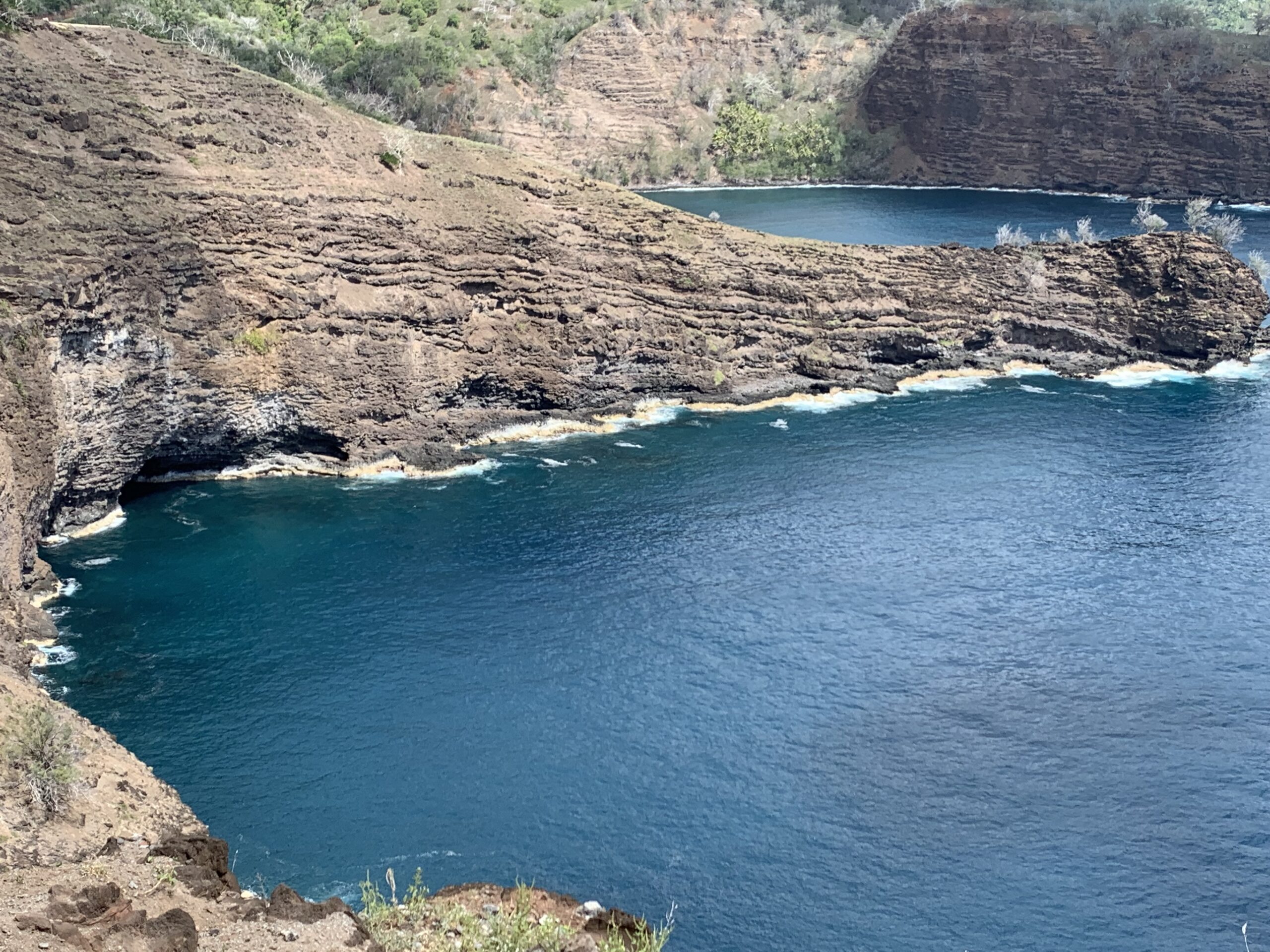
Looking from Belvedere toward the reef we went through to get to Port Phaeton on the rightLooking down at where Tahiti Nui and Tahiti Iti meet
The next day, we drove back back to Marina Taina to visit Tahitit Crew. We needed a better Internet box and they had one being turned in later that morning. So we headed to the port area where many of the boating stores are. We were looking for a fitting to transfer butane cooking gas from the bottles sold in French Polynesia to the bottles on the boat. But no one had the fitting.
When we returned to to Tahiti Crew, they directed us to Michel, who runs the chandlery at the marina. He told us how to make the fitting and hose and said he would help if we got the parts. Meanwhile, we picked up the Internet box, had lunch at La Casa Bianca and then headed into downtown Papeete.
We shopped at the big market so Linda could buy gifts. And we shopped at the great Venus fabric store next to the market. As we walked along the waterfront next to Marina Papeete, I saw a few boats I know but couldn’t get in to say hello.
On Linda’s final day, we visited the botanical garden, which is quite near Port Phaeton but in rather sad shape. It is just barely being cared for. We also ended up at La Casa Bianca for one last lunch since we were looking for a museum near there that is unfortunately closed for renovation.
The next morning, on Saturday, we got up at 3:00 a.m., took the dinghy to shore, and drove to the airport to get Linda there in time for her flight. I was back at the boat by 6:00 a.m. and gathered up laundry to take to the laundry mat. One load costs between $10 and $14 dollars, which is cheaper than in the Tuamotus where one load is $30. I didn’t have enough coins to fully dry all the laundry so I took it back to the boat to dry. That day was a laundry management day.
I stayed put on the boat on Sunday. I used the time to re-mark the anchor chain so I know how much I have let out. I defrosted the freezer. And I filled the diesel tank with fuel from the remaining jerry jugs that were still full.
On Monday morning I headed back toward Papeete. I started with Michel at Marina Taina, who helped me with my butane hose fitting and sent me to the Cope plumbing store to get the right barb. Then I went to Technimarine in the main port to see about hauling the boat out for a day in October. I have a thru-hull valve that needs to be replaced and I’d rather do it when the boat is hauled out. If I do it in the water, and something goes wrong, the boat could sink. I ran into Andrew and Liane of Waveriders at Technimarine. They are having trouble with some leaking thru-hulls and need to haul out as soon as they can. My final stop was at Nautisport to see if they can fix my BC for diving. They will call when it is ready.
And then it was back to Port Phaeton with a little stop at Carrefour.
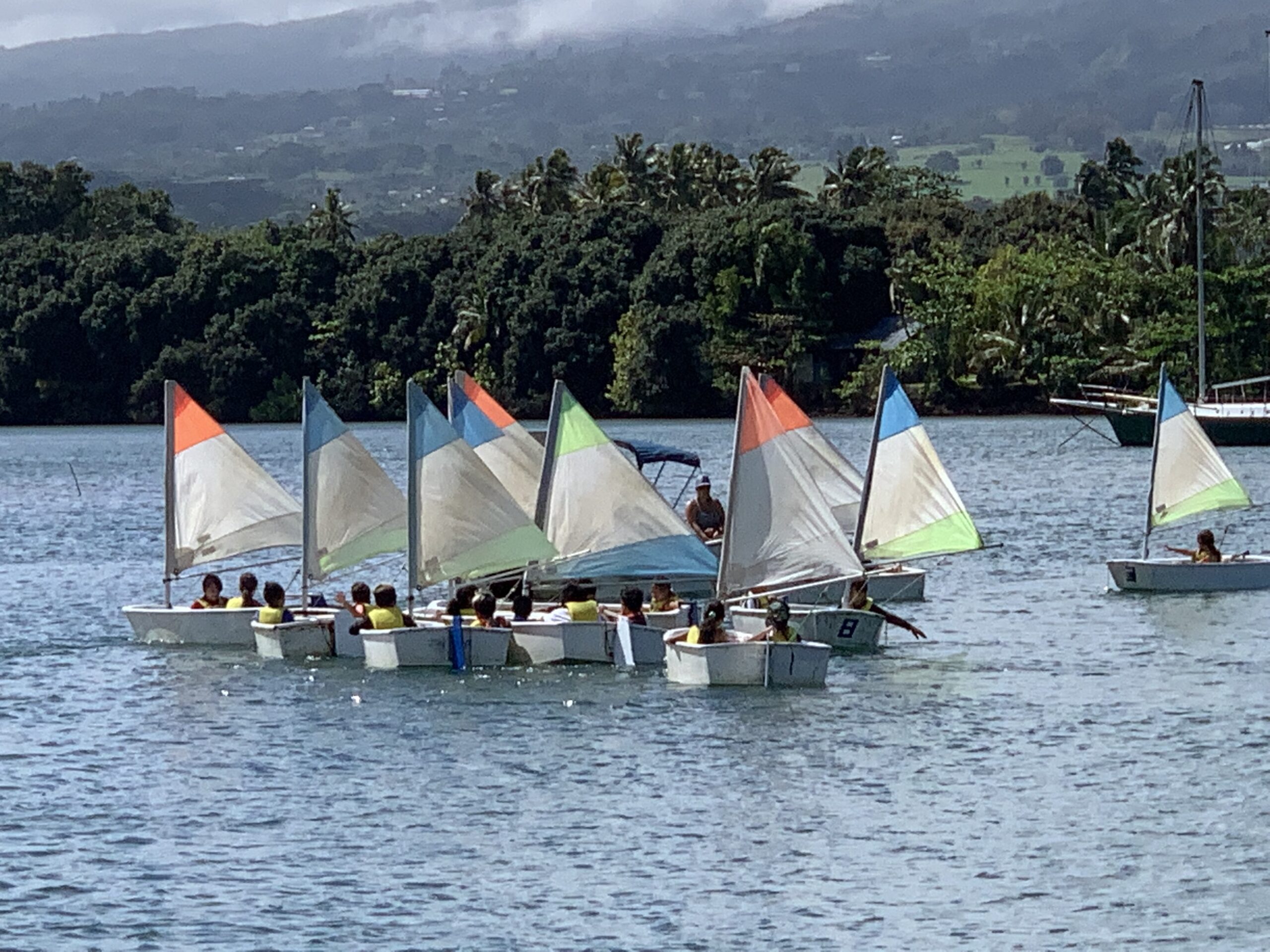
On Tuesday, I stayed on the boat to defrost the refrigerator and run the watermaker. The next day, I returned the rental car and remained somewhat captive on the boat to clean and tidy up. Mundane, I know, but that is part of cruising life, especially when you are just about the only occupied boat in the anchorage. This is a place where people leave their boats for periods of time. So I am surrounded by many empty boats, except when the sailing school is in session.
While checking the bilge on Wednesday, I discovered some oily water in a compartment that leads to the bilge. I changed the oil in the diesel engine and the transmission. It looks like the engine is not leaking oil at this point so I will just keep an eye on it.
For the rest of my solo days I did small projects and cleaned. I also baked a bit (granola and cookies) so I could use up ingredients and the butane in the tank that needs to get filled.
On Thursday, September 15, Linda and I put the dinghy back on the davits, and pulled up the anchor, rather early in the morning. We headed out of the pass near Marina Taina and motored over to Moorea.
Heading to Moorea
The wind was next to nothing but the seas were nice and big.
Approaching the pass at Cook’s Bay
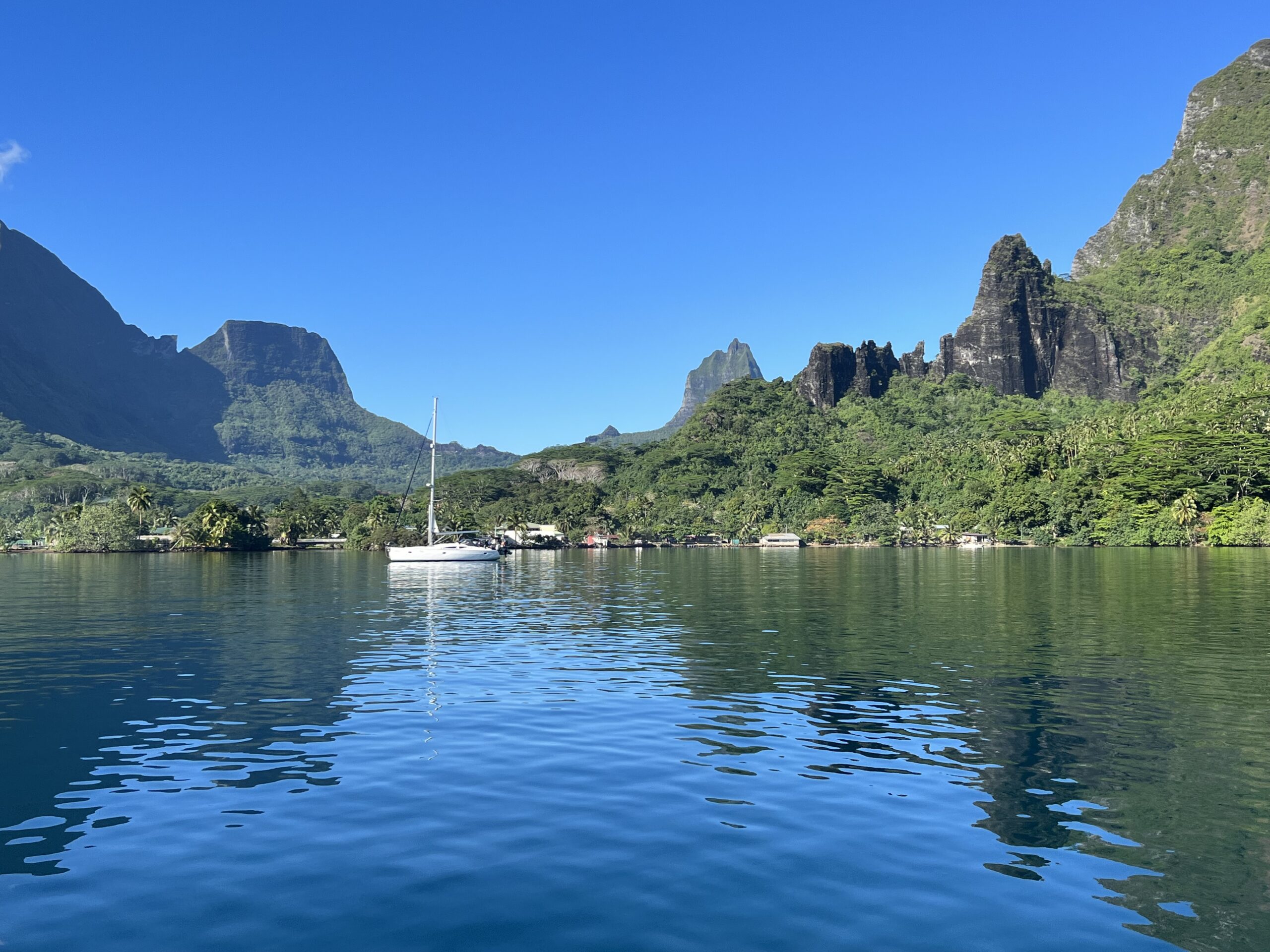
We entered the pass at Cook’s Bay and had the anchor down by noon. After a nice lunch, we hung out on the boat and enjoyed the view and the peace. In contrast to the density of boats in Papeete, the Cook’s Bay anchorage had nine boats, all spaced reasonably apart. The wind was gusting down from the hills but the water was flat except when tourist and dive boats returned with their clients and left nice big wakes.
The anchorage in Cook’s Bay. That’s Pasito, last seen in Rangiroa
The next morning we put the dinghy in the water and cruised around the bay to explore.
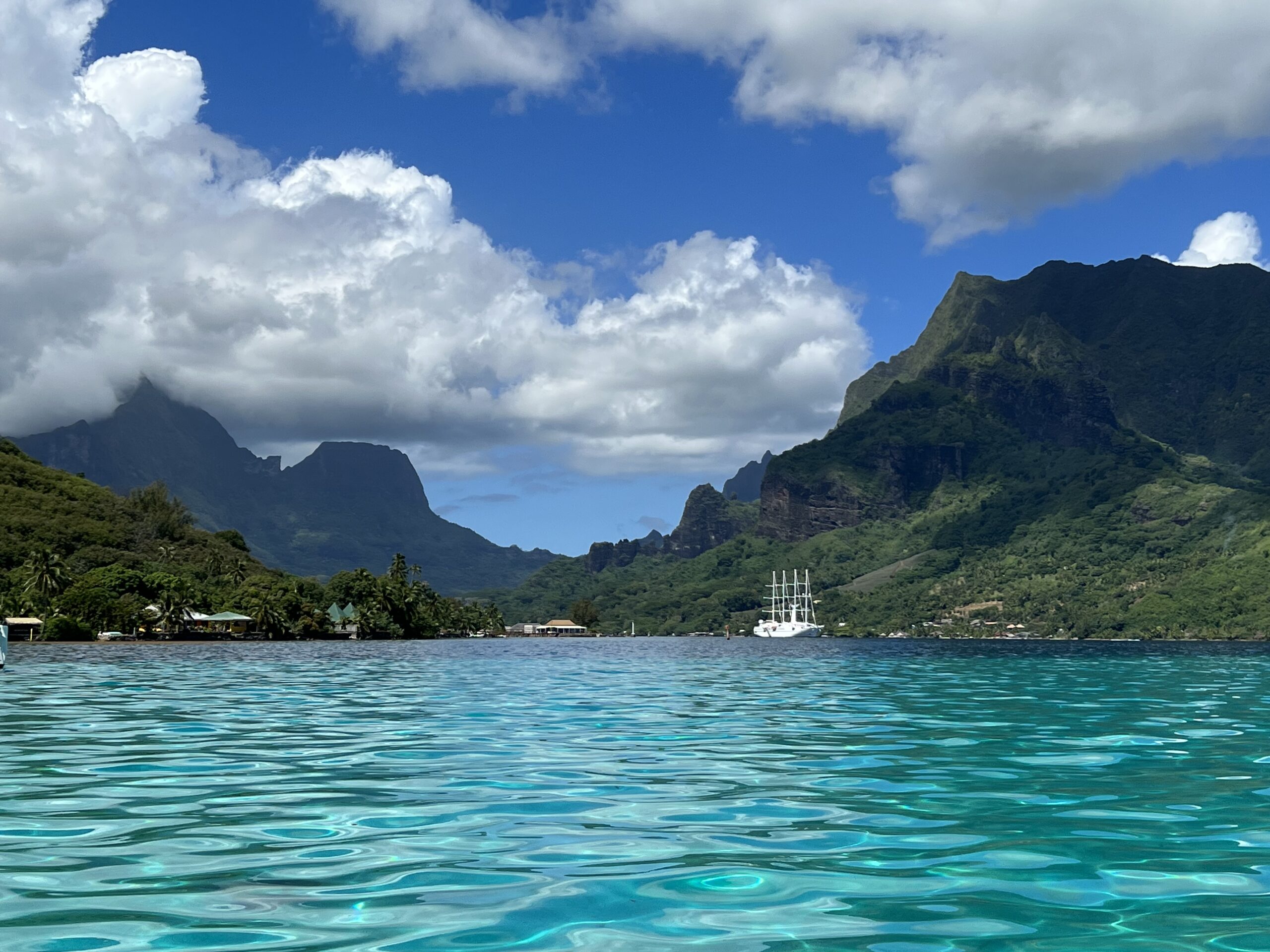
Touring around Cook’s BayThe clear shallow water inside the reef looking into the bay
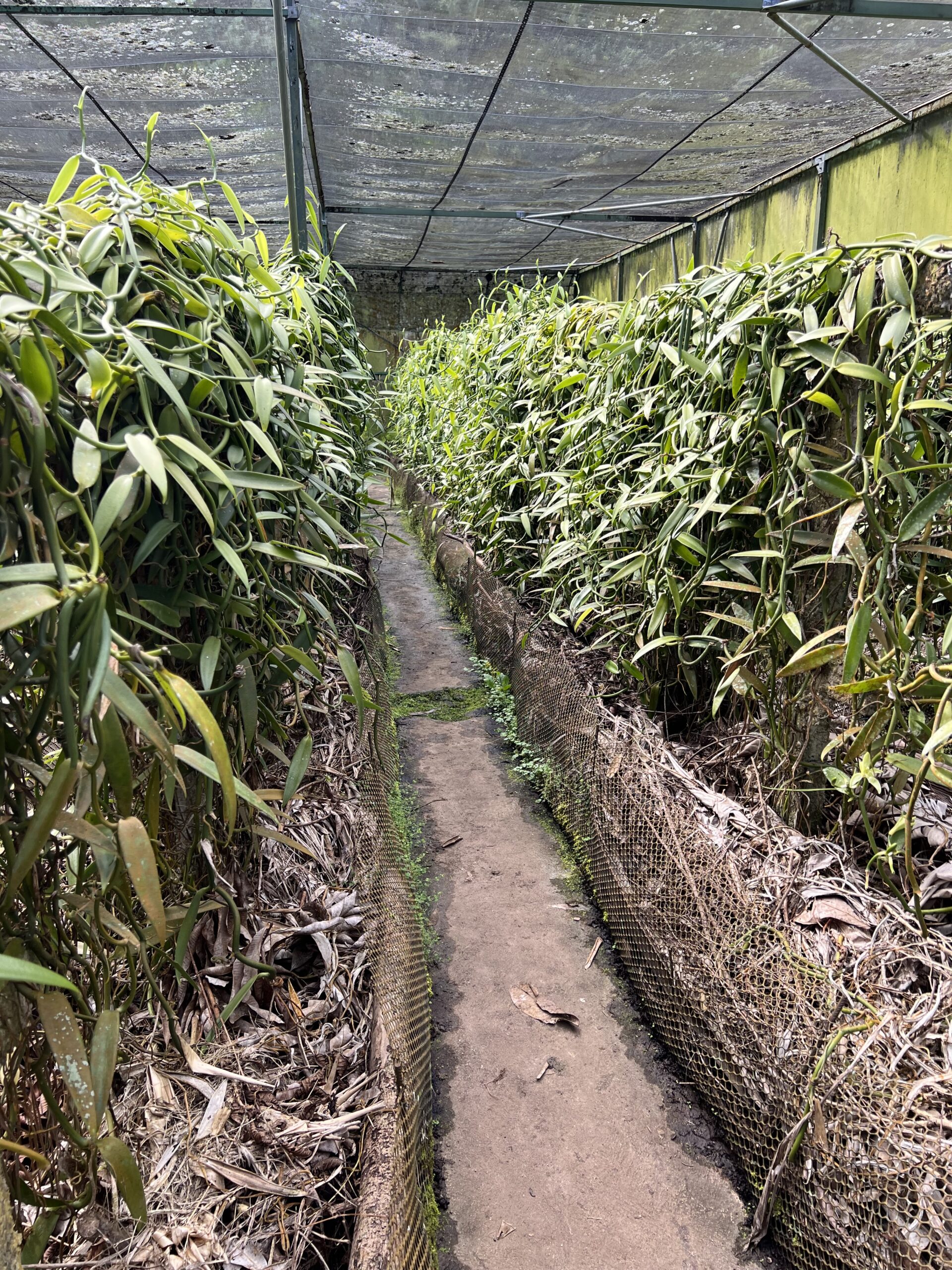
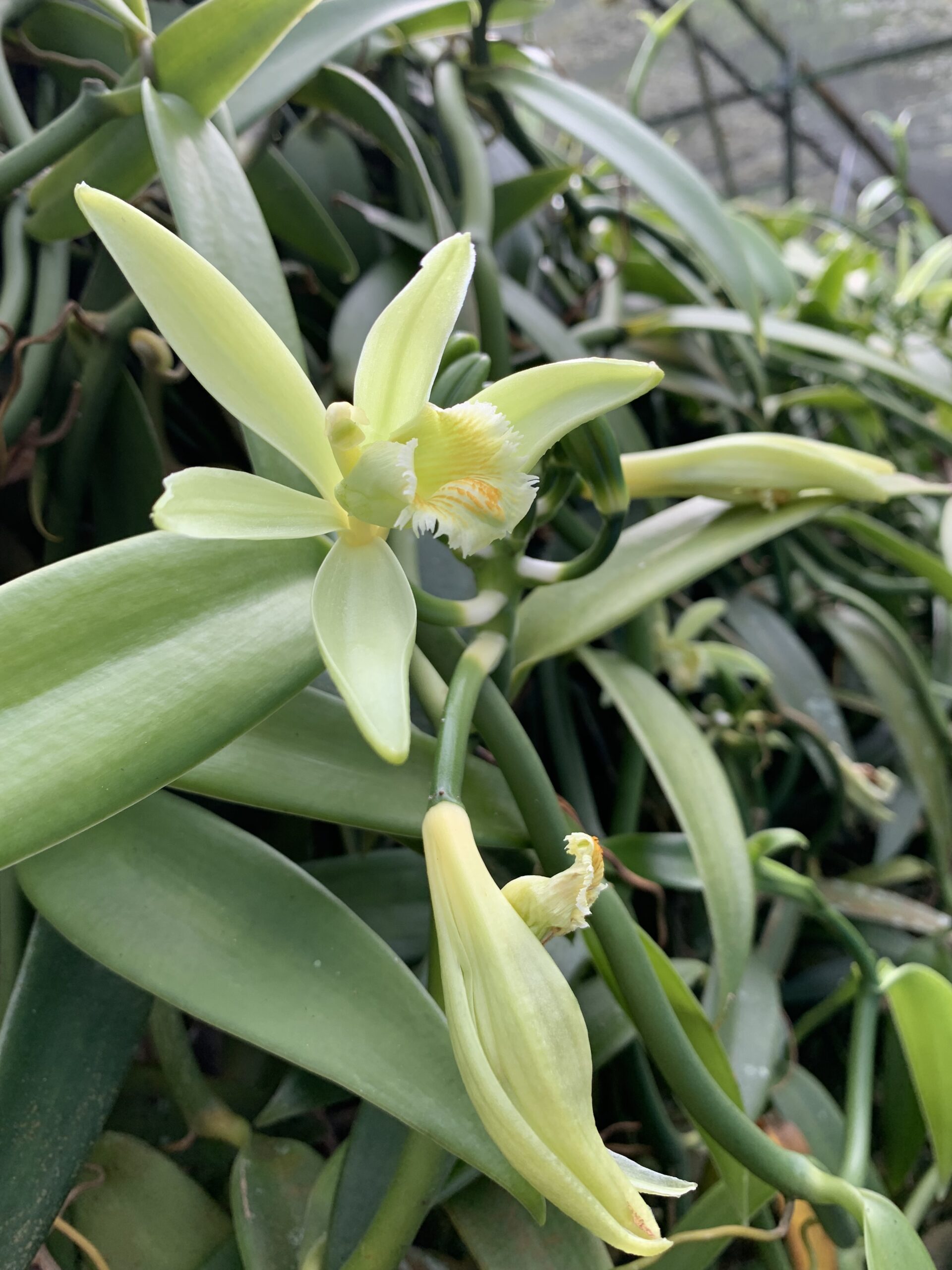
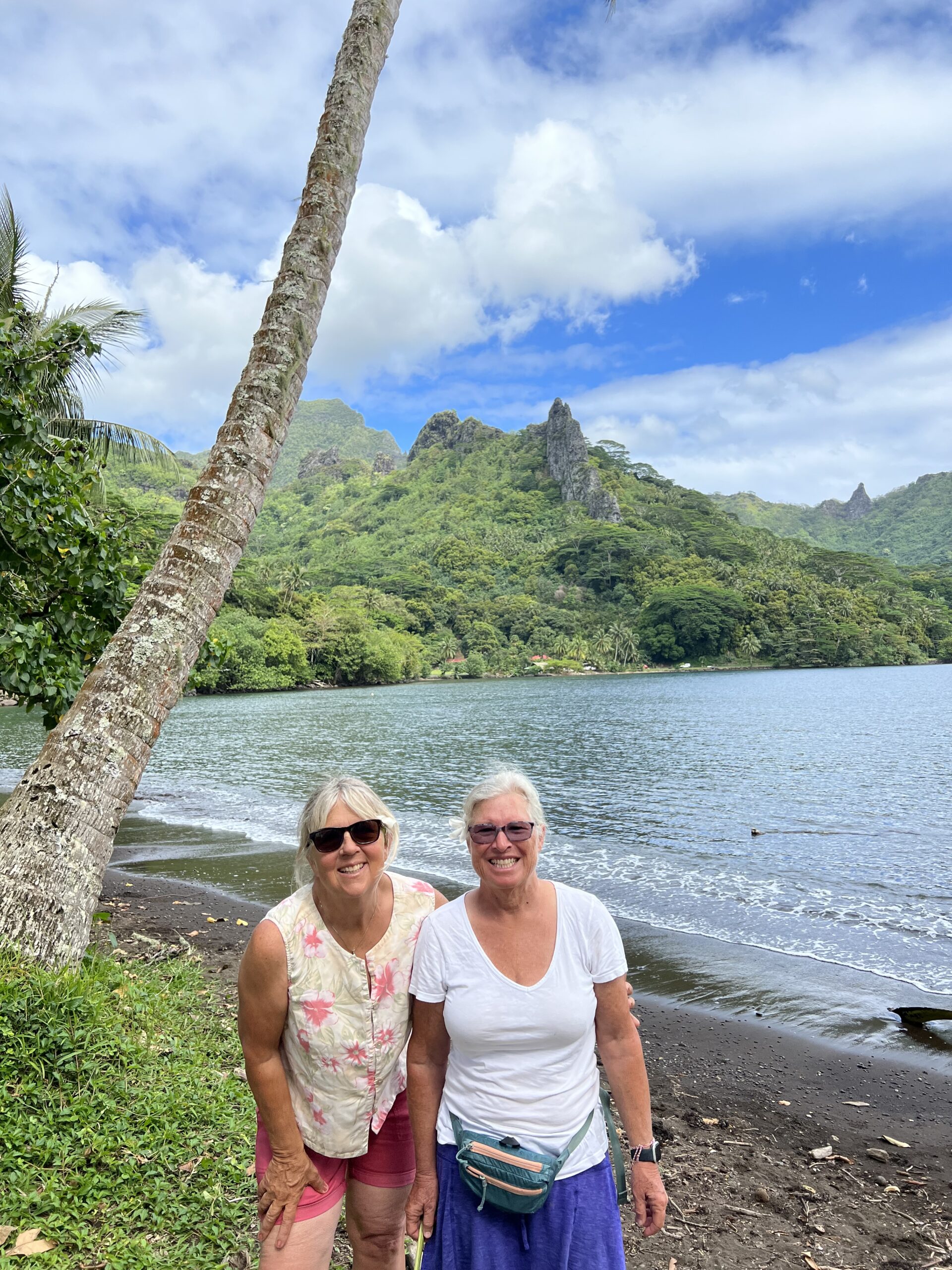
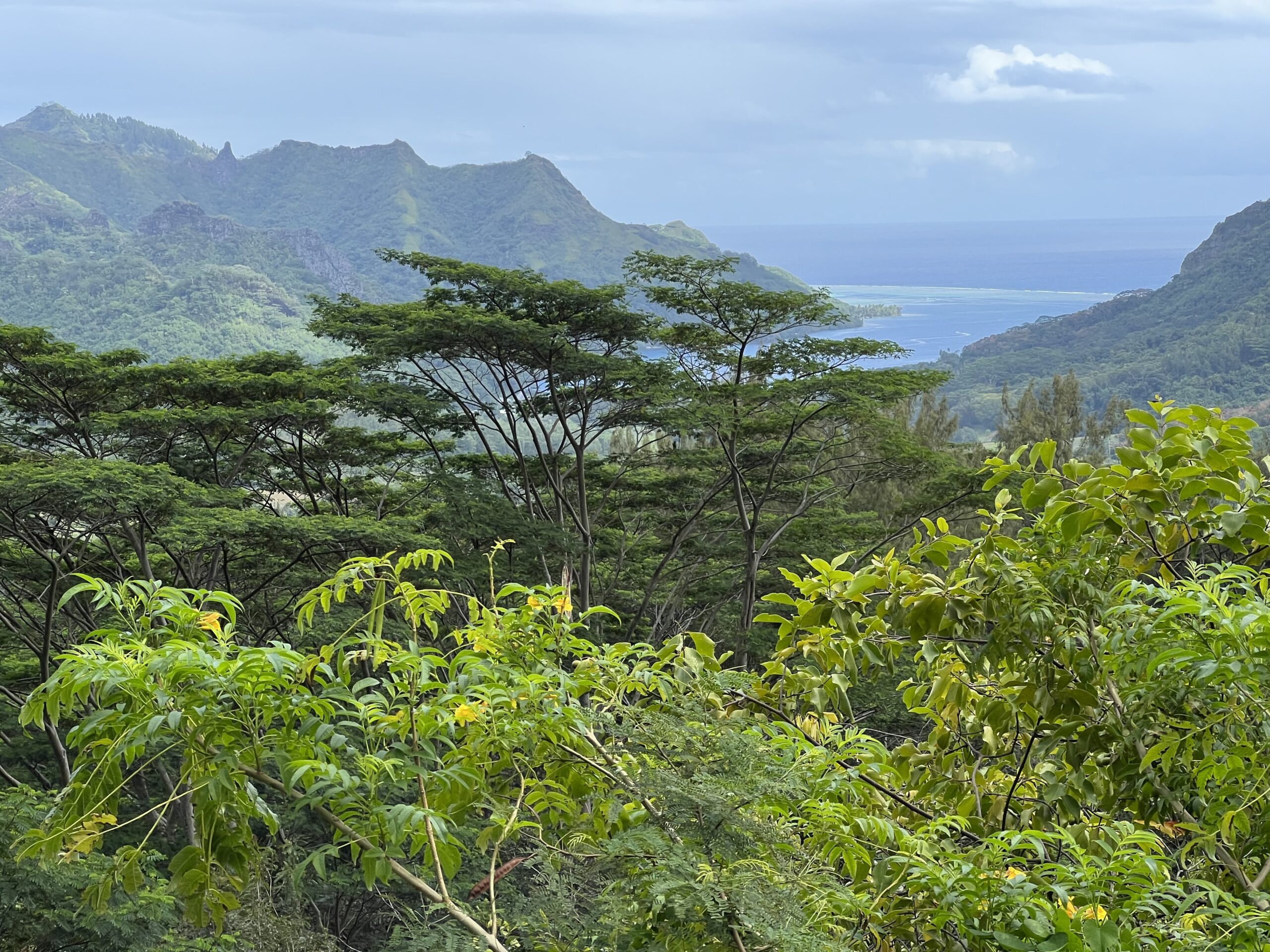
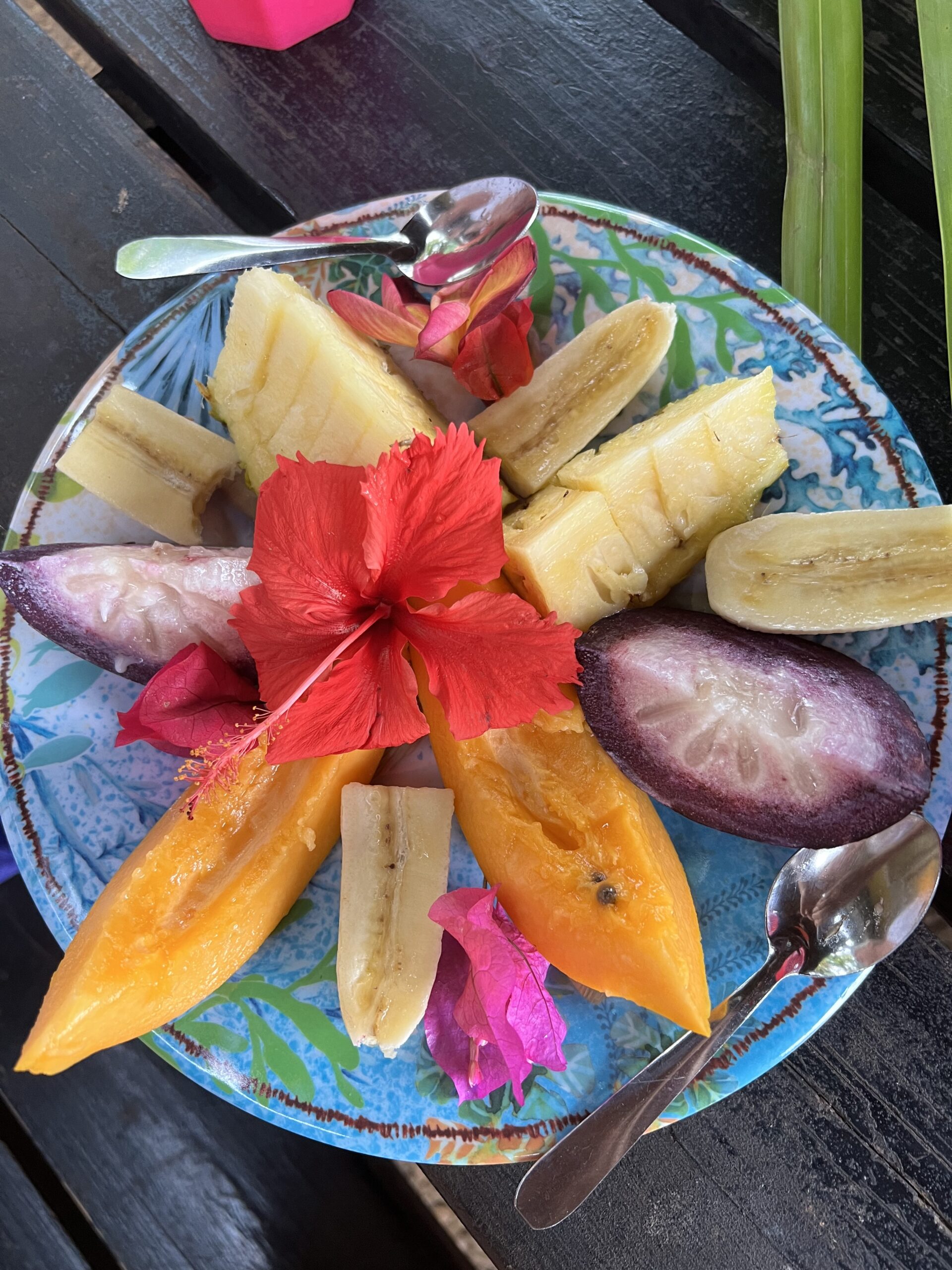
We stopped at a dock at the end of the bay, bought some groceries and had lunch at the snack before going back to lounge on the boat. After a very windy night, we got up early to get to shore in time to join a “nature” tour of the island with a guide Etienne and two very nice couples from the U.K. We saw vanilla and pineapple plantations, a small botanical garden and a beautiful park with hiking trails and great views. It gave us an opportunity to see the other anchorage, Opunohu Bay, without pulling up anchor to go over there. Our guide told us he met Obama there when he was finishing up his memoir. He was staying on Bruce Springsteen’s yacht when he visited the bay. We also toured the Hinano distillery and bought some spirits.
Growing vanillaVanilla floweringPosing in front of Opunohu BayA view from the parkA sampling of fruit on the tourA sacred grove of chestnut trees. Communication was by pounding a coconut on the base of the trunkSunsets come in all colors
Swimming in Cook’s Bay is not all that inviting. And there is very little room to anchor outside the bay between the reef and the little town. So we mostly lounged on the boat. We were looking for a weather window to sail back to Tahiti and all the way around to the connection between Tahiti Nui and Tahiti Iti, a place called Port Phaeton. We rather spontaneously decided to head over on Monday morning, September 19.
On Sunday, September 11, we pulled up the anchor around 8:30 a.m. and sailed on the jib alone across the Tikehau lagoon, using the OpenCPN satellite images to navigate around bommies. We exited the pass a little after 11:00 a.m. and it was uneventful. Once outside the pass, we put up the main with the first reef in, pulled out the jib and headed toward Moorea. It was sunny and windy at first but eventually became rainy and windy, with big seas. The whole passage was like that. Big seas, wind and then some intense squalls with rain. One of us had to stay at the helm at all times because the wind shifted so much that big surprises occurred if we weren’t attending to the course at all times. Neither of us enjoyed it. Linda did get a little sleep during the night but I didn’t.
Leaving Tikehau on the way to TahitiEnroute to TahitiThe skies were stormy
We were grateful when the sun came up on Monday morning but we still had twelve more hours of our little hell. As we approached Tetiroa, the Marlon Brando island, we decided to head to Tahiti instead of Moorea. It seemed about an hour shorter in distance and we knew we were going to run out of daylight. We got to the Papeete pass at 5:00 p.m. and made our way to the anchorage in front of the airport. We dropped anchor at 6:00 p.m., just as it was getting dark. We were so grateful to be in flat water and no wind. Both of us slept very well that night.
Arriving just before dark at airport anchorage in Tahiti, Moorea in background
The next morning, Tuesday, we woke up to realize that the boats had all swung around significantly and we were too close to another boat. We pulled up anchor right away and proceeded farther along the channel, requesting permission from Port Control to cross at the end of the runway. After searching among zillions of boats, we finally found a place to drop the anchor. We lowered the dinghy and went to shore to Marina Taina and left the dinghy at their dock.
Walking along dock at Marina Taina
After dropping off our trash and recycling, we checked in with my agents, Tahiti Crew. They had been holding my Carte du Sejour for me, so I got that. It is the document that lets me stay in French Polynesia for a year or more (if I renew). After a nice lunch at La Casa Bianca, we returned to the boat, only to be visited by a marina authority who told us we could not anchor where we were. We pulled up anchor and moved across the channel to the low-rent district and finally found a spot that was safe for anchoring.
Legally anchored between the Intercontinental Hotel and Marina Taina
After a quiet night, we went back to Marina Taina with the dinghy and went grocery shopping. We also stopped by Tahiti Crew again and rented a wifi box that allows us to get Internet access on the boat, which is why I am able to make blog posts for the first time in a long time.
After returning to the boat, we saw Antje come in and anchor nearby. Antje is the boat we hit in Omoa in Fatu Hiva. I had been able to pay online for the spare parts that they needed to fix the steering vane, but we got in the dinghy to visit so I could give him something more to compensate somewhat for the inconvenience I had caused them. While we were talking to Jorge about his plans for the boat and his family, we realized that the visitors he had onboard for a day sail were Dana’s friends from high school. They were shocked to see Linda. It is such a small world.
We also noticed that Waveriders had anchored near us so we took the boat over to find them. They weren’t home, but shortly after we returned to Aldabra, Andrew and Liane stopped by on their water bikes for a bit of a visit. It was nice to catch up with them.
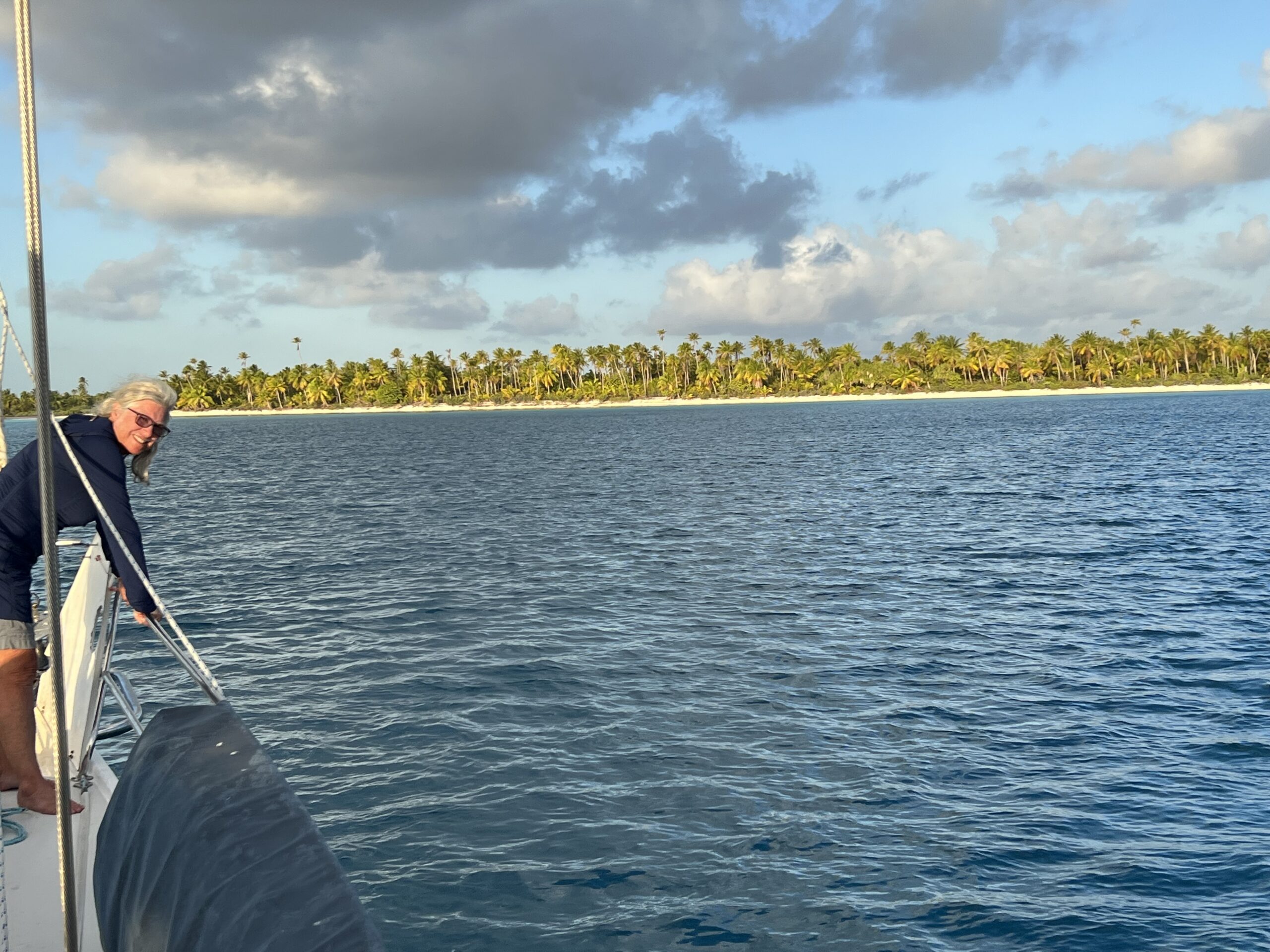
We arrived at the pass at Tikehau at 1:00 p.m. on Tuesday, September 6. The wind was starting to build on the nose as we tried to enter the pass. Slack tide was probably delayed because of the strong winds so it wasn’t easy to go into the pass, but we were really just going slowly, not facing difficult seas. Once we got into the pass and turned right into the channel, we were motoring very slowly in choppy seas and some wind. Linda steered while I double-checked our navigation and we made our way down the channel toward the village. Before we got there, we turned left out into the lagoon and headed for the east side of the atoll, motoring nearly upwind the whole time and using OpenCPN navigation software with satellite images to steer around the coral heads (bommies). We arrived at the anchorage in front of Motu Ohini a little after 5:00 p.m. We anchored in sand and were set. It was very protected from the wind and seas so everything was flat and calm.
Anchoring in front of Motu Ohini in Tikehau
It was so nice to be away from the rolly, wake-filled anchorage at Rangiroa. After a quiet night, we took the dinghy to shore and explored around the atoll. Linda collected shells and I collected some coral and abandoned pearl-farm floats that can be used to float anchor chain above coral heads. After our land expedition, we snorkeled a bit and headed back to the boat, where we stayed put during the following two days of intense winds in the high teens and twenties – but the water was flat so I have no complaints.
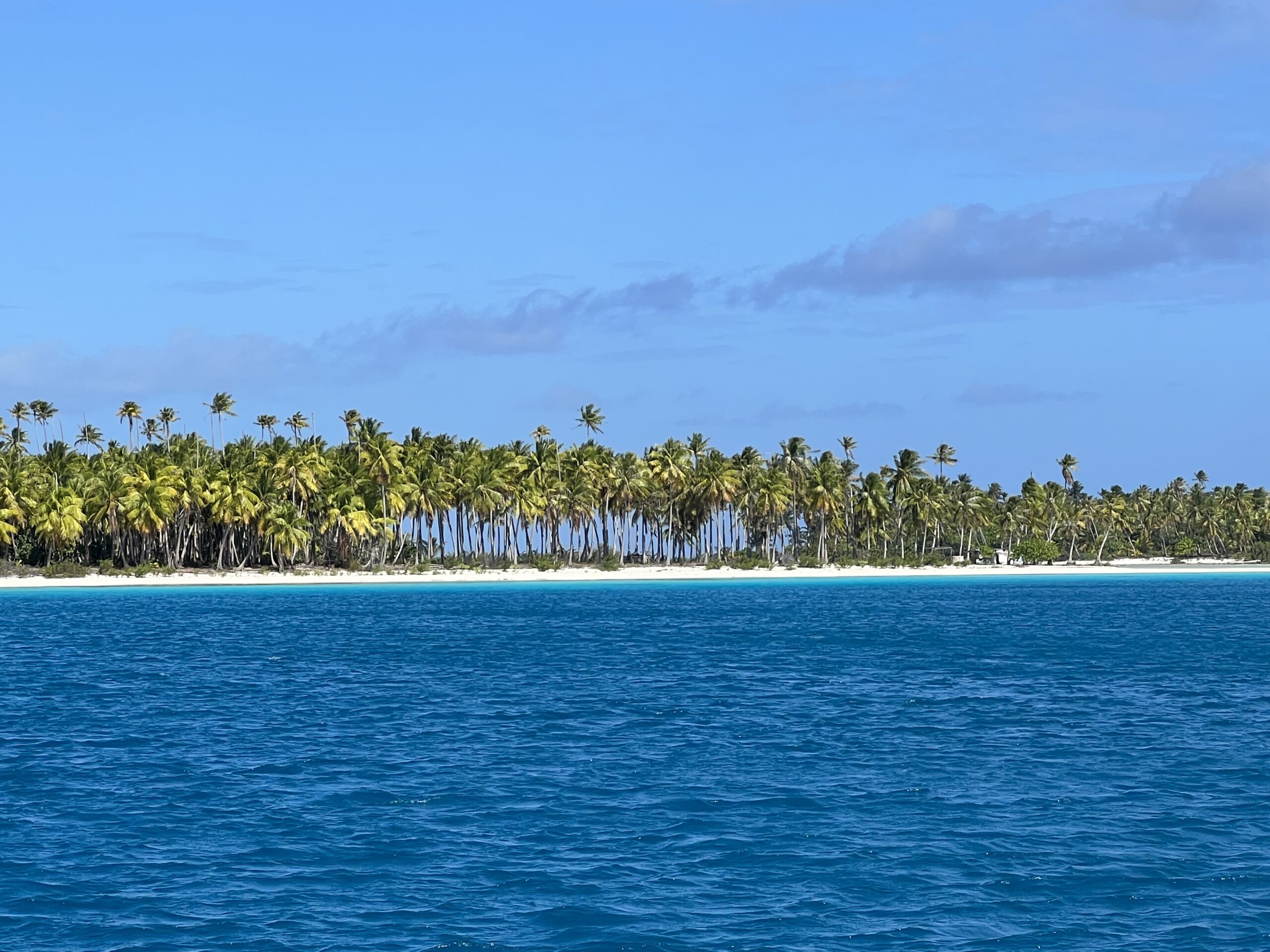
Our home for several days in Tikehau Looking from shore toward the boat in Tikehau
After a couple days of wind, we ventured back to the motu on Saturday. I found more floats and coral and Linda found more shells. Then we went back to the boat, but the dinghy on the davits and plotted a course for the next day.
On August 14, my sister Debbie and my niece Julia arrived on Rangiroa by plane. They brought some treats and provisions and some parts I needed.
Unfortunately for them, the weather did not cooperate with their visit. We had many days of high winds and rain. We were able to eat a nice lunch a couple of times at Relais Josephine and watch the activity in the pass.
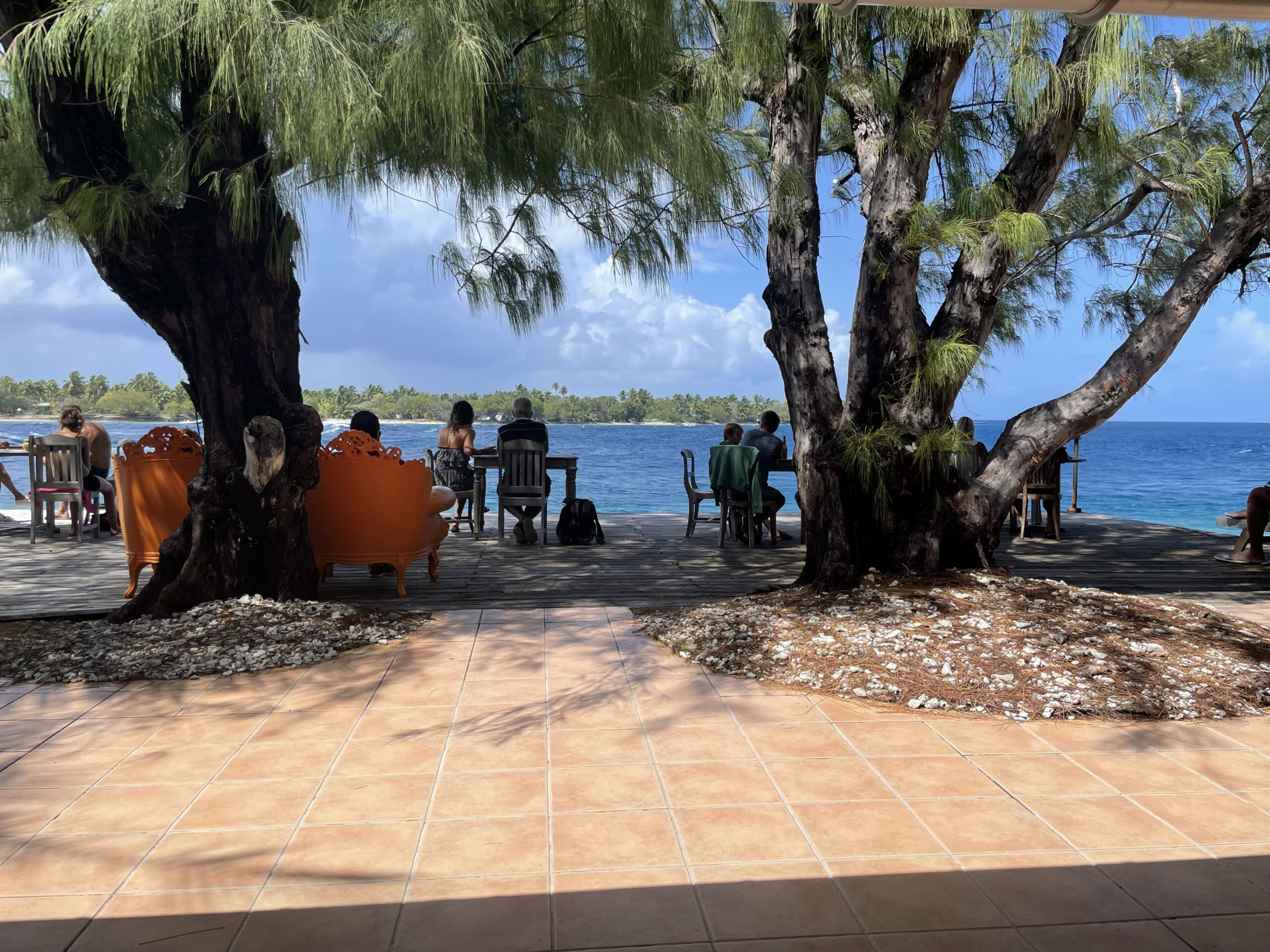
Looking out from the restaurant at Relais Josephine at the Tiputa PassThe walk to Relais JosephineWatching the activity in the pass
At one point we had a nice sail over to the other side of the atoll, to the Blue Lagoon. When we go there, however, it was too rough to stay, so we pulled up anchor and motored back to the Kia Ora anchorage, arriving just before dark and anchoring quickly, without being able to see where the anchor landed.
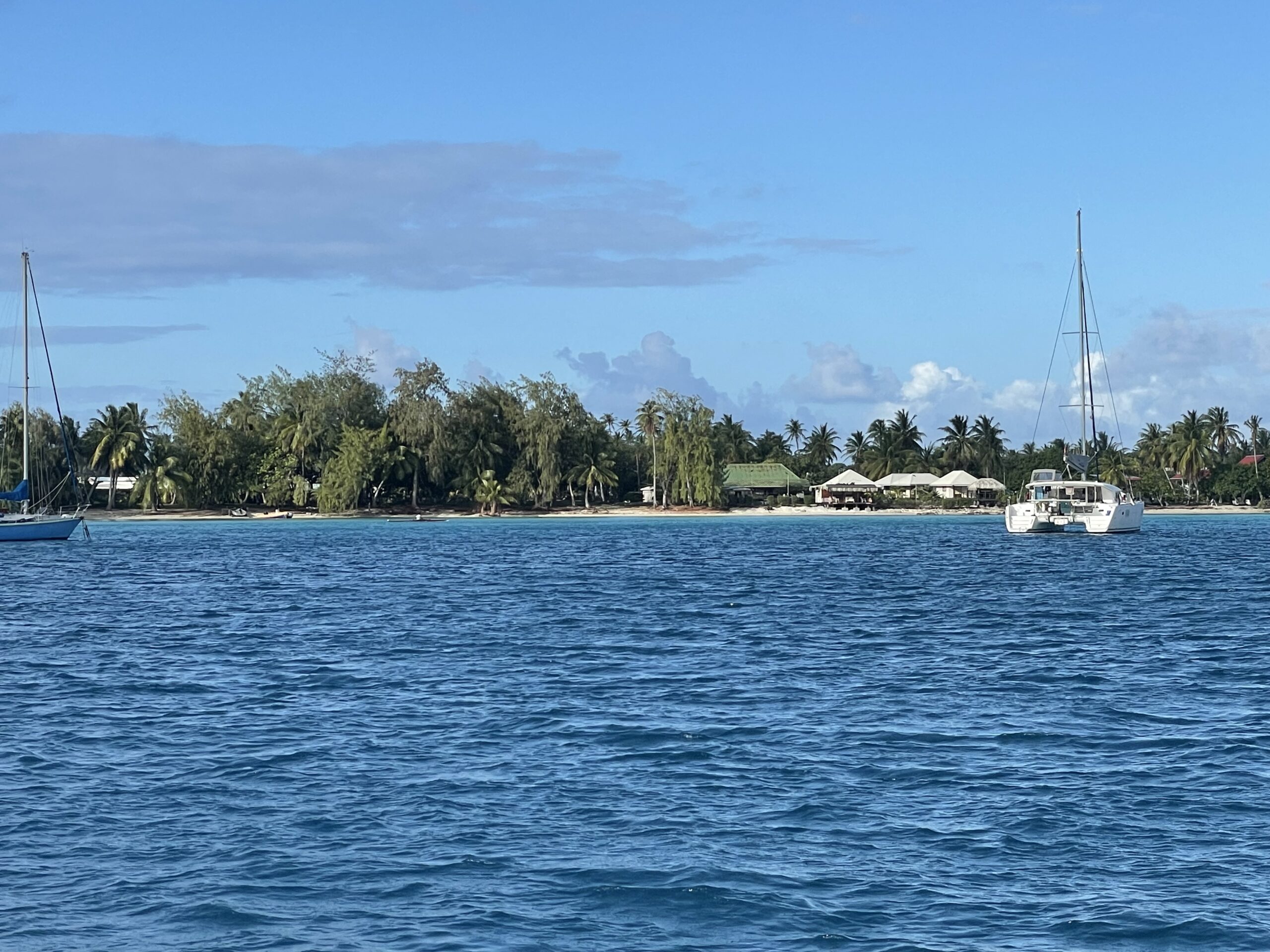
Looking from the boat toward shore at the Kia Ora Hotel Anchorage
We waited out the weather again, and a few days later sailed back to the Blue Lagoon. We had a nice day there and a couple of nice nights with flat seas and no wind. Early on one morning, before the tourist boats arrived, Julia and I snorkeled on the reef outside the entrance to the Blue Lagoon and saw lots of sharks and fish.
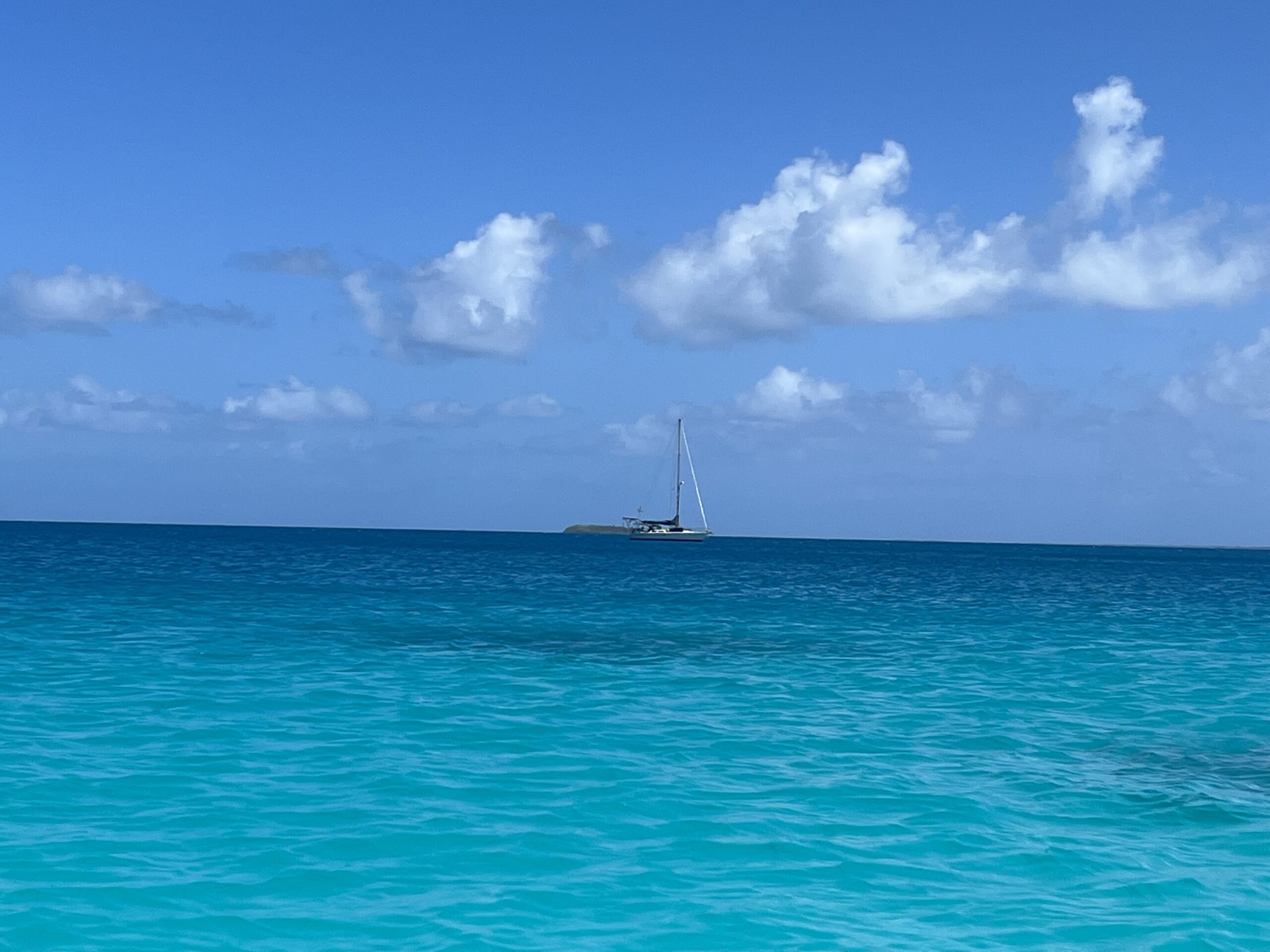
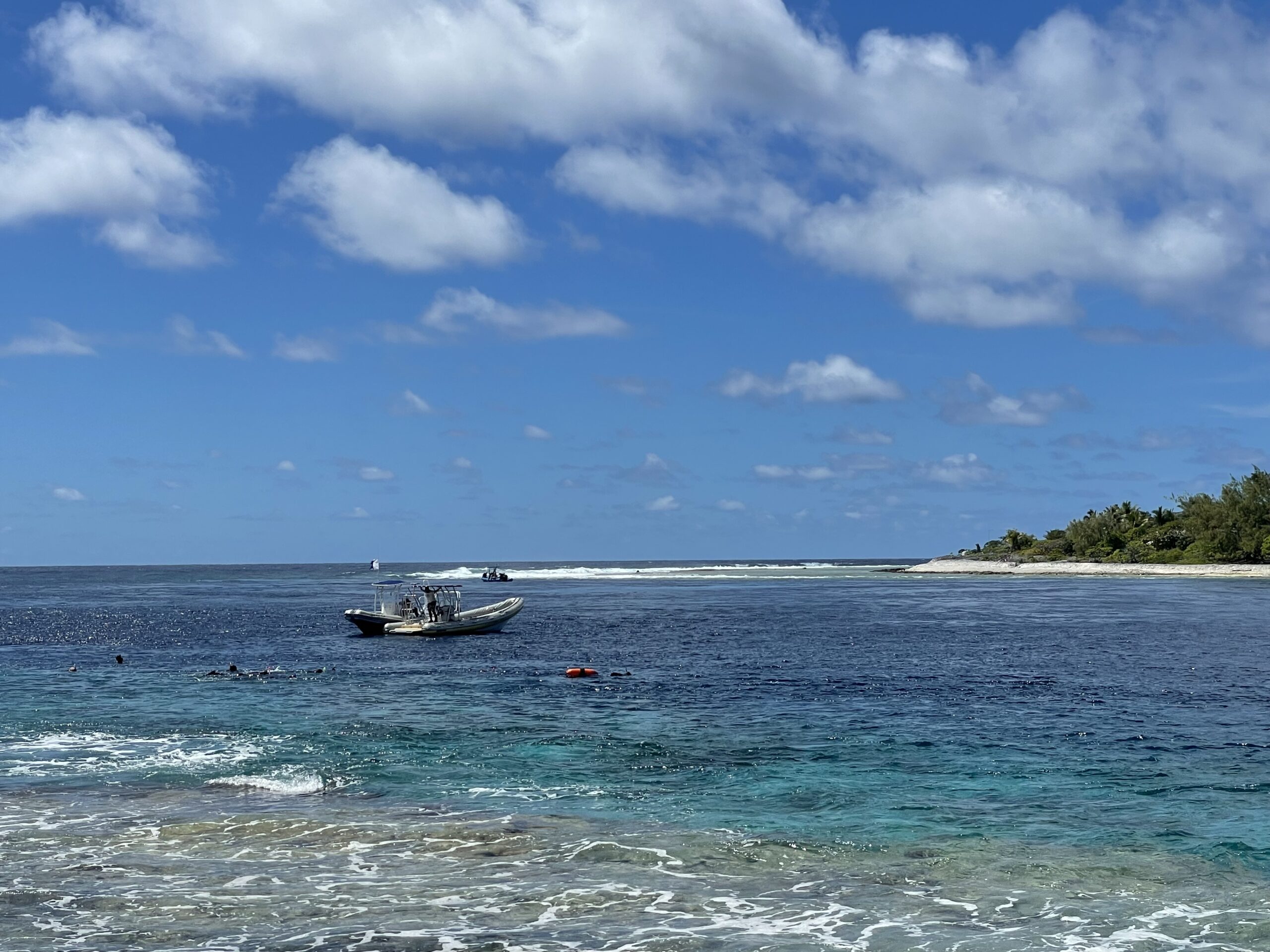
Quiet moments at the Blue Lagoon, Pasito is the boat in the shotWading in the Blue Lagoon
We next went down to Motu Fama and anchored for the night. It was beautiful there but that night a big squall came in from the south and our anchor may have dragged. We monitored the situation until the squall subsided and then Julia and I put out more chain. I did an anchor watch until 1 a.m. and when all seemed stable, I went to sleep.
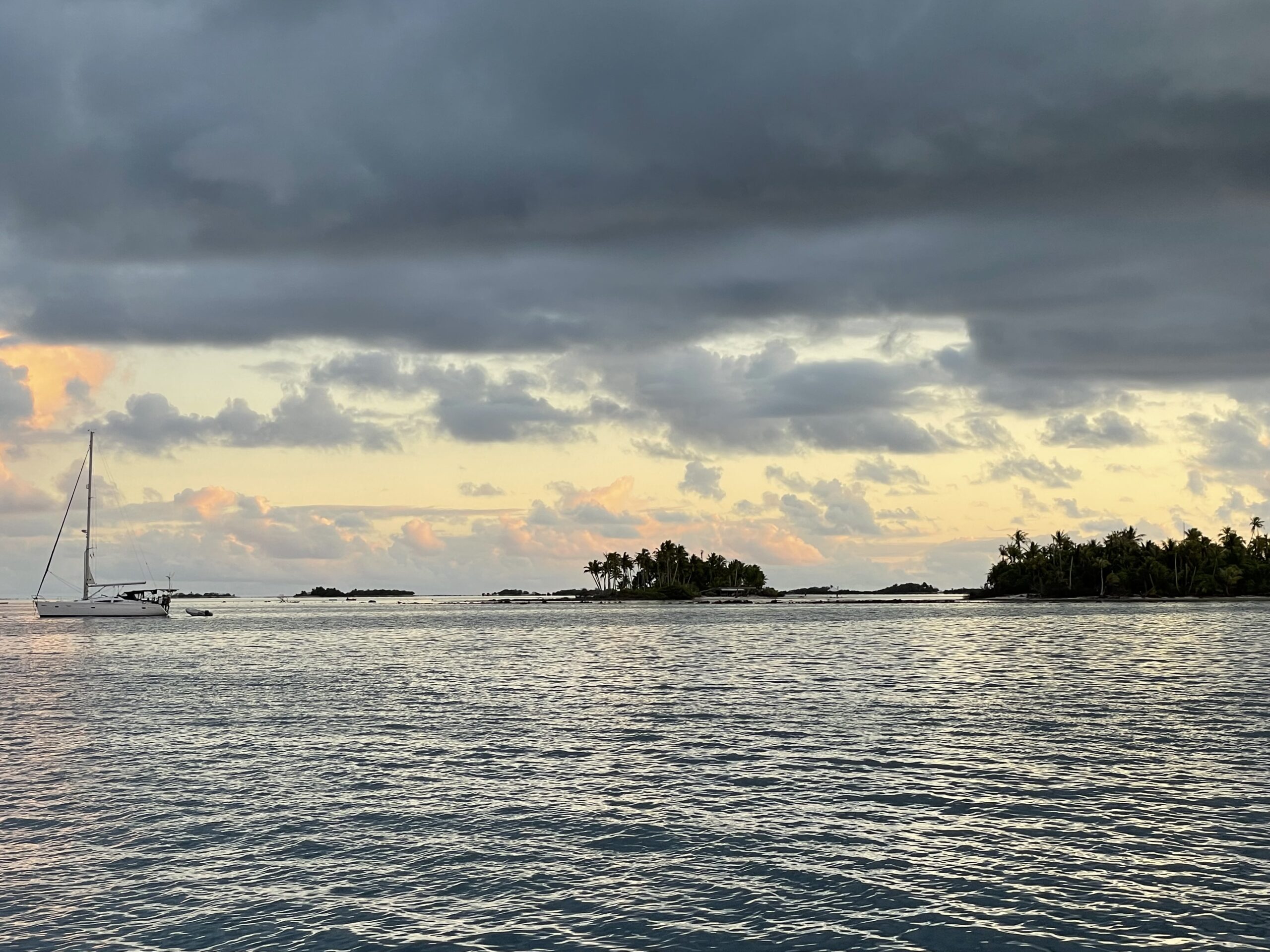
Anchored in front of Motu FamaAnother View at Motu FamaAldabra in front of Motu Fama
The next day, the wind was building sooner than I expected, so we pulled up anchor and sailed back across the lagoon and then turned into the wind and motored back to the Kia Oro anchorage with enough time to anchor before dark. That was the end of our adventuring on Rangiroa. The lagoon is so big that the seas really build on the other side. So we stayed put and snorkeled at the Aquarium, which can be really good snorkeling. We also went over to Tiputa on the last Sunday of their visit to attend church. The Catholic service involves lots of beautiful music.
Bike Riding on the windward side of RangiroaAnother beautiful sunset on Rangiroa
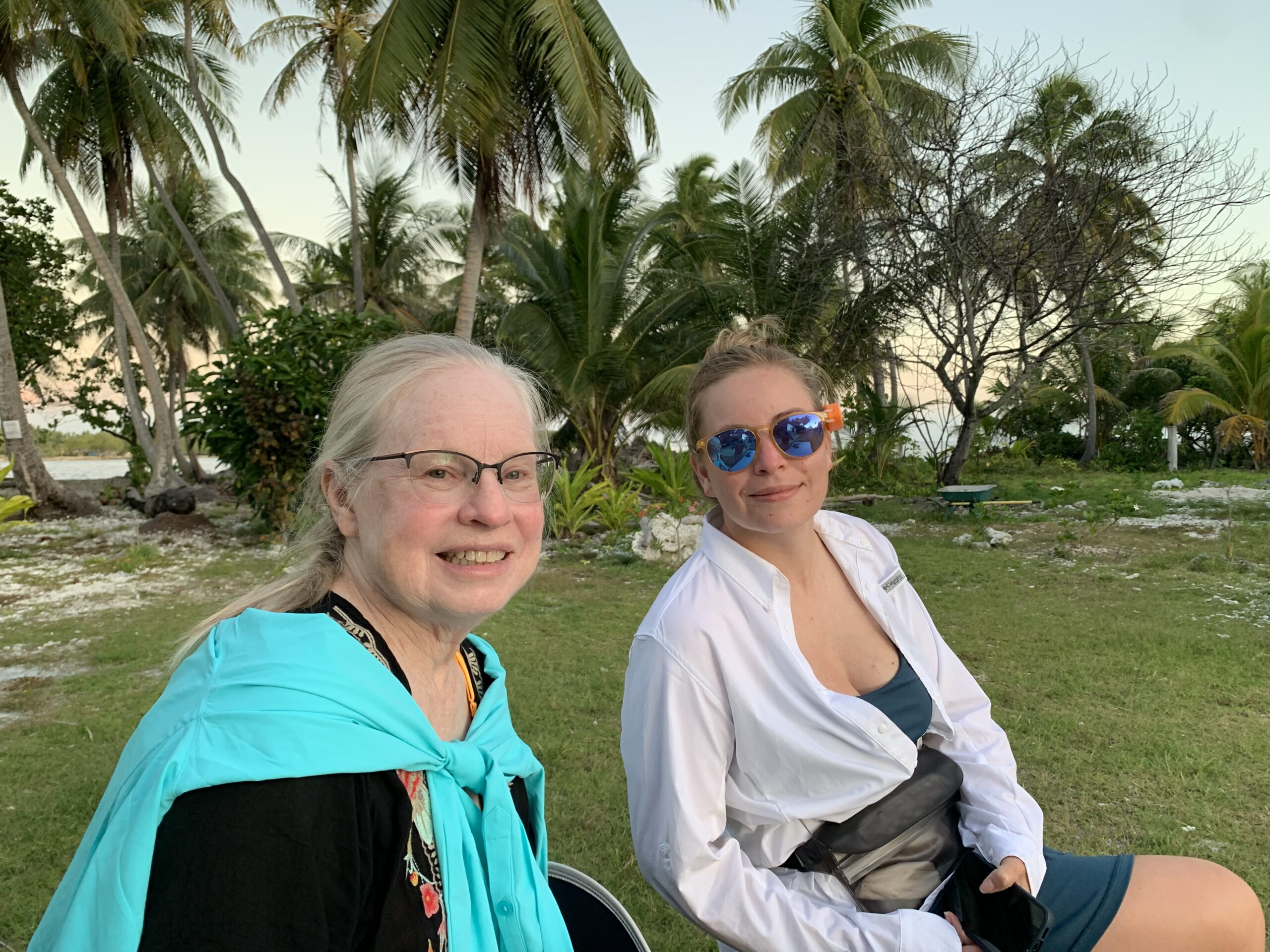
Debbie and Julia left at the end of August and I took a couple of days to get the laundry done and clean a bit. Then my friend Linda Moore arrived. After taking a couple of days for Linda to settle in, we did some dives outside the Tiputa pass, followed by lunch at Snack Puna one day and Relais Josephine on another.
dLunch in front of Tiputa Pass after a dive
We also snorkeled at the Aquarium, which Linda liked better than the dives. Seeing the dolphins up close is fun, but the diving can get boring as you wait out in the blue water away from the reef for them to show up. The last dive was probably the best because we went more slowly and could see more fish on the reef. We were joined by two divers from California and it was fun to talk to them.
Looking at the weather predictions, we thought we would be pinned down in Rangiroa for multiple more days during strong winds. I was anxious to move on, so we found a weather window on Tuesday morning, leaving the Avatoru Pass at 7:00 a.m. uneventfully and sailing over to Tikehau. The sail over was very nice. We went around the top of the atoll and were protected from the seas, so they were flat.
Heading for the Tuamotus, we left the Omoa anchorage on Fatu Hiva on Saturday night, July 9 at 10:30 p.m. We set our sails as soon as we cleared the island and then put a reef in the main. The winds were in the mid-teens and we moved along nicely above 7 knots. The moon was out and it was lovely. Sunday was nice, with winds between 9 and 12 knots, always on the beam. And Sunday night was a calm, pleasant sailing night. Monday brought about the same light winds and more sunshine. A pod of dolphins joined us briefly. It’s nice to have an uneventful, comfortable passage.
On Tuesday, the winds kept getting lighter. After trying the spinnaker, we sailed on the jib alone. Finally, in the gap between Raroia and Takume, we pulled in the jib and motored. Once we got near the pass at Raroia, we turned off the motor and bobbed for the rest of the night and into the morning, waiting for the right time to enter the pass. As I later figured out, I was reading the current tables wrong so we entered the pass at the wrong time. For our first entry into an atoll pass, it was a bit intense but otherwise fine.
Once we entered the pass, we went over and anchored in front of the village. It took us 2-3 hours to anchor because we were floating our chain for the first time. We had to find a sandy place for the anchor and then attach fenders to the chain to keep it from touching the coral on the sea floor.
As we were coming in, an armada of dinghies passed us on their way to drift snorkel the pass. Bob and Sarah from Rhapsody were among them. That night we met the rest of the armada. We went over for sundowners to Womble, a beautiful Seawind 1600 from the U.K, owned by Dale and Katrina with crew Jack and Etta. We also met Lance and Amy on Lorien, and Kate and Jim on Polaris. It was a very nice evening with good people. We had a little mini-emergency because Marshall fainted. But Dana, Dale and Katrina tended to his medical needs.
The next day was Bastille Day and on many islands in French Polynesia they celebrate. Raroia was not among them. It was a very windy day in the anchorage and some of us had to re-anchor in those conditions. We stayed on the boat. Rala also joined the rest of us, having come from the other side of the atoll.
The next day, Friday, July 15, most of the boats were headed to Makemo but we headed over to the other side of the atoll, first to the Kon Tiki monument and then to a beautiful, quiet anchorage on the northeast end. We explored on land a bit and otherwise hung out. The weather went from still to rain to wind.
Raroia: Introduction to the Tuamotus
On Monday, July 18, we left the northeast anchorage at 8:00 a.m. and headed out of the pass. I still handn’t figured out that I was reading the current tables wrong, so we didn’t exit during slack tide, but it wasn’t too bad. We put the jib up and ran on a broad reach to Makemo. Dana caught a very large tuna and cleaned it with guidance from Johno. We arrived at 5:00 a.m. and waited until 6:30 a.m. to enter the pass, again at the wrong time, but it was fine. We anchored in front of the village, floating our chain. It took about an hour.
We went ashore and bought provisions, got money at the ATM and answered emails because we had a cell signal for the first time in many days. We had Dana’s tasty fish for dinner. The boats in the anchorage included Womble, Polaris, Rhapsody, Lorien, Rala and now Candine and Black Moon (who had been in Fatu Hiva with us). It felt like quite a community although of course we would all head off in different directions.
While we were in Raroia, Johno and Marshall had colds. We tested them for Covid and they were positive. It sort of explained why Marshall had fainted. I went around to as many of the boats as I could to let them know that we had exposed them. By the time we got to Makemo, some of the cruisers were symptomatic.
On Thursday, July 21, we motored to the Punaruku anchorage. It was a calm day inside the lagoon but there was a big south swell outside and you could see the waves breaking on the reef. We had a nice snorkel on the reef and a nice evening. After a gorgeous sunrise on Friday, we motored to the anchorage near the west pass, which we would not have done if it weren’t for OpenCPN and the satellite images that are integrated into the charts. We could see each bit of coral as we navigated into the anchorage. It was a fun place to snorkel for the day and a nice quiet night.
Makemo Sunrise
On Saturday, July 23, we left Makemo via the west pass (still at the wrong time) at 6:25 a.m. We sailed on a beam reach with 10-12 knots of wind from the north. It was a nice day of sailing. In the evening, the wind came up and we put two reefs in the main. We had 13-15 knots of wind and we were still going too fast to reach Fakarava. We arrived at the pass at 10:00 p.m., took down the sails and motored for four hours. Then we shut off the motor and floated around until sunrise. After that, we put the jib up and sailed around, killing time. We entered the south pass at 9:25 a.m., at the wrong time, and it was a bit hairy. There were a bunch of dive boats in the pass and they were yelling at us. I’m not sure what they were saying but I think they were chastising us. As we headed to the anchorage near the pass, it was really windy and it seemed imprudent to pick up a mooring ball there. We kept on going (which meant passing up the opportunity to snorkel the pass) and went to Hirifa.
For kite boarders, Hirifa is the spot. The wind seemed perfect and lots of boats had people kiting around the anchorage. For me it was just an overnight spot. We pulled up the anchor the next morning and headed toward the north side of the island, stopping for the night in an anchorage by ourselves. We had a nice snorkel and a quiet night.
The next day we proceeded to the village of Rotoava and anchored. Rala was there at anchor and Rhapsody was tied up at the wharf because their windlass had broken. We spent a week in that anchorage. Partly it was due to multiple days expected of high winds. We also were dropping Marshall off there so he could fly out. And it was a decent place to provision, ride bikes, eat at restaurants and tour a pearl farm. We hung out with Ian and Laura on Rala and saw Bob and Sarah on Rhapsody before they left for Tahiti. There wasn’t that much to do on Fakarava during super windy days, but Fakarava Yacht Services was a godsend to cruisers. We could get laundry done, use wifi, get cooking gas fill-ups and rent bikes. I discovered that I couldn’t take Marshall off the crew list in Fakarava so that would have to wait until Rangiroa.
On Monday, August 1, Rala and Aldabra went over to the anchorage near the north pass so we could get an early start going out of the pass the next morning. (I had finally figured out how to use the current tables properly.) We each picked up mooring balls but it was really windy, the seas were huge and choppy and the balls were very close to shore. If a ball had broken, we would have only seconds to start the motor and keep the boat off the shore. And the motor would be working very hard against the wind and seas. Both boats elected to go back to the village and anchor. We each had a somewhat peaceful night before an early morning departure back to the pass.
On Tuesday, August 2, Rala and Aldabra pulled up anchor at 6:00 a.m. and sailed to the pass. Because I finally had the timing right, it was very smooth. Outside the pass, the swell was a bit big and the winds were in the high teens. Headed for Rangiroa, we sailed on the jib alone on a broad reach, jibing every so often. Rala was sailing downwind so they had a much better angle and stayed ahead of us the whole time. At one point we ran the motor for an hour and a half to charge the batteries and they didn’t charge. Johno found a loose wire and reconnected it to the alternator and charging resumed. Whew!
To arrive at the pass in time, we motored for the last few hours and went through the pass as soon as we got there at 8:00 a.m., just behind Rala. We anchored in front of the Kia Ora hotel with several other boats, none of whom we knew. Rangiroa was to be the last stop for Dana and Johno, who were flying out on August 7.
As soon as we anchored, we went ashore to walk around. We ran into Ian and Laura at the pass, where people were watching dolphins surf the waves. They took us to a great little restaurant at the pension Relais Josephine where we could eat while watching the dolphins. We had a nice lunch before heading back to the boats for naps. Ian and Laura came over to Aldabra that night for sundowners.
I needed to get to the gendarmerie to take Marshall off the crew list. Google Maps said it was in the village of Avatoru. So the next morning, Dana and Johno and I took the dinghy the four miles to the village and beached it. It was a windy, wet ride and I was soaked from head to toe. We couldn’t find the gendarmerie and there was confusion among the locals about its location. We stopped by the mayor’s office to pay our cruiser’s tax and a very nice man explained where it was. We could walk 5 kilometers or take the dinghy. We elected to take the dinghy and found a little pass to tie up before walking a short distance to the gendarmerie.
We found it, but I don’t speak French and the staff didn’t speak English. We spent a lot of time on forms that I was pretty sure were not right. At the end, the woman sent me away without anything in hand. I asked if I should be signing something and she assured me that everything would go to Papeete and be just fine. But later that day I got an email from her saying that I needed to come back and sign a form.
After we left the gendarmerie, we ran into Ian and Laura, who were taking a bike ride. We stopped at a magasin before going back to the dinghy, and then we took the wet ride back to the boat, something I would rather not repeat.
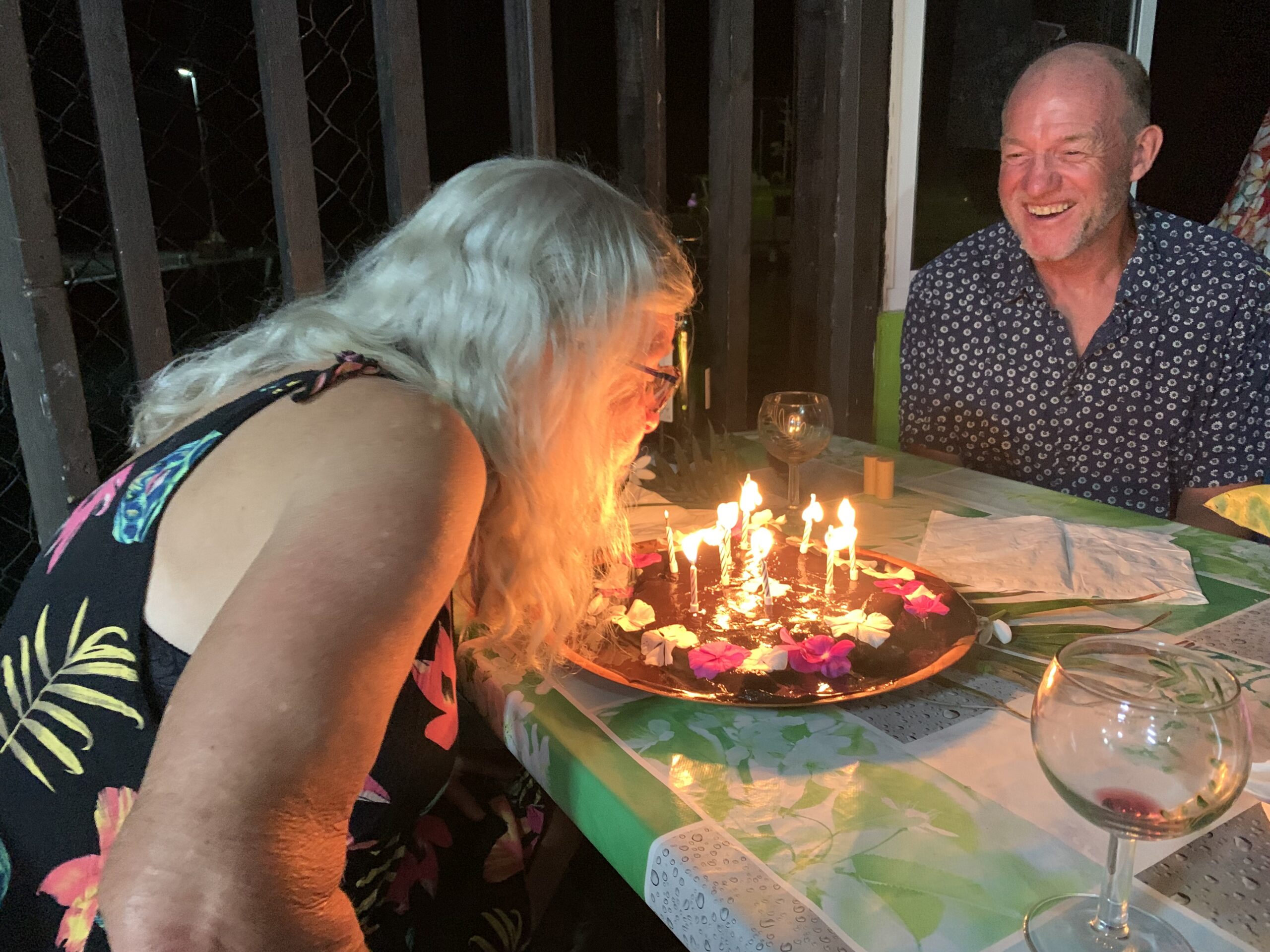
Dana and Johno banished me to the cockpit during the middle of the day so they could bake a birthday cake. Later, with Ian, we attempted to snorkel the pass by pulling our dinghies along with us as we drifted. But we were working against a current so we abandoned that and went over to the aquarium at the motu near the pass. The snorkeling was good there so we spent a bit of time before heading back to the boats to rinse off before dinner. The five of us had a nice birthday dinner at Snack Puna, which included a chocolate torte with trick candles that didn’t blow out.
Trick birthday candles
The next day, Friday, Dana and I joined Ian and Laura for two dives with Rangiroa Diving Centre. The first dive was a reef dive outside the pass on the east side. The second dive took us into the pass from the outside. We were hoping to see dolphins, which is a highlight of the dives here, but they didn’t appear. The second dive was a sunset dive and we did see a lot of fish, which had all come out of their holes in the reef to feed. When we got back to the boat, we were freezing and cold. Johno kindly whipped up a meal.
On Saturday, Johno and Dana and I went to shore in search of bikes, but the place was closed. We ended up taking the dinghy across the pass to explore the Tiputa village. We found a working ATM at the post office but not much else. Later we went snorkeling at the aquarium and then joined Ian and Laura at the Snack Puna for a last-night dinner.
On Sunday, Dana and Johno’s last day, we rode bikes to the Avatoru village and happened to find the gendarmerie open. I stopped in to sign the paper, which turned out not to be the right form. I finally got a form, officially stamped, that probably isn’t correct, but at least it shows I tried to sort it out. At the end of the motu, we checked out the Avatoru pass, which is wide and looked very tame. After spending the rest of the afternoon on the boat, I took the two of them to shore at 5:00 p.m. to catch their taxi to the airport. Sitting on that boat that evening, I could tell that no plane had come to whisk them away, but finally, a couple of hours late, it arrived and they took off.
With Dana and Johno’s departure, I was alone on the boat for the first time since April. I was ready to do some serious cleaning. But first, I got one more day of scuba diving in with Ian and Laura. We did two dives, basically in the same place as before, but we saw dolphins. They came and swam around us. We also saw a turtle that didn’t dart away. It let us gawk at it. And we saw lots of sharks and some big pelagic fish, along with beautiful reef fish. That night I had a lovely dinner on Rala with Ian and Laura.
On Tuesday, the taxi driver, Gilbert, took me to the gas station where I could buy gasoline and oil for the dinghy. I was also able to drop of my laundry at Addison’s house. I spent the rest of the afternoon cleaning.
On Wednesday morning, amidst much rain, Ian and Laura stopped by to tell me that one of the magasins had some fresh produce. So I hopped into the dinghy and went there to find some mangos and avocados. (I’d had only one avocado since arriving in French Polynesia.) Later that day I went back to get the laundry from Addison, who had managed to dry everything even during a big rainstorm. (It had rained so much the night before that the dinghy was completely filled while hanging on the davits. Had it been in the water, it probably would have sunk.)
Sadly, Ian and Laura left on Rala on Wednesday afternoon, headed for Moorea and then parts west and south. I’m not sure I will see them again anytime soon. But I really value the friendship.
Rala Leaving for the Societies
Alone on the boat and without anyone I know in the anchorage, I just puttered away on the boat, defrosting the freezer and fridge and cleaning the galley, cleaning the heads, the floors, the rugs. I re-glued a seal on one of the hatches, changed out the watermaker filters, cleaned the cockpit. Mixing the chores up with a bit of reading and writing, I’ll be ready when my sister and niece arrive in a few days.
We arrived in the Bay of Virgins on Fatu Hiva before 2:00 p.m, in front of the village of Hanavave. There were about six or so boats in the anchorage and no room for us in water less than 70 feet deep. Migration came in right behind us and found a spot in a slightly shallower area. Waveriders, Andrew and Liane, came in behind us as well.
Looking down on the Bay of Virgins in Fatu Hiva
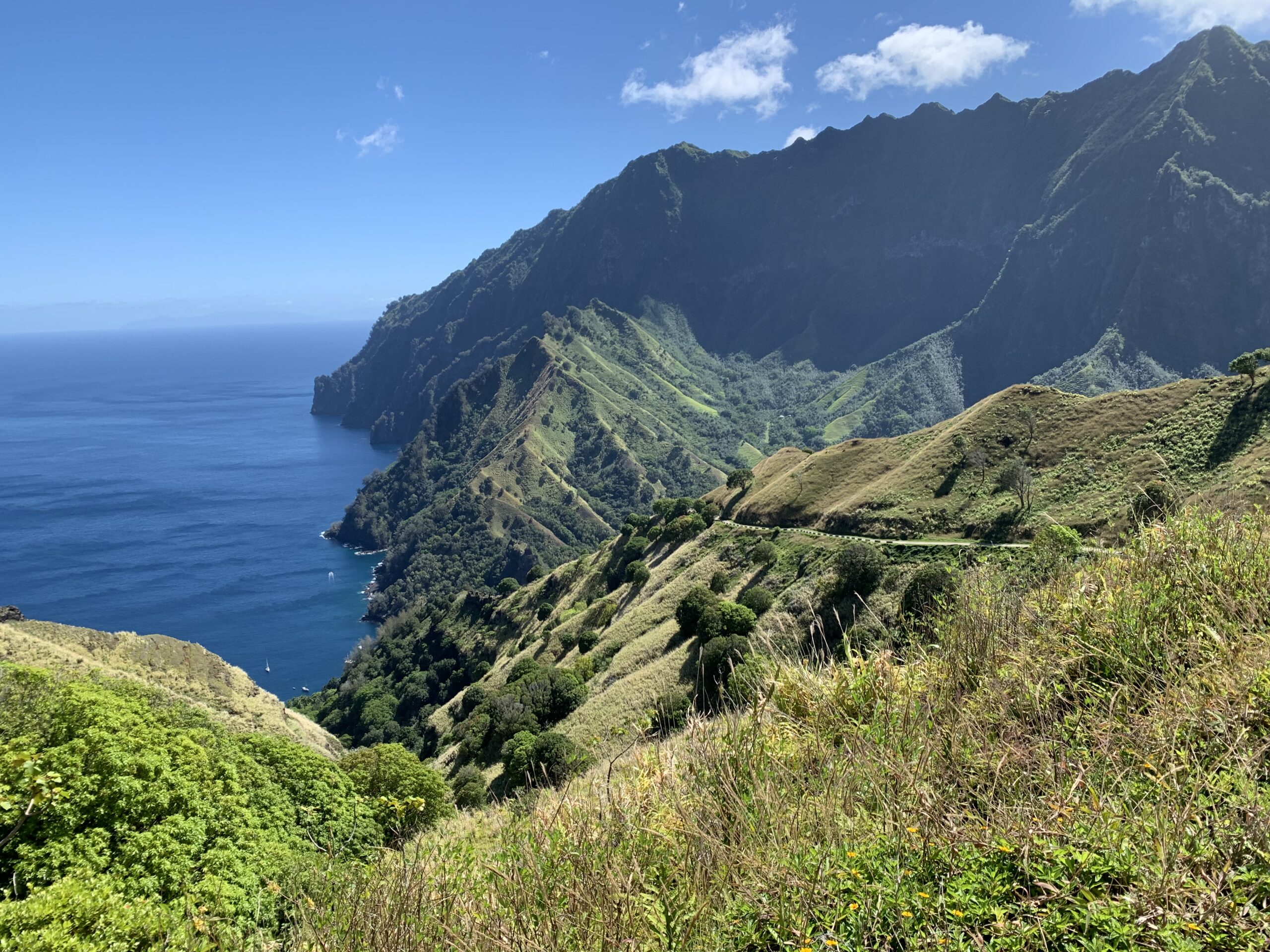
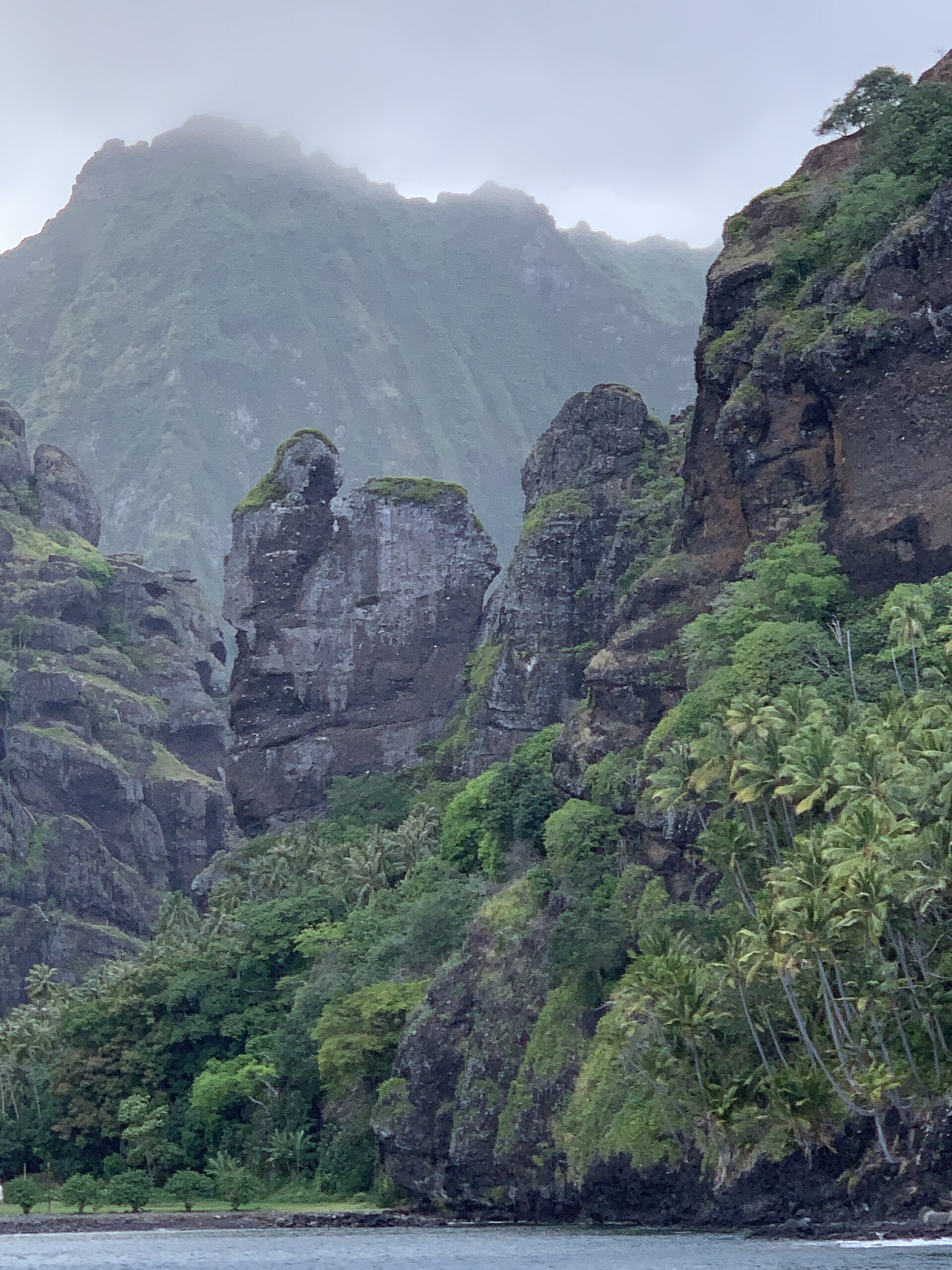
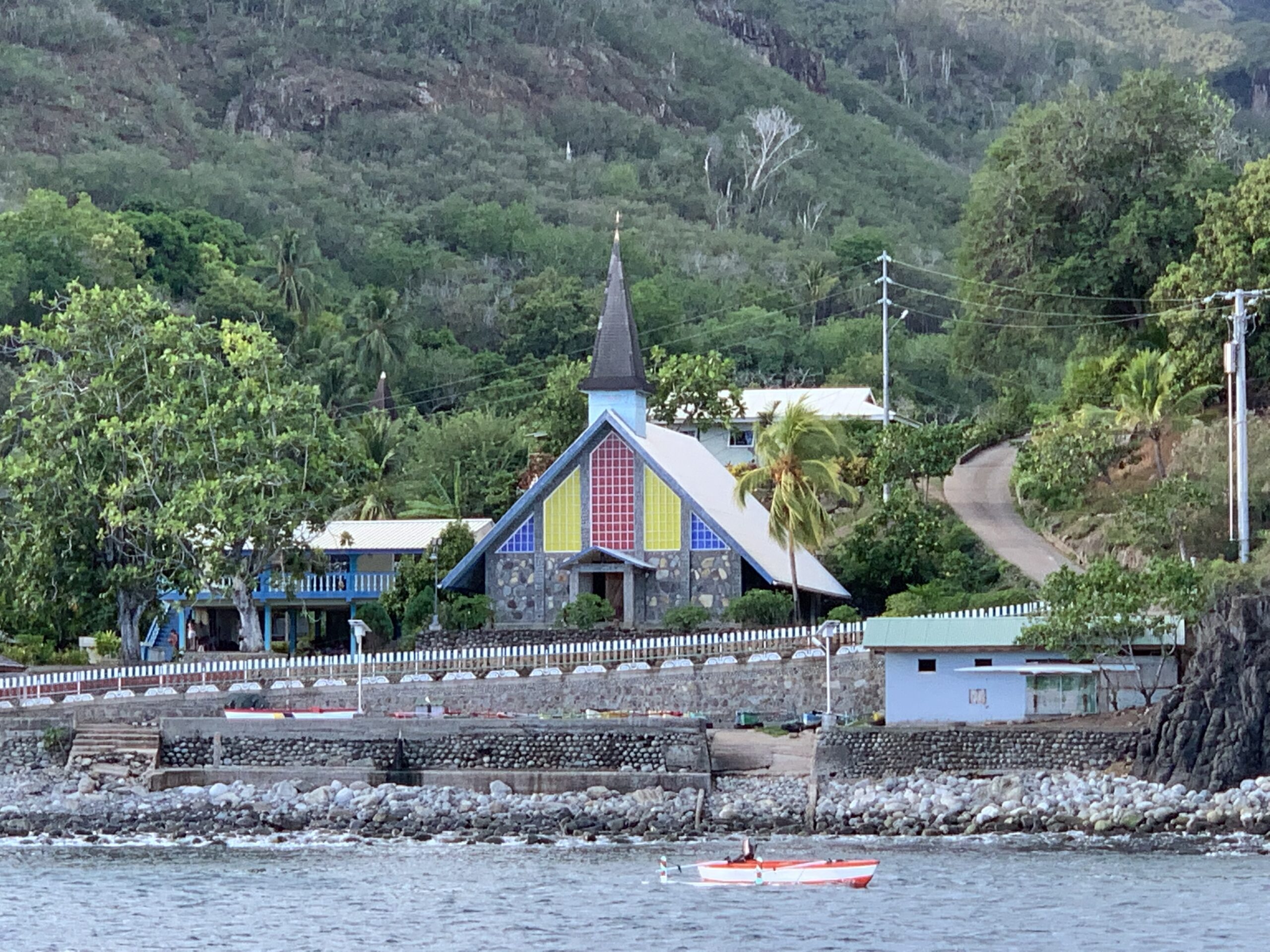
Fatu Hiva is a storied place, perhaps one of the most beautiful islands in the world. It has a population of about 700 people and is accessible only by boat or helicopter. The Bay of Virgins is surrounded by steep walls of tall, distinctive rock formations and lush greenery, including hundreds of coconut palms. The peaks of the mountains are often shrouded in fog. And while we were there, the wind gusted down from the mountains, through the valleys and through the anchorage, sending gusts of 20 to 40 knot winds to harass the boats. While we were there, boats came and went, with many staying as long as we did, in anticipation of an inter-island festival to begin on July 7. The anchorage is mostly deep and several of the boats dragged and had to re-anchor, sometimes more than once.
The day after our arrival, Wednesday, we went ashore, leaving the dinghy behind a breakwater that forms a safe little harbor. As we began walking through the town, we met a man by the name of Cristian in front of the house. He invited us to his home to see his carvings and I bought a rather large tiki carving. We made arrangements with him to come to his house the next night for dinner and he would give us fruit. From there we walked a couple of miles to the waterfall, meeting up with Andrew and Liane on the way. We visited the waterfall without swimming in the pool because it had some scum on the top, then walked back to town.
As we were heading back to the dinghy, we met Patrick, who gave us bananas and invited us to go with him to the other town, Omoa, in his truck the next day. We joined Patrick at 8:00 a.m. on Thursday and he drove us through hairpin turns up over a steep mountain and down into Omoa. There we shopped at the magasin (market) for a few provisions (they didn’t have much) and met with a woman by the name of Glenda to look at her carvings and tapa cloths. I bought three tapas, Marshall bought one and Johno bought one and a stone carving of a manta. She gave Dana and me each a necklace. Patrick drove us around to see a bit of the town and then we headed back to Hanavave. At the summit, Dana and Johno got out and walked the two hours back and Marshall and I continued on with Patrick back to the dinghy.
The road from Hanavave to OmoaMore landscape looking back toward Hanavave The famous rock formations of the Bay of VirginsPosing with Patrick
Later in the afternoon, Marshall and I went back to shore and met up with Dana and Johno. We tried to watch a local practice for the festival but no one was there yet, so we wandered into a neighborhood behind the soccer field. As we walked aimlessly, we met Angela, whose husband carves beautiful bowls out of rosewood. We met Priscilla, who promised us mangos for the next day. And we met Kulina, who invited us to their house for a dinner.
Later, we met up with Bruce and Alene of Migration for a delicious dinner at Cristian’s house, where he gave us more fruit. On our way to Cristian’s, we met Alex and Yvette of Blue Beryl. This young Dutch couple is quite adventurous and energetic. They told us the story of getting dismasted between the Galapagos and the Marquesas. Alex worked with another cruiser (Tim on Candine) to salvage a mast from another boat and re-rig his boat. It was quite an epic story.
We started the next morning by going to shore to meet up with Priscilla for the mangos. It turned out that she wanted to trade them for rope, so I dashed back to the boat to get some rope. On my way back, I met up with my crew and a man named Sopi, who was coming home from the hills with a pack horse carrying coconuts and bananas. He saw the rope and wanted it. So I cut it in two and gave him half. He then took us to his home to show us his carvings. While he was showing Marshall and Dana and Johno his carvings and how to husk the coconuts, his wife asked me for perfume. So I went back to the boat and got her some perfume.
We invited Migration and Blue Beryl to join us that day, Friday, on a hunt for a grotto that Dana’s parents had found in 1992. We set out from the anchorage, going north toward the tip of Fatu Hiva and managed to find the grotto. We anchored the dinghies, swam to shore and crawled behind some boulders to find the hidden brackish pool. We swam around in it to explore. And as we left, Bruce and Alex brought out large pieces of plastic that had been left there.
Discovering the grotto behind the boulders
On the way to the grotto we found a beautiful tunnel-like cave with lustrous teal water. On the way back from the grotto, we stopped by again so Dana could scatter some of her dad’s ashes there. He surely would have seen it and loved it in 1992.
Scattering some ashes of the late great Jim Foley
That night we went to Migration (a large trimaran with tons of deck space) for a potluck with other boats, including Blue Beryl, Pablo and Candine. It was a lovely night that passed by too quickly to talk to each person.
Our plan after the potluck was to leave at 3:00 a.m. to go to the Tuamotus. We had a narrow weather window to get there between light winds and really heavy winds. Our new friends at the potluck encouraged us to stay another week for the festival. When we got back, the crew had a meeting and decided to indeed stay.
The next day, Saturday, Dana, Johno and Marshall hiked with Alex and Yvette back up to the waterfall while I stayed on the boat to run the watermaker and defrost the freezer. On their hike, they ran into Ian and Laura (on Rala), who we had met in Daniel’s Bay on Nuku Hiva.
On Sunday at 8:00 a.m. we joined Bruce and Alene for the Catholic church service. It was mostly singing and a bit of prayer in Marquesan. It was beautiful and captivating. I can’t think of an hour better spent. Patrick, who we knew was a devout Catholic was one of the church elders who participated in the service.
The service was not well attended that day because the supply boat had come in that morning and the townspeople were at the dock, waiting to get their deliveries. After church, most of the attendees headed to the magasin, not necessarily to shop, but just to be social. We were there too, trying to buy cooking gas with Migration, but the store did not want to sell it to non-locals because there has been a shortage in the Marquesas.
We ran into Ian and Laura on Rala and I learned they were having trouble with weather downloads and were headed to the Tuamotus. So later that afternoon I took my weather download over to their boat and shared it with Ian, and he shared tips he had learned about making it into the passes of the Tuamotu atolls. We planned on getting together the next day on Aldabra, but the wind came up that afternoon and a lot of boats started dragging their anchors. Rala tried to re-anchor several times, helped by other cruisers late into the evening. They finally anchored for the night but it was an intense night of gusty winds so they pulled up anchor the next day to head for a shallower anchorage. I imagine that they will get a couple of nights rest before heading to the Tuamotus but I wasn’t able to say farewell.
Monday brought more gusty winds in the anchorage. Dana and Johno went for a walk to the top of a mountain. Marshall and I cleaned the cockpit and he visited with other boats in the anchorage. I made some hummus. Migration and Blue Beryl joined us on Aldabra in the evening for sundowners, appetizers and hot dogs to celebrate the fourth of July. Migration is the only other American boat in the anchorage.
Monday night was an intense night of winds, which carried through all day on Tuesday. I did get into the water at one point to clear a thru-hull that was backed up with critters in it. But it was an otherwise lazy writing and reading day for all of us while we waited out the winds, which were gusting in the 30-knot range.
On Wednesday morning, another windy and rainy day, Dana and Johno set off from town to walk the 17 kilometers up and over the hill to Omoa. In the afternoon, Alex and Yvette from Blue Beryl took our dinghy over to pick Dana and Johno up. They were joined by Sam from Pablo in his dinghy. They had managed to get a bottle of cooking gas with the help of Graham on Pulsar. When they returned, Bruce from Migration came over to show us how to transfer the butane from the big bottle to our smaller tanks. We were pretty excited to be topped off with cooking gas since we’d been rationing ourselves by not using the oven.
On Thursday, I baked banana bread and the others did chores. We took the dinghy the three miles to Omoa for the start of the festival. We started by having lunch at the snack where we could use wifi. Dana and Johno booked their flights to return home in August. We then joined in watching the performances, which lasted until after 10 p.m., after which we took the dinghy back to Hanavave, arriving at 11:30 p.m.
On Friday, Marshall and Dana and Johno went back to the festival in the afternoon, first to do Internet and then to watch the evening dancing. I stayed back and ran the motor and the watermaker and did some chores. Earlier that day, we tried to convince a boat that had anchored in front of us to move. They weren’t inclined to do so, and left for the festival. Shortly afterward, as we were in our dinghy talking to Alex, the new boat hit Alex’s boat. We used dinghies to push it away and Alex put a stern anchor on the new boat. Meanwhile Migration went over to Omoa in their dinghy to send the people on that boat back to move their boat, which they did.
Alene and friend at the festivalI was so busy watching the dancing that I didn’t capture much, but her is a little taste of the younger generation
Saturday was to be our last day at the festival. We decided to take Aldabra over to Omoa and anchor to avoid the long dinghy ride between the two bays. We planned to pull up anchor after the festivities and sail to the Tuamotus. Unfortunately, we anchored too close to Antje, and while we were ashore, our boat hit their boat and damaged their steering vane, an essential part of their sailing needs. After we successfully avoided all the boat-collision drama in Hanavave, we now caused a huge problem for Antje. Although we did pull up anchor that night for the Tuamotus, I regret not staying there to help mitigate the hardship for Antje.
The dancing that night by the Nuku Hiva and Fatu Hiva groups was spectacular. A great way to end our magical visit to Fatu Hiva. We made wonderful new friends among the cruisers and the islanders. I started missing them all as soon as we were underway.
The trip to Hiva Oa was a nice upwind sail for about five hours. Johno hand steered as we made our way south. Once we were at the latitude of Hiva Oa, we turned left and motored into the wind for another twelve hours. We anchored in Baie Hanaiapa on the north side of Hiva Oa. There we were befriended by Noah and Ky from the sailboat Genesis. They stopped by our boat for a visit and then Dana, Johno and Marshall went over to their boat for sundowners.
The next day we joined them on a little expedition to the coast west of the bay. We anchored our dinghies and swam to the rocky, surgy shore to walk toward a waterfall. We couldn’t get all the way there without risking lives, so we went back to where we started on shore and got ourselves back to the dinghies. Later we all went to shore to walk around the quiet, picturesque village. At one house, a group of people were sitting in a circle, playing ukuleles and guitars. We walked a distance up the main road that leads to the other side of the island, enjoying all the rich vegetation and scenery. On our way back to the dinghy dock, we noticed that Migration was coming into the bay with Bruce and Alene onboard. Both dinghies motored out to greet them and invite everyone over to Aldabra for cocktails. It was a fun evening getting to know both couples better.
Because Migration and Genesis had already visited places we wanted to go to, we heeded their experience. A south swell was expected, and they warned us that the Tahuata anchorages would b e miserable. We had intended to go to the west side of Tahuata and then up to the south side of Hiva Oa, to provision in the town of Atuona. Instead, we rented a truck and started checking off what we wanted to do on Hiva Oa. We went into Atuona and bought provisions, we dropped off some laundry, got fuel, visited the Gauguin museum, got on the Internet and drove to Puamau to see the ruins there, having lunch at a nice place called Resto Puamau. The drive to Puamau was breathtaking as we wound down from the ridge to the coves on the northeast side of the island.
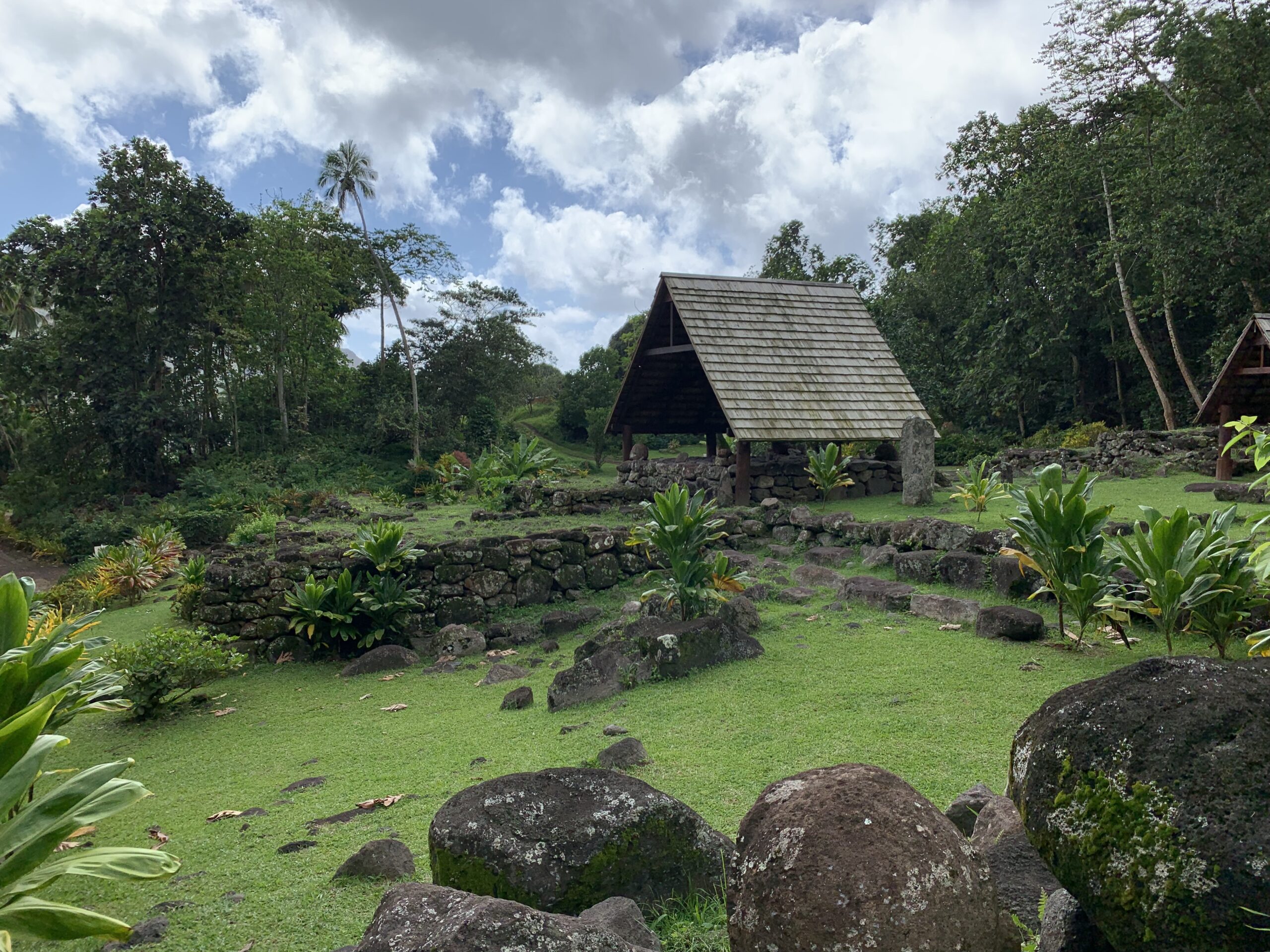
The beautiful north side of Hiva OaExploring the Ruins of Hiva Oa
While the days were busy with errands and boat projects, we got together in the evenings a couple more times with Migration and Genesis. One night was game night and dessert on Migration and another was back on Aldabra for after-dinner drinks. Bruce also helped trouble-shoot issues I was having with Sailmail.
The next morning, those two boats left the anchorage. They were delightful company and we hoped to see them somewhere else along the way. We then did our final errands in town. We bought beignets from a little bakery, bought a few more provisions, filled the truck and some jerry cans with diesel, got a tiny amount of gas before the pump ran out, and hunted everywhere for Internet. Finding none, we went to a hotel on a hill above the harbor, the Hanakee Lodge, where they offered a package of lunch, wifi and use of the pool for the afternoon. The lunch of poisson cru was delicious, the wifi worked and the pool time was nice.
Internet and a swim
Afterward, we picked up our laundry and returned the rental truck to the owners, a very lovely, warm family that we would have liked to spend more time with. They were very touched that Johno had washed the truck and that we returned their one-month-old vehicle in the same condition as when they gave it to us. If we weren’t planning to leave in the morning, they would have had us come to their house for hospitality. We promised to contact them if we return to Hiva Oa.
On Friday, June 24, from our anchorage in Hiva Oa, we went west around the corner and south across the Bordelais Channel, which had lots of wind for our little crossing. We anchored in a small bay on the other side of the channel, on Tahuata, Anse Ivaiva Iti, just south of Hanamoenoa, which had too many boats in it. The bay was idyllic, with a nice, soft-sand beach. We swam to the beach and hung out for the afternoon.
The next day we motored four miles south to Hanatefau, an anchorage just to the north of Hapatoni. The anchorage is surrounded by a vertical wall of palm trees and other lush greenery. The anchorage was a bit crowded but we found a spot in about 50 feet of water with a sand bottom. It was quite windy during our stay, so I stayed on the boat the next day and Marshall, Johno and Dana went to shore for a walk. The following day, we hung out on the boat and swam at times with some pods of spinner dolphins that seemed to have made this bay their home. There were dozens of them and they hung out all day. We also swam with mantas that slowly moved around as we gawked with admiration.
Swimming with the spinner dolphins
At 3:00 a.m. on Tuesday, June 28, we left Tahuata, motor sailing down to the southern tip of the island in brisk winds. Once we rounded the tip, we pointed as high into the wind as we could, heading for Fatu Hiva. After about five hours of upwind sailing, we pointed dead into the wind, took the sails down and motored the rest of the way, another six hours in 16 knot winds and big swells.
On Sunday morning, June 12, we did a day sail to Ua Pou, about 25 miles south of Nuku Hiva. The island’s tall spires are stunning.
Approaching the Stunning Spires of Ua Pou
We anchored for a couple of nights in front of the main village of Hakahau. We walked around and found some stores and bought additional provisions. And we dropped off some laundry at the bakery. When we picked up the laundry the next day, we bought baguettes and took advantage of their wifi. Later that day we walked up to the cross on a hill for a scenic view before finding a restaurant for some poisson cru.
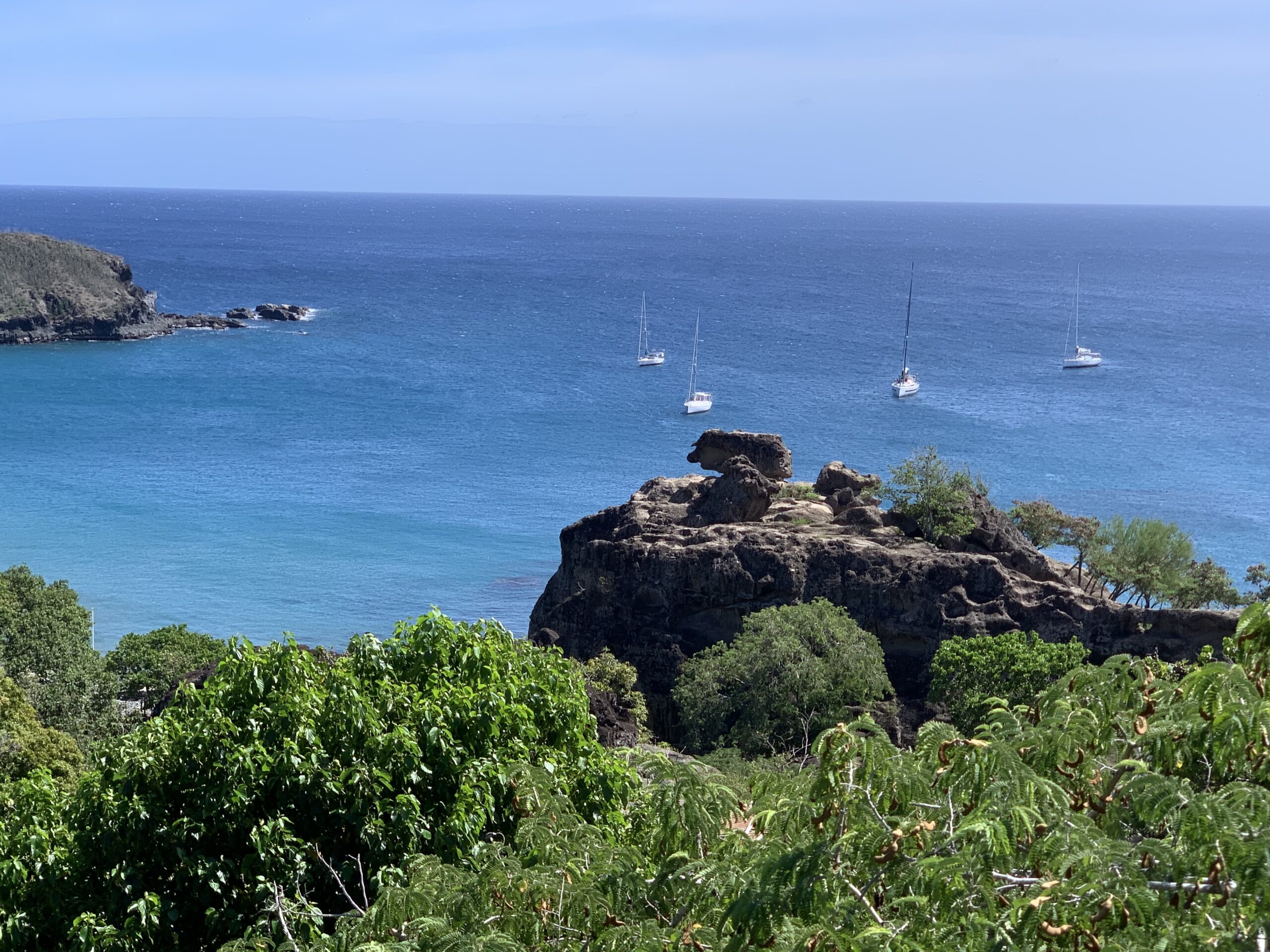
Looking Down at the Anchorage in Front of the TownWe walked up a hill and could see this other anchorage on the other side
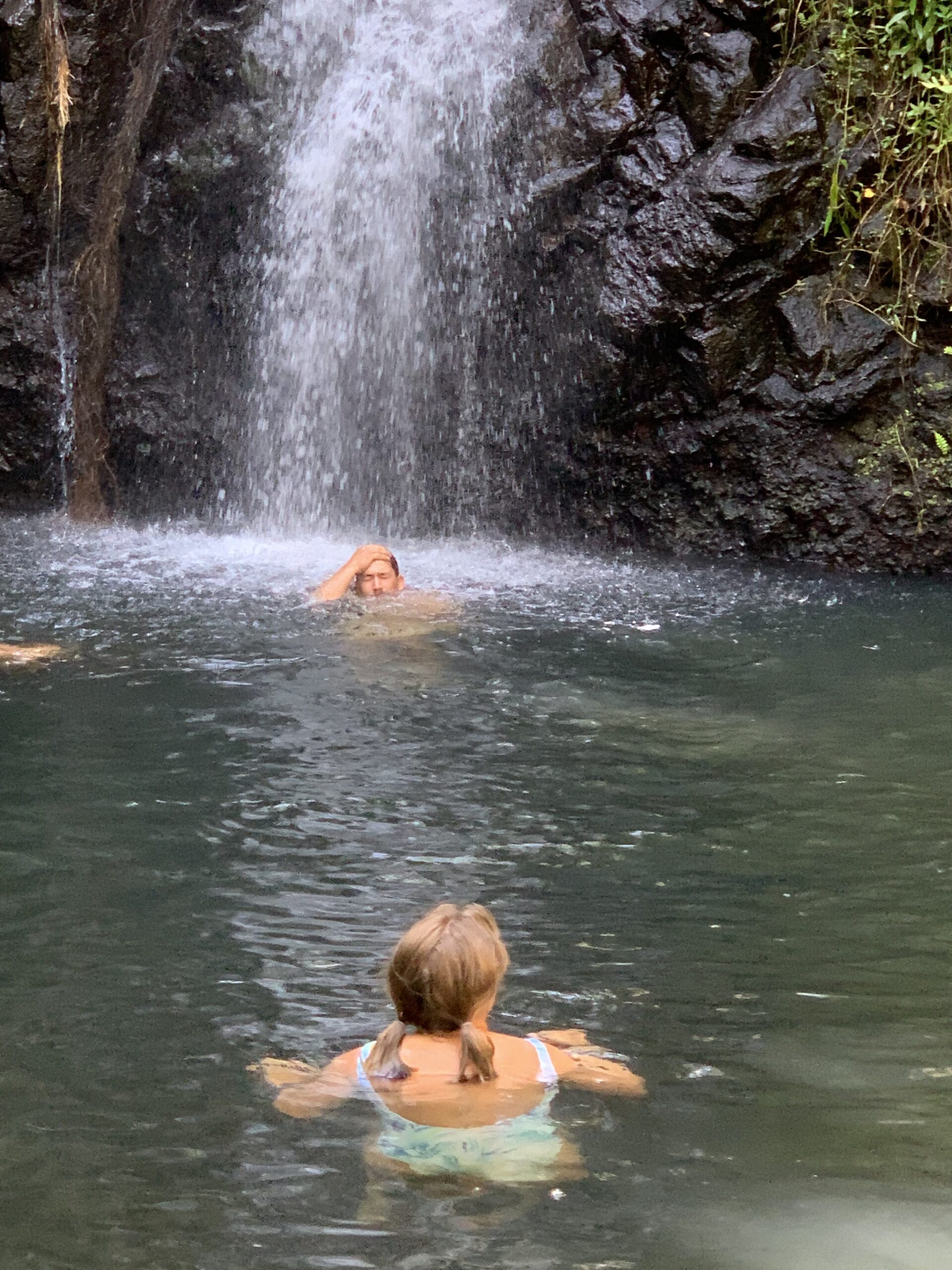
We explored a few more anchorages on the west side of Ua Pou. Baie Hakahetau was in front of a village. We joined Sarah and Bob on Rhapsody for a walk up to Manfred’s house to taste and buy his delicious chocolate bars. Then we walked to a waterfall and swam in the pool beneath it.
Waterfall at the end of a hike
Looking out at the anchorage after out hike
Baie Vaiehu was an uninhabited bay with good snorkeling. The last one, Baie Hakamaii, was in front of a picturesque village with no easy way to go ashore. We hung out on the boat until evening and then pulled up anchor to sail to Hiva Oa.
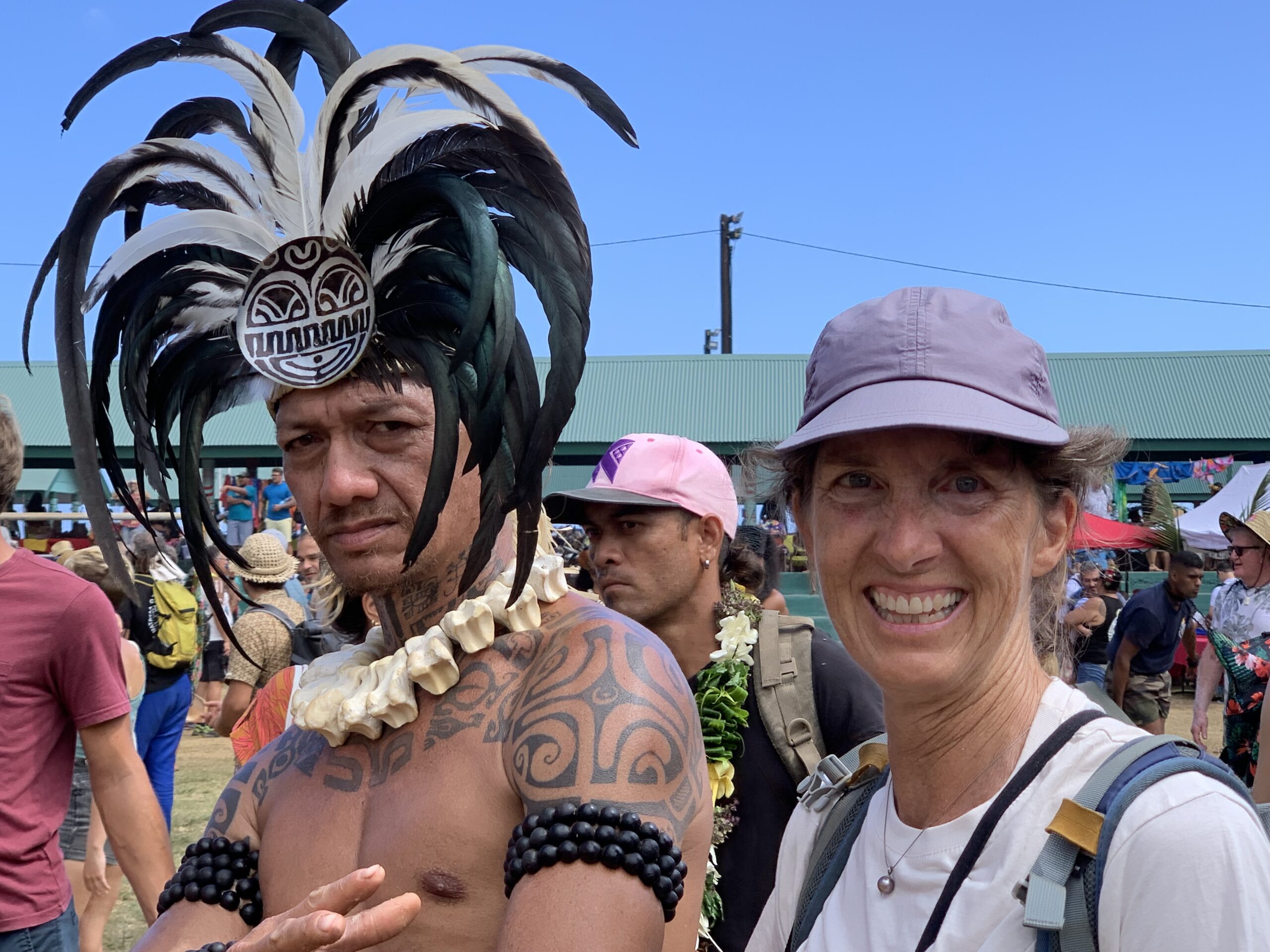
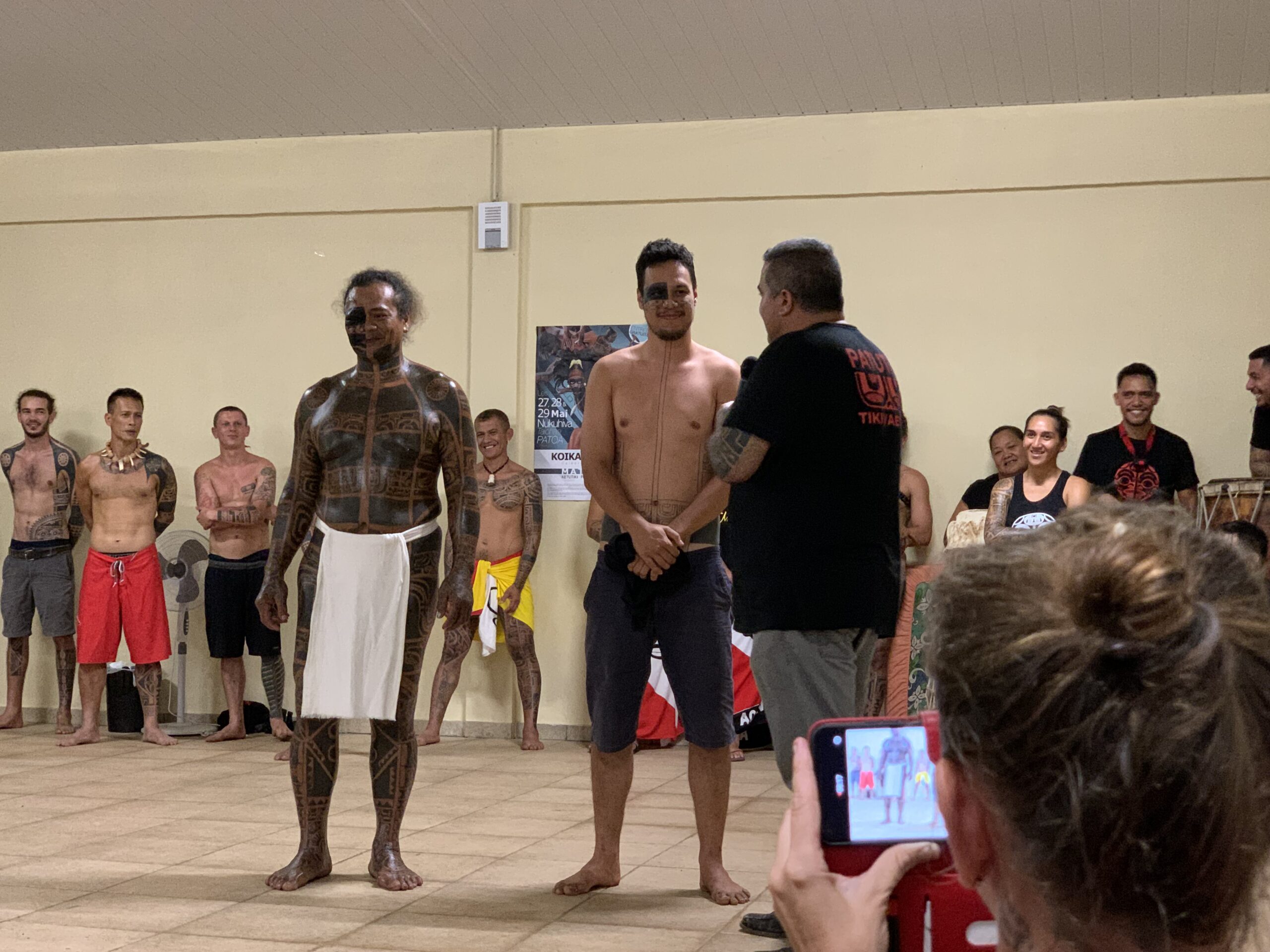
The tattoo festival ended with judging, awards, presentation of the winning tattoos and dancing by some of the notable tattooed people.
Judging and Presentation of Tattooee and Tattooer
After that, Marshall and I busied ourselves with chores (such as changing the oil, getting cooking gas) and then took some time to go over to Daniel’s Bay (Taioa). There, we hiked up to the waterfall and had lunch at Kua and Teiki’s along with other cruisers, including Sarah and Bob from Rhapsody. (Kua and Teiki serve meals at their house in the village. They grow or catch most of what they use. They are both outgoing and Teiki especially has a big personality. He’s very animated and can pose as a fierce warrior. We also got fruit from them.)
On Sunday afternoon, June 5, we went back over to Taiohae Bay. The next morning, we picked up a nice 4×4 rental car from Regina (our guide Mate’s mother) and took a slow, scenic trip to the airport to pick up Dana and Johno.
Touring around the island going toward the airport
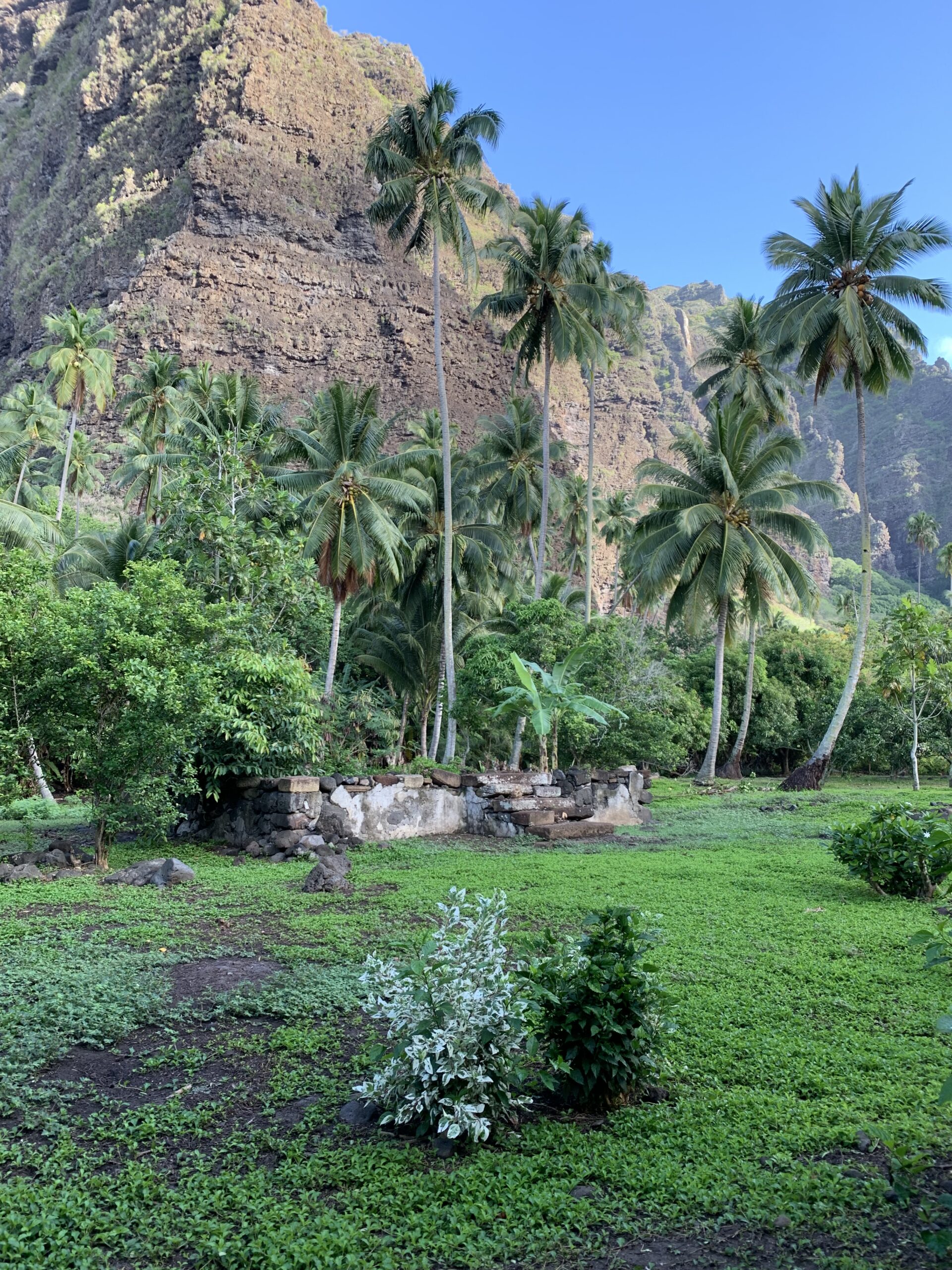
Their plane was early and their flights had been easy. We then drove back to Taiohae where we could get them a bite to eat and let them swim. The next day, we took the rental car on somewhat the same tour that we took with Mate, Taipivai and then over to Hatiheu. At the ruins near Hatiheu, there was a brief dance performance for the benefit of the Aranui passengers, who had come in that morning. Then we went to the Chez Yvonne restaurant and ate the same traditional Marquesan meal that was served to the Aranui passengers. During lunch, several local musicians played and sang.
Brief Performance at the Ruins for the Aranui Passengers
After lunch we drove back to Taiohae and stopped at a couple of grocery stores to provision. It was perfect timing because the shelves had just been restocked with supplies from the Aranui.
Once provisioned, we left the next morning to go back to Daniel’s Bay. We were the only boat in the anchorage that day and all night. Marshall and Johno fixed the propane tank fitting with parts that Dana and Johno had brought with them. They also put in the new transducer for speed/depth/temp so we now have accurate depth.
Dana and Johno in Daniels Bau
The next day, Thursday, Marshall, Dana and Johno hiked to the waterfall while I did some chores on the boat. I met them in the village for lunch at Kua and Teiki’s.
Hiking in Daniel’s Bay
On Friday, Dana and I finished cleaning the boat bottom while Johno and Marshall fixed the disconnected wire that was preventing the motor kill switch from working. They first replaced the relay before discovering that it wasn’t the problem. It was a head-scratcher so they tried a number of ideas before sorting out the problem, a wiring one.
We all then went snorkeling. I swam by Rala (UK) to chat with Ian and Laura. And I stopped by Tohora (New Zealand) to meet that family, which had recently arrived from Hiva Oa.
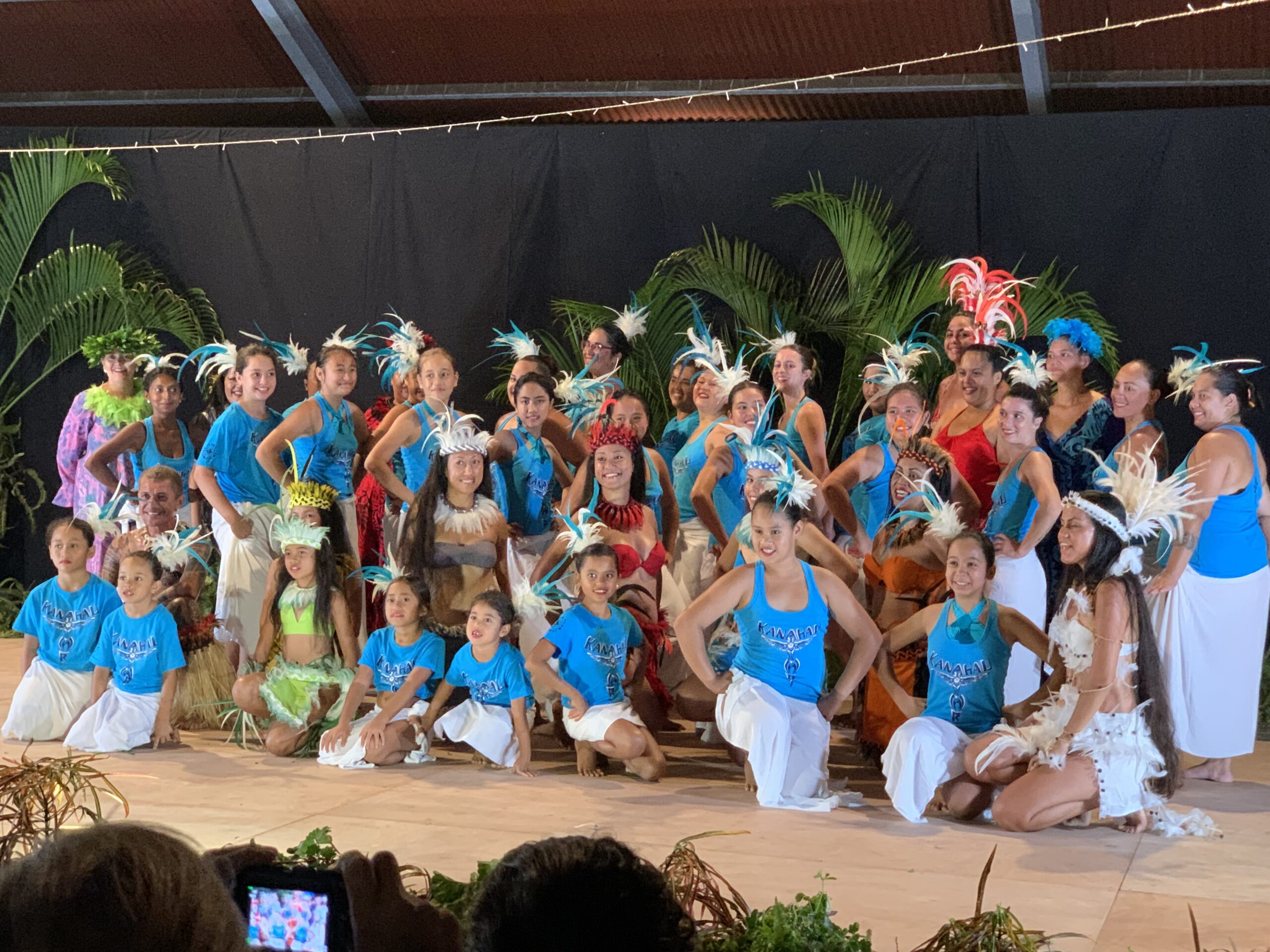
The next day, after a quiet morning in Daniel’s Bay, we packed up our gear and headed back over to Taiohae to attend the evening gala and dance performance. It was kind of like a school recital. Evidently, there is a local dance school for women and girls that has been in operation for a couple of years and they now have five teachers. The performances were mostly by the students and teachers, with some guest appearances from other local dancers. We saw little girls, pre-teens, teens, young women and older women. All the dancing was special. The appreciative audience filled the hall, with lots of locals and expats, and kids happily running all over the room.
One of the younger dancersGroup Shot of the Dancers