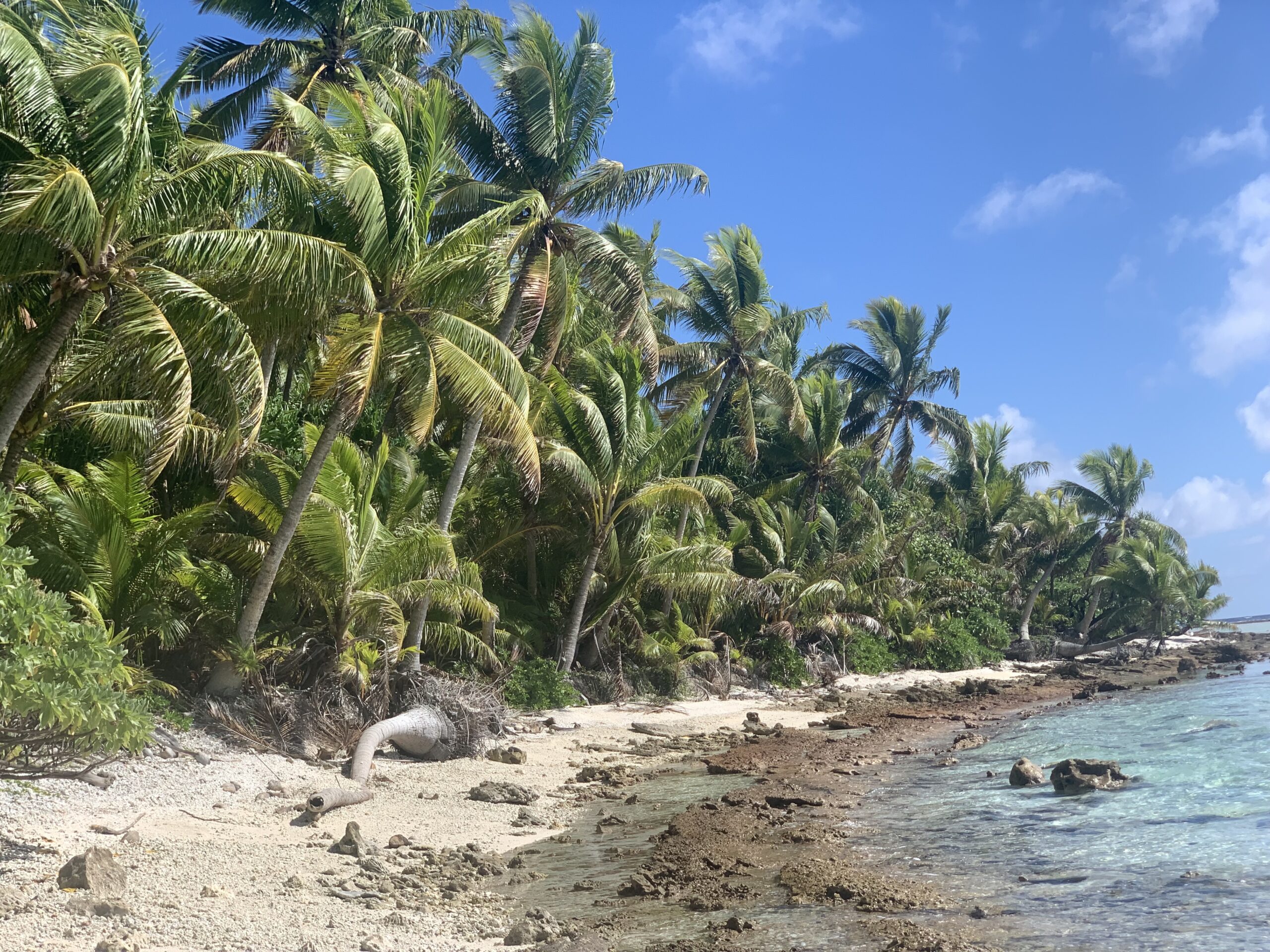
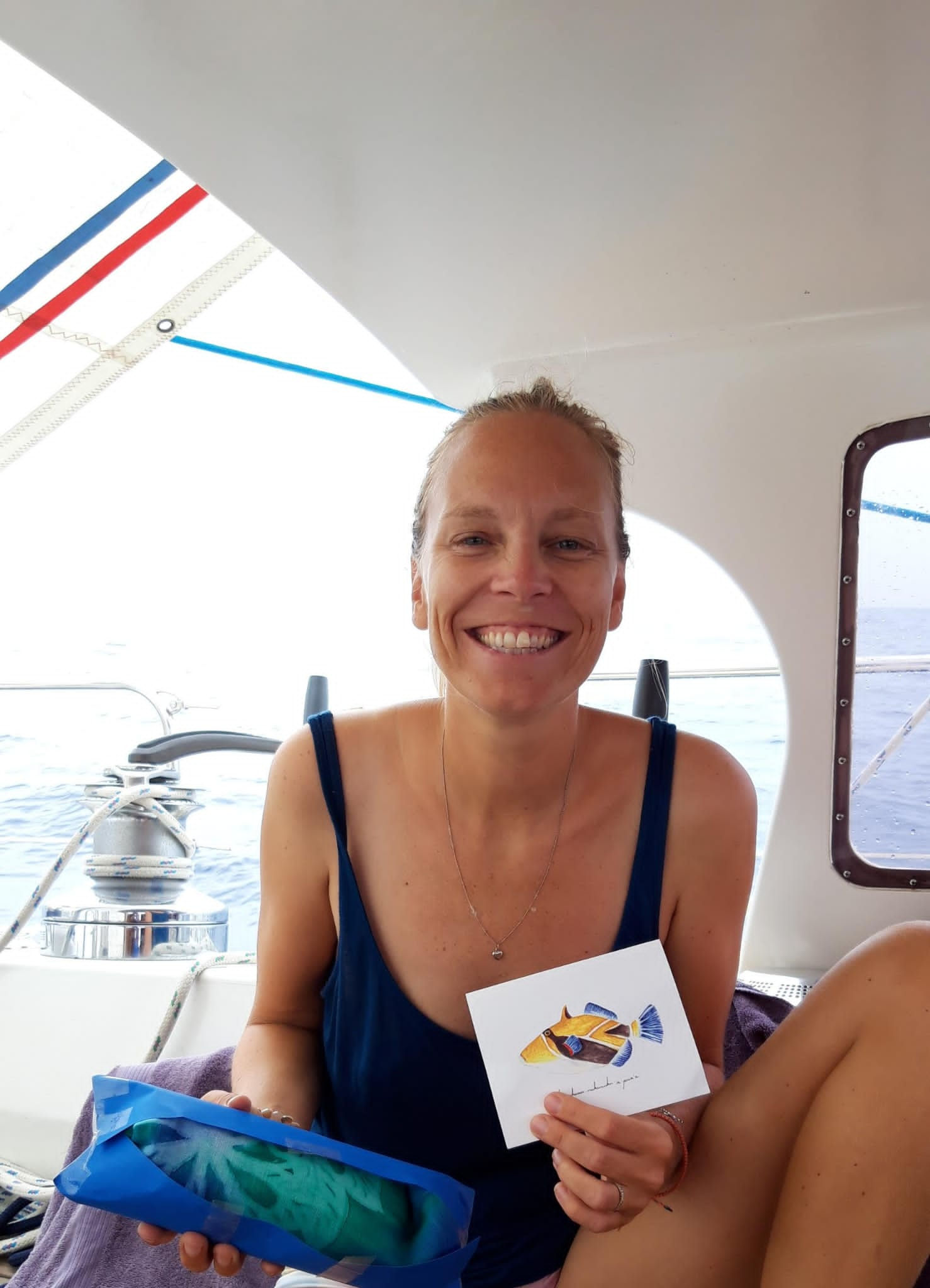
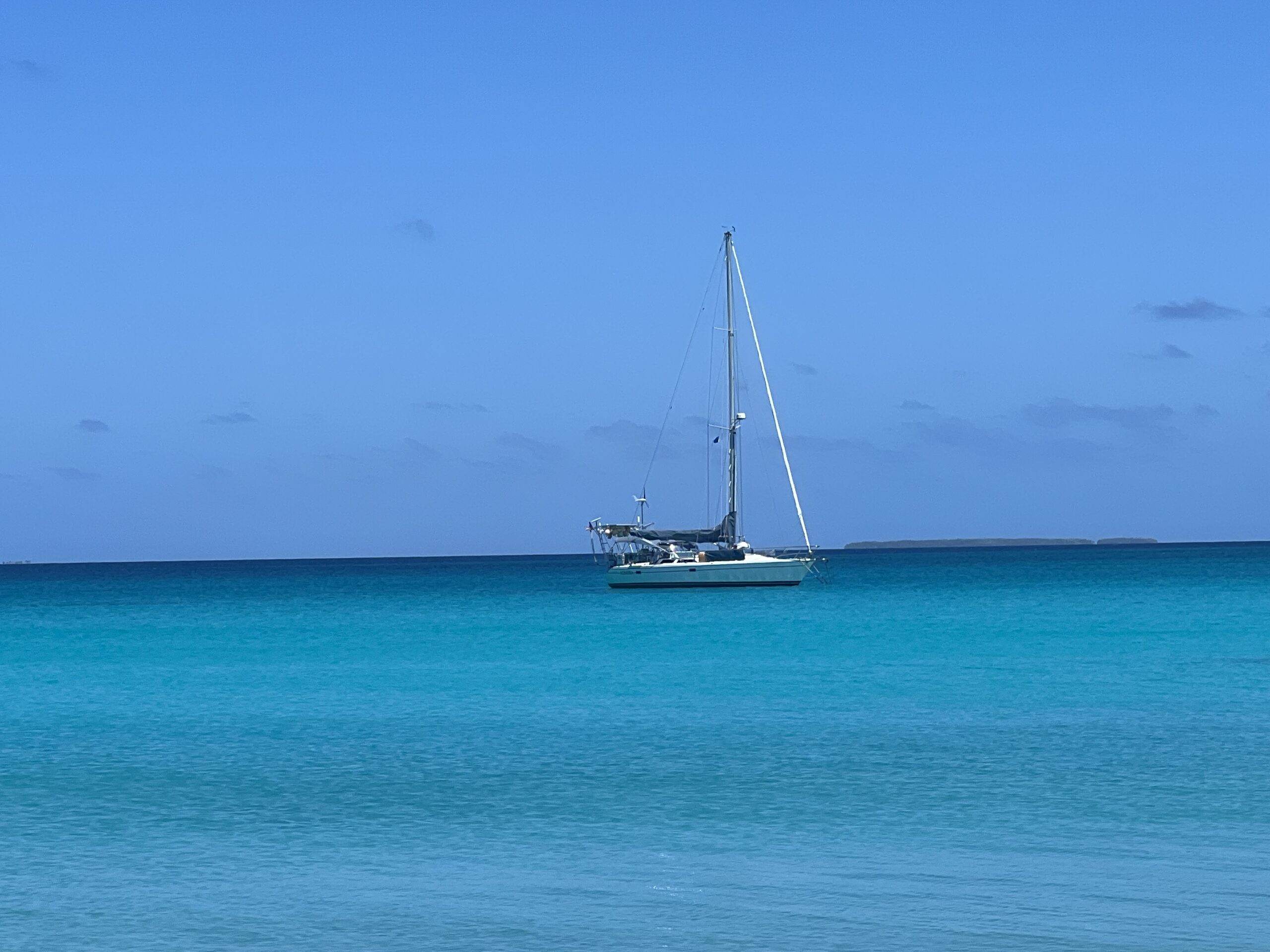
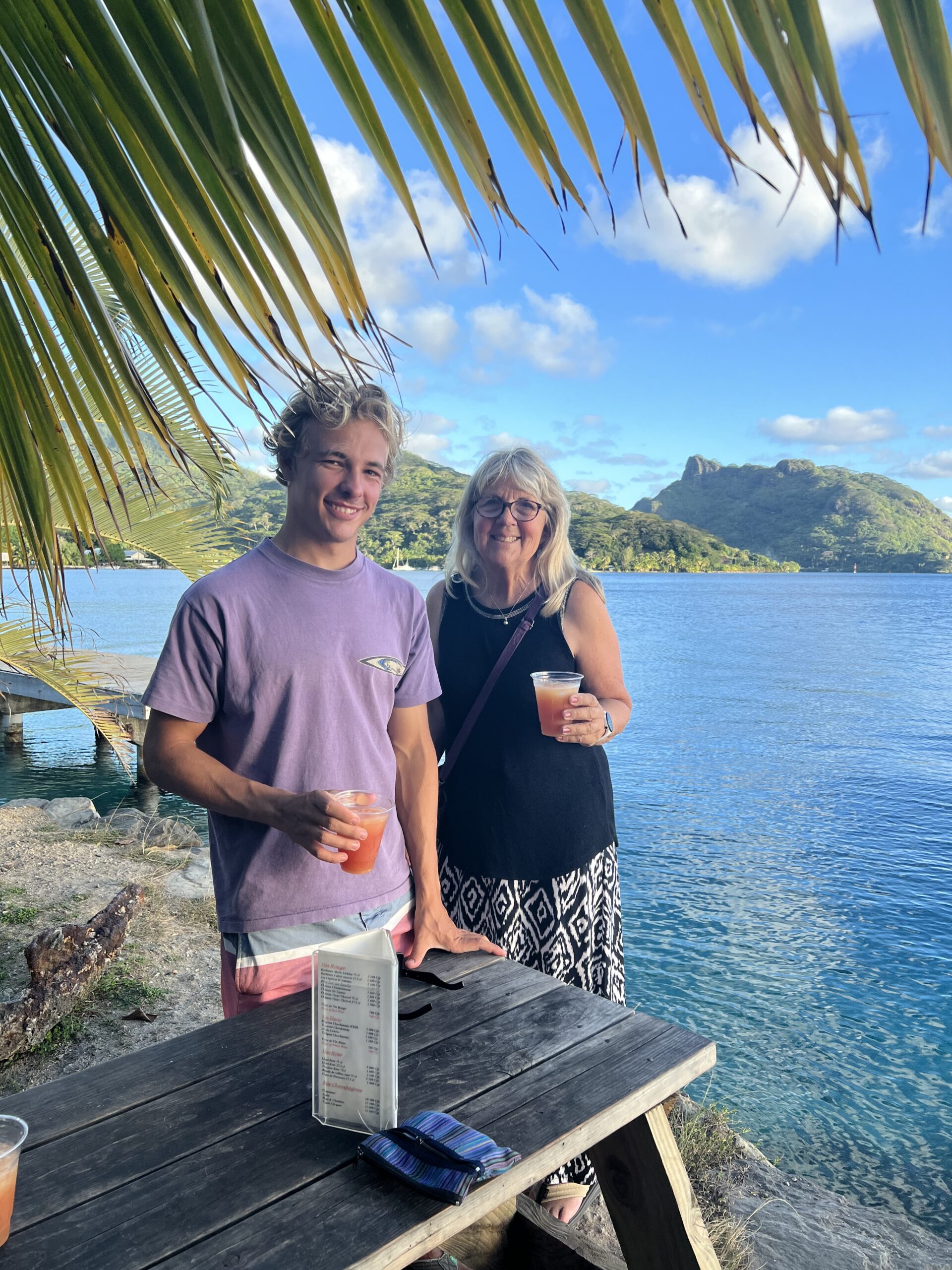
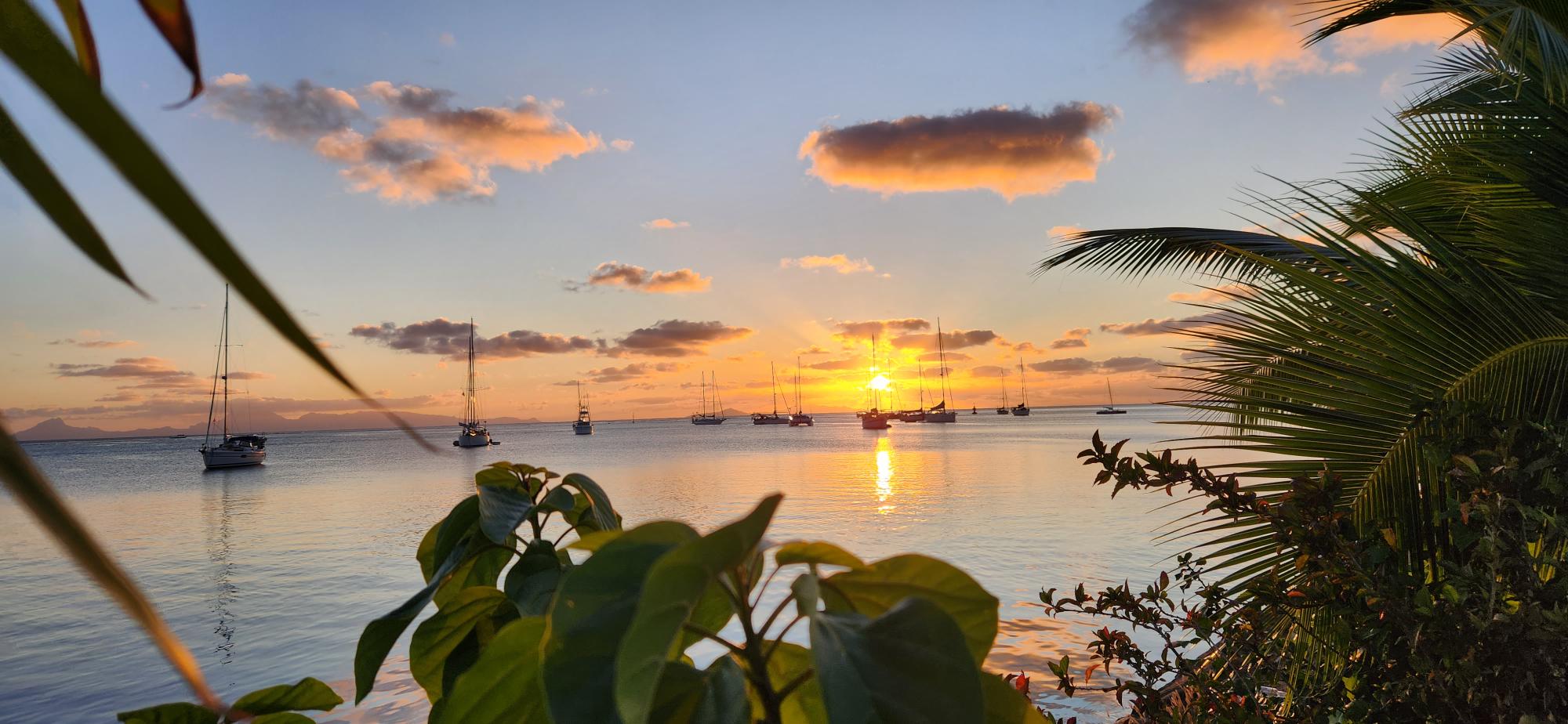
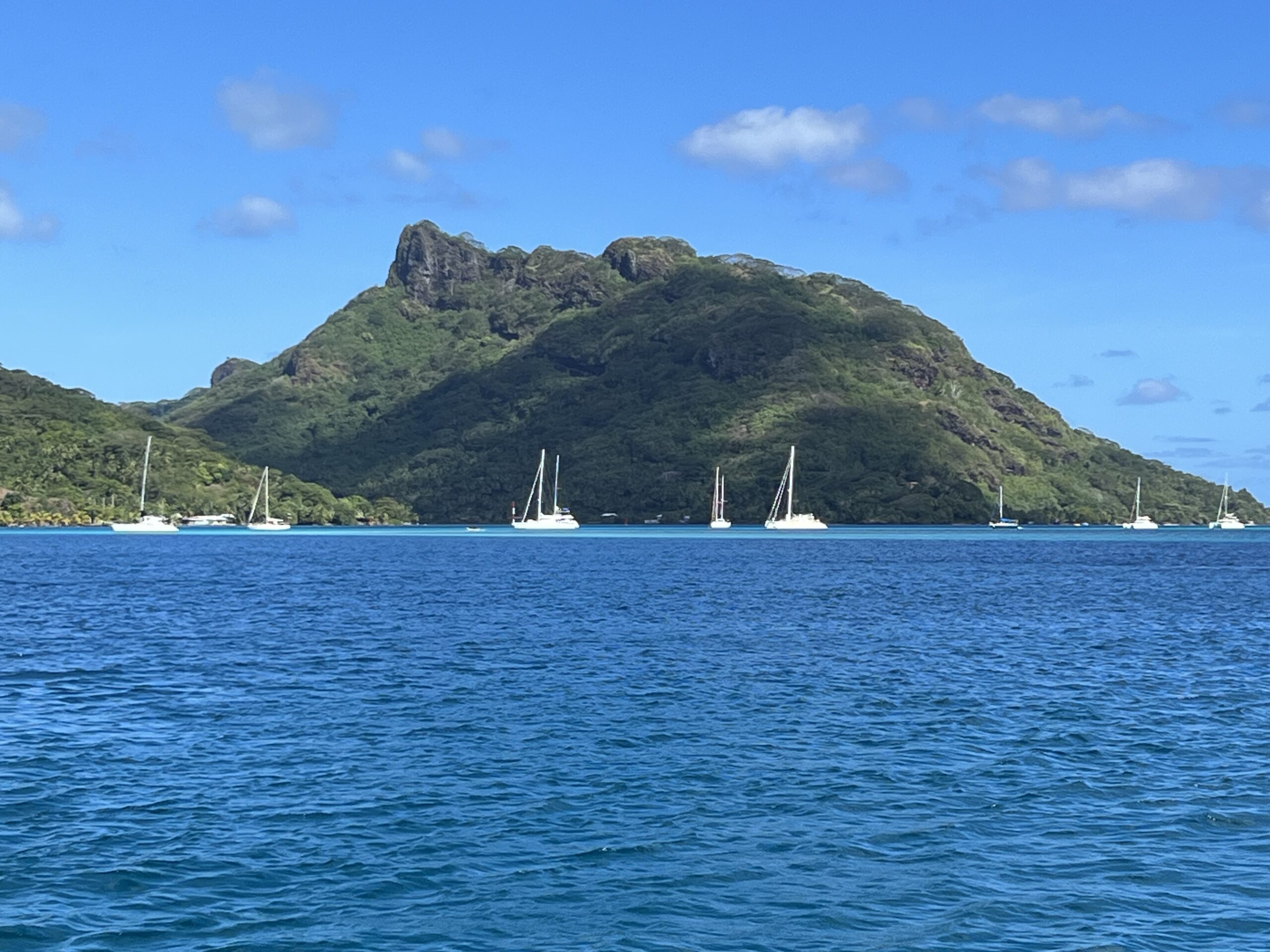
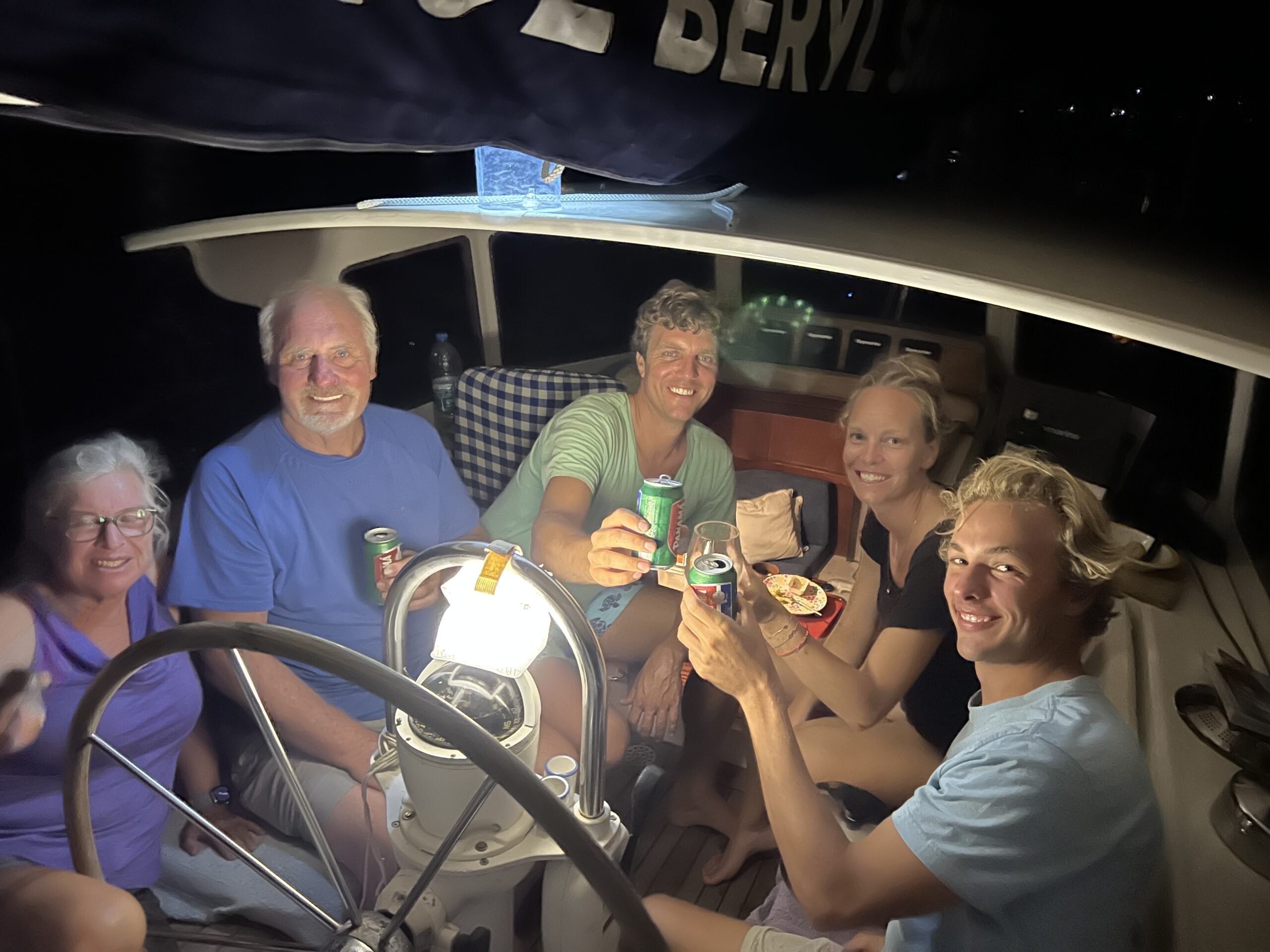
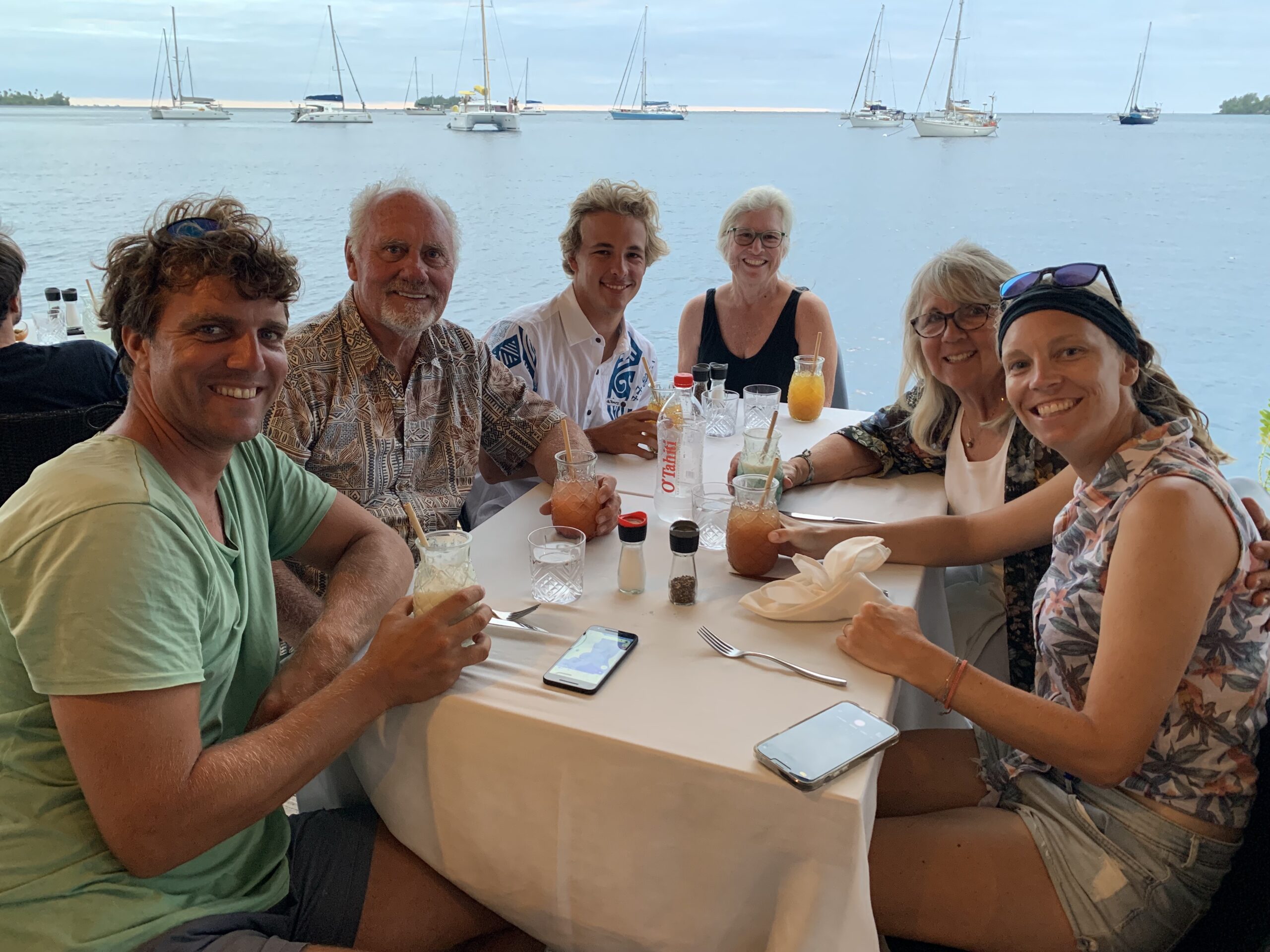
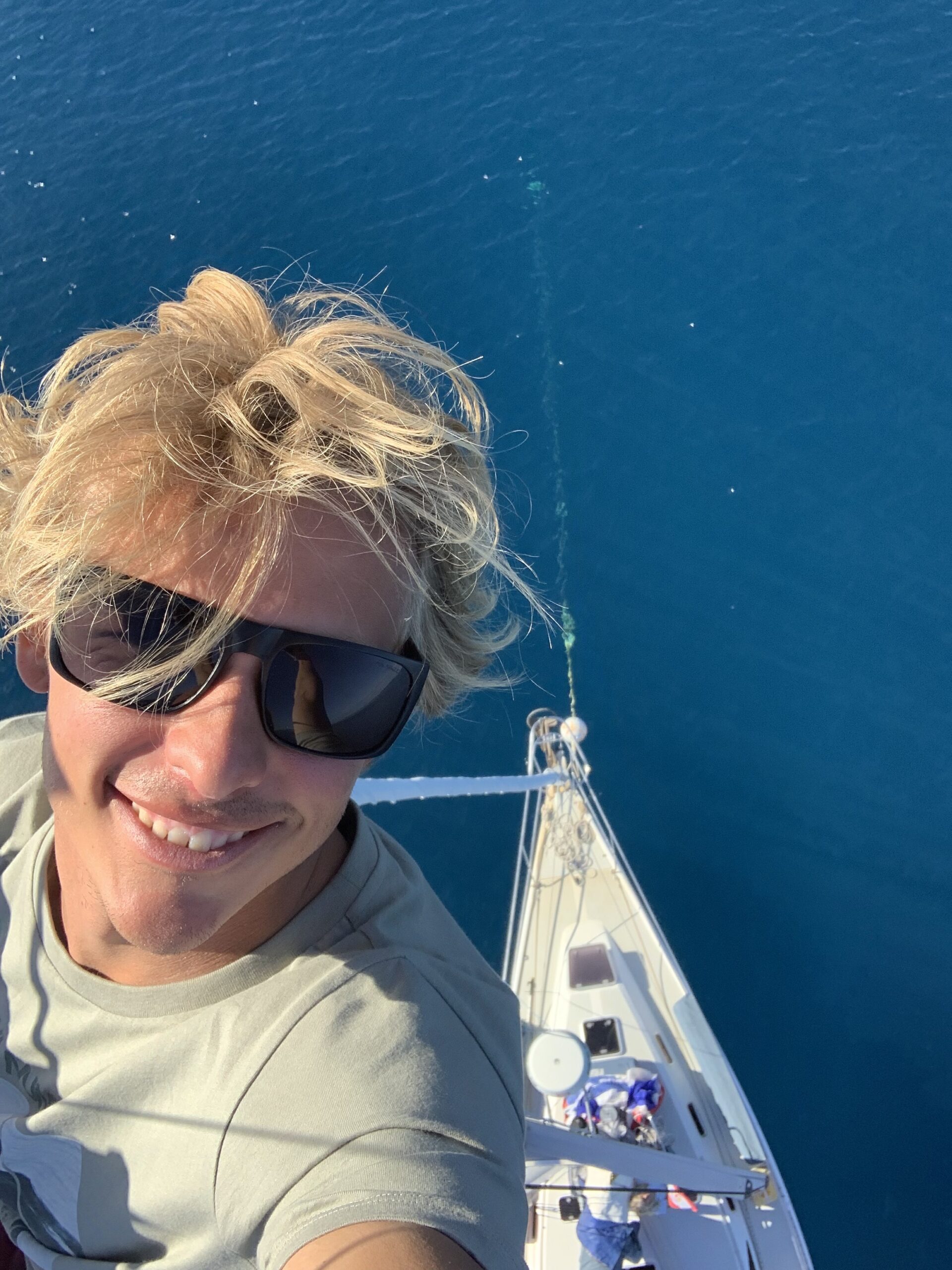
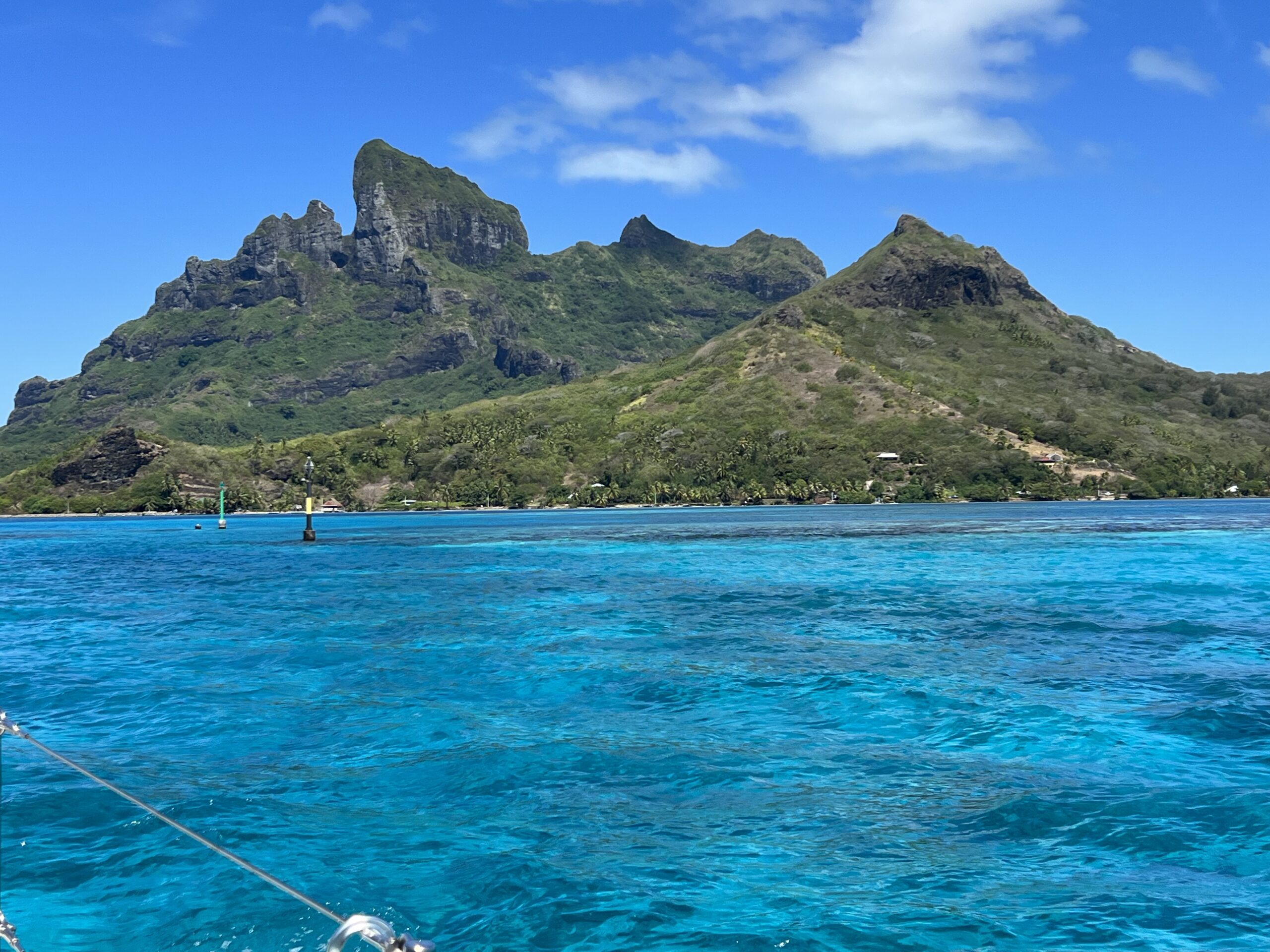
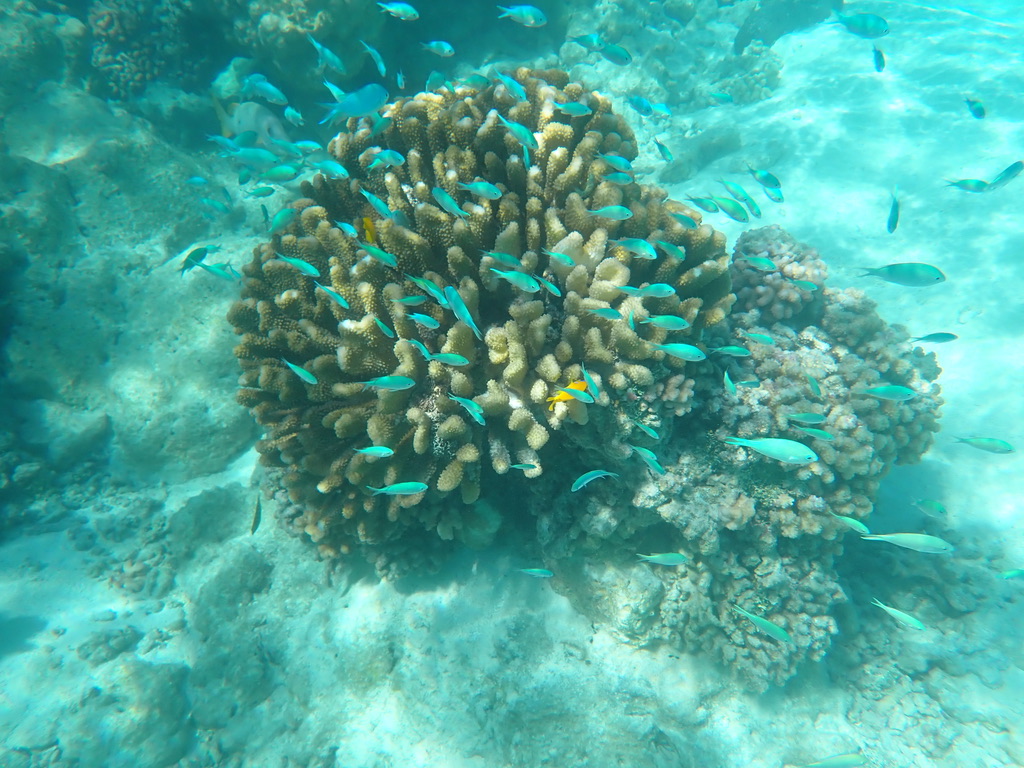
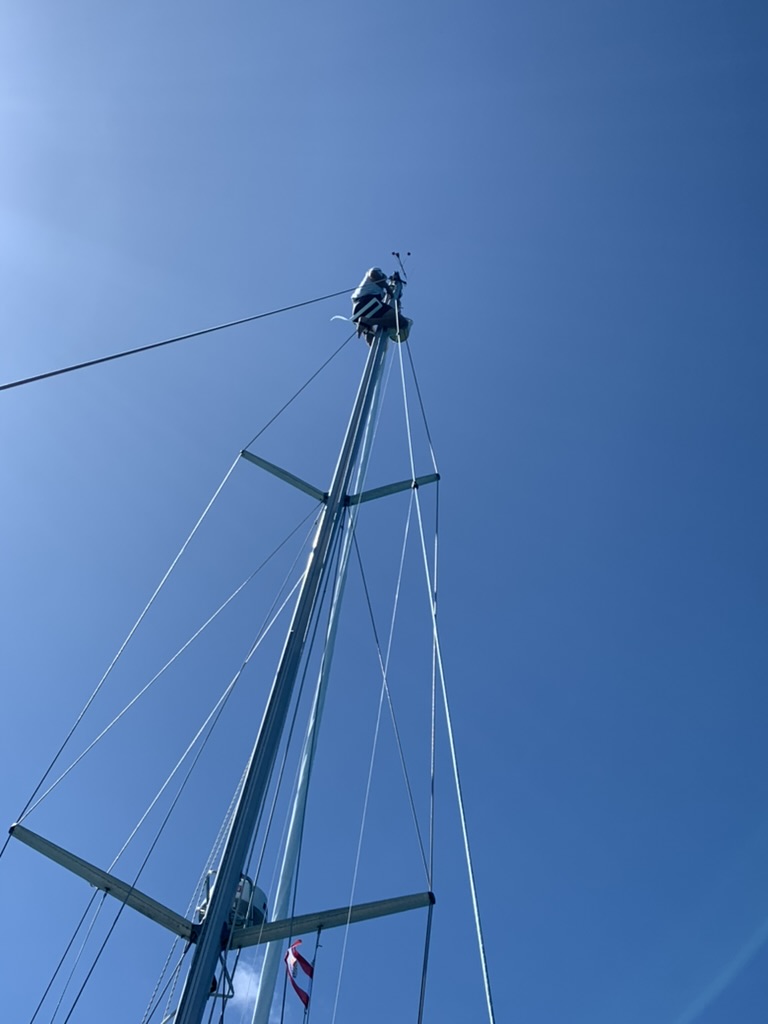
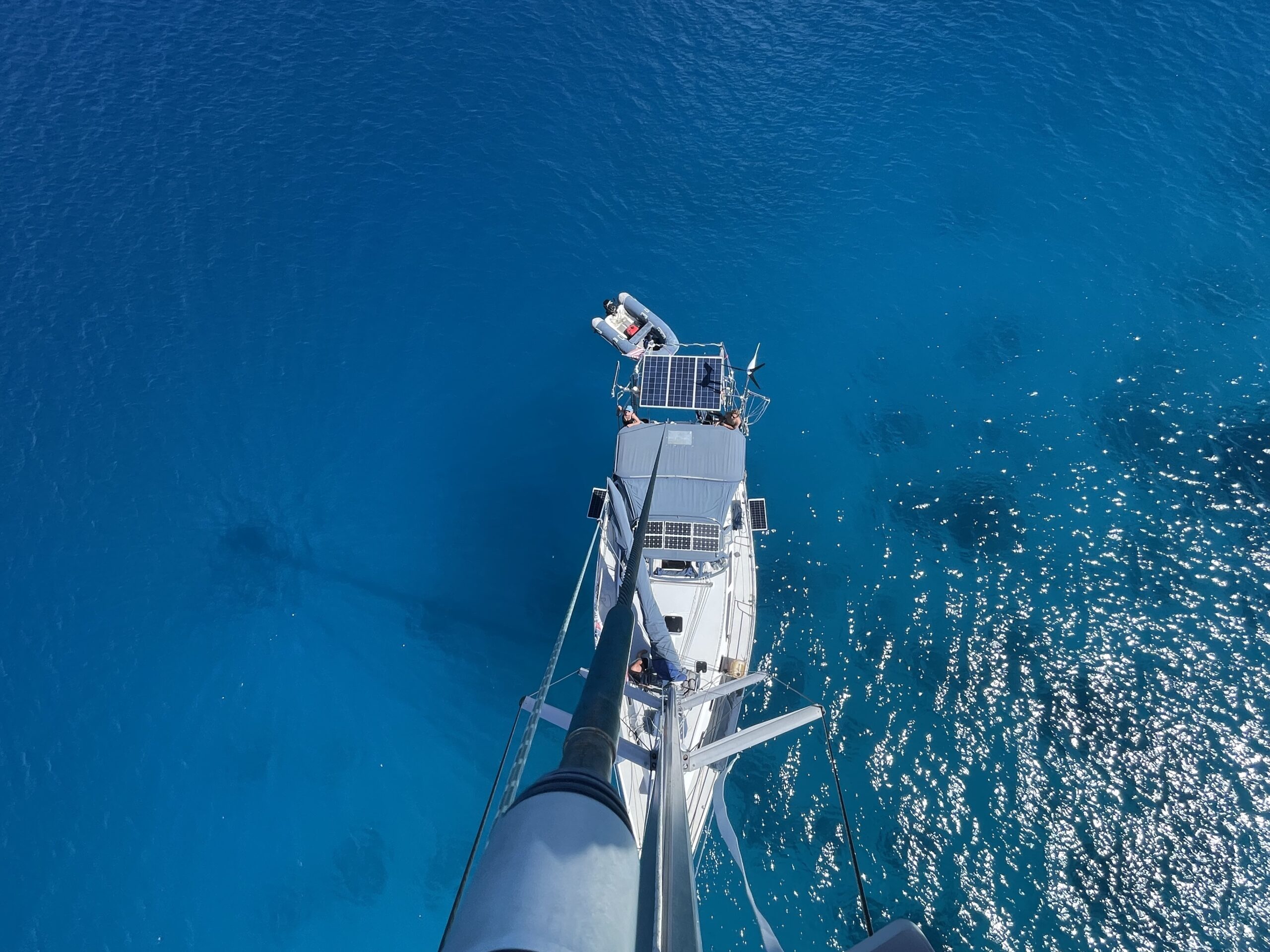
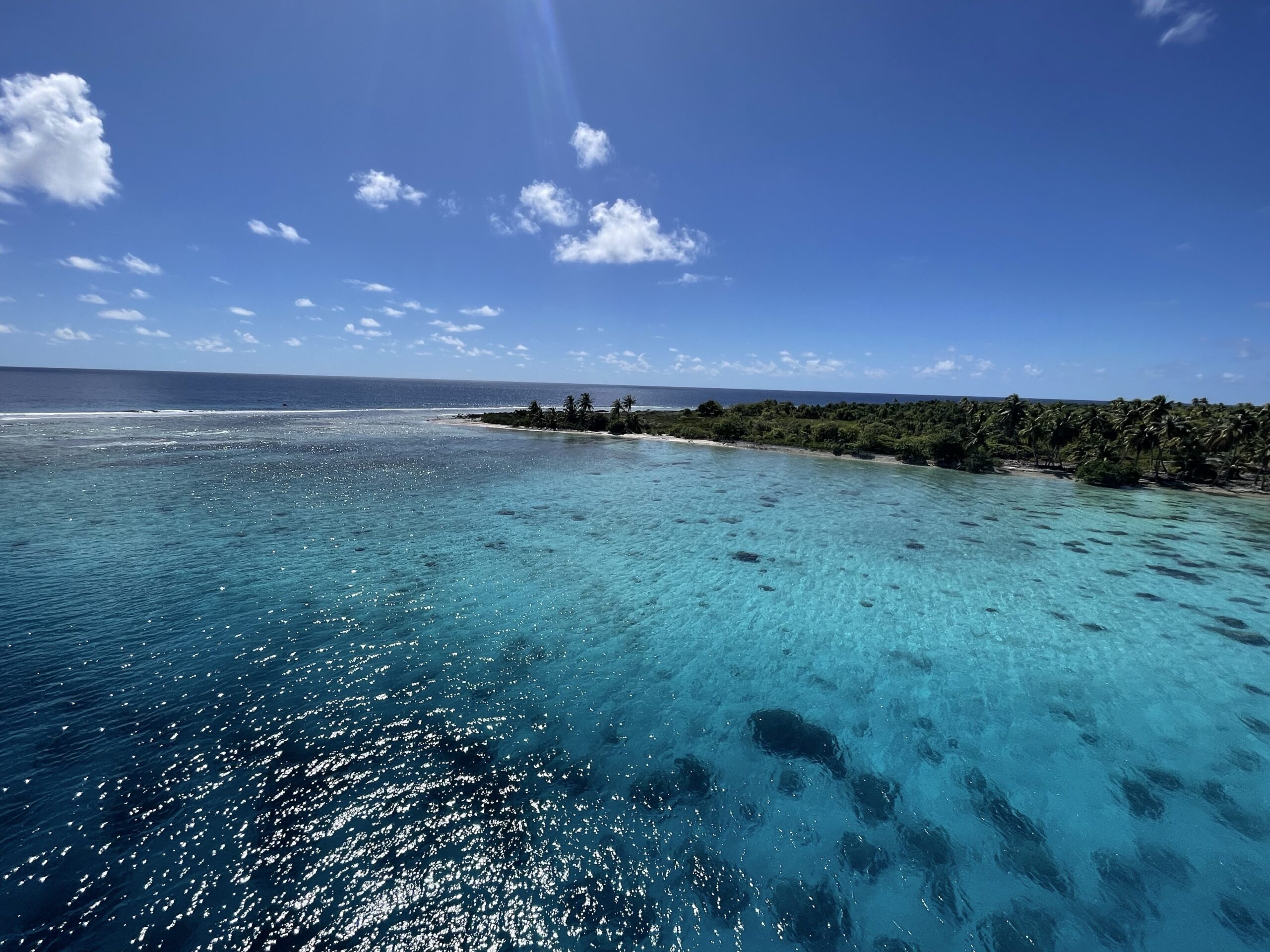
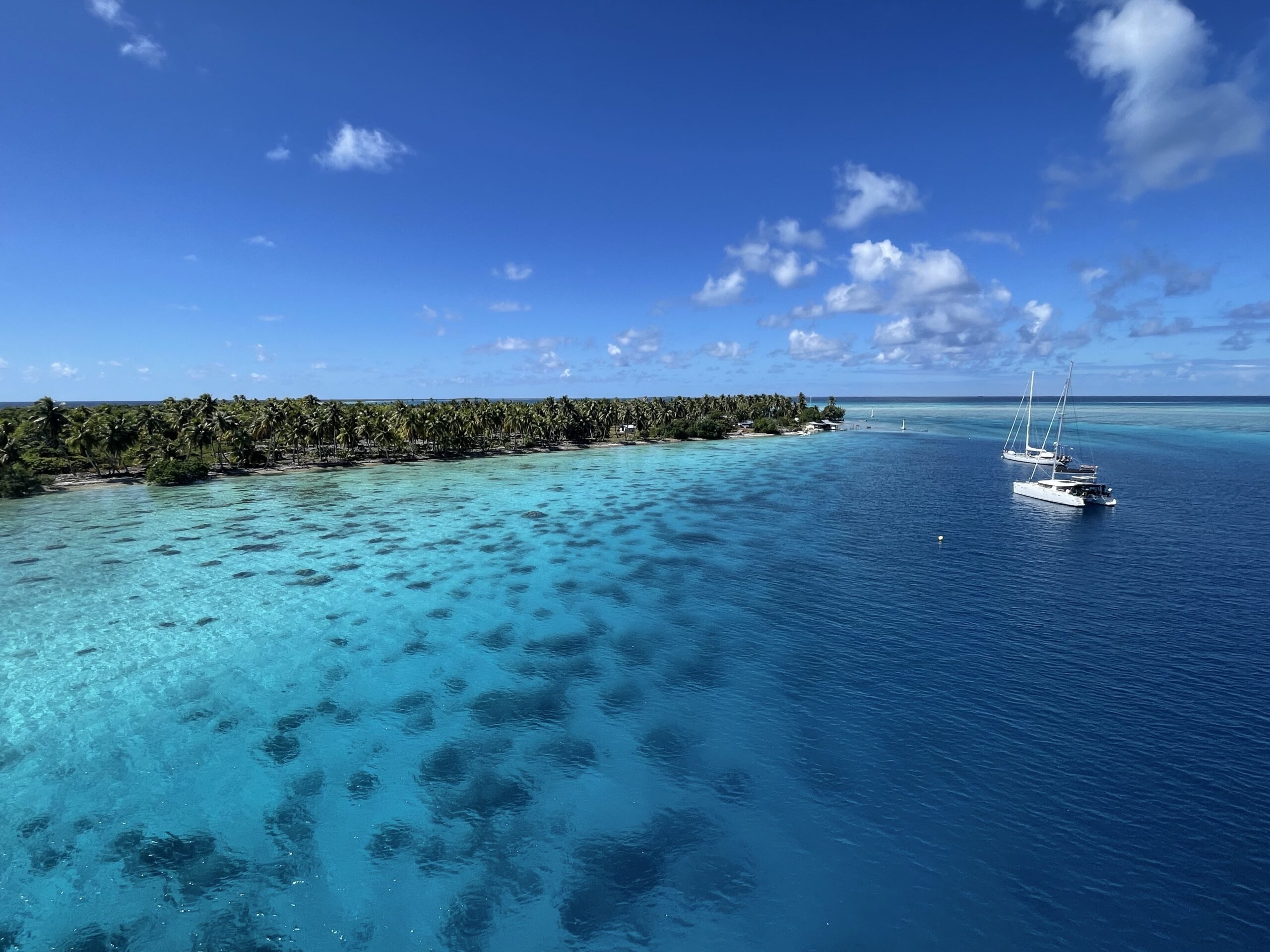
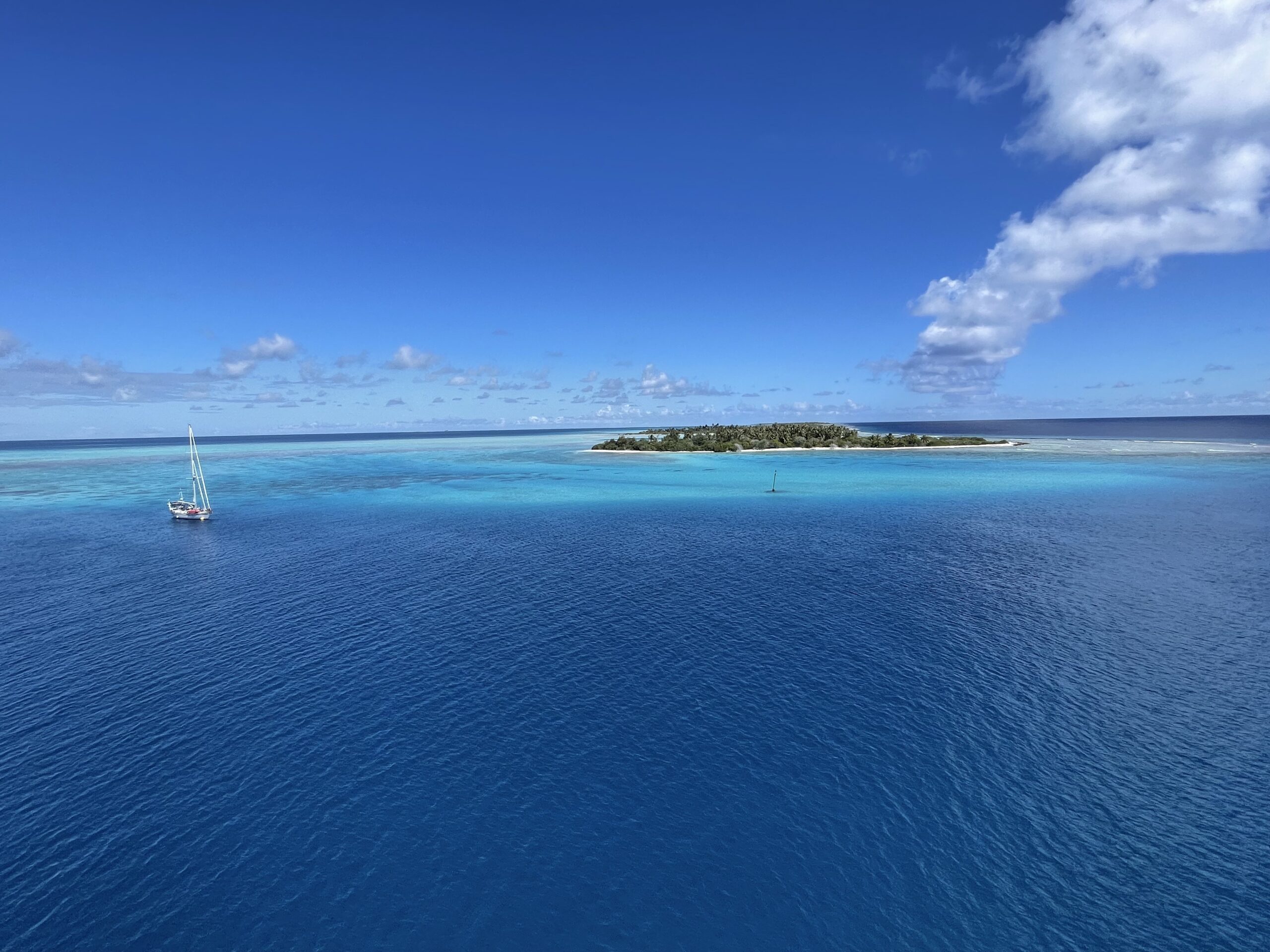
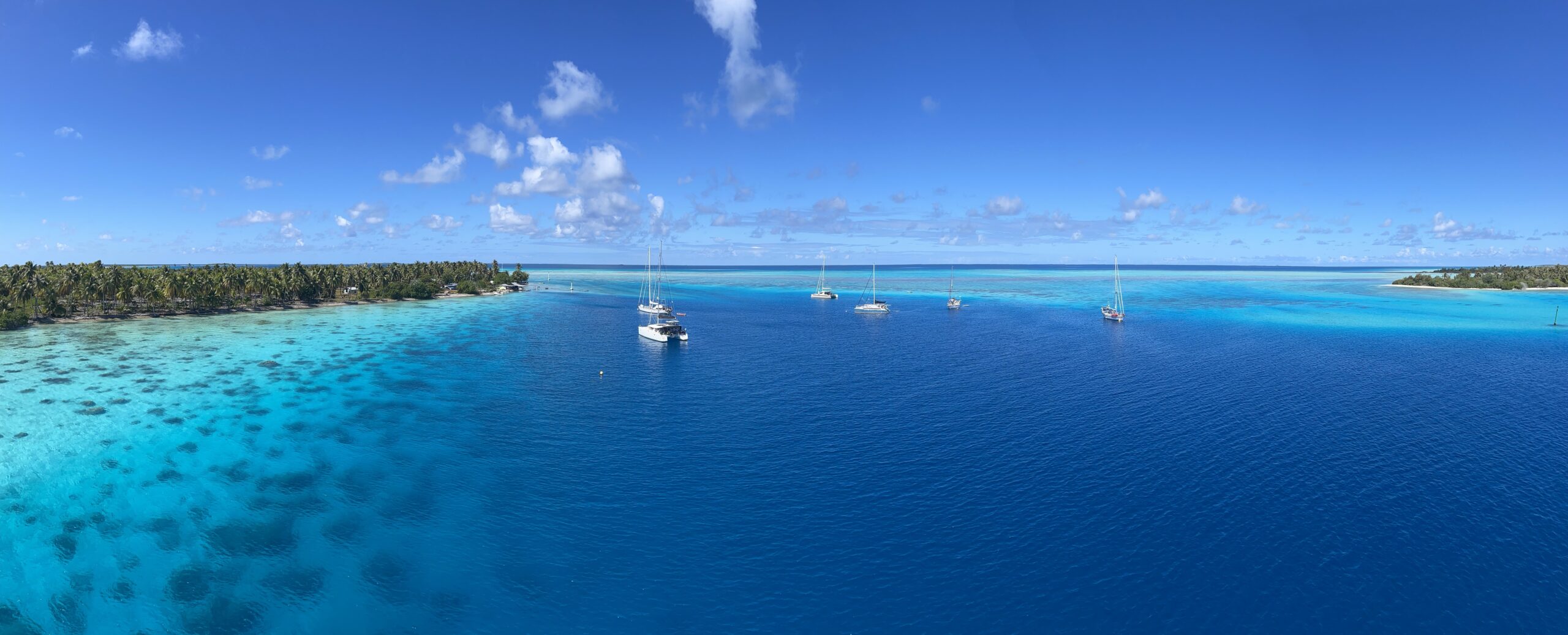
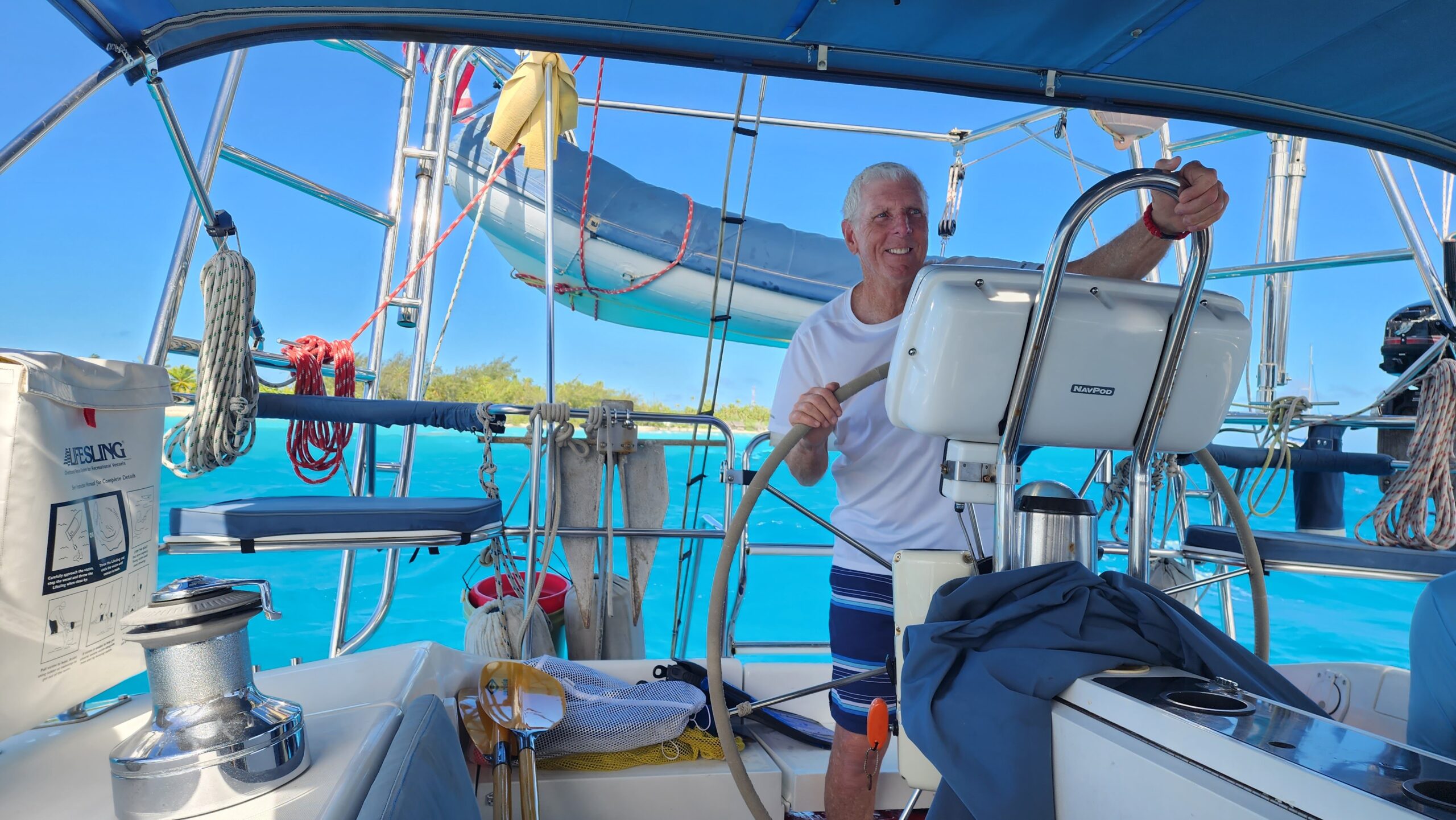
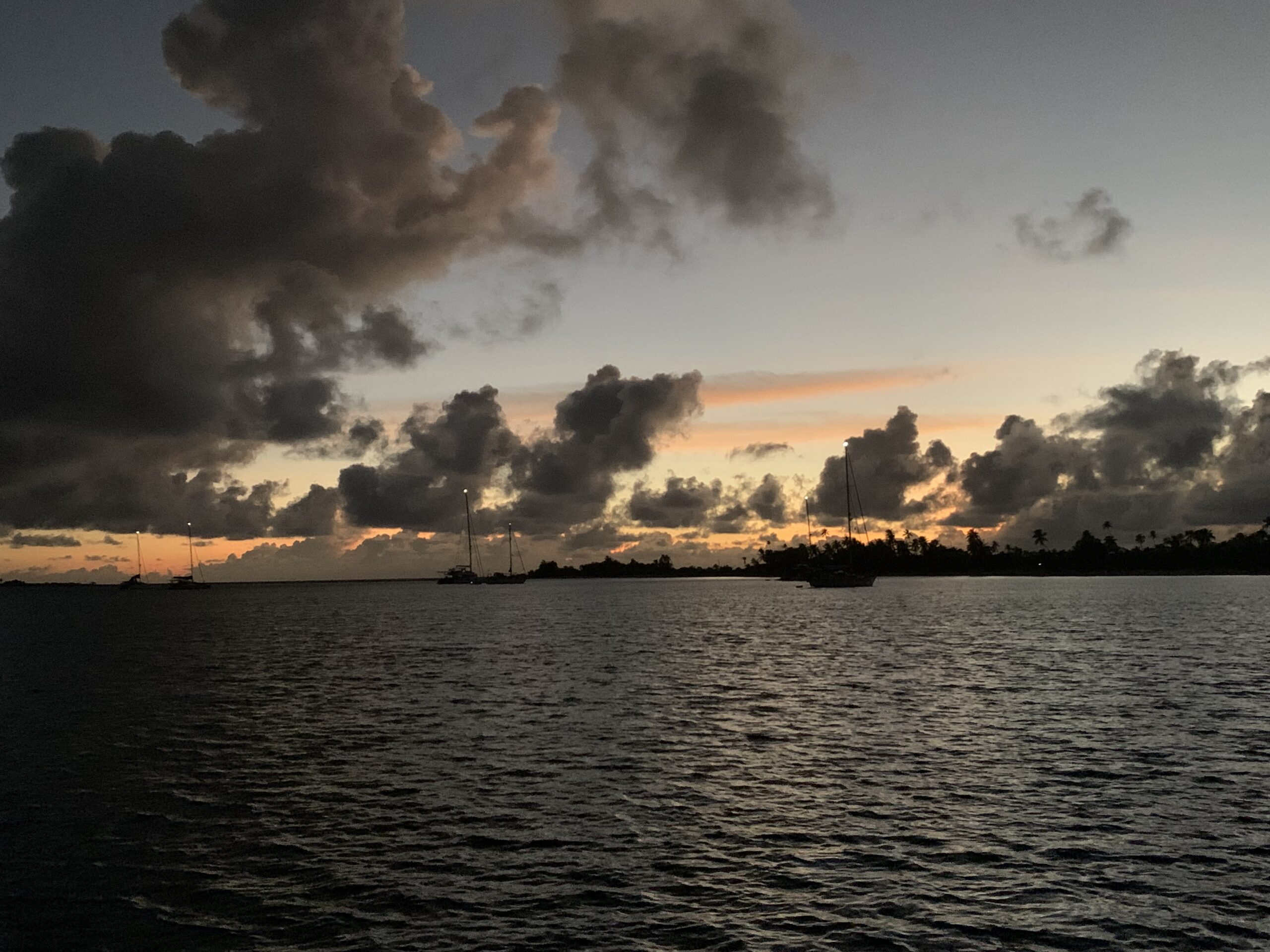
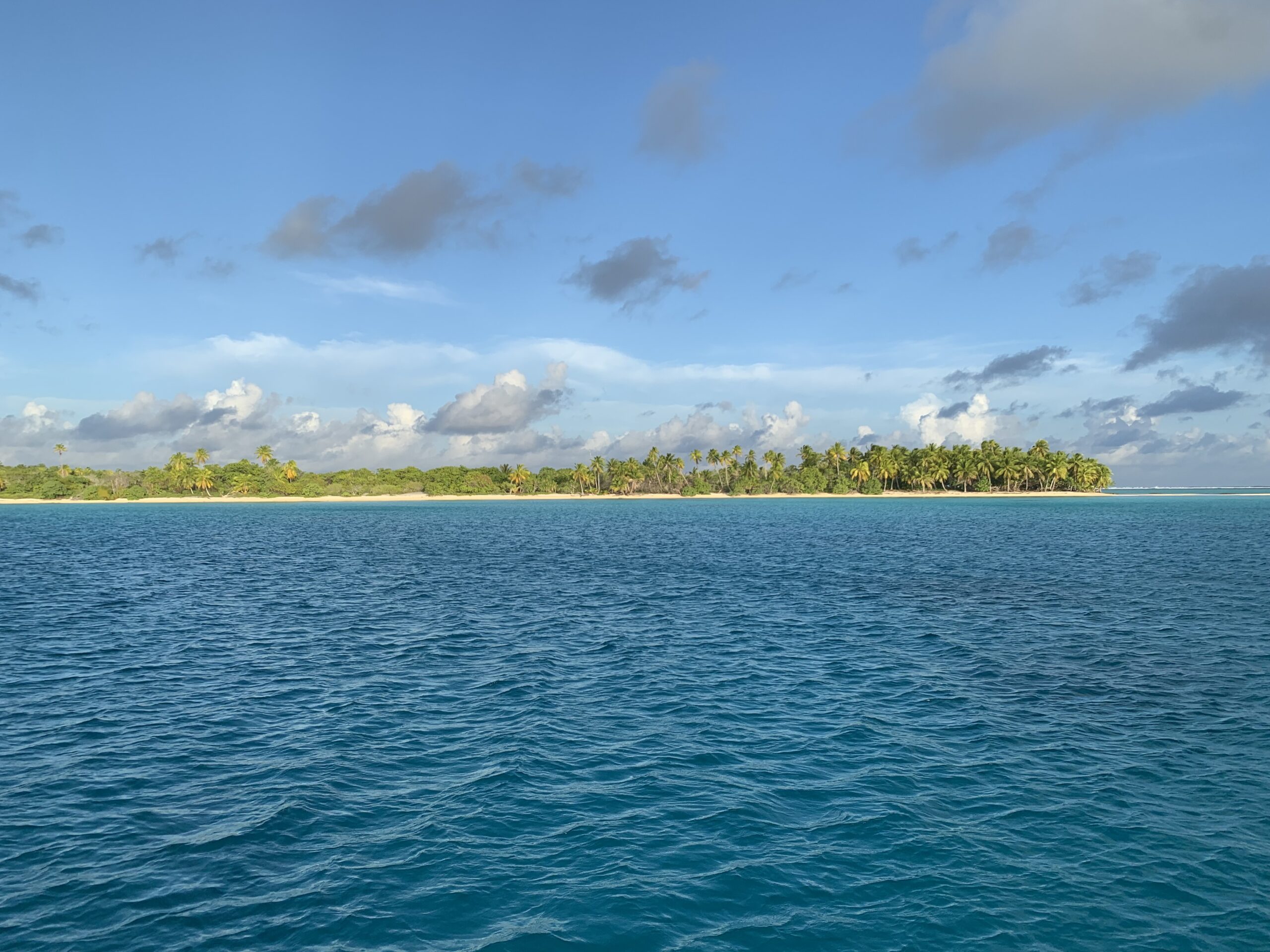
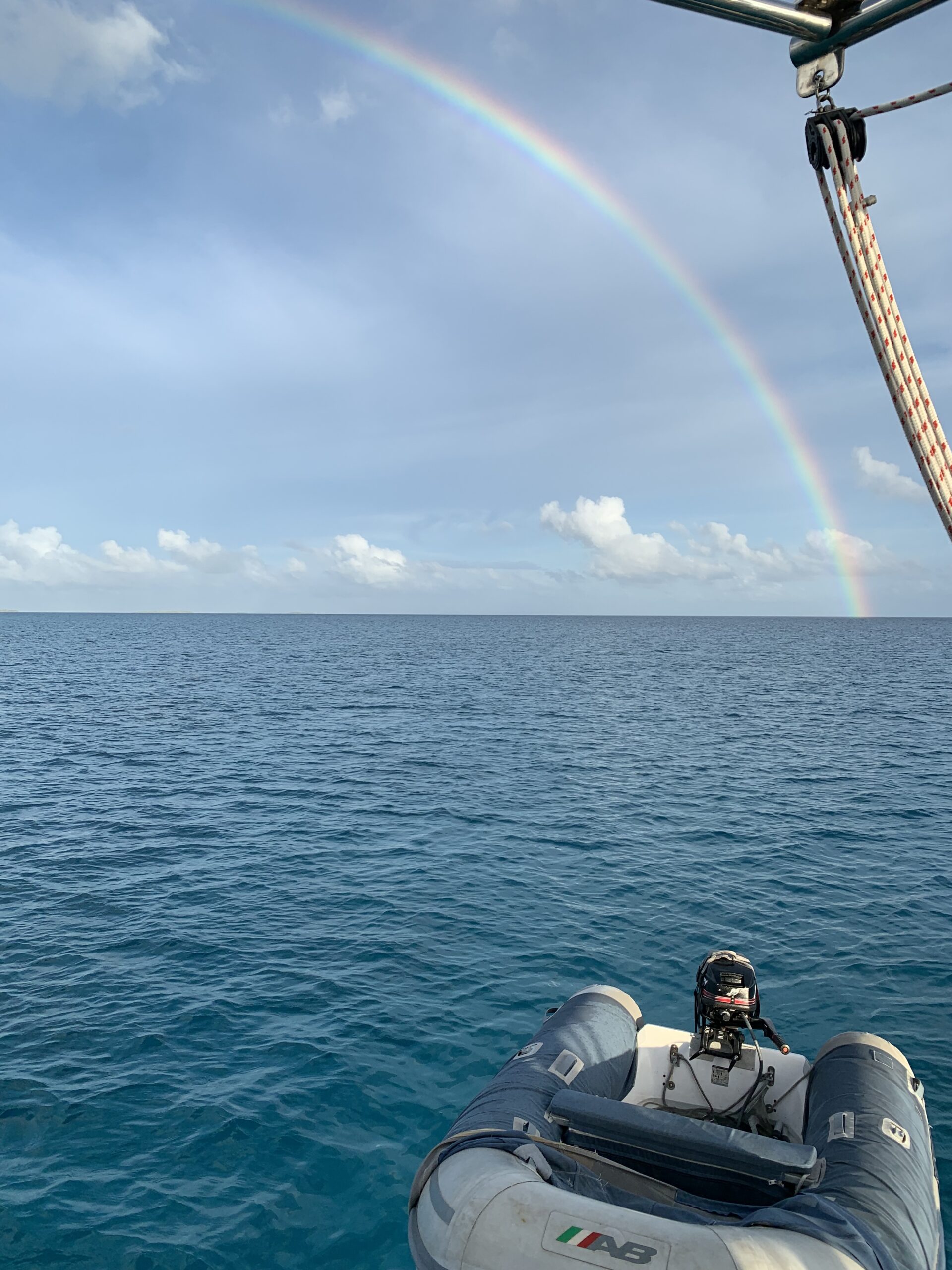
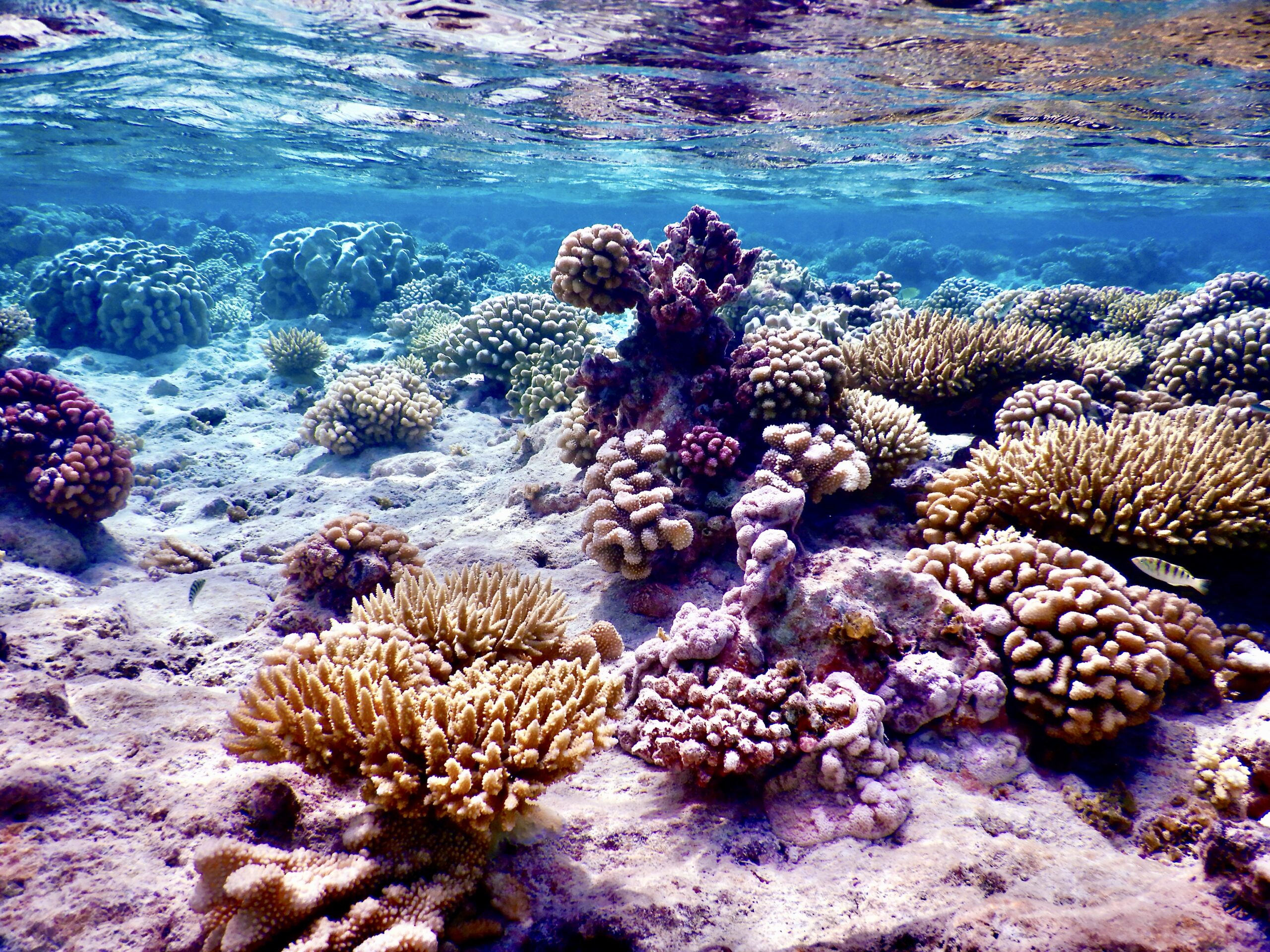
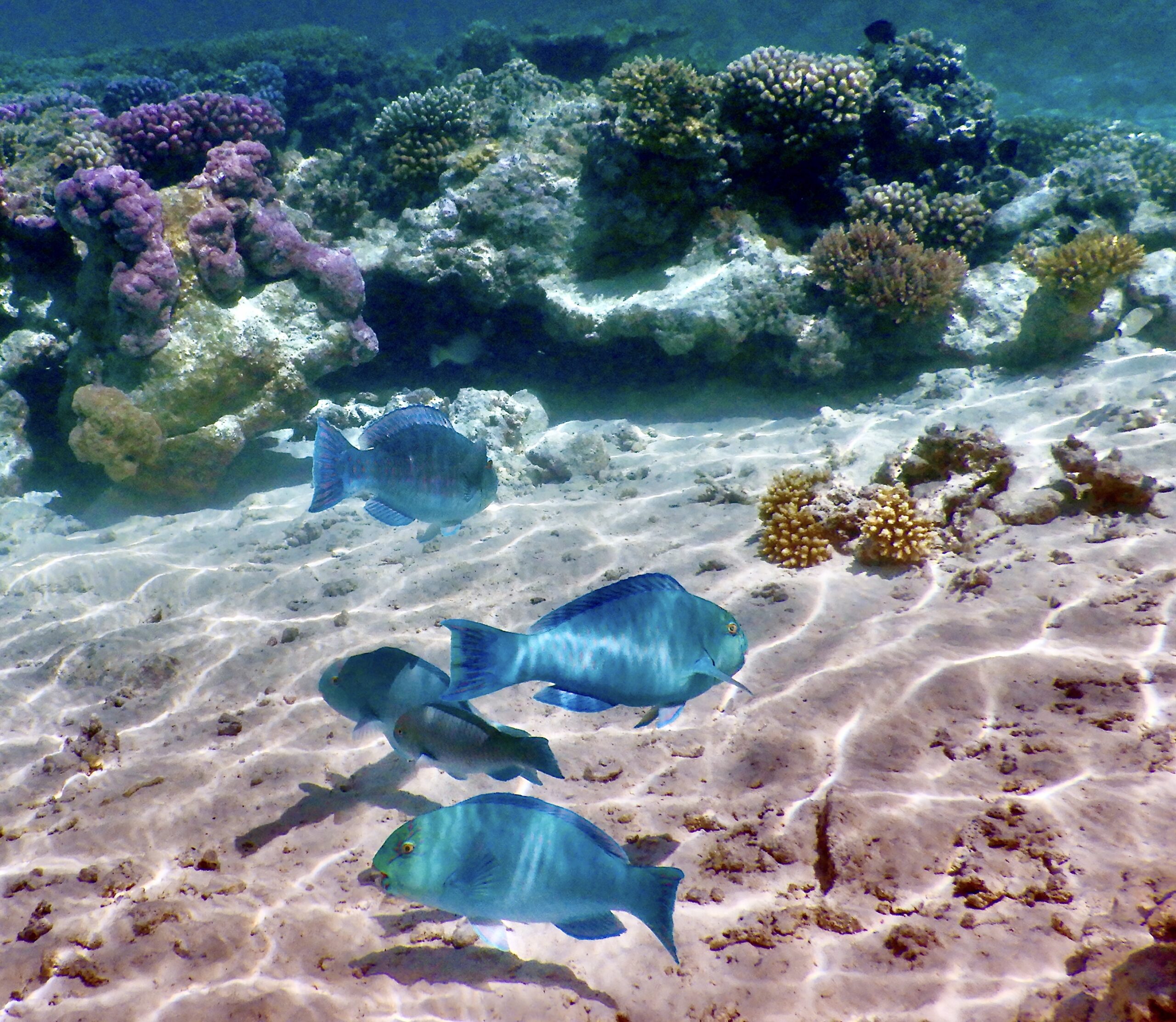
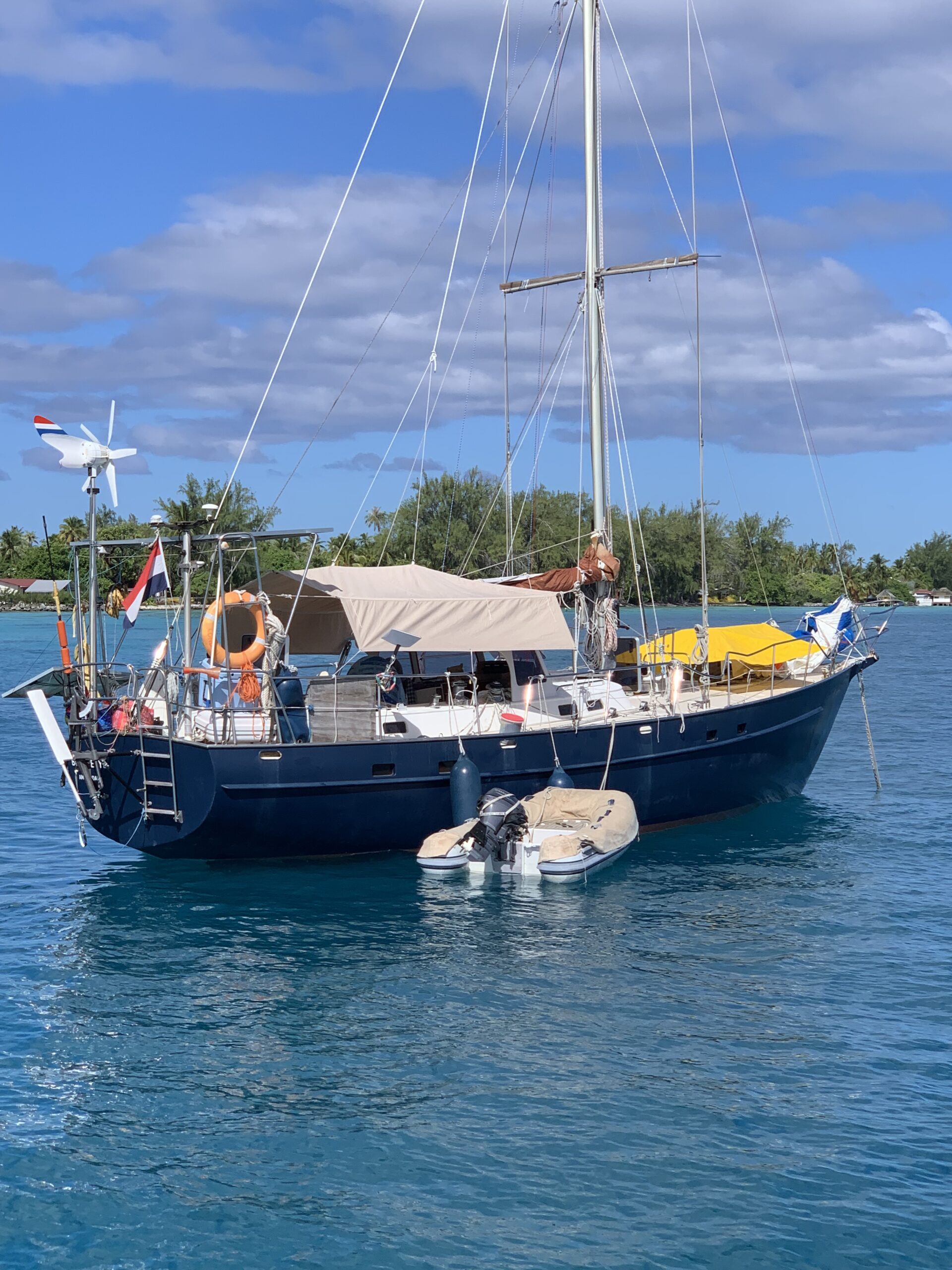
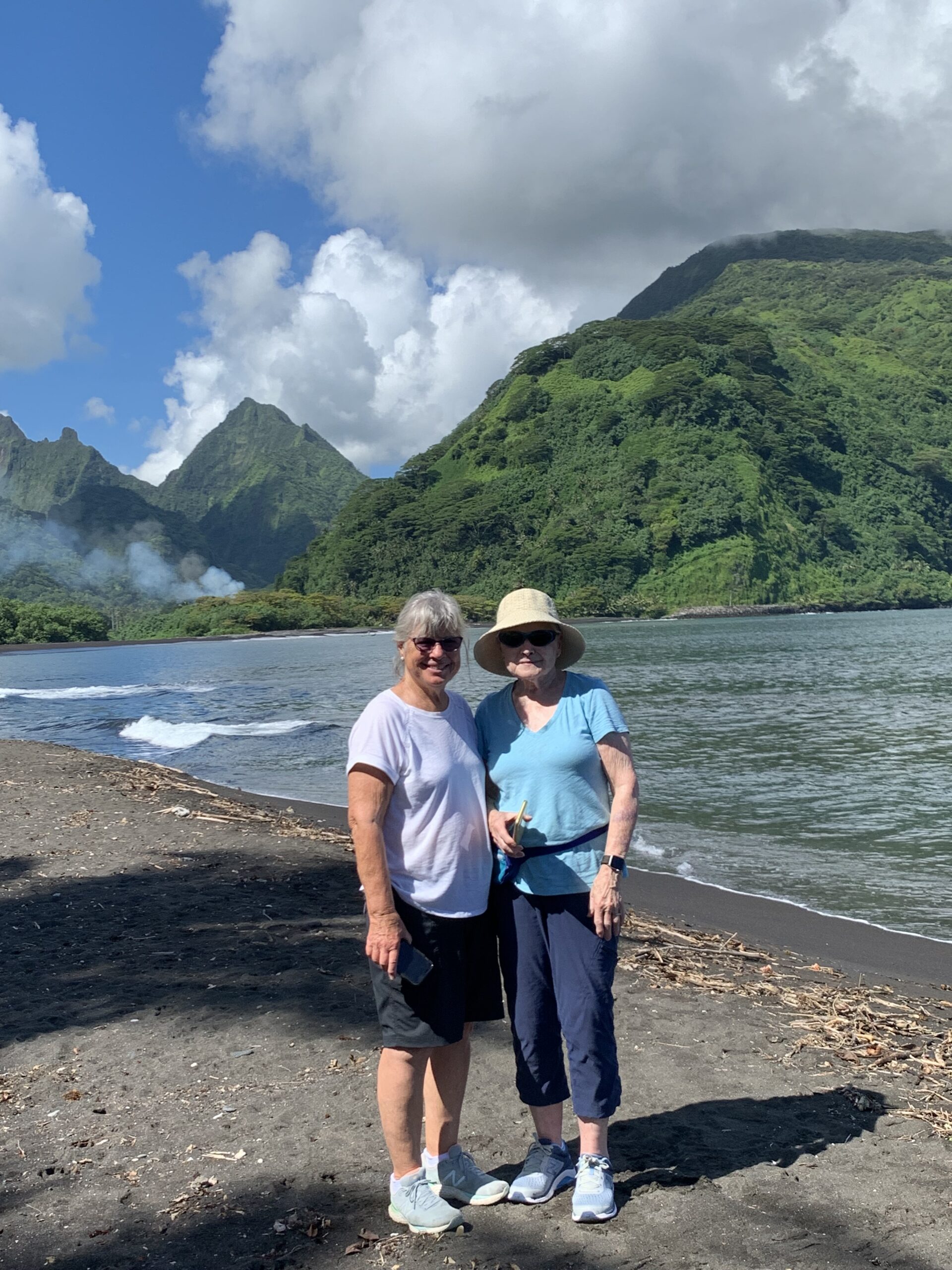
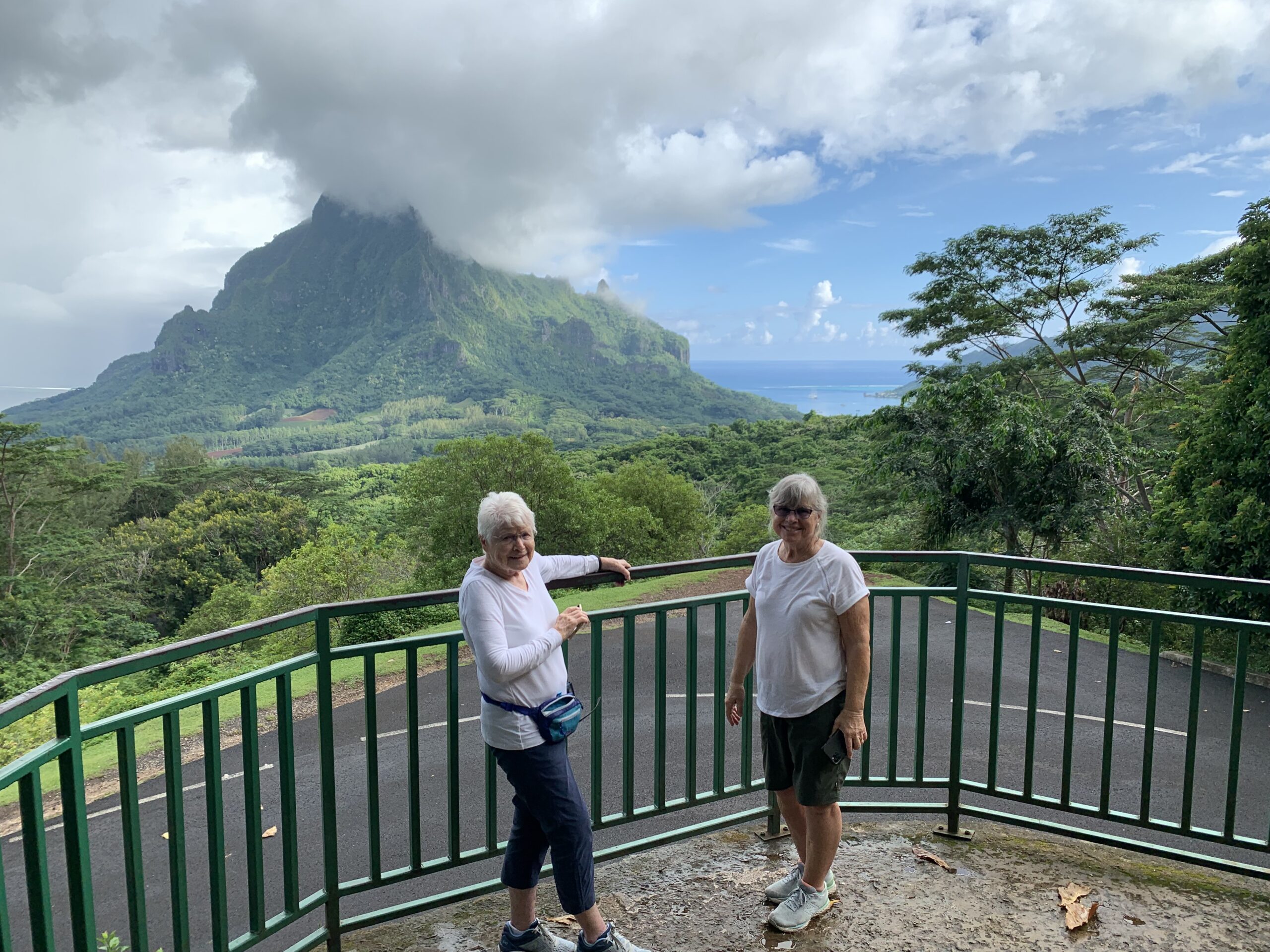
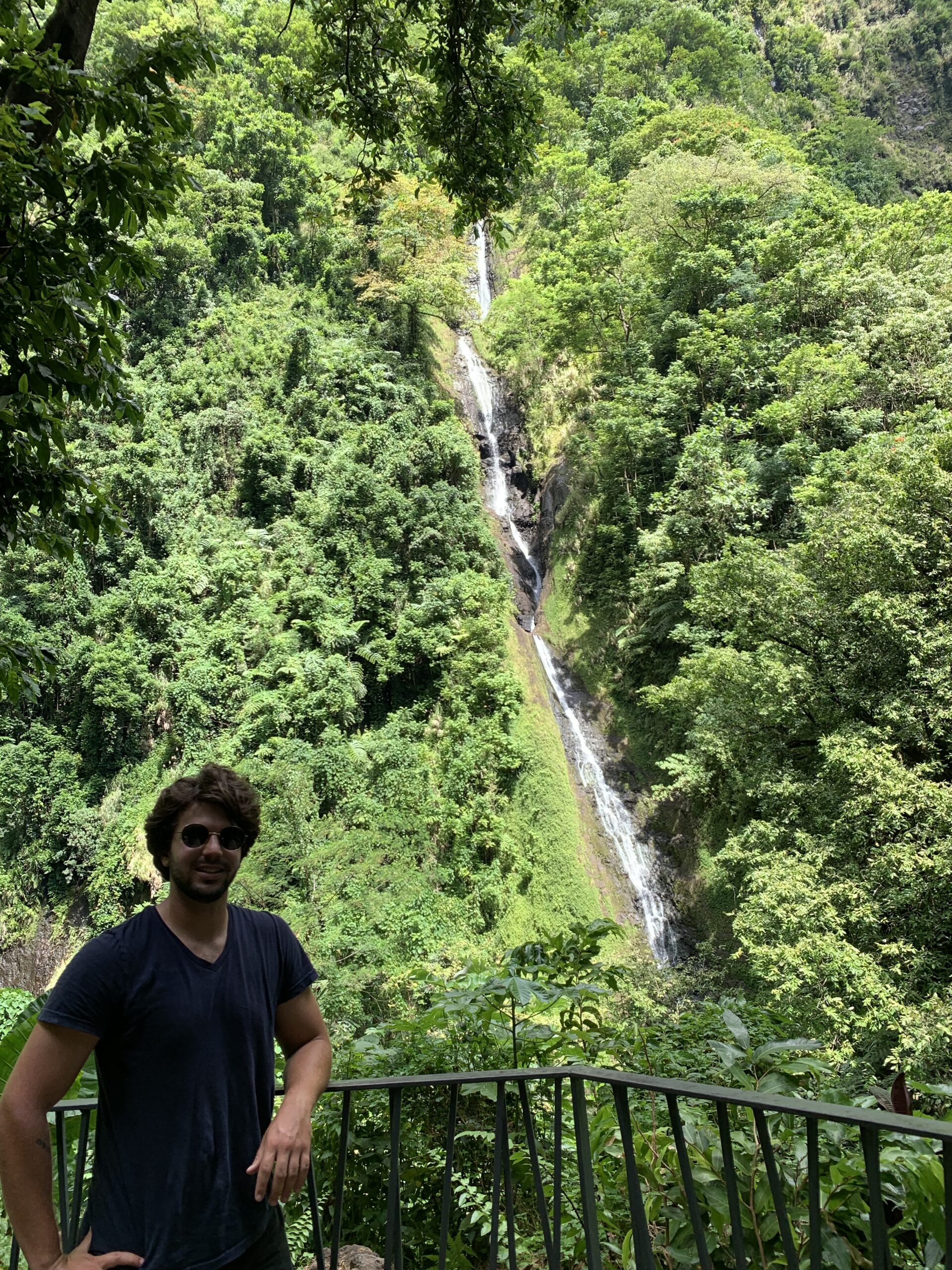
On Monday, September 4 at 10:00 a.m., we pulled up anchor at Penhryn Island and headed across the lagoon to the pass, exiting closely behind Szel and Blue Beryl. We all put up our sails and headed to the island of Suwarrow, also part of the Cook Islands. Although we were officially checked out of the Cook Islands, we had permission to stop over in Suwarrow, which is a national park, with just two rangers living there.
As we started out, the seas were bumpy and the winds were in the mid-teens, sometimes higher. We were making good time but the winds were moving from our beam to aft of the beam, putting us on a broad reach. At around 4:00 p.m., we put a second reef in the main and furled the jib in a bit. Blue Beryl sailed passed us right then. It was a bump night and none of us slept much.
On Tuesday, September 5, the seas were still bumpy, with 2-2.5 meter waves, and the winds were getting lighter. By noon, we had made a 138-mile day. We took the second reef out and wind started letting us point more directly to Suwarrow. We could still see both of the other boats on AIS.
On Wednesday and Thursday, the winds stayed light all day, aft of the beam. I took the reef out during my watch on Wednesday morning, but we ended up motoring the rest of the way to Suwarrow.
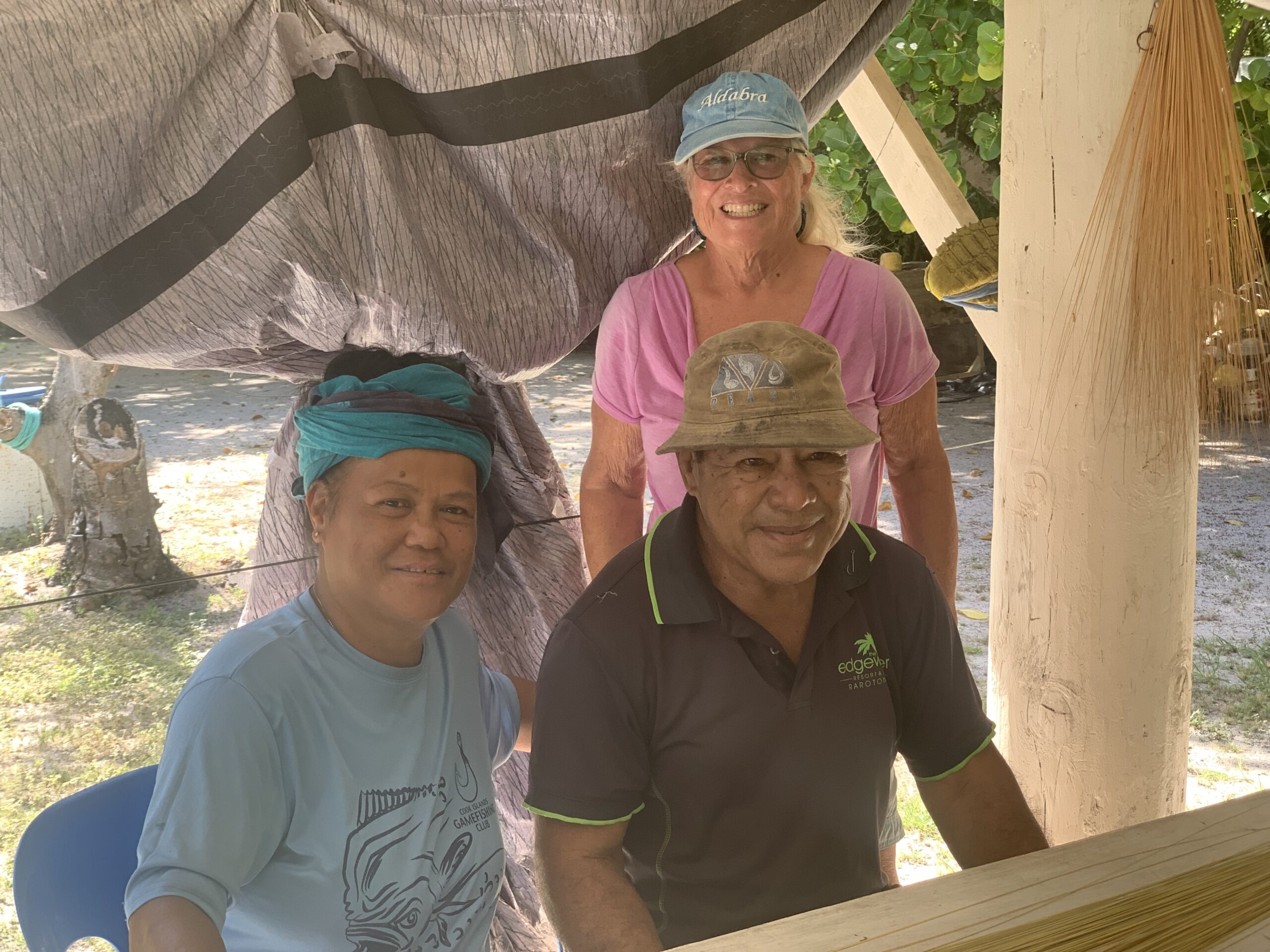
We got to the anchorage a little after noon on Thursday. John Blair from Ballyhoo stopped by to say hello. We then put the dinghy in the water and went ashore to check in with the rangers. Harry and Tana (my spelling). The process was easy because of our check-out in Penrhyn. We gave them a six-pack of Sprite and a six-pack of Coca Cola. We had heard that they were craving it so we bought some when we were still in Tahiti. To thank me, she gave me a grass broom she had made.
We had dinner that night on Aldabra with Blue Beryl. It was nice to be anchored in flat water.
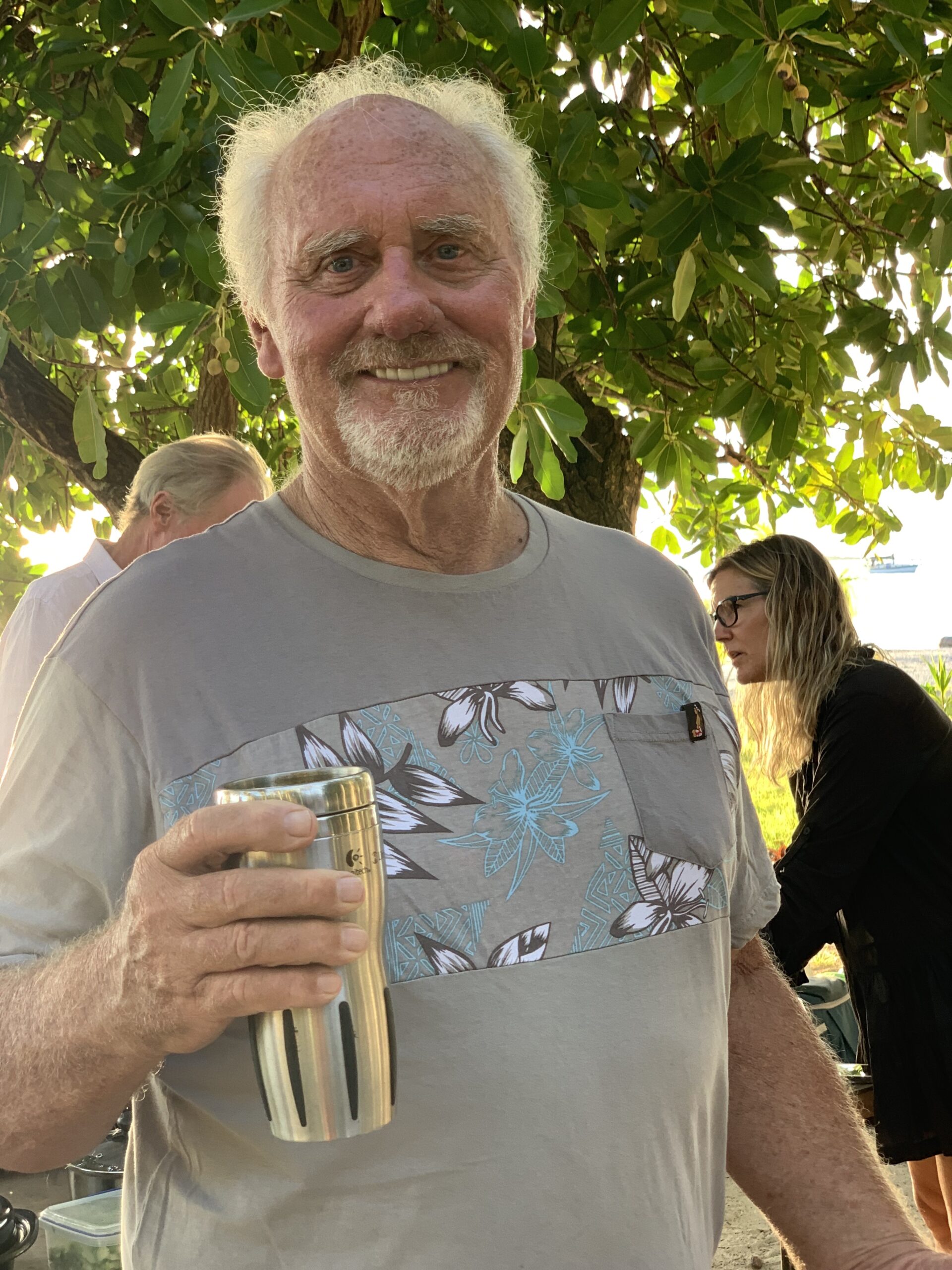
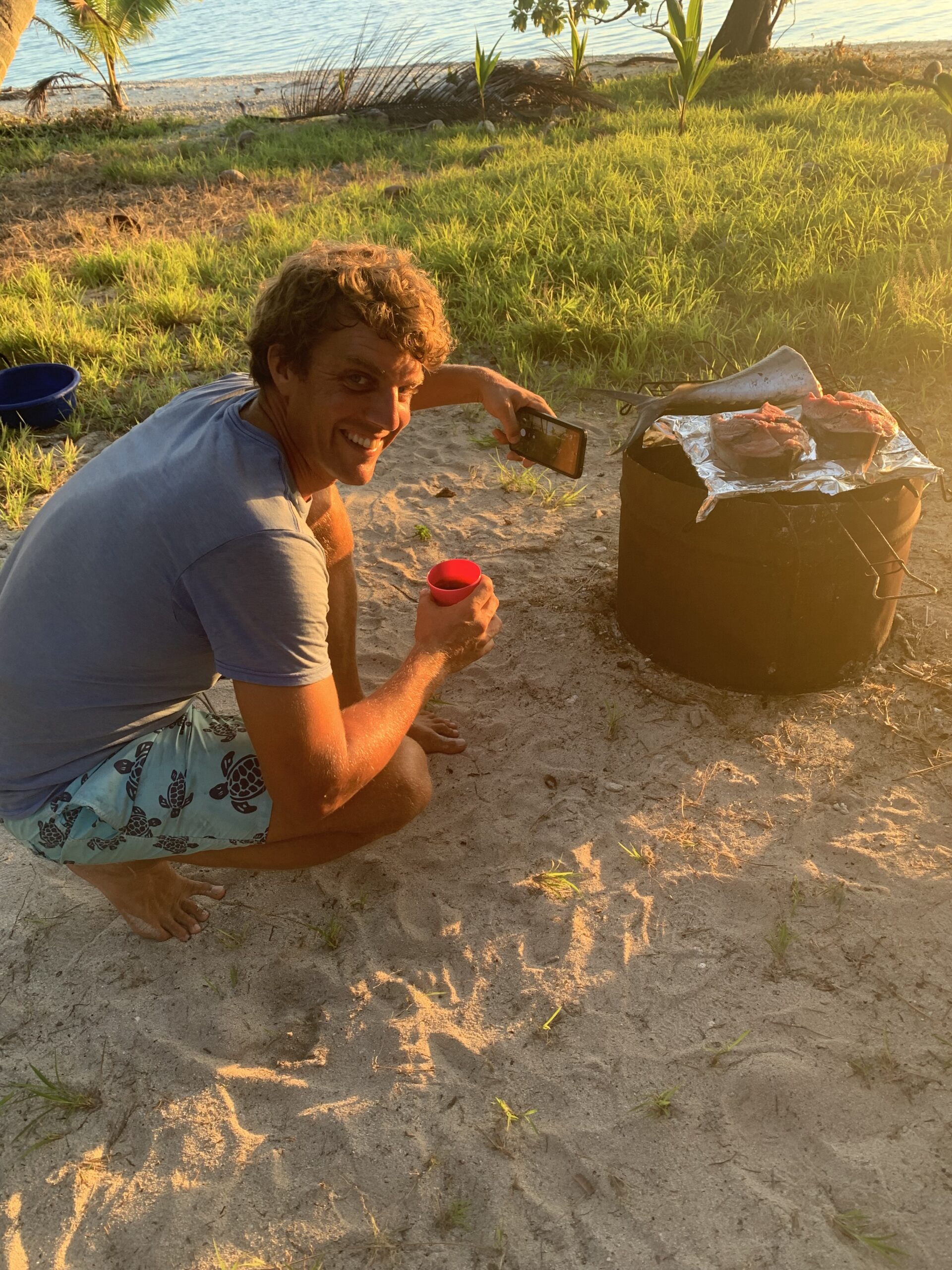
There were quite a few boats in the Suwarrow anchorage, and the rangers told us that they had been so busy checking boats in and out that they had not had time to do their ranger work. So on Friday, we went ashore with some of the other cruisers and helped clean up an area between the beach and the rangers’ house. Later that evening, the rangers hosted us for a potluck with all the other cruisers. We had fish that Alex had caught and coconut crab that the ranger had caught. Other people brought tasty food and it was a nice evening.
Grilling coconut crab
The rangers, Harry and Tana (my spelling)
Tom enjoying the beach party
Alex grilling fish
The group of cruisers at the beach party
The next day, Saturday, September 9, we mostly stayed on the boat. I helped Tom patch a hole in the dinghy. Linda and Alex worked on sorting through and upgrading our fishing gear.
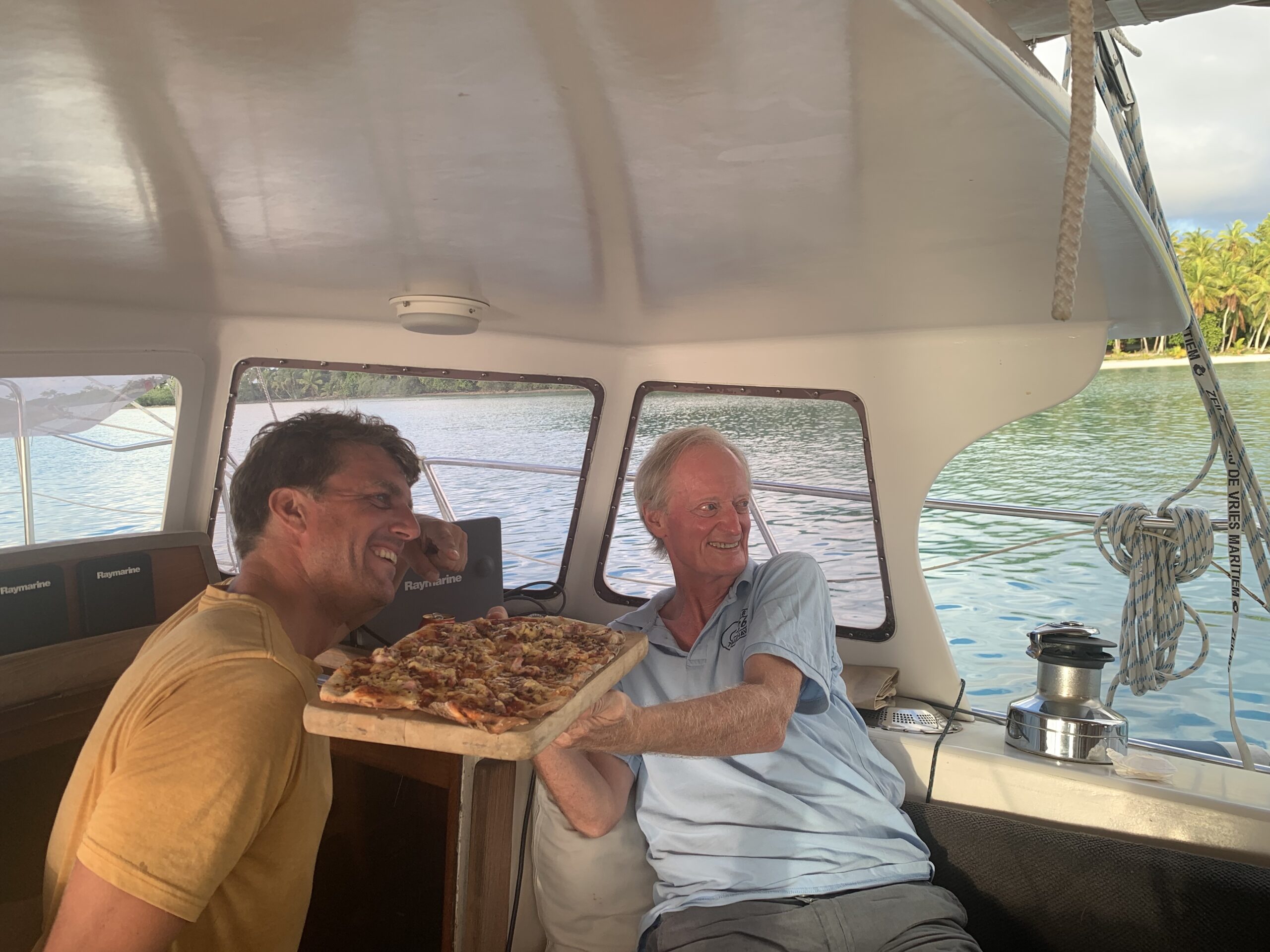
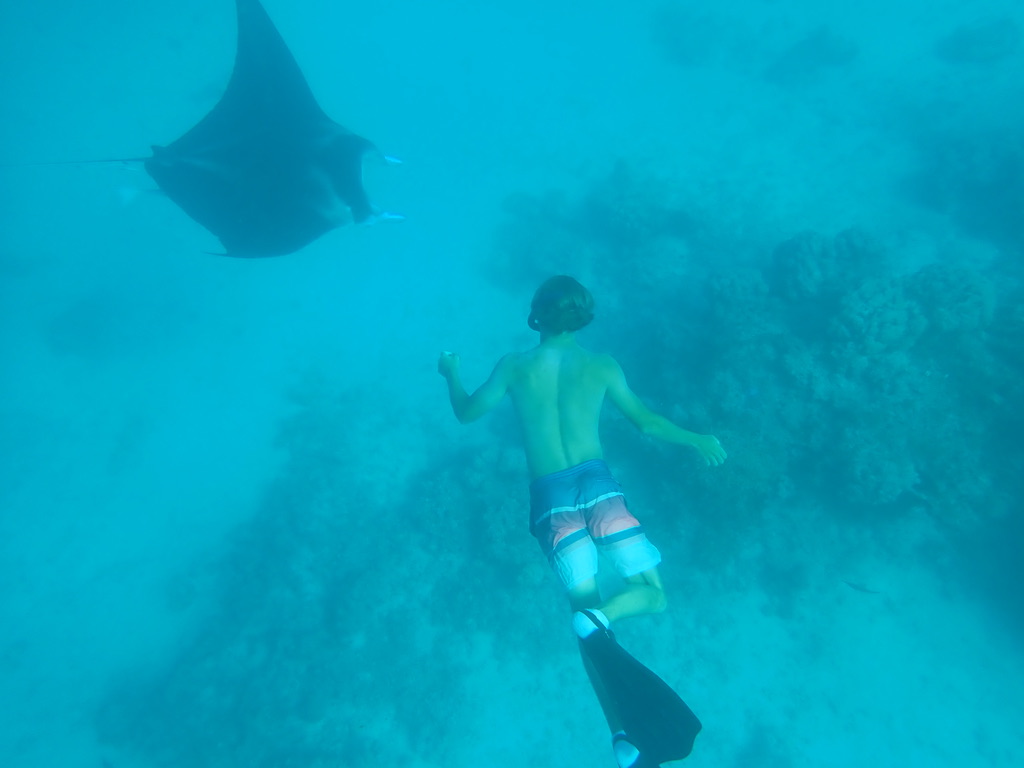
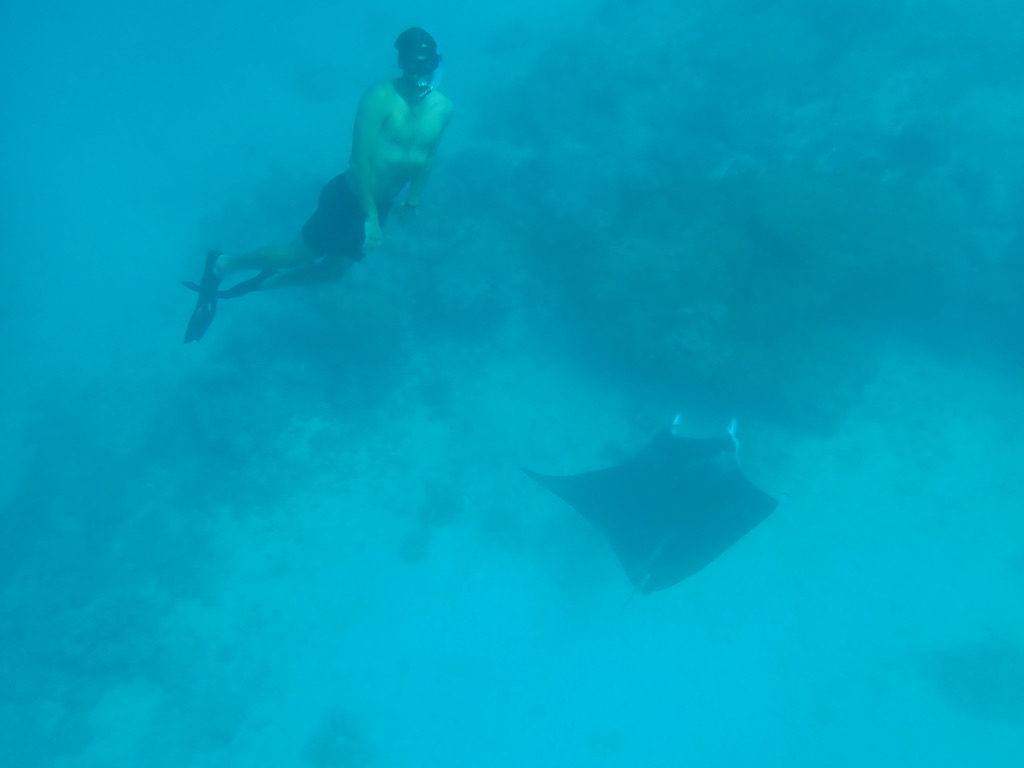
On Sunday, we transferred some fuel from jerry cans to the diesel tank. I tried to clean the boat bottom, but it was so bad I only got the waterline. I baked a cake and later we went and swam with manta rays on a nearby reef. That night we celebrated Yvette’s birthday on Blue Beryl, with Szel and Aldabra.
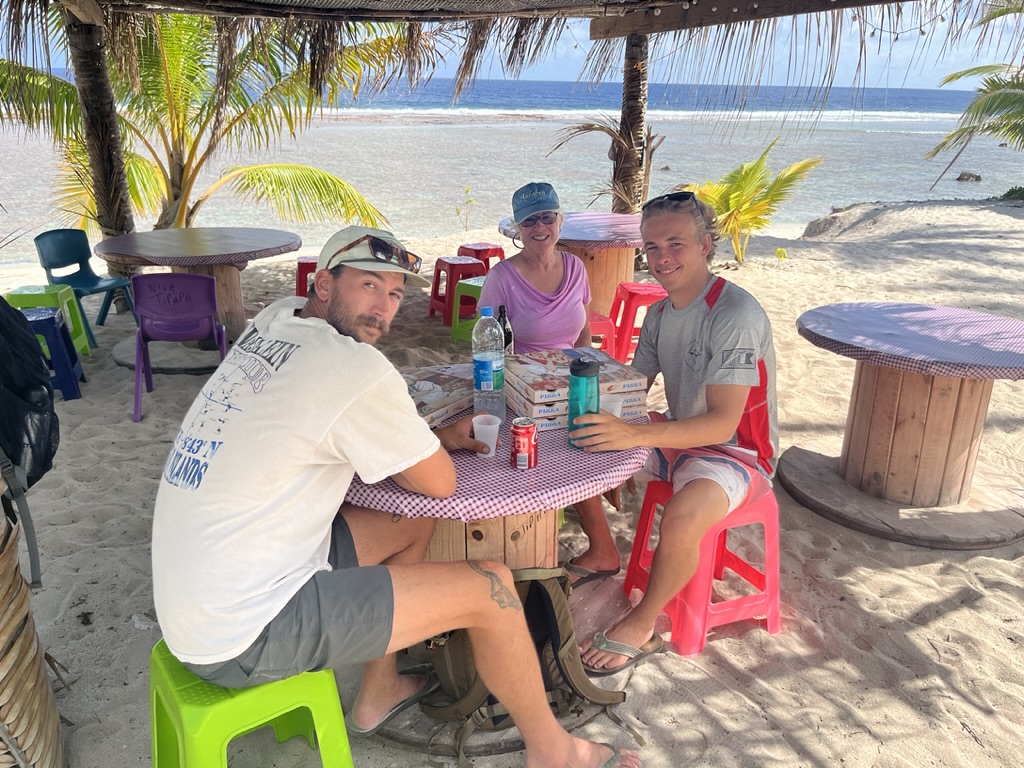
Alex and Jamie posing with the pizza Alex made for Yvette’s birthday
On Monday, Alex brought over 30 gallons of diesel fuel, to get us to Tonga if we had to motor much. Tom fixed the location of the boom bales to improve our reefing system. Several boats left the anchorage, heading to either Fiji or Tonga.
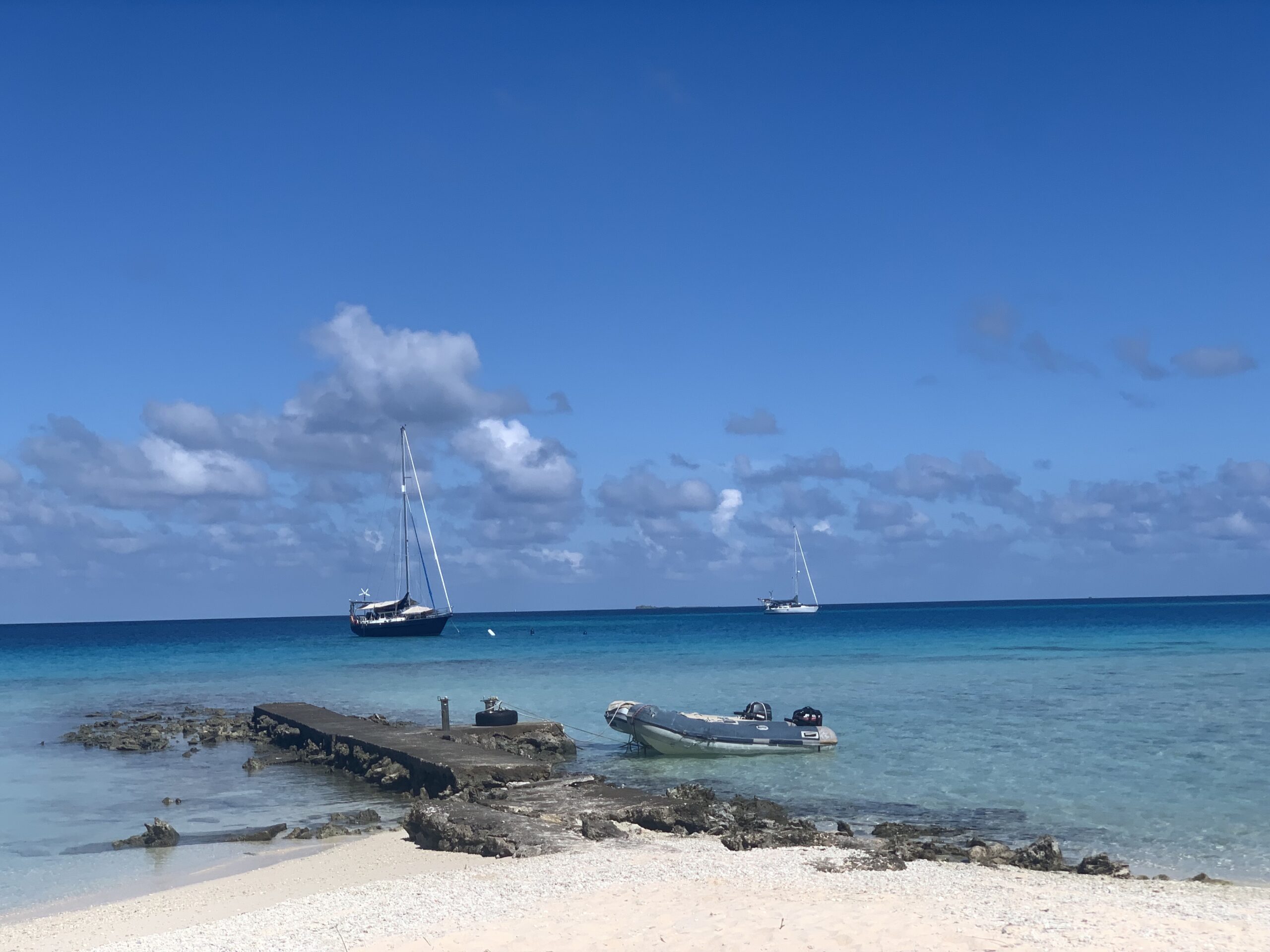
Aldabra and Blue Beryl were the last two boats to leave the Suwarrow anchorage
Even though we had not been in Suwarrow long enough to explore this paradise, the winds were threatening to keep us there for more than a week unless we left right away. So on Tuesday, we went ashore to say goodbye to the rangers.
Saying farewell to the rangers
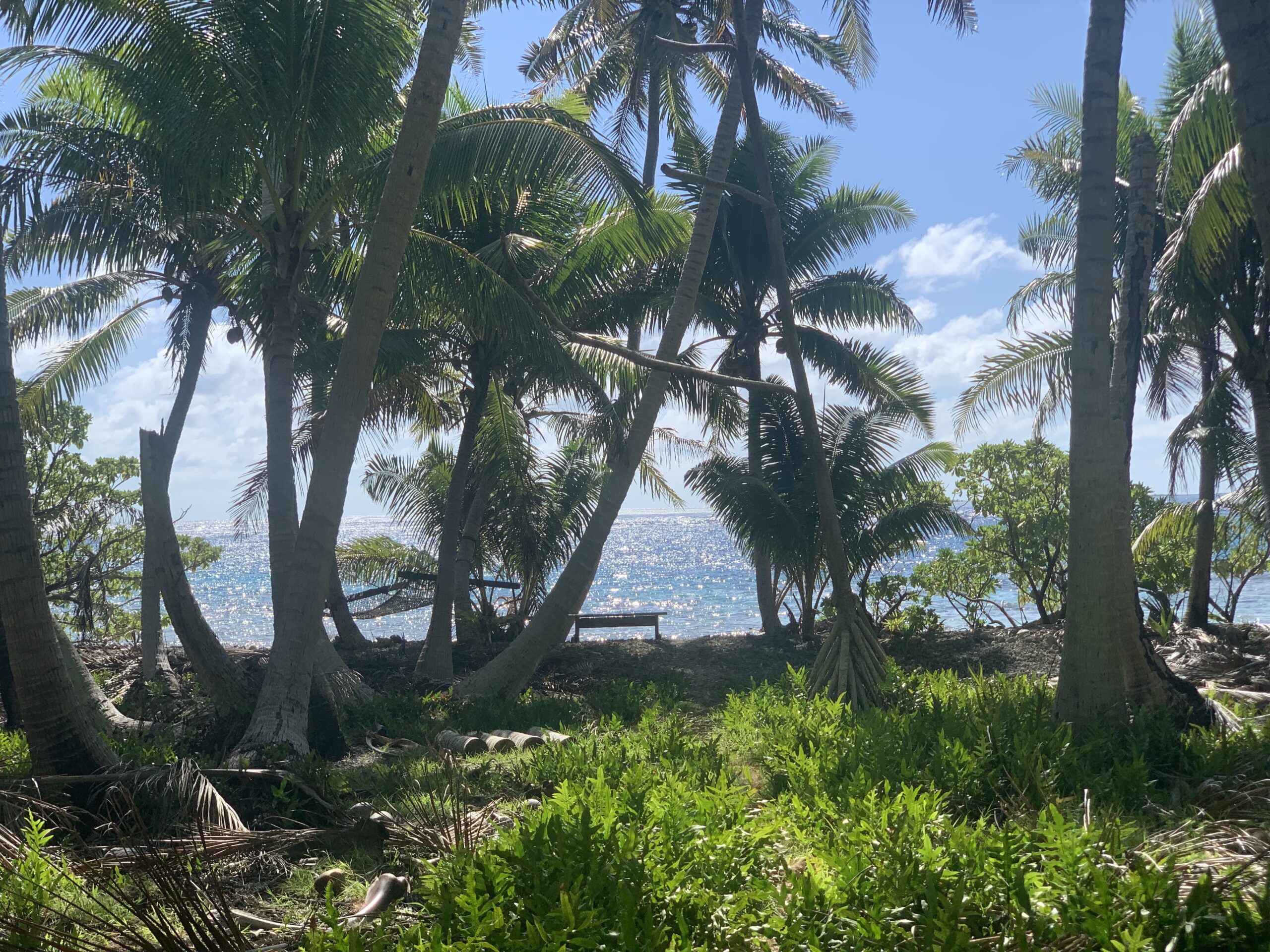
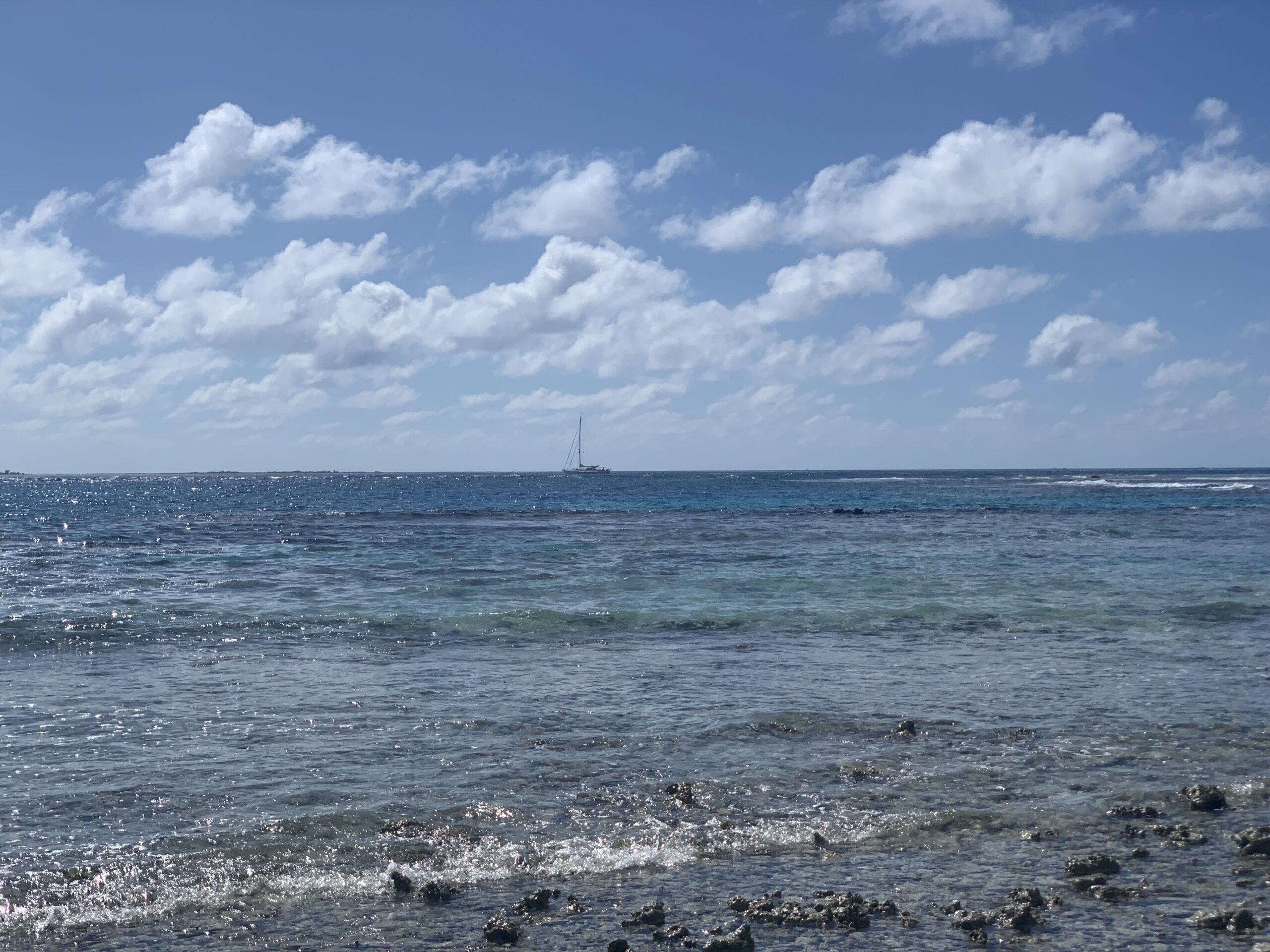
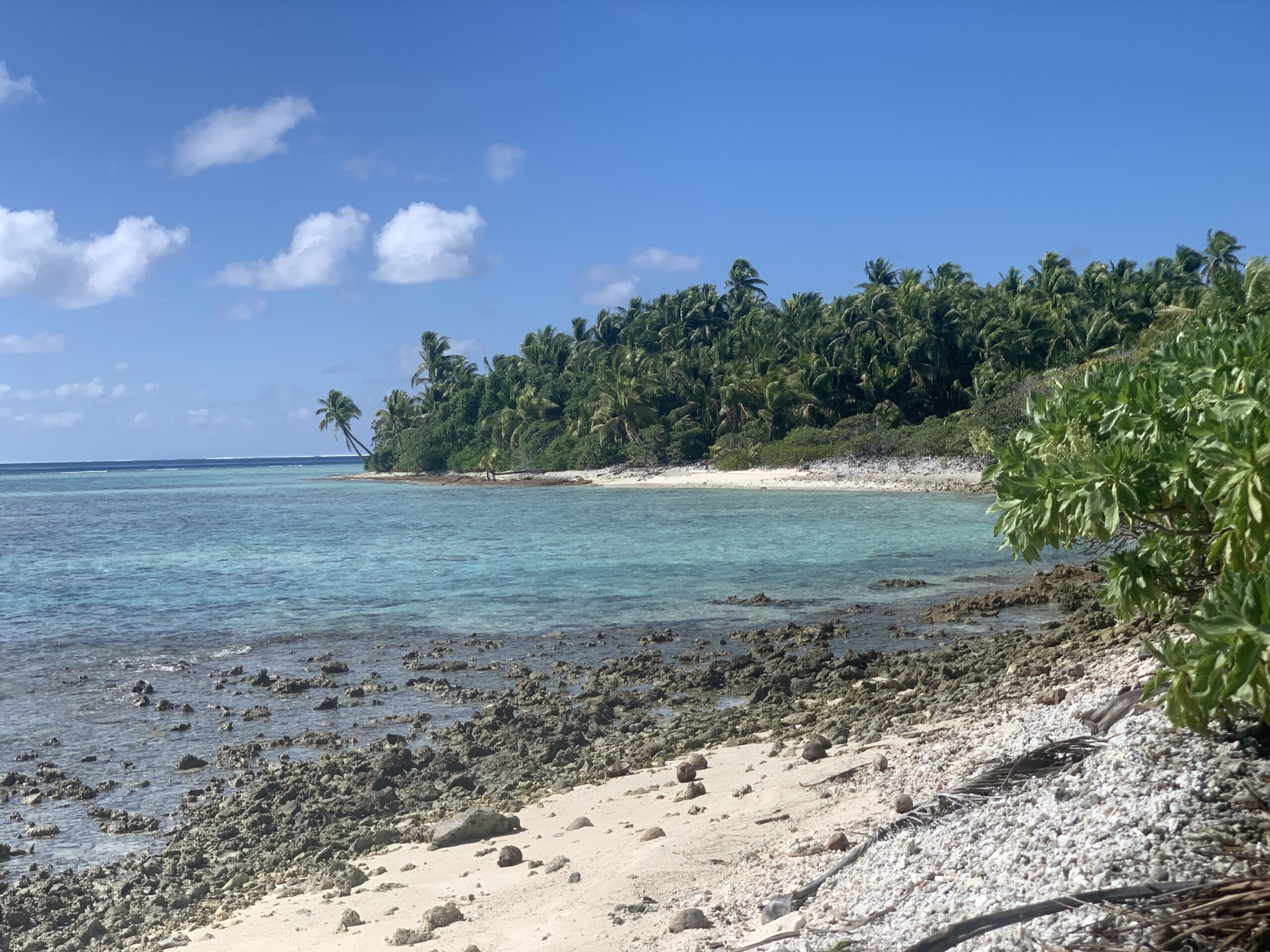
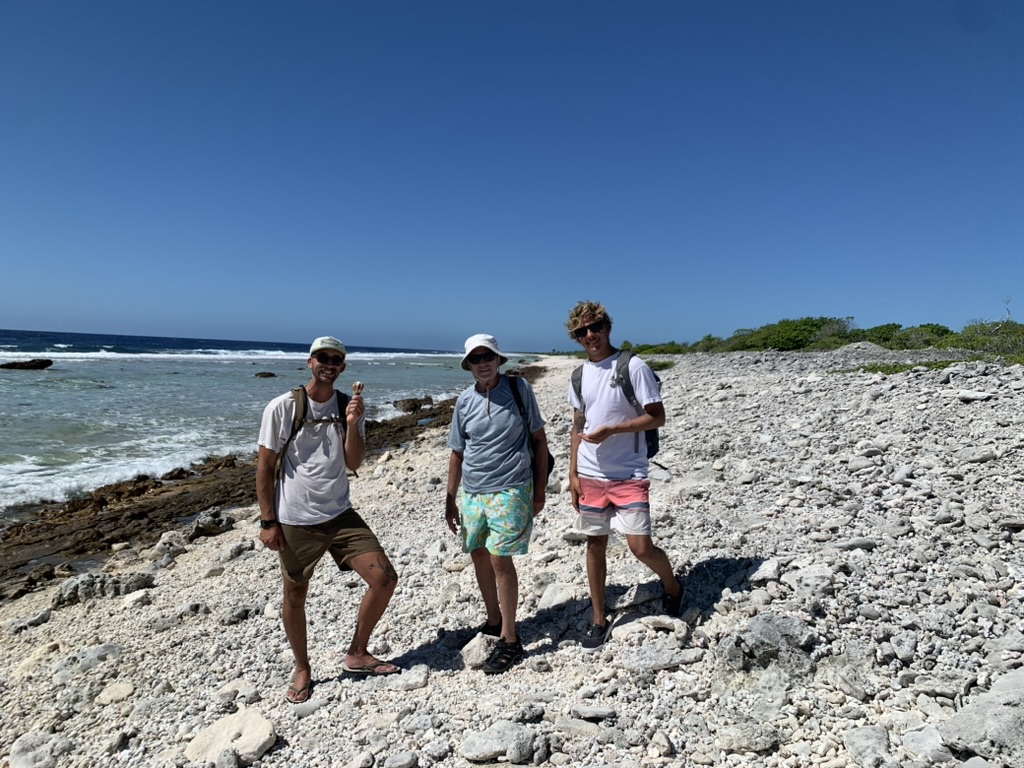
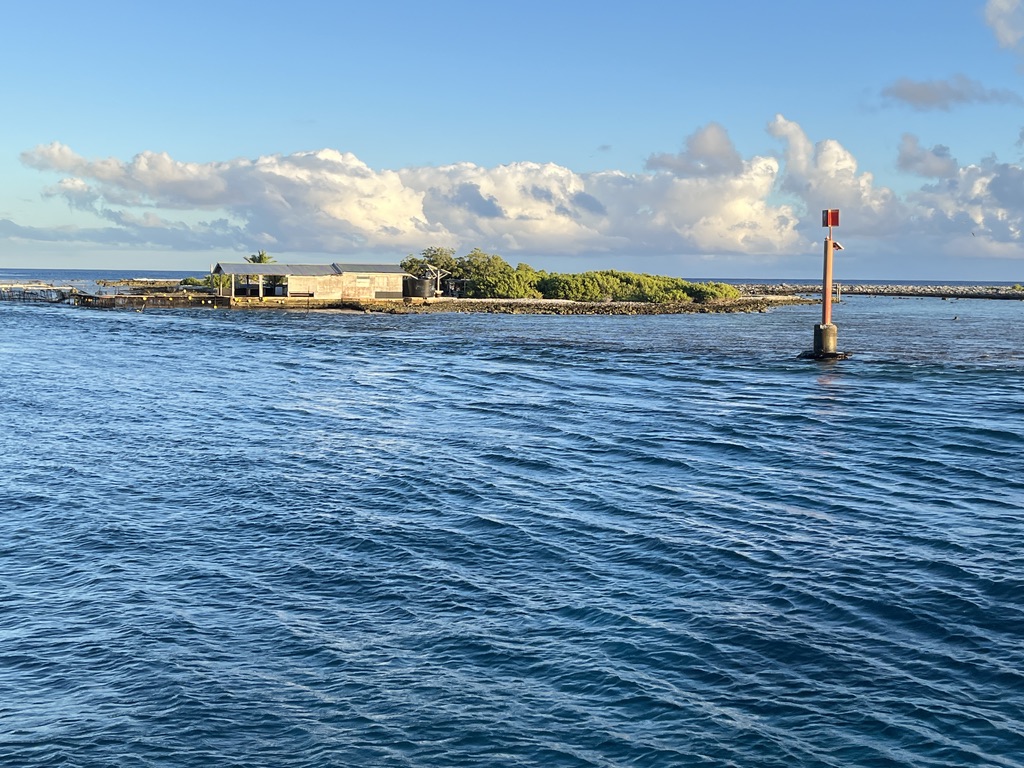
After we said goodbye. Linda and I walked to the other side of their motu, which faced the pass. We watched as Szel went through and took a few pictures of the island.
Szel heading toward the exit of the pass
I then baked some bread and cooked some sausages and we pulled up anchor around 2:00 p.m. Szel had already left in the morning and Blue Beryl left right before we did.
On Saturday, August 26, Blue Beryl left Bora Bora on a very windy morning, and Aldabra and Szel left about 1:30 p.m. We were headed to Penryhn Island, part of the northern Cook Islands group. Szel is a very fast SunDeer 64 and she left us in the dust immediately. Blue Beryl and Aldabra were pretty even at times, although Blue Beryl headed to the left of the rhumb line and Aldabra attempted a more direct course to the island. We passed them during the first night and then lost AIS signals for both Szel and Blue Beryl by morning. We kept up with the two boats on a What’sApp group chat.
At the beginning of the passage, the seas were lumpy and the winds were in the high teens. In our first 24 hours, we averaged about 5.5 knots.
On Sunday, the winds were down in the low teens and the seas were flattening out a bit. We were having a comfortable sail with speeds around 6 knots and sunny skies. We continued to have no sign of the other boats and we were starting to be pushed to the west.
By Monday, we were in a slow slog with light and shifty winds. We ran the motor several times when the winds got too light. That night, we had some good wind but it was coming from directly behind us, which is not favorable for Aldabra. With swept-back spreaders, we can’t let the main go far enough forward to optimize for downwind sailing. Thus, we carried on by sailing a little bit to the left of our course or a little bit to the right of our course.
On Tuesday, we had wind but still from behind. We decided to try to put up two jibs, one on each side, with the main down. Linda drove while Tom and I spent a couple of hours working on getting the spinnaker pole up and the boom out and each jib in place. Right as we completed the setup, the wind shifted and nearly died and we had to take everything down. We motored for a while with no sails. In the evening, we put the main back up but we were motoring with the sail slapping around.
Yvette sent us a picture as she celebrated her birthday underway
Wednesday was a frustrating day with lots of motoring. Finally on Thursday, August 31, we arrived at Penryhn and went through the pass in the late morning. There was a lot of current but we managed to navigate into the pass and then take the long way around, in the lane for larger boats, to arrive in the anchorage in front of the town. Szel was already there.
Almost immediately, a boat showed up with the local authorities for Customs and Health. After we filled out the paperwork and paid some fees, they left and the Biosecurity guy came onboard. We filled out something for him and paid his fee.
The anchorage was very windy and choppy and we stayed on the boat that night. Blue Beryl showed up later in the afternoon and came for a visit in the evening. The next day, we went ashore to continue the check-in process, but we also ended up checking out as well. Andrew, the Customs officer, checked us out of the Cook Islands, even though we would be staying in Penryhn for a few days and then going to Suwarrow. It simplified everything for us and would make our entrance into Tonga less complicated.
After we checked out, all three boats went over to the village on the far side of the atoll. Anchoring in the late afternoon. Aldabra and Szel stayed on our boats but Blue Beryl went to shore to a warm welcome by the villagers.
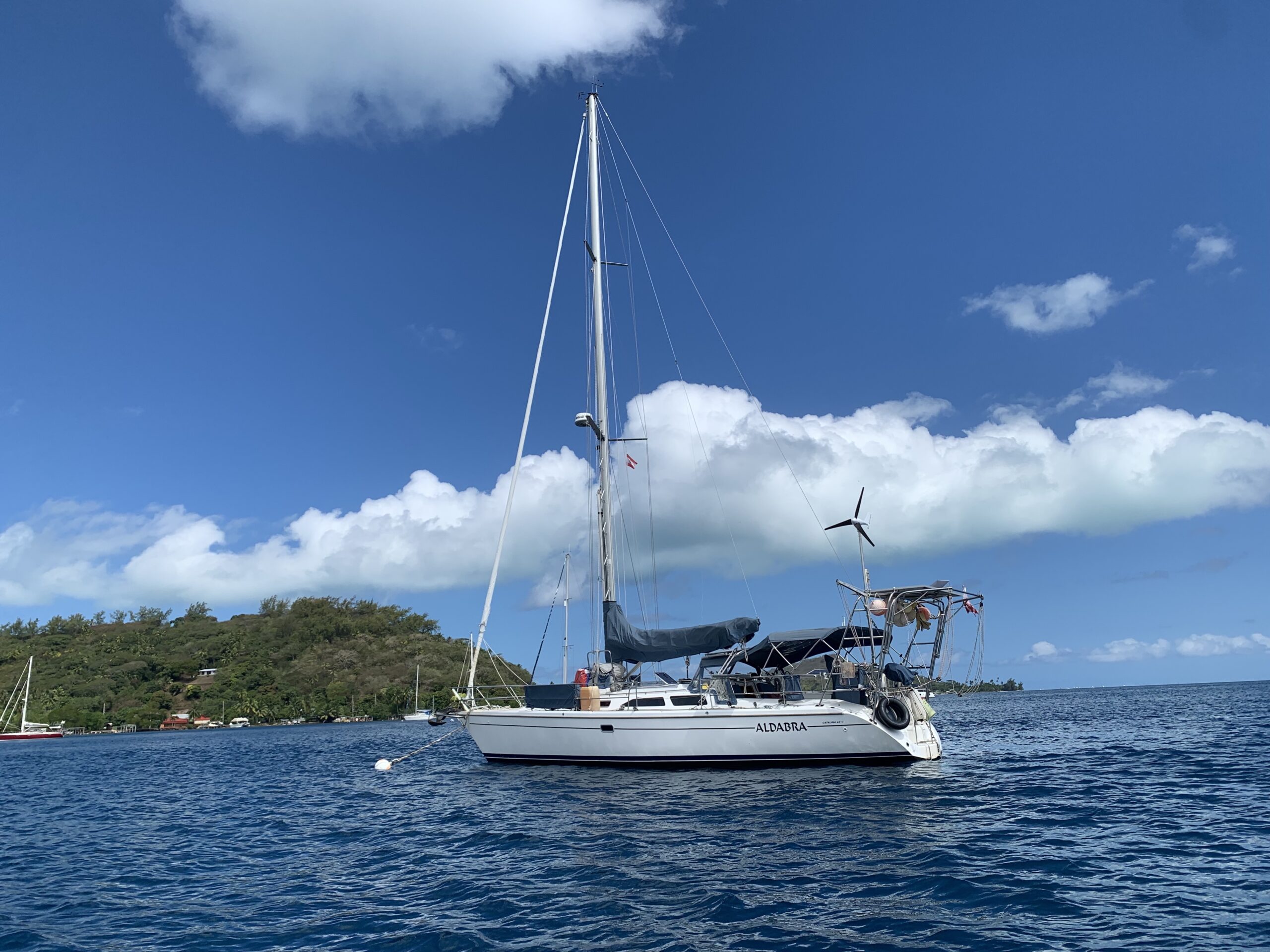
Aldabra in Penrhyn
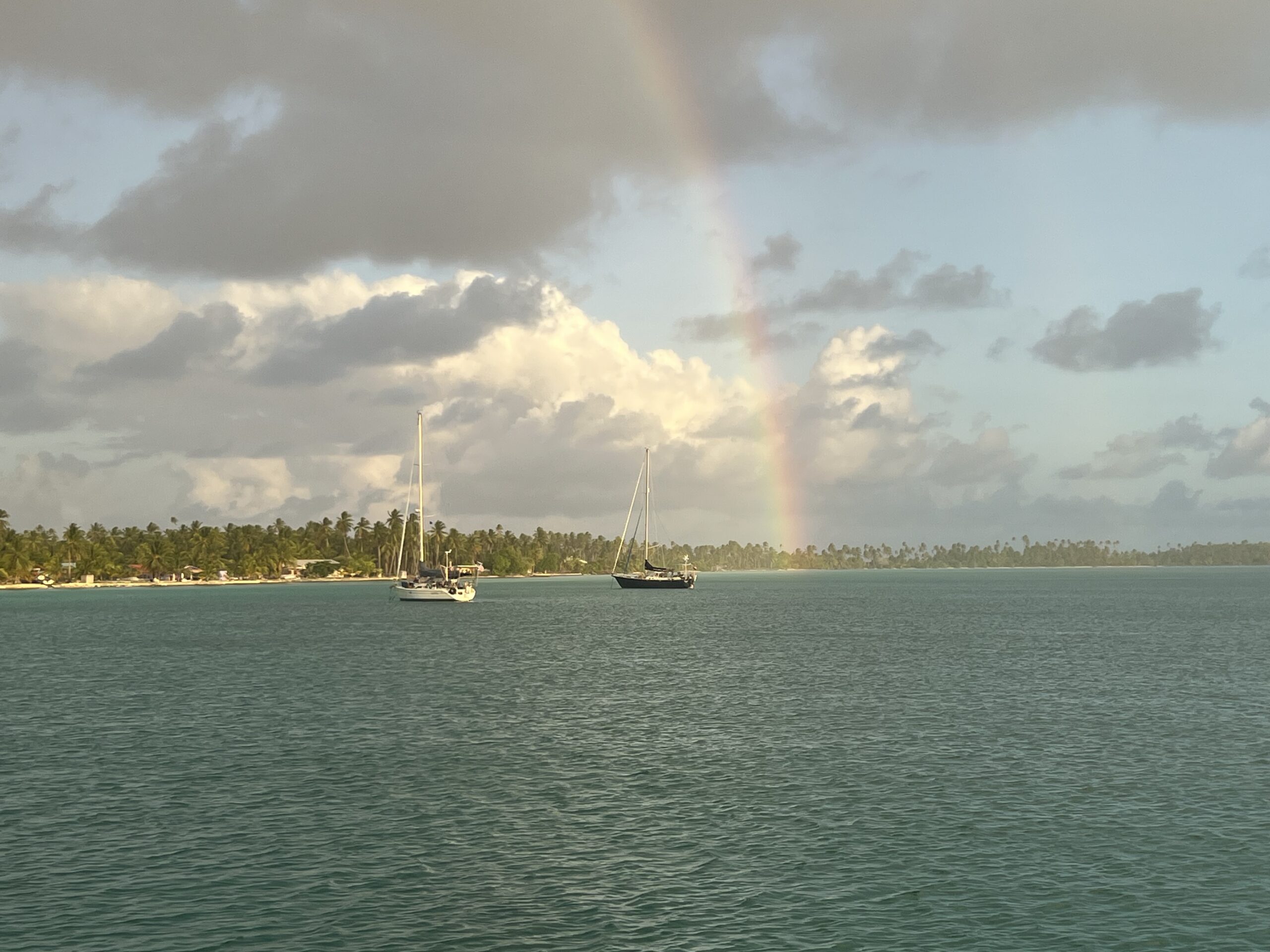
Rainbow in Penrhyn, with Aldabra and Blue Beryl
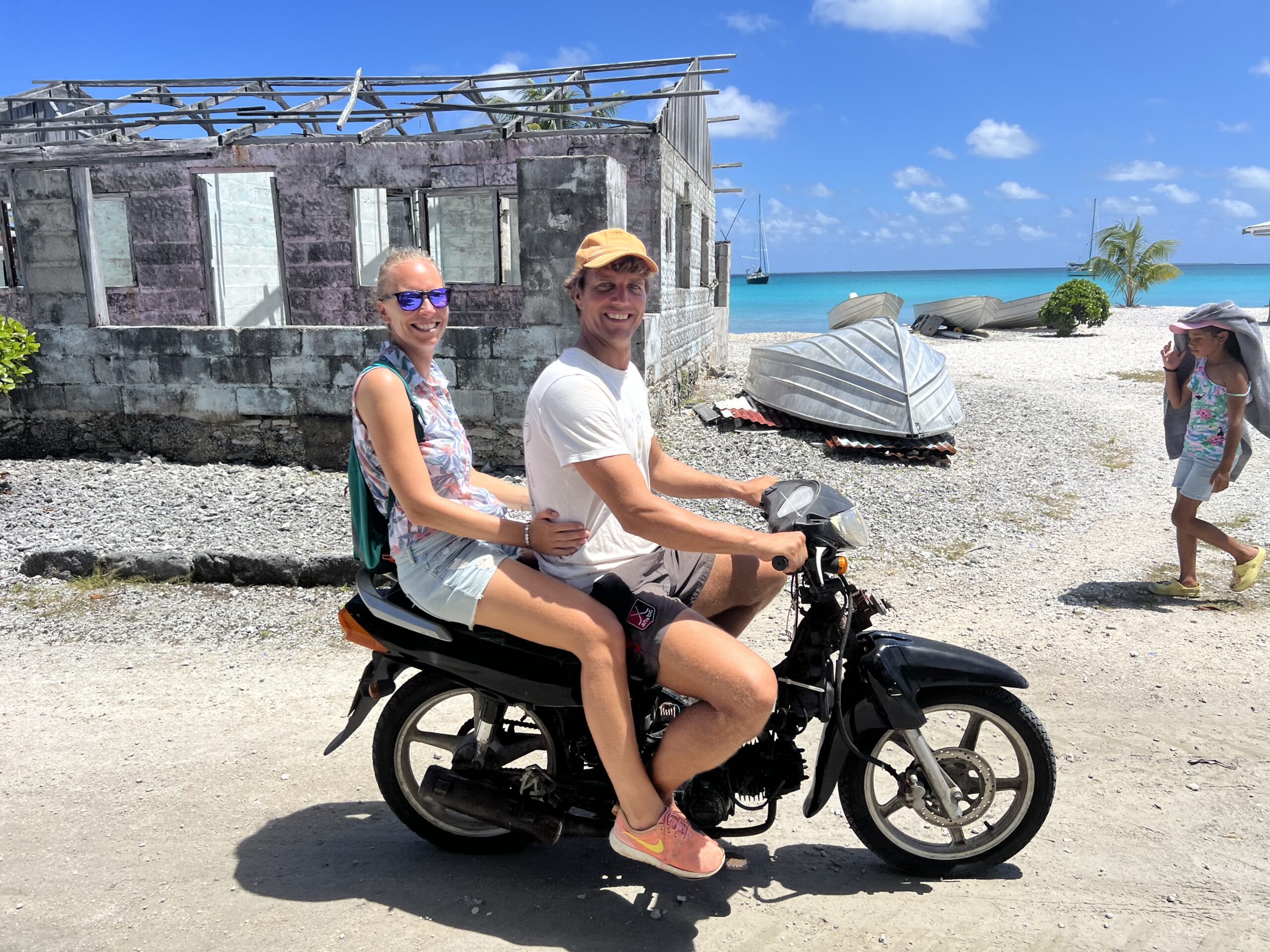
The next morning, Alex, Yvette and Tom went to shore. Alex and Tom worked on a couple of motorcycles that hadn’t been running for ten years. They got them running. Yvette went with the wife of the pastor to her house so Yvette could do her laundry and have lunch.
Alex and Yvette riding a newly repaired motorcycle
Linda and I went to shore a bit later than the others. We first stopped by Szel and invited Fiona to join us, which she did. We got to shore and started walking around, not really seeing anyone. Fiona and I got separated from Linda and found the guys working on the motorcycles. Meanwhile Linda met a family and went to their house for a visit.
Once we all found each other again, we visited Yvette and the pastor’s wife, giving the pastor’s wife a bag full of gifts, mostly for the children. After returning to Aldabra, we found things on the boat that were needed by the family that Linda had befriended so we went back to shore to give them to them.
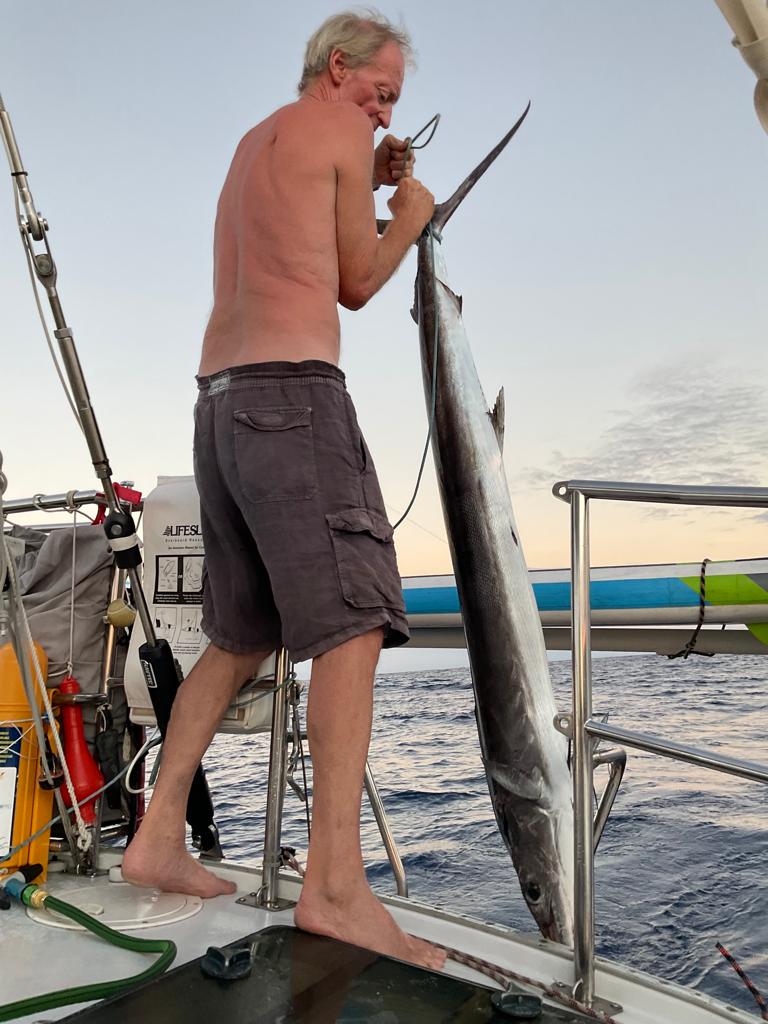
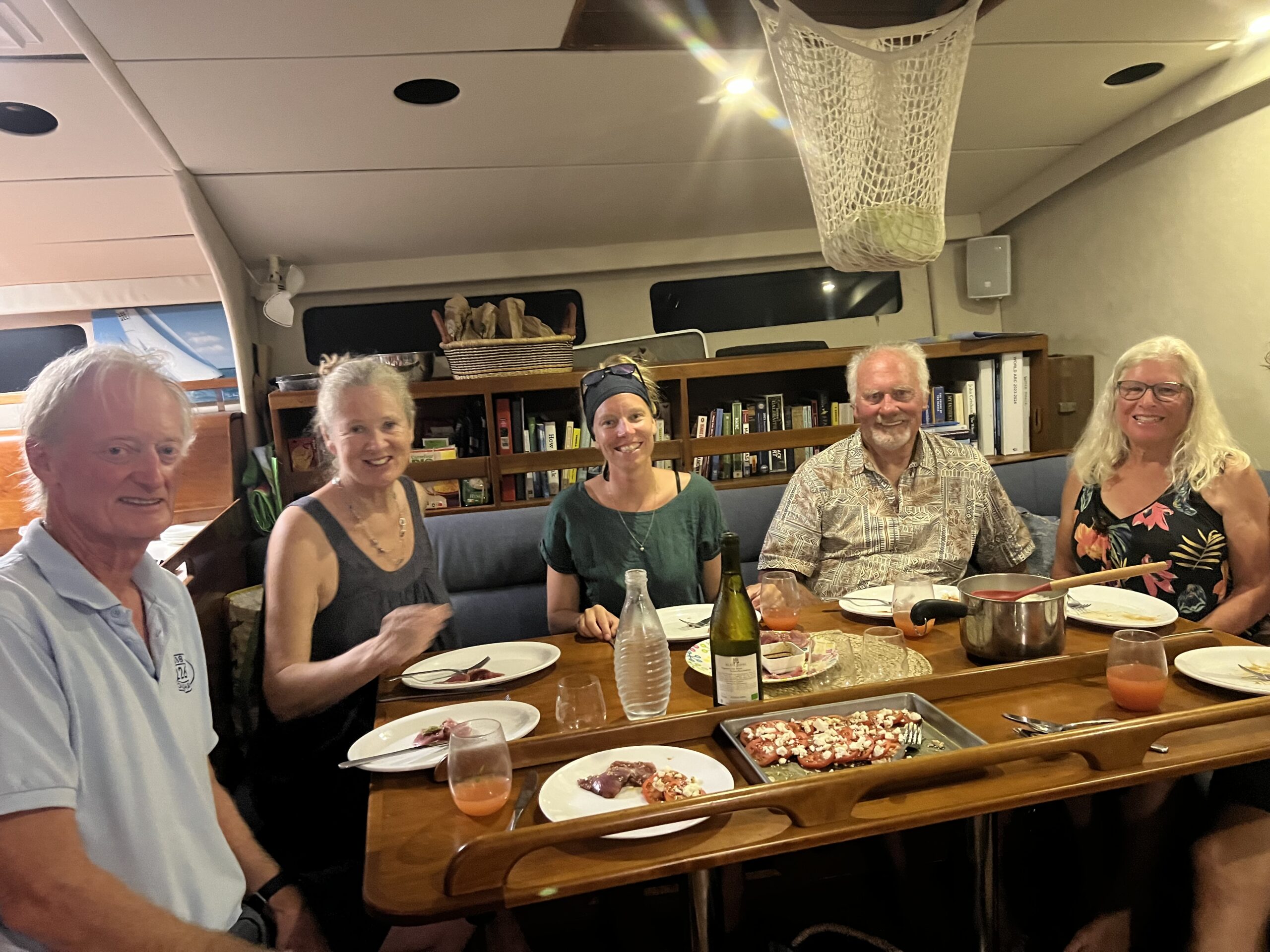
Dinner that night was on Szel. Jamie had caught a sailfish and he seared steaks for us. We also had rice, tuna sashimi, tomatoes with feta cheese, and brownies and ice cream for dessert. It was a very fun evening.
Fiona sent us this pictue after Jamie caught the sailfish
Dinner on Szel. Not everyone in the picture
On Sunday, September 3, we all put on whatever we had that was white. (Tom decided that he didn’t have anything suitable, so he opted to stay on the boat.) The rest of us went to shore in our all-white garb, stopping first at a house that had lots of hats. Some of the hats the women were wearing were not white enough, so they loaned them white hats. Then we proceeded to the church.
Tom took this picture of us getting ready to go to church in our whites
We went inside the church, which was very beautiful inside and sat down in the back. The women were practicing their singing from their seats in the pews. After a bit, Alex went outside and figured out that the children, in another building, were practicing their singing, and it was beautiful. So we all went over and listened until right before church was to start. We then went back to the church and sat in for the sermon. The pastor was very welcoming, said that we were now family, and blessed our journey.
Because of the strict rules about behavior on Sundays, we went back to our boats for the rest of the day. Alex and Yvette did go back to shore in the evening, after the restrictions were lifted, and had a very warm goodbye from the islanders. They also returned the visitor’s book that we all wrote in.
Photo we left in the Penrhyn village visitor’s book
On Monday, we didn’t end up going to shore to say goodbye. Instead, we prepared for the passage to Suwarrow. At 10:00 a.m., we started across the lagoon to exit the pass, shortly after Szel and Blue Beryl. We all put up sails and headed to Suwarrow.
As we sailed away from Tahiti on Friday, August 11, we weren’t sure where we were headed. We could sail over to Moorea and spend the night. Or we could do an overnight to Huahine. (Yes, we had checked out of French Polynesia, but we planned short visits under the radar to some of the other Society Islands. By checking out in Tahiti, we could have Tahiti Crew take care of the process.)
As we sailed in the vicinity of Moorea, we decided to just keep going to Huahine. The first hours of the passage were in 18-20 knot of wind and big seas. Conditions mellowed out during the second half of the trip.
On Saturday, August 12, we arrived in Huahine around 10:00 a.m. We were lucky to find a free mooring ball in the anchorage near the pass and close to the town of Fare. Naps were the first order of business. Before that, Sarah and Bob from Rhapsody stopped by and we made plans for dinner. We went ashore around 4:00 p.m. and walked around before meeting Sarah and Bob for dinner at the Huahine Yacht Club. The cocktails and the food were good and it was a fun night. Rhapsody left the next day.
Linda and Trevor enjoying their welcome drinks
Tom took this picture from the Huahine Yacht Club
Huahine Anchorage
On Sunday, we had a lazy day on the boat. Trevor and Linda swam out to the entrance to the pass to see a whale. Blue Beryl came in and anchored near us. We barbequed steak on the boat and played cards that night.
On Monday, we went to shore and made arrangements to rent scooters on Wednesday. Dinner that night was on Blue Beryl. Tuesday was a holiday in French Polynesia and nothing was open. We stayed on the boat all day.
Dinner on Blue Beryl, Linda took the picture
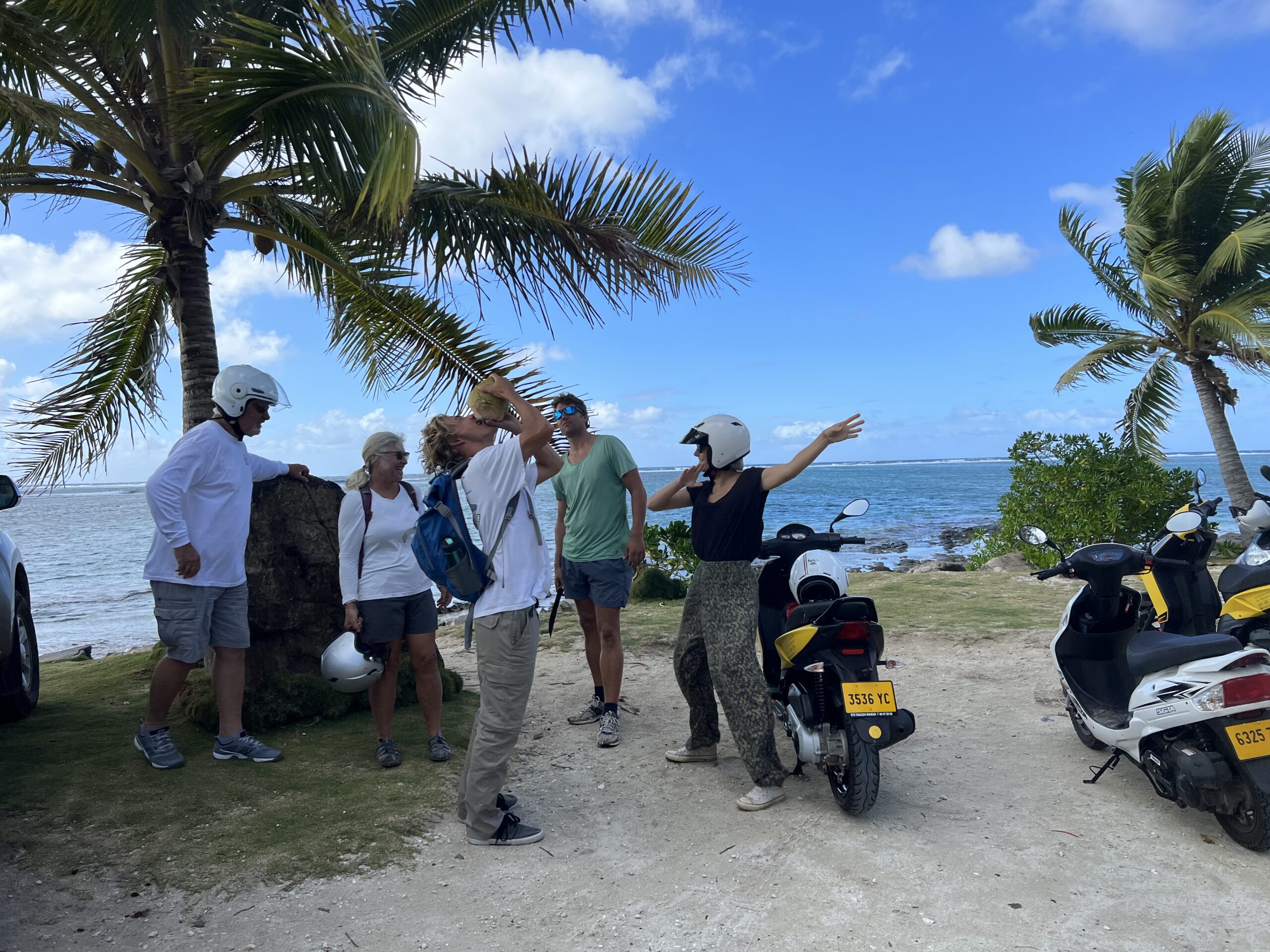
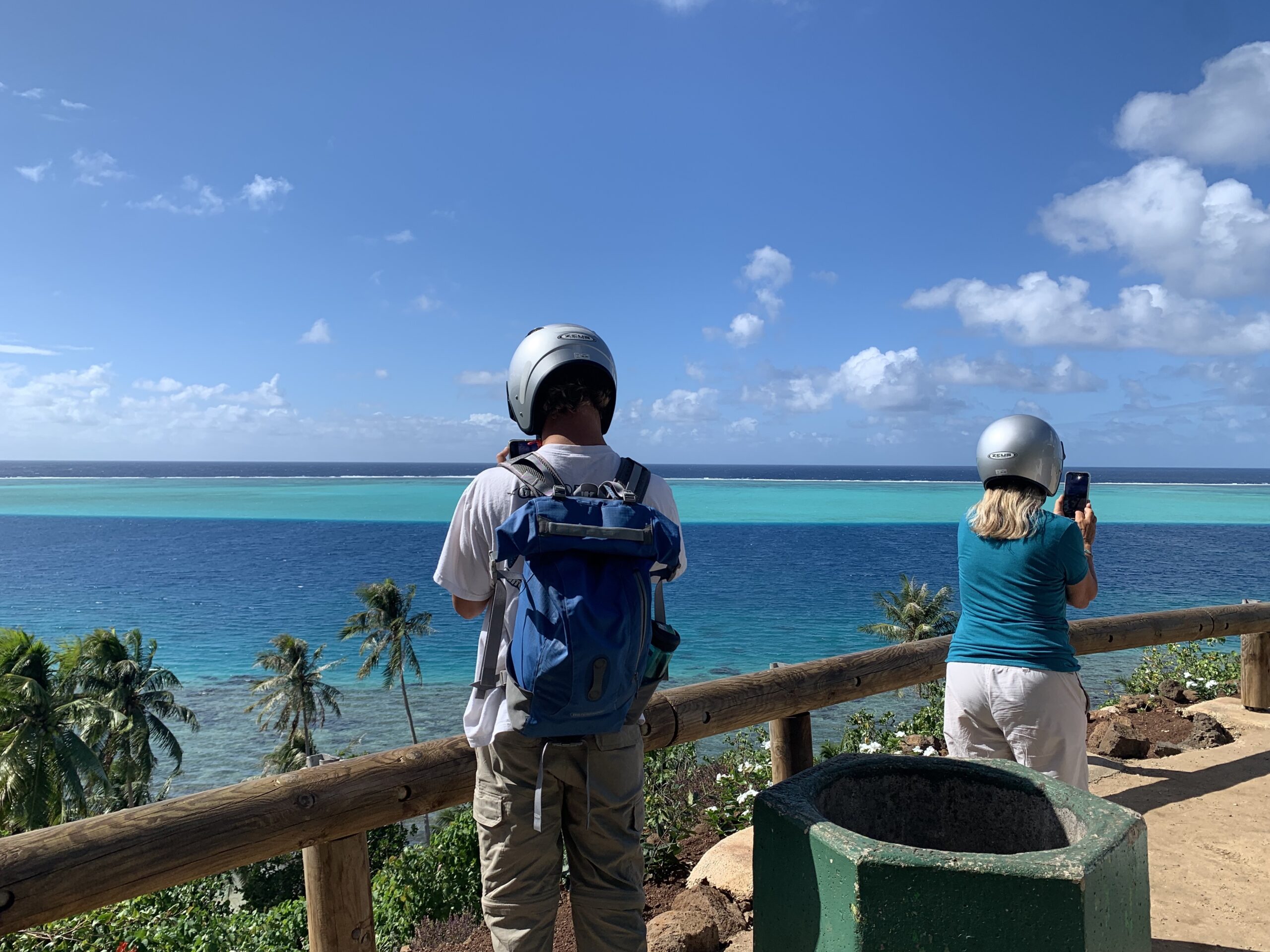
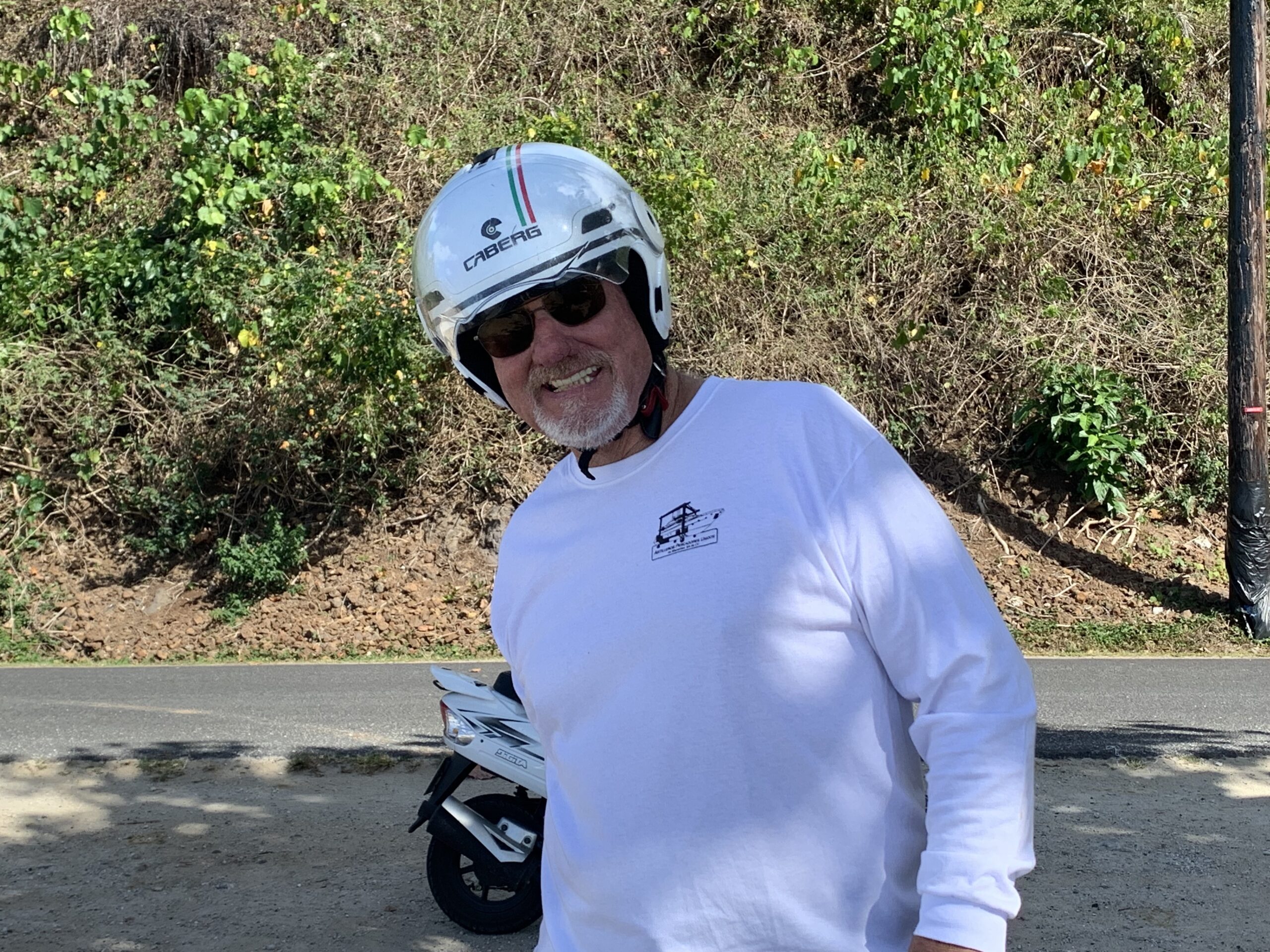
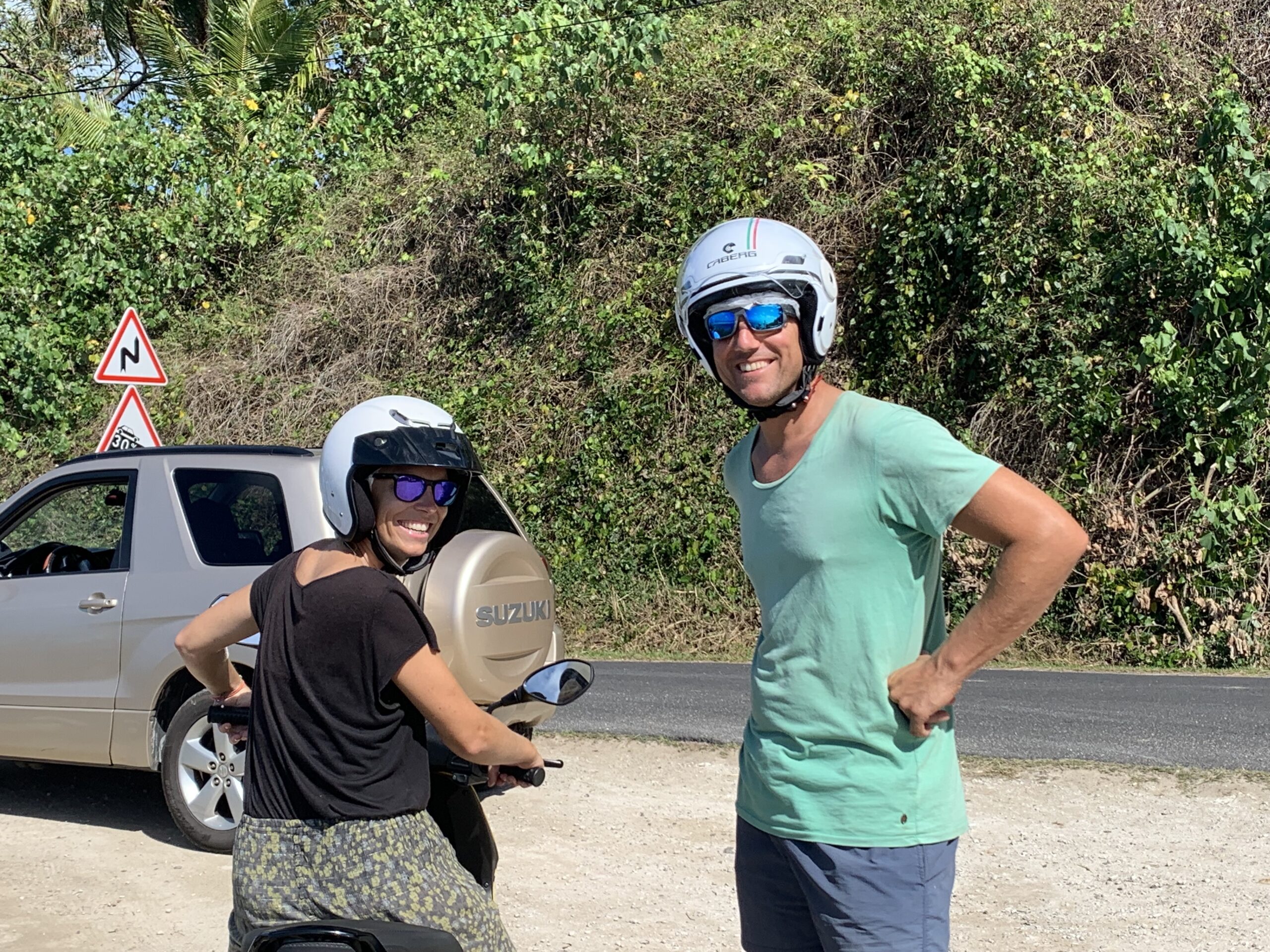
On Wednesday, the crews of Blue Beryl and Aldabra rode scooters around the island. We rode for only three hours but it was a great way to see the whole island.
Sharing a coconut on the scooter ride
Trevor and Linda
Tom
Yvette and Alex
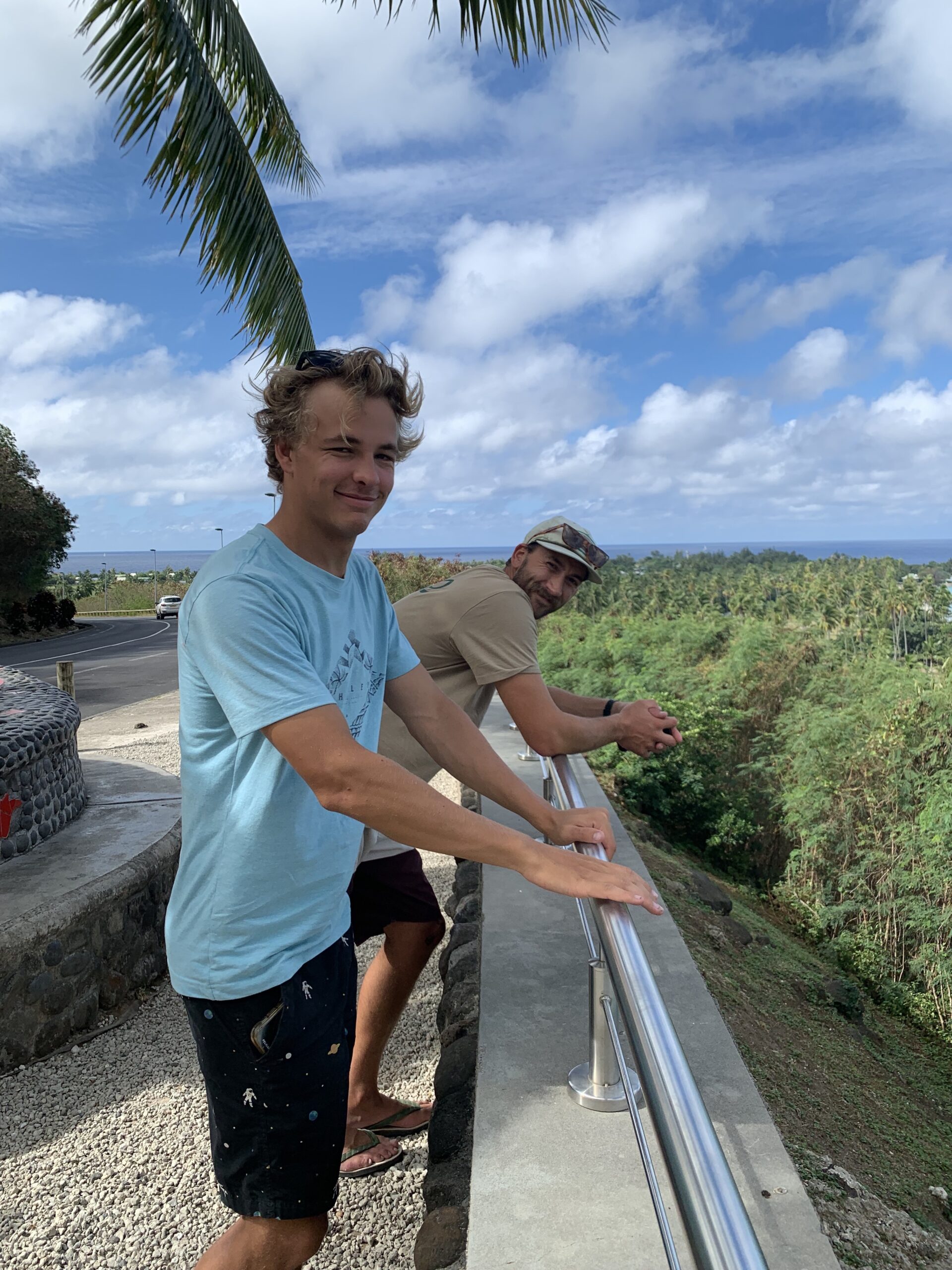
Stopping at a lookout
A view of another bay. That’s the cruise ship Wind Spirit
After lunch at the Huahine Yacht Club, we took the boats (Aldabra and Blue Beryl) halfway down the island to a different anchorage. It was a windy, rainy night and we did only a little bit of exploring the next day before picking up the anchor and going down to the anchorage at the end of the island. There were a lot of boats there. It was really windy. But Trevor and Alex got to kiteboard, and it made them very happy. After they were finished, we pulled up anchor again and went back to an anchorage near town.
Trevor enjoying a dinghy ride
We liked Huahine. The town of Fare had a nice vibe and it would have been easy to stay longer, but we had a lot of ground to cover and none of the crew had unlimited schedules. So, on Saturday, August 19, we left the anchorage at 7:00 a.m. and sailed to Raiatea. The winds were in the mid-teens and we sailed on a broad reach with just the jib. We arrived around noon and picked up a mooring ball across from town, got in the dinghy and headed across the channel to shore.
We got ice cream bars at the grocery store and started a bit of a search for motor oil for my next oil change. I should have bought it in Tahiti, but I forgot. The gas station was closed so we walked down to the operating base for Dream Yacht Charters to see if we could use the mooring ball we were already attached to. At the base, we were told we needed to provide a 6-pack of beer. So we walked back to the grocery store, bought the beer and then took the dinghy to the base. Once we presented the 6-pack to the base manager, we were told that they could no longer allow us to use the mooring ball. He told us that it was prohibited by local authorities. He got on the computer and showed me where we could anchor. I gave him the 6-pack anyway and headed back to the dinghy. We returned to the boat and headed north through the east channel and up to the east side of Tahaa to an anchorage on the reef. Blue Beryl joined us there, as did a few other boats.
On Sunday, we continued north on the east side Tahaa and rounded the island from east to west. Then we headed south down the west side of Tahaa to the Coral Gardens. It was quite windy but we found a decent place to anchor next to the reef. Blue Beryl arrived a bit later and we snorkeled the Coral Gardens in the afternoon.
The Coral Gardens are a small pass between two motus on the outside of Tahaa. You can walk up one motu and then slip into the water and follow the current through the coral. It is quite picturesque. I went down, then swam back against the current to go down again.
On Monday, August 21, Aldabra and Blue Beryl left Tahaa and sailed over to Bora Bora. We left at 7:00 a.m. and arrived in the early afternoon. It was a nice sail, with the spinnaker, until our spinnaker halyard broke and the spinnaker dropped into the water. We gathered it onto the boat and continued on in through the pass. After wandering around a bit, we attached ourselves to mooring balls in front of the Bora Bora Yacht Club.
Aldabra in Bora Bora
The sailboat Szel with Jamie and Fiona was also on a mooring near us. Linda and I took the dinghy over to see them for a visit. Later that evening Aldabra and Blue Beryl had drinks and dinner at the Yacht Club and Jamie and Fiona came later and sat at the table next to us. We chatted a bit before we left and they had their dinner.
Dinner at Bora Bora Yacht Clug: Alex, Tom. Trevor, me, Linda and Yvette
On Tuesday, August 22, Trevor went up the mast to retrieve the halyard that had frayed and broken.
Trevor up the mast
Then we followed Blue Beryl as we motored around to the back side of Bora Bora, through very narrow, shallow channels. Trevor drove and we picked our way through, sometimes within an inch of touching the bottom. In a catamaran, the trip would have been a breeze, but with a deep keel, it was quite nerve wracking. In the end, we arrived at a beautiful anchorage. We explored the motu on foot and in the water, and had a dinner party that night with Blue Beryl on Aldabra.
Crusing around the island
The next day, we had a swimming race between the two boats. Alex represented Blue Beryl and Trevor represented Aldabra. Trevor was handicapped in two ways. He was wearing his snorkeling mask instead of swim goggles. And he was wearing his swim trunks. Alex, with no swim trunks and with swim goggles beat Trevor by a small margin. But they were both completely spent.
After the race, Aldabra headed back around the island, following our track from the day before. After picking up a mooring ball in front of the Yacht Club, we took the dinghy to town to find out about a ferry for Trevor to get to the airport. After sorting that all out, we found a restaurant for lunch and a gas station to buy motor oil. Then we went back to the boat so Trevor could pack. Linda took him back to town later that afternoon so he could take the ferry to catch his flight back to Tahiti. He then spent the night in the Tahiti airport and caught a flight the next morning to San Francisco. (Once home, Trevor began his job search and rather quickly landed a job in his field.)
We had a quiet night on the boat. Then on Thursday, Tom and I went to shore early to hand over our laundry to Julie, a very nice woman who picked it up in her car. Back at the boat, we did some cleaning and reorganizing, along with paperwork to enter the Cook Islands. We had dinner that night at the Bora Bora Yacht Club and retrieved our laundry from Julie while we were there. We also took showers there and dropped off our trash.
On Friday, August 25, Linda and I took the dinghy into town to fill up a jerry can with gasoline and buy 2-stroke oil and some groceries. It was a windy day and we spent the rest of it on the boat, stowing things and otherwise getting ready for a passage. Alex came over and inspected the rigging and gave me a report on areas of concern.
At his suggestion, we connected the inner forestay and the starboard running backstay. We pulled the port running backstay back to a car on the rail because it was getting chafed on the spreader. It was a very windy and rainy night and we stayed on the boat.
On Saturday, August 26, Jamie of Szel and Alex and Yvette of Blue Beryl came over for a weather meeting. We all decided to leave that day for Penryhn Island in the Cook Islands. We were now saying goodbye to French Polynesia.
On Thursday, July 27, Johno, Trevor and I motored from Moorea over to Tahiti in light air. We couldn’t get a slip in Marina Papeete and the free anchorage near Marina Taina was crowded, so we anchored in a good spot in the airport anchorage. Friday was a rainy day and we took the dinghy over to the dock at Marina Taina and caught a bus to the airport, where we picked up a rental car. We drove back to Marina Taina, where I dropped off paperwork to renew my Carte de Jour at Tahiti Crew. We also dropped off used motor oil, recycling and trash.
Our next stop was the Tahiti Museum. I try to take everyone to this place. It’s newly reopened and offers a myriad of displays about the migration of people to Polynesia as well as the cultural history of each of the island groups. Afterwards, we had lunch at Casa Bianca at Marina Taina and then walked over to Carrefour to buy groceries, a luxury after so many weeks in the Tuamotus.
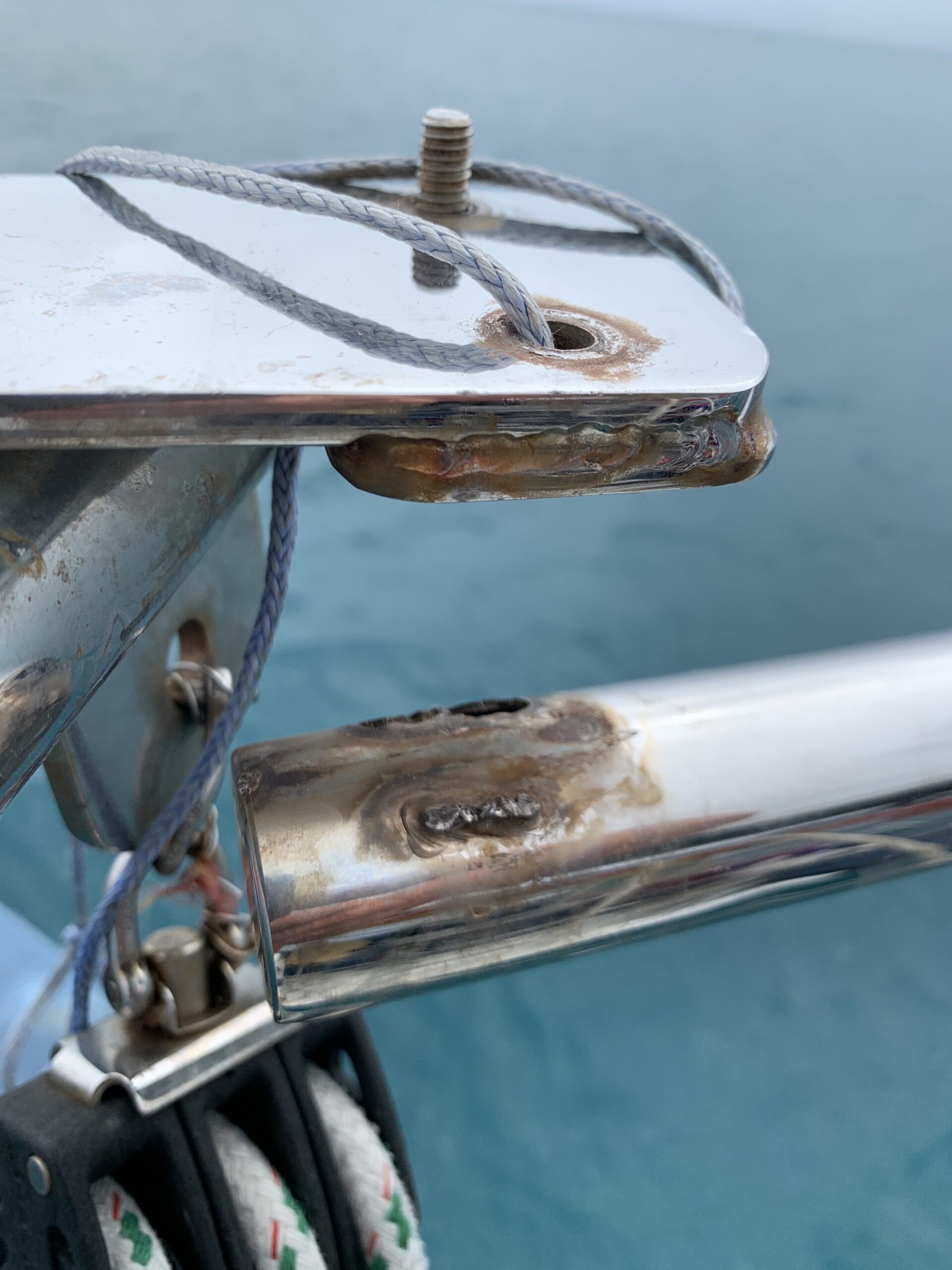
Saturday was super windy and we didn’t leave the boat. On Sunday, Ludo Martinez, a welder, came out to the boat to talk about rewelding a cross-piece for my davits.
Davits with broken weld
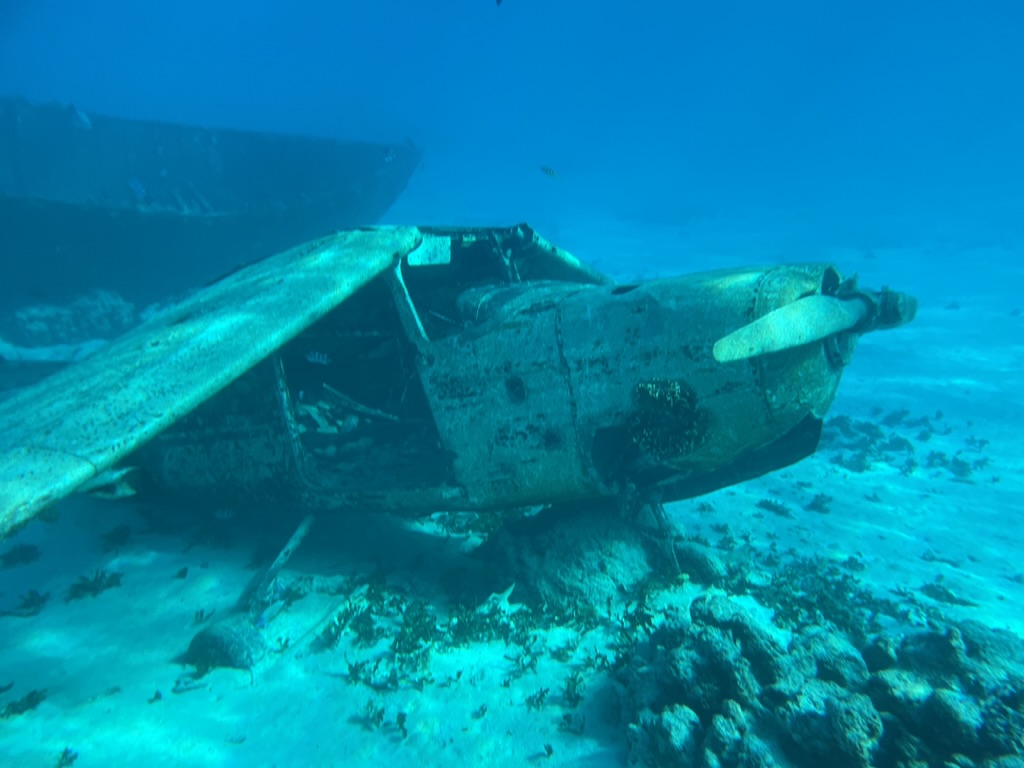
Then we went back to get the car and drove to Marina Papeete to talk to John Blair on Ballyhoo. He was offering to give us his slip as he departed from the marina. Because the marina is first come, first served, the way to get a slip when it’s really crowded is to coordinate with someone who is leaving. John also told us about a couple of airplane wrecks out near the airport anchorage and we resolved to check them out. We had lunch at the brewery restaurant not too far from the marina and then went back to Taina and parked the car before heading back to the boat.
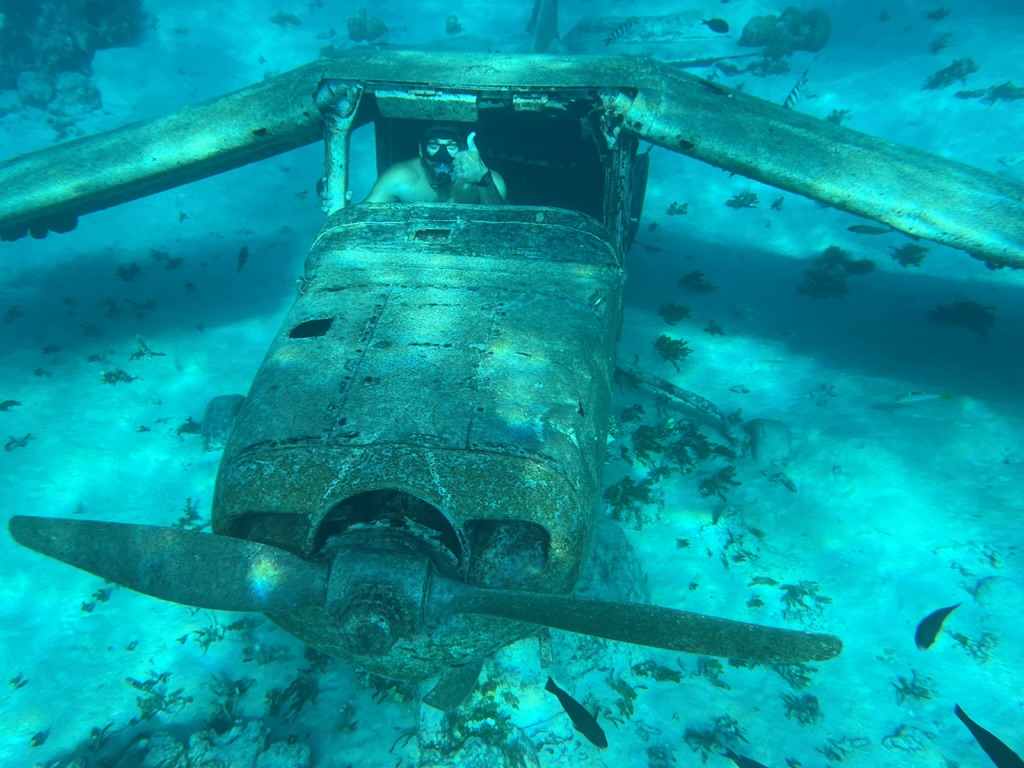
On Monday, we snorkeled on the smaller of the wrecks. As we were looking for the larger one, the wind and seas came up and we bailed on that one.
Wreck of small plane near the airport anchorage
Johno in the wreck
Trevor in the wreck
Someone built a desk at the wreck
Trevor at the desk
Back at the boat, the wind kept building, gusting to 35 knots. We stayed on the boat for the rest of the day, asking John Blair to postpone his departure from the marina, which he did.
Finally, on Tuesday morning, August 1, we pulled up the anchor and headed to Marina Papeete, arriving shortly after 6:00 a.m. John was out of the slip but idling in the marina so that no one could get past him to take the slip. We headed on in and one of our new dock mates helped us with lines. It was a tight fit. Due to a slight lack of communication, the bow sprit bumped into a rubber bollard, with no damage to either boat or bollard. We finally settled in and got the lines tied off. We were in our new home, the main attractions being real showers and water to wash the boat. It was the first marina Aldabra had been in since leaving San Diego. Because of the marina’s proximity to downtown Papeete, it also offered an easy way for any of us to go exploring.
After taking real showers, we walked around the downtown market and went to the fabric store where Johno found fabric he liked and Trevor eyed some he might buy later. Afterwards, we walked toward Marina Taina and then caught a cab so we could retrieve the rental car from Marina Taina. As soon as we got the car, we toured around the island.
View from the beach on the far side of Tahiti Iti
Hanging out at the beach in Tahiti Iti
Later, back at the boat, which was quite visible to anyone walking along the waterfront, we had a surprise visit from Jeff from Infinite Grace, whom we had met back in Aratika. He had flown from Rangiroa for an urgent dentist appointment. It was nice to catch up with him.
On Wednesday, August 2, we used the car again to tour around the island. After dropping our mainsail off to be repaired at the Tahiti Sails loft, we drove to Tahiti Iti and went up to the lookout there.
On Thursday, August 3, we drove Johno to the airport at a very early hour. Then Trevor and I went to Marina Taina and did laundry. It was so early that we had no competition for the machines. Afterwards, we went back to the boat in Marina Papeete. Trevor then walked around town and I joined him later for a second walk. We had dinner at a restaurant near the marina with Don and Gloria from Windswept, also from the Santa Cruz area.
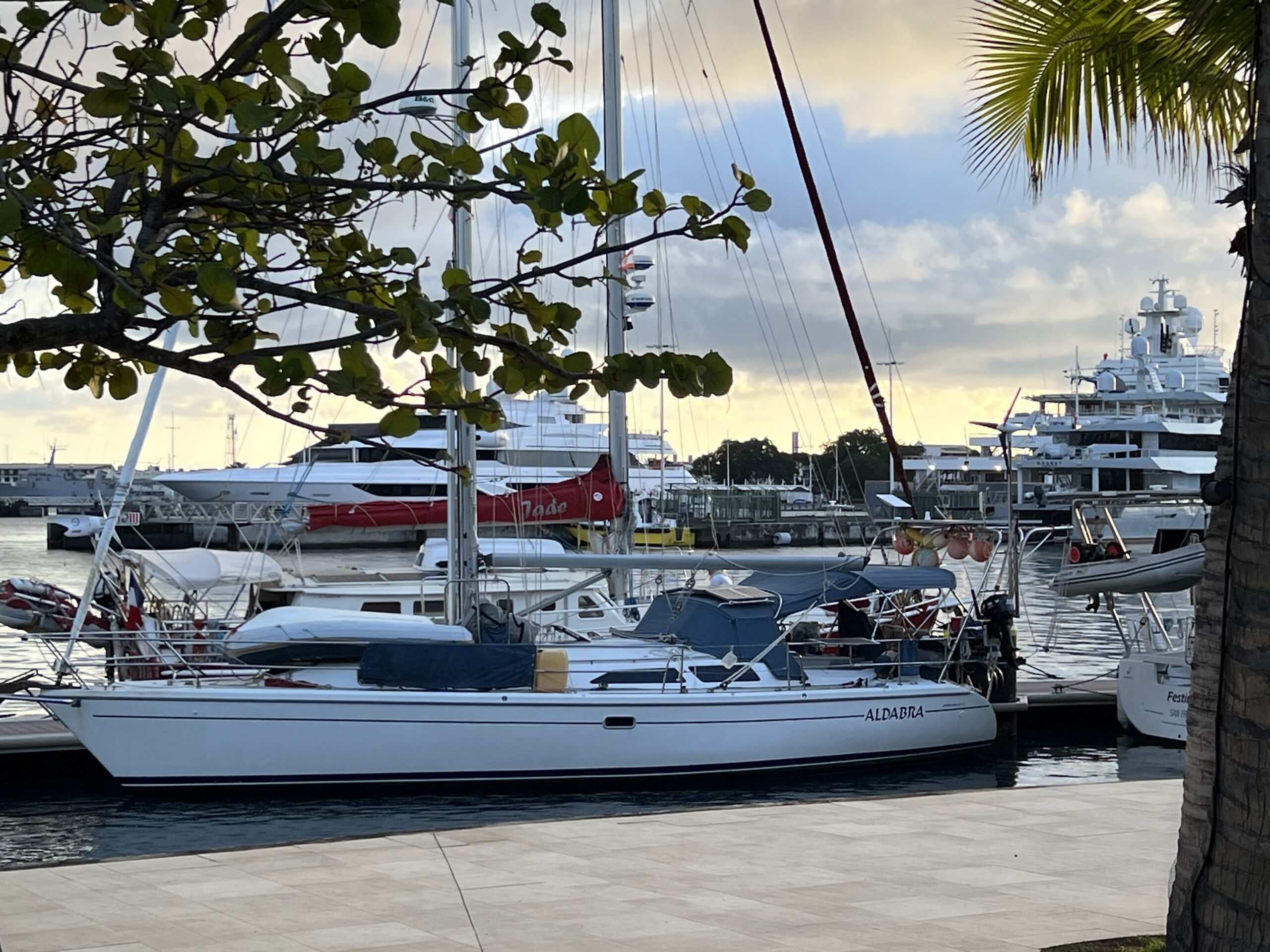
Aldabra at Marina Papeete
The view from Aldabra at Marina Papeete
Friday, August 4, was my birthday. Trevor and I snorkeled on the larger plane wreck. While we were there, Alex and Yvette from Blue Beryl stopped by in their dinghy. Later, when we were back on the boat, they stopped by and we made plans for dinner. Trevor and I washed most of the boat exterior before taking a few down hours before dinner. At around 5:00 p.m., Alex and Yvette joined us and we walked to the brewery restaurant. We had a very nice dinner and some beers, and they gave me the gift of a blue beryl stone. I was very honored.
On Saturday, we all went out to the big plane wreck again. The plan was for Trevor to use my dive gear, but when he got into the water, the regulator had a leak. He dove with just his snorkel gear while Alex and Yvette used their scuba gear. Afterwards, Trevor and I worked on washing the bottom of the dinghy. That night, the restaurant in front of the boat played really, really loud music all night.
On Sunday, August 6, Trevor and I made final preparations for our new crew, helped Blue Beryl with their dock lines as they came into the marina to get water, and met up with some new friends from California, Doug and Michelle on a catamaran in the marina.
On Monday, August 7, Trevor and I took the car early (4:30 a.m.) to pick up Linda, his mother, and Tom, my friend from Mexico and San Diego. I’ve grown close to Tom and his partner Helen over the last few years and was excited that he and Linda were going to be on the boat for the next leg of the journey. We took them back to the boat to get settled and then we went with Alex and Yvette and Doug in the car to see about getting my regulator fixed and to get our cooking gas tanks filled. My only choice was to buy a new regulator, which I did. Then we had to drop off the cooking gas tanks at a different location from what we had planned. Afterwards, Trevor, Alex and Yvette took the car to tour the island while I hung out on the boat with Tom and Linda. We all had dinner that night at the brewery.
The next day, Trevor and Tom worked on installing the Starlink system that Linda had brought in her luggage. Trevor swapped out two refrigeration modules that Linda had brought and he installed new fans for the watermaker feed pumps.
On Wednesday, August 9, we left Marina Papeete around 7:00 a.m. and headed over to Marina Taina.
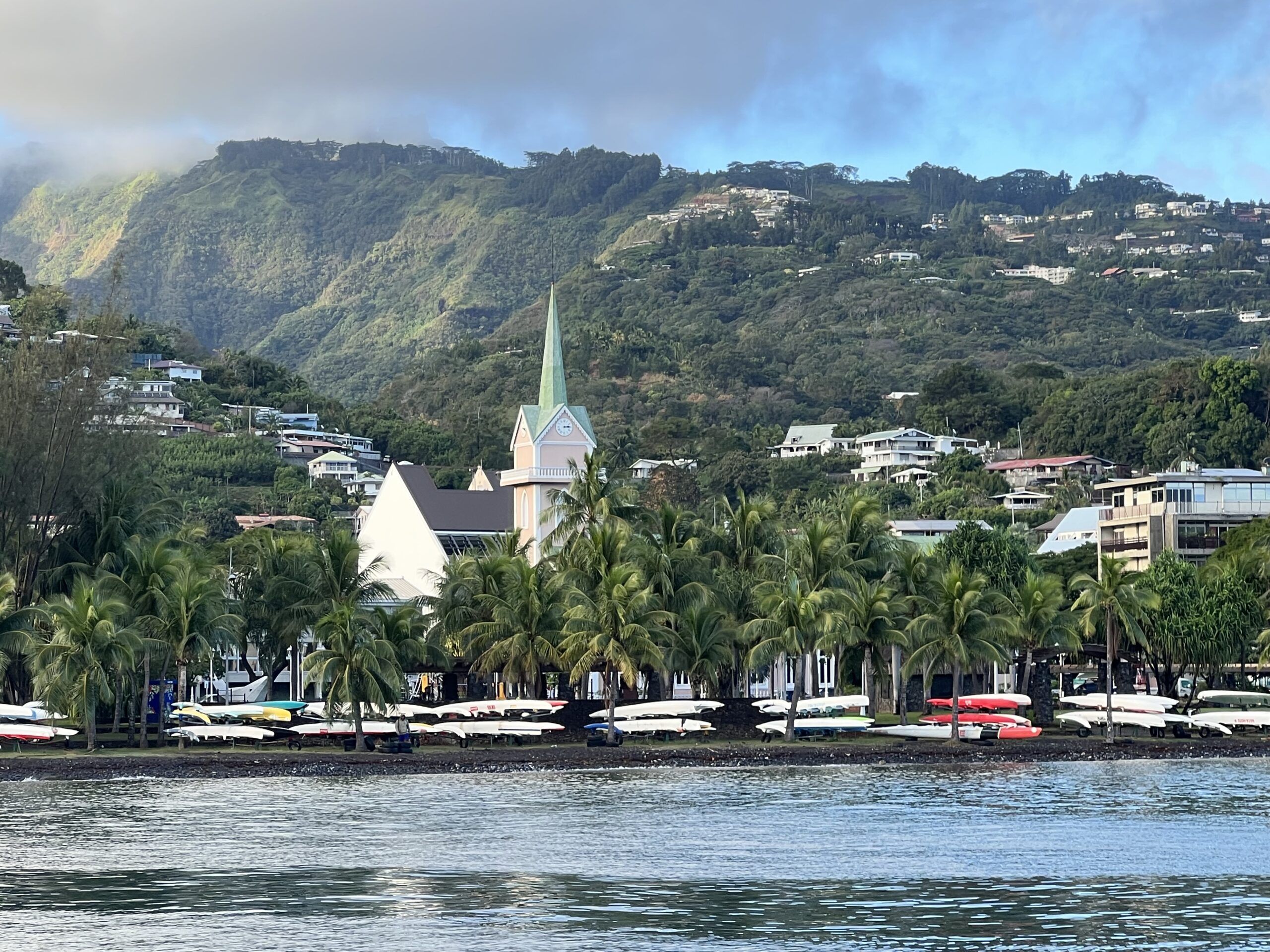
The waterfront view at we went from one marina to the next
Our welder had arranged for us to have dock space so he could work on the davits. It was a tight squeeze to get in, but with his help along with a couple of other guys, we got the boat turned around and situated so he could work. We were right at the entrance to the docks, in front of the Casa Bianca restaurant. Ludo thought that the work would take two days, but he was finished by noon. Linda and Trevor took the bus back to Papeete to get the rental car and then did some touring while Tom and I worked on the boat.
The next day, Tom and Linda went to the Tahiti Museum while Trevor and I shopped at Carrefour and brought two cartloads of groceries back to the boat. It’s not a long walk between the store and the marina. Later, we all went downtown to look around and picked up the cooking gas tank. Back at the marina, we put the mainsail back on the boat and had dinner at Casa Bianca.
On Friday, August 11, we checked out of the country, with the help of Tahiti Crew. We also took delivery of some duty-free wine and liquor and checked out of the marina. We took a final run to Carrefour and then took the boat over to the gas dock. Unfortunately, they closed for lunch after filling up the boat in front of us, so we had to wait until after 1:00 p.m. to get diesel fuel. Finally fueled up, we were out of the pass and headed toward Huahine by 2:30 p.m.
It felt funny to say goodbye to Tahiti, knowing that I would not be returning. It isn’t my favorite place in the world, but I had spent considerable time there over the last year, and was growing quite used to it.
Johno and Trevor arrived in Fakarava on July 3. Johno was on Aldabra last year from the Marquesas to the Tuamotus, along with Trevor’s twin sister, Dana. This was Trevor’s first time on the boat in the South Pacific. He had just graduated from Cal Poly San Luis Obispo and was able to fit this trip in before some serious job hunting in mechanical engineering/robotics. They joined Pat and me on the boat and brought lots of goodies, such as a new wind generator, some new components for the refrigeration system and food treats.
On Tuesday, July 4, we picked up the anchor and went to the fuel dock.
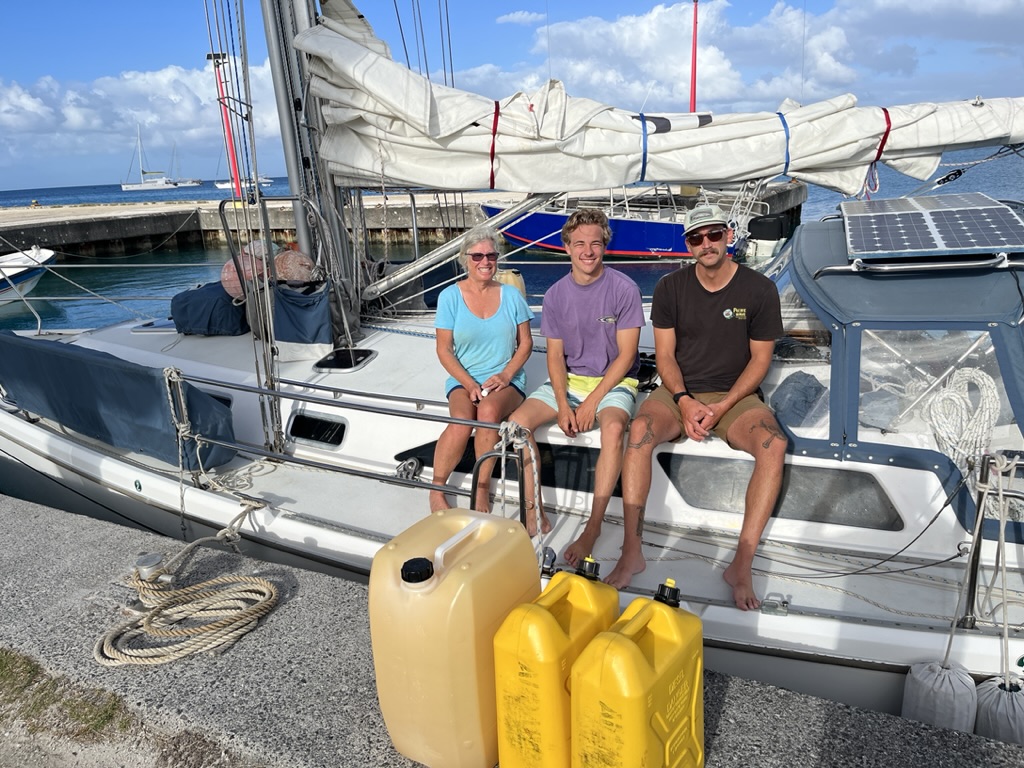
Sitting on the boat at the Fakarava fuel dock with Trevor and Johno
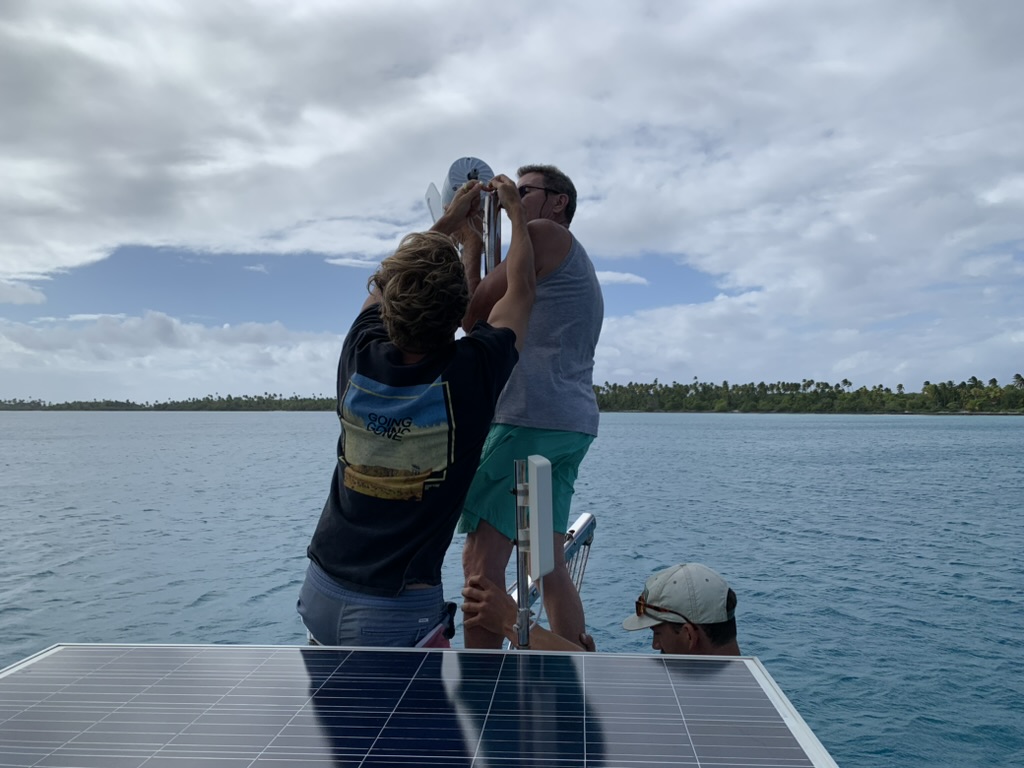
We then sailed down to the Fakarava South Pass. We anchored at about 2:00 p.m. and snorkeled the pass before joining a Fourth of July picnic set up on shore by our friends Bruce and Alene on Migration. It was nice to see Bruce and Alene and to meet some new cruisers. On Wednesday, we sailed over to Hirifa in 25 knot winds and anchored in that more protected anchorage. I baked banana bread while Pat, Johno and Trevor installed the replacement wind generator. (We’d had so much wind since arriving in the Tuamotus that I was constantly aware of how much we were wasting it by not having a working wind generator to charge the batteries.)
Installing the new wind generator
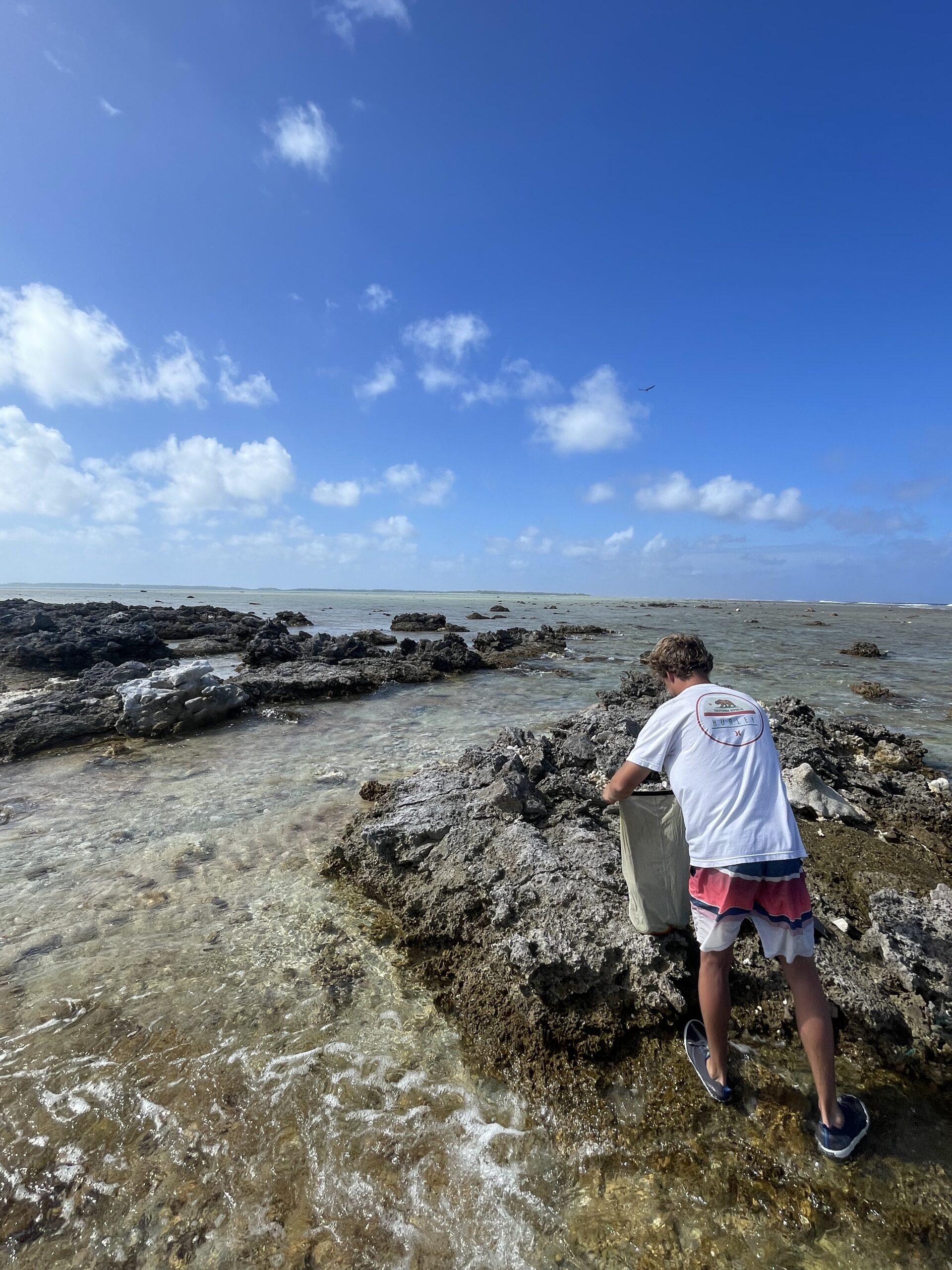
The next day, Trevor and Johno took a really long walk across multiple motus and sand bars to explore a distant motu, three miles away. They did a lot of wading and were quite spent and sunburned when they finally returned.
Trevor on the long walk
While they were away, I was planning the itinerary for the coming weeks in the Tuamotus and measuring the watermaker output, which was way under capacity for no apparent reason. Bruce and Alene from Migration came over for dinner that night and it was great to see them again. We spent the next day cleaning the boat bottom. On Saturday night, we had a nice dinner on shore at Eliza’s, with a few other boats.
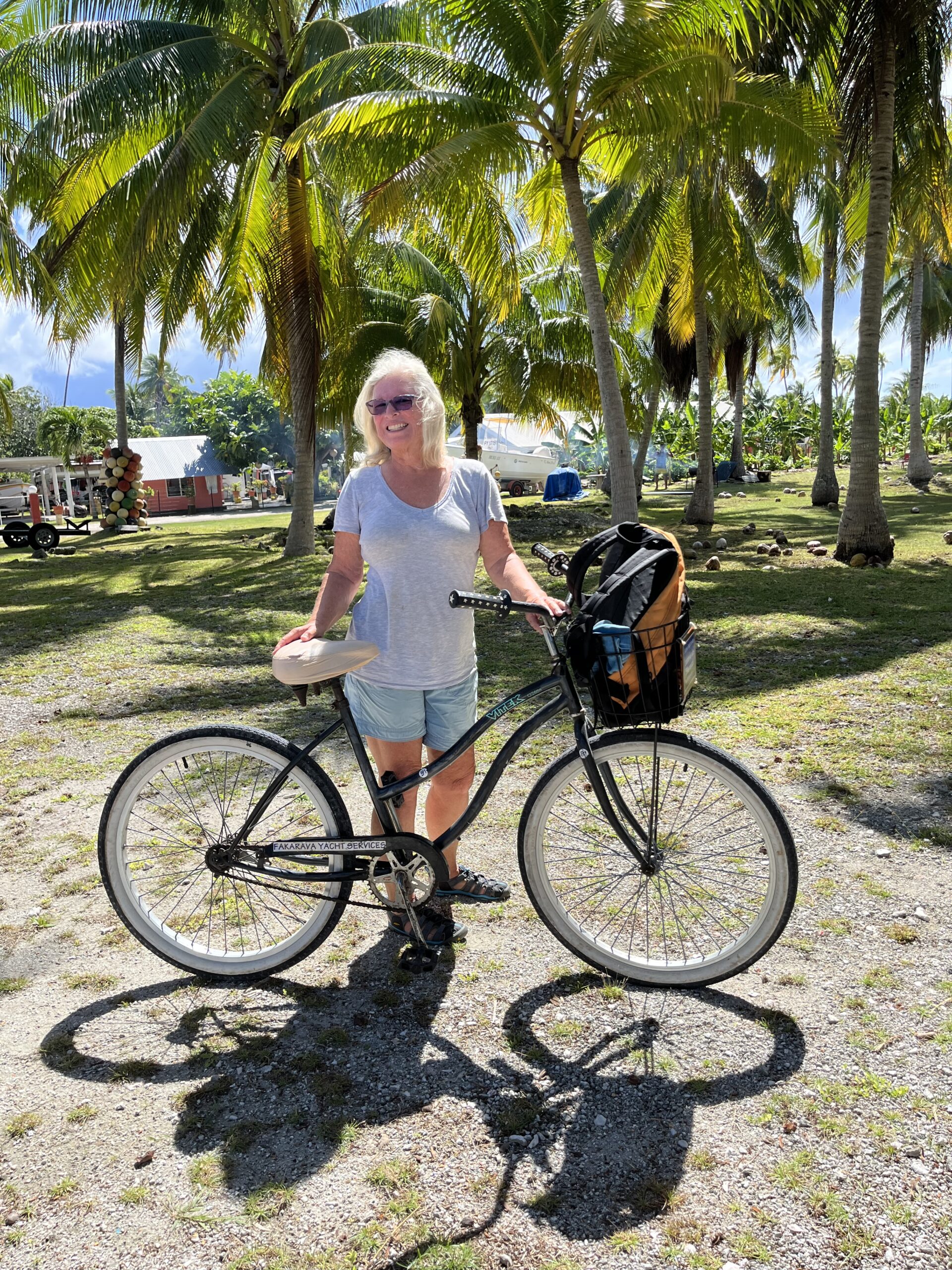
On Monday, July 10, we left Hirifa a few minutes before 7:00 a.m. and sailed back to Rotoava, arriving shortly after noon. It was a nice sail with 12-18 knots of wind. We went ashore to drop off a cooking gas tank to be refilled, and we bought some groceries. The next day we rented ebikes and toured around the atoll before having lunch at the snack that Pat, Bill and I had been to previously. After picking up the cooking gas tank, we went back to the boat to endure a windy, rolly night.
Exploring the outer beach of Fakarava during the bike ride
On Wednesday, July 12, we picked up the anchor at 5:00 a.m. and motored over to the north pass of Fakarava. We exited the pass at 6:15 a.m. at slack tide, with very mild current. Outside the reef, we put up the sails with two reefs in the main. We had a fast sail on a beam reach with winds in the high teens. We arrived outside the Aratika pass at noon, right behind Infinite Grace, a boat we hadn’t met yet. Once we were inside the pass, a squall came up and we had white-out conditions while trying to navigate across the lagoon to some mooring balls in front of the village. The visibility soon improved and we got ourselves across and attached to a mooring ball by 1:30 p.m. It was a rainy afternoon and we stayed on the boat.
On Thursday, July 13, we took the dinghy to shore and walked into the village. There we found the town clerk and paid a nominal fee for two night’s mooring. We were in Aratika at the suggestion of Bruce and Alene, who had done a lot of research to find a Tuamotu atoll that wouid be celebrating the annual Heiva festival. Many of the other atolls were sending their community members to Tahiti for the celebration, so they were not celebrating on their home turf. Aratika is a tiny community and we looked forward to meeting people and participating in the celebration. Infinite Grace was there for the same reason and Migration would be following the next day.
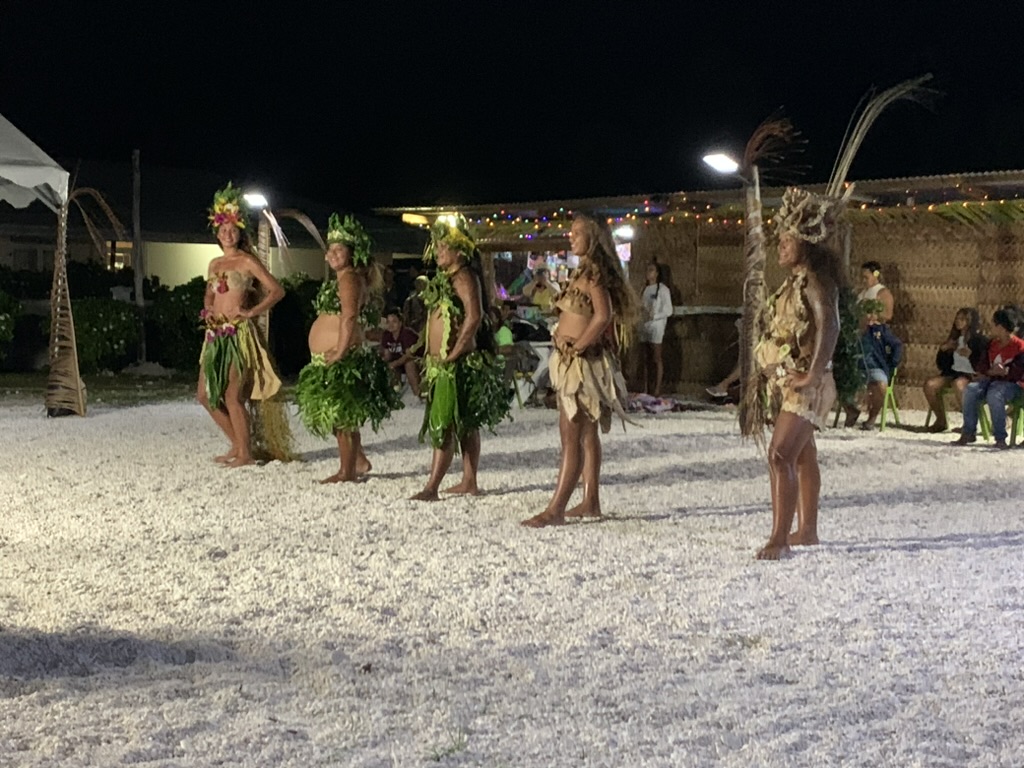
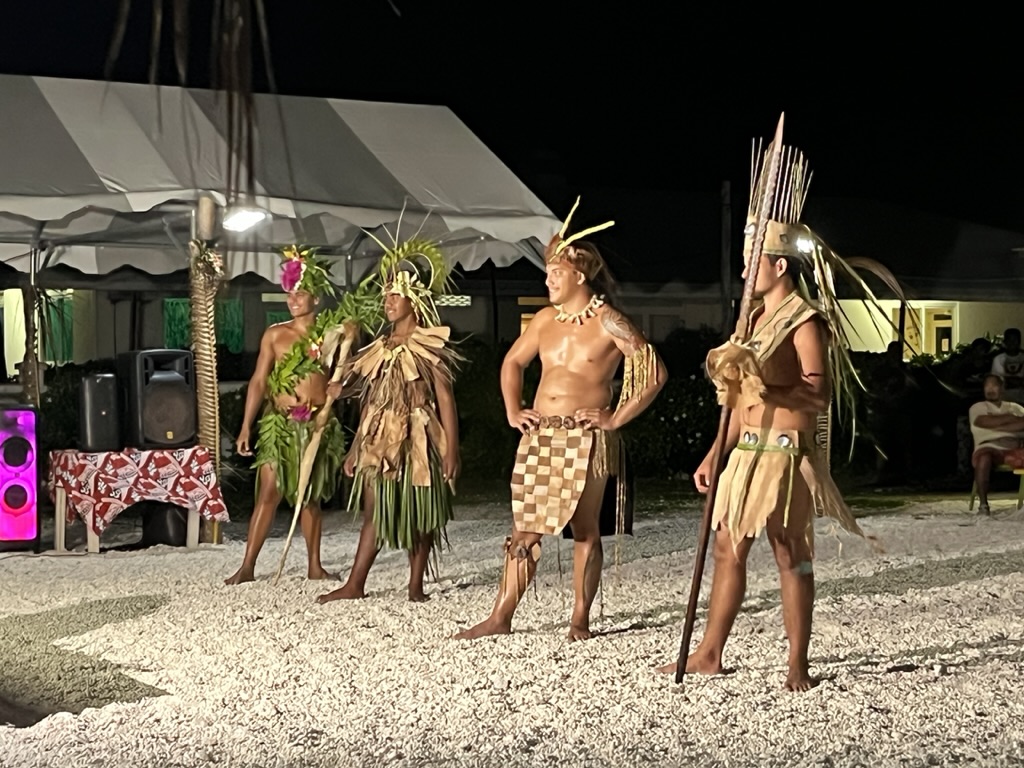
We walked around the windward side of the atoll to check out the beaches there, and we talked to Tea, who owned a restaurant that would be serving dinner during the celebration. He told us that the first event would be that night, a Mr. and Mrs. Aratika competition. After spending the rest of the afternoon on the boat, we returned to the town center in the evening, chatting with Jeff and Michelle on Infinite Grace, Bruce and Alene on Migration, and Yves and Marta on Breakaway. Then we watched the 3-hour competition before having a late-night dinner at the restaurant. The competition featured about five women and four men who modeled a variety of outfits, such as traditional, casual and evening wear. The two winners were announced after a rather lengthy and confused deliberation by the judges. It was fun to be there with all the members of the community and to see all the children running around and playing. We got back to the boat around midnight.
The women doing a final pose in their traditional outfits
The men in their final pose in their traditional outfits
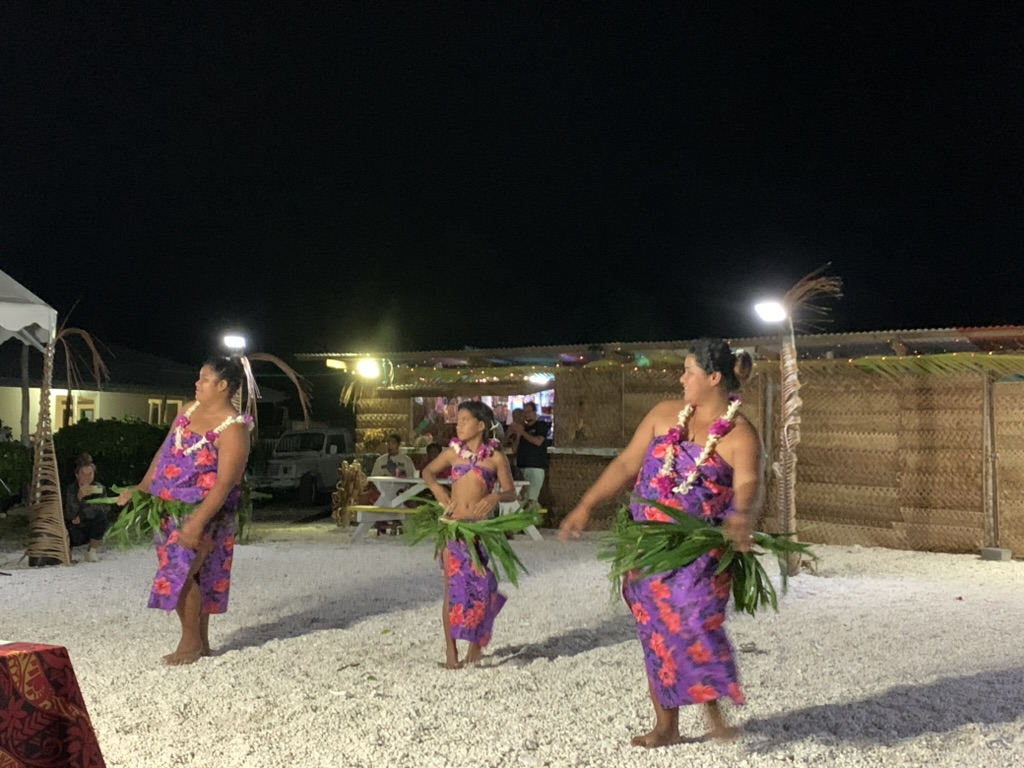
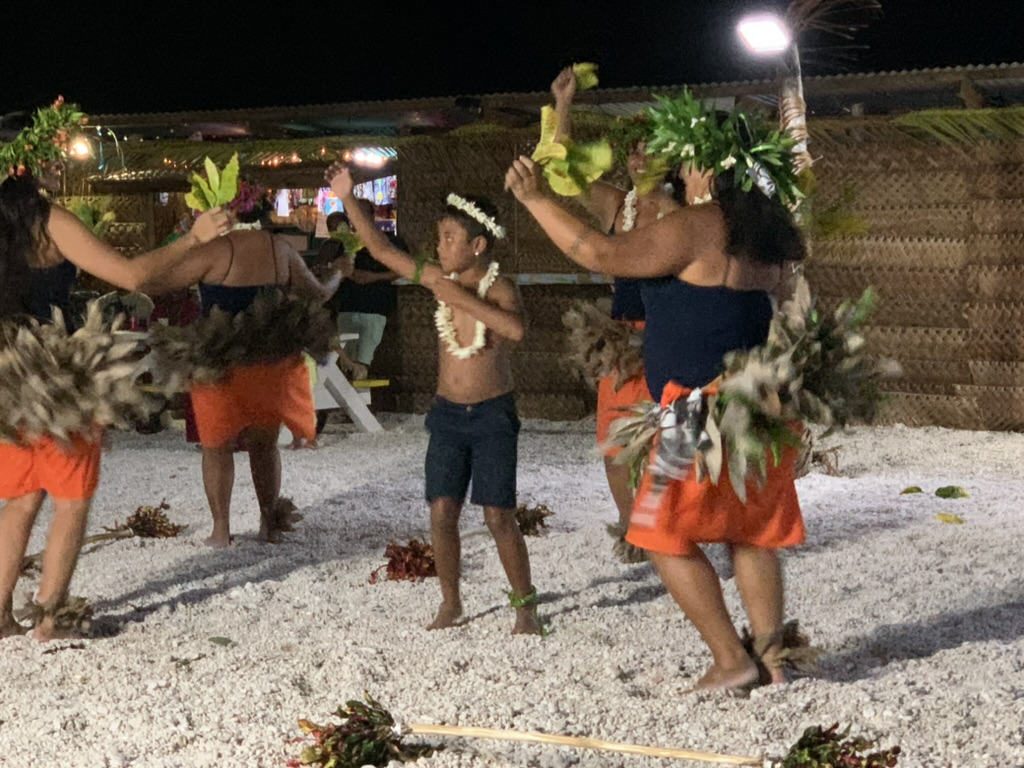
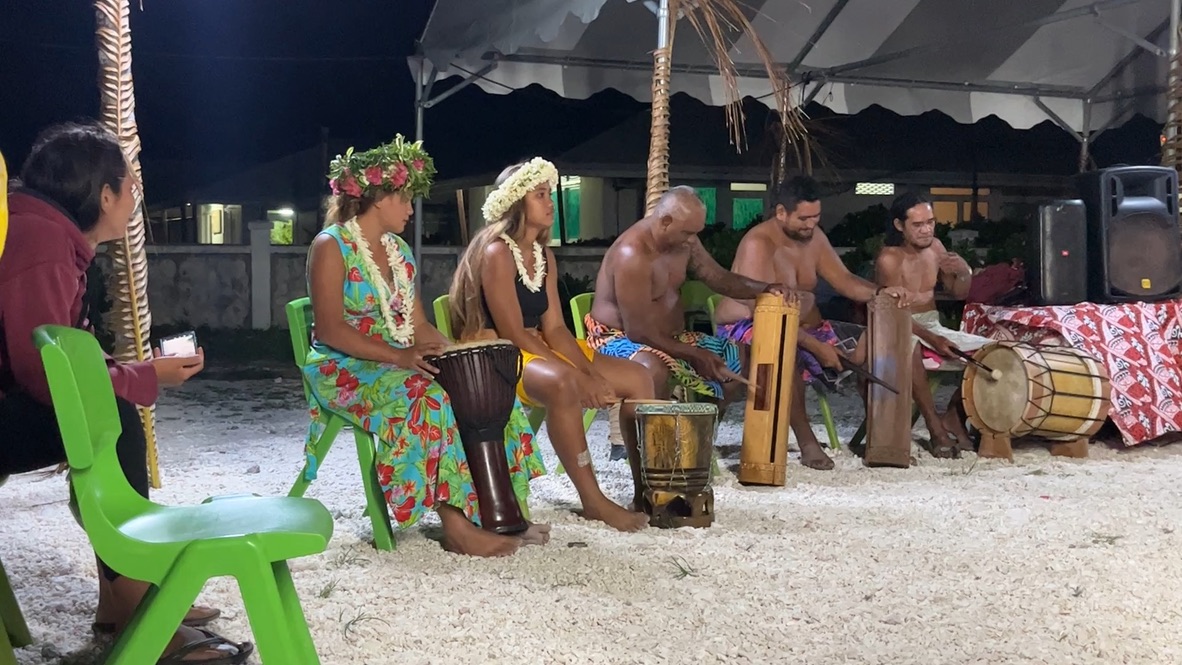
The next day, we slept in and did not go into town for the scheduled parade. Instead we repaired a rip in the mainsail and Johno and Trevor snorkeled on the reef. We ate dinner on the boat and then went back to town that evening for the dancing competition, which included just women. Evidently the men were too shy for that. But we really enjoyed the women dancers and the evening was not a long one.
Actually there was one young man in the dancing competition
The singers and musicians
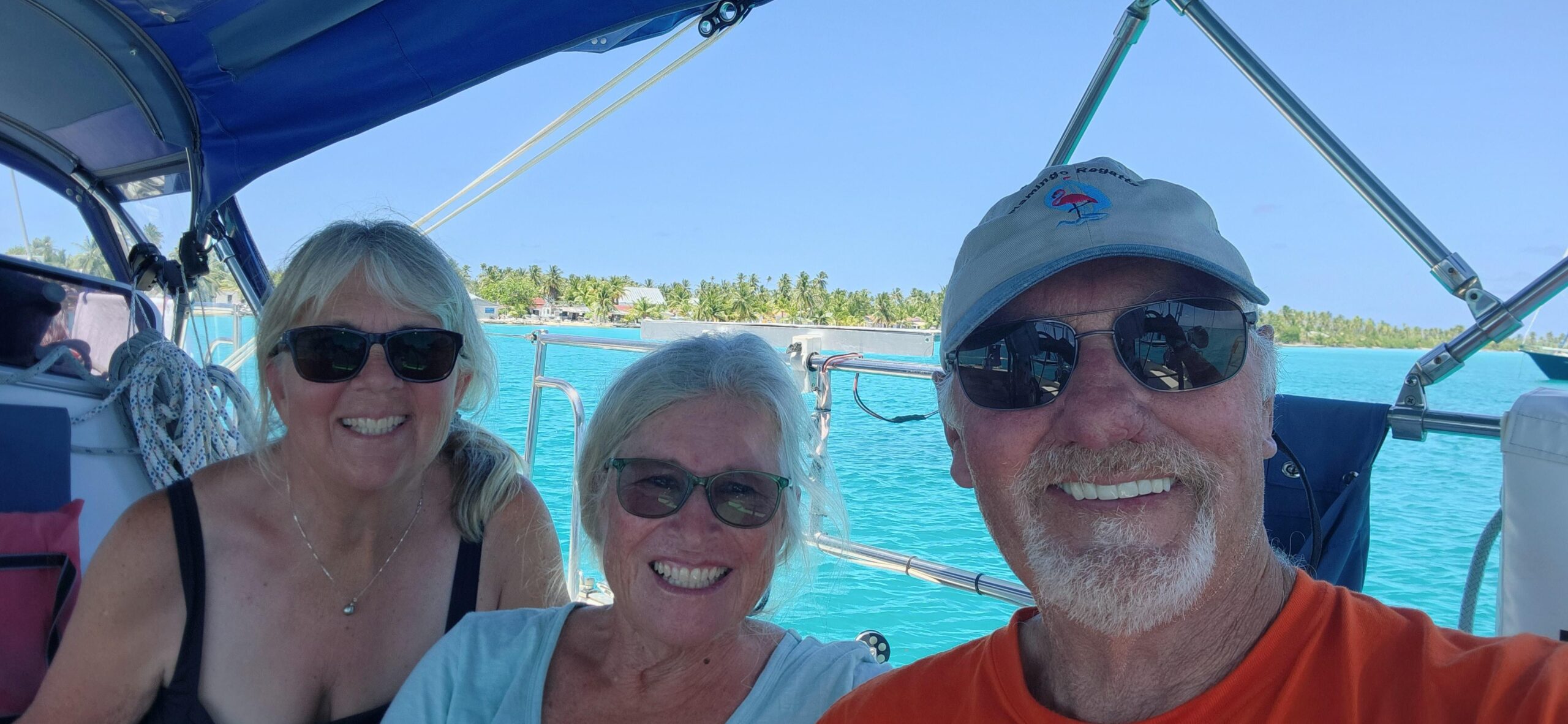
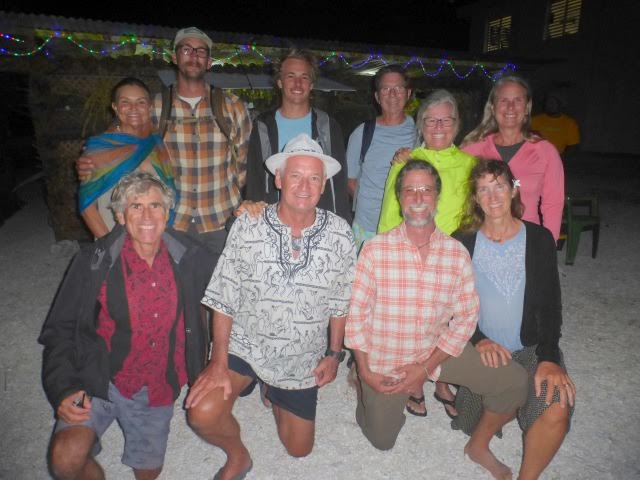
The cruisers visiting Aratika for the festival
The next morning, on Saturday, July 15, we left the mooring ball and exited the pass. We were a couple of hours before slack tide and the current was strong but manageable. It whooshed us out very rapidly.
The current as we left the pass
We sailed west across to the False Pass of Toau on a nice beam reach and were on a mooring ball shortly after 2:00 p.m. We talked to a very nice Dutch couple on Dina Helena. They were on their way to the Marquesas and had come from Patagonia and the Gambier. Johno and Trevor got out snorkeling on the reef near where we were anchored.
On Sunday, we all snorkeled near the southwest side of the anchorage, crossing the reef to look for mantas. It was a calm day and the snorkeling was great.
Johno up the mast in the False Pass
Johno’s view from the top of the mast in Toau
On Monday, we left the mooring ball at 5:30 a.m. and exited the pass, heading to Tikehau. During the day, the winds were in the low teens and we sailed with the spinnaker. We took it down before nightfall, but didn’t tie the sheet off properly. That night, with winds shifting, we needed to jibe to avoid hitting Rangiroa. Later, the winds picked up significantly and we needed to reef. As I pulled in on the furling line, I must have caught the spinnaker sheet, and the spinnaker ended up in the water, being dragged behind the boat and making it nearly impossible for Johno to steer. Trevor and I managed to get the spinnaker back up on the boat and we realized how lucky it was that we didn’t lose it altogether. We finished reefing the main just as the wind started calming down.
The next morning, as we approached the pass to enter the Tikehau atoll, we discovered that our old friends on Blue Beryl were anchored there. As we entered the pass around 11:00 a.m. they approached the anchorage near the pass and we met up in that anchorage. It was pretty windy but we had a nice dinner together that night and got caught up on their lives since we’d last seen them.
The next day, Blue Beryl exited the pass, heading over to Rangiora, and we sailed over to Motu Mauu to see the mantas that frequently hang out there. We anchored in pretty marginal conditions, high winds and very choppy. But we got the dinghy in the water and headed over to some mooring balls near the motu. After snorkeling for a bit, we followed a tour group and indeed got to see a giant manta. People would dive down and try to engage it and it would just hang out, unbothered by the attention. It was quite spectacular.
Trevor with the giant manta in Tikehau
Johno with the giant manta
After that splendid show of nature, we pulled up the anchor and headed over to the anchor near the village, where it was a little bit more protected from the wind and waves. We went ashore and walked around the village We found a pizza place on the other side of the motu and ordered a few pizzas. Then we walked to the airport just to see how far it was. After returning to eat our pizza, we went back to the boat.
Eating pizza in Tikehau
The next day, Thursday, July 20, Pat made omelettes and packed. It was a gloomy, windy day. We went ashore and walked with Pat to the airport, where he flew to Tahiti and then on to Los Angeles. On Friday morning, I went ashore to look for a bakery, but the woman had no baked goods because she had no flour. With the weather making it difficult to enjoy Tikehau, we decided to head over to the anchorage near the pass for a quick getaway the next morning. Once we got there, however, it was so choppy and windy that we decided to just leave that afternoon. We put the dinghy up, had lunch and headed out of the pass. The exit was smooth. We put the sails up and headed for Moorea in 14 knots of wind.
On Saturday morning we had light winds and sunshine for the first time in three days. The swells moderated a bit and we sailed most of the day on a close reach. The winds got even lighter as we approached Moorea. For the last twenty miles we used a motor assist, arriving at the entrance to Cooks Bay around 10:00 p.m. Because I had been in there so many times, I thought it would be easy enough to do at night. But everything is different at night and entering was a bit disorienting. We just followed the charts and the buoys into the bay and then started heading deeper into the bay. It was too dangerous to motor among the boats because we couldn’t really tell what was what among the anchor lights. We ended up dropping the anchor in deeper water, behind the fleet and then celebrating our arrival with a beer. I think we all slept well after our overnight sail.
On Sunday, July 23, we all slept in. I then started taking care of business I needed to attend to and Johno and Trevor went for a walk around the bay. The next morning, we picked up a rental car and drove around the island. We had lunch at the restaurant at the Timpanier Resort.
Enjoying the view in Moorea
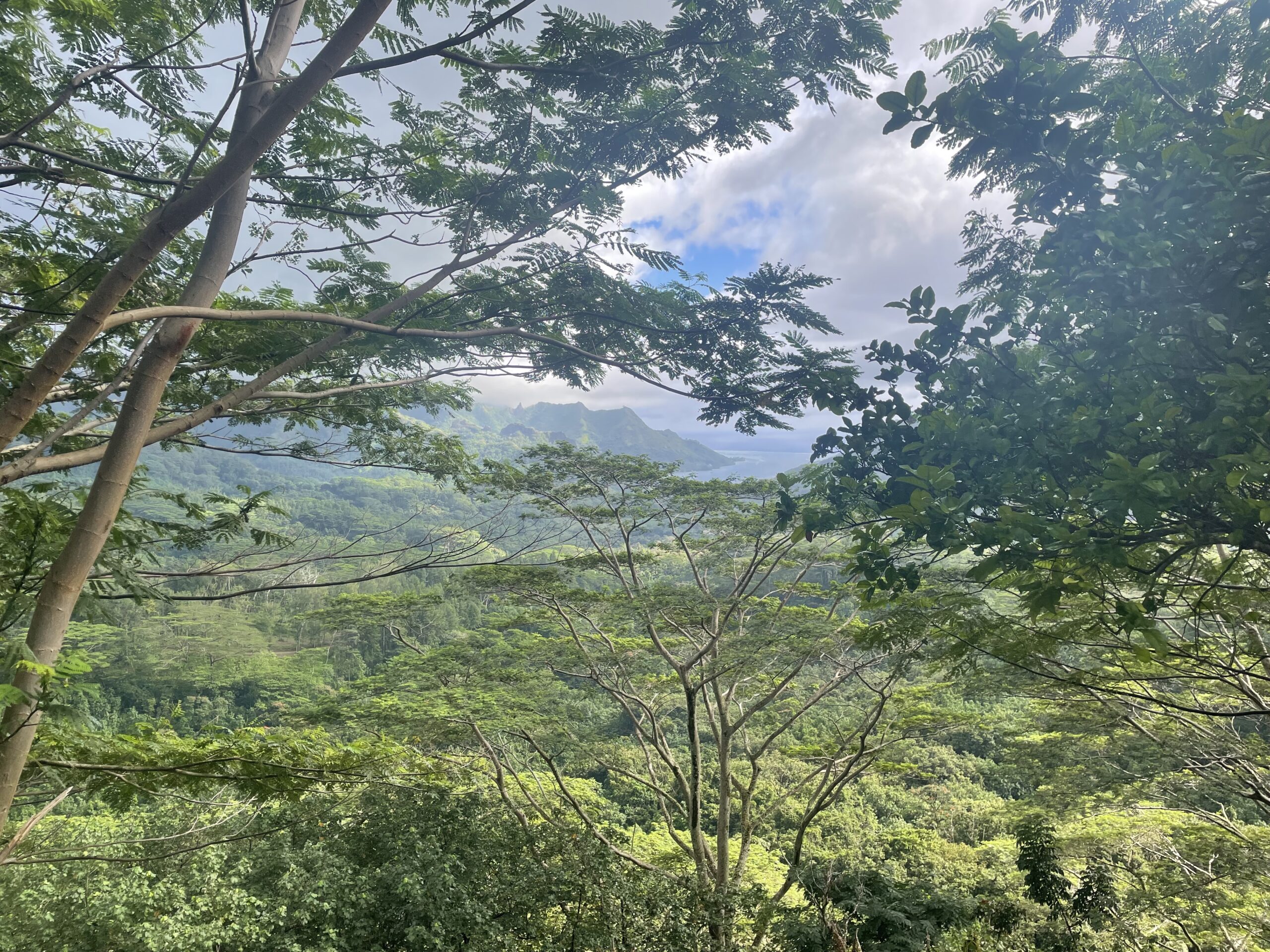
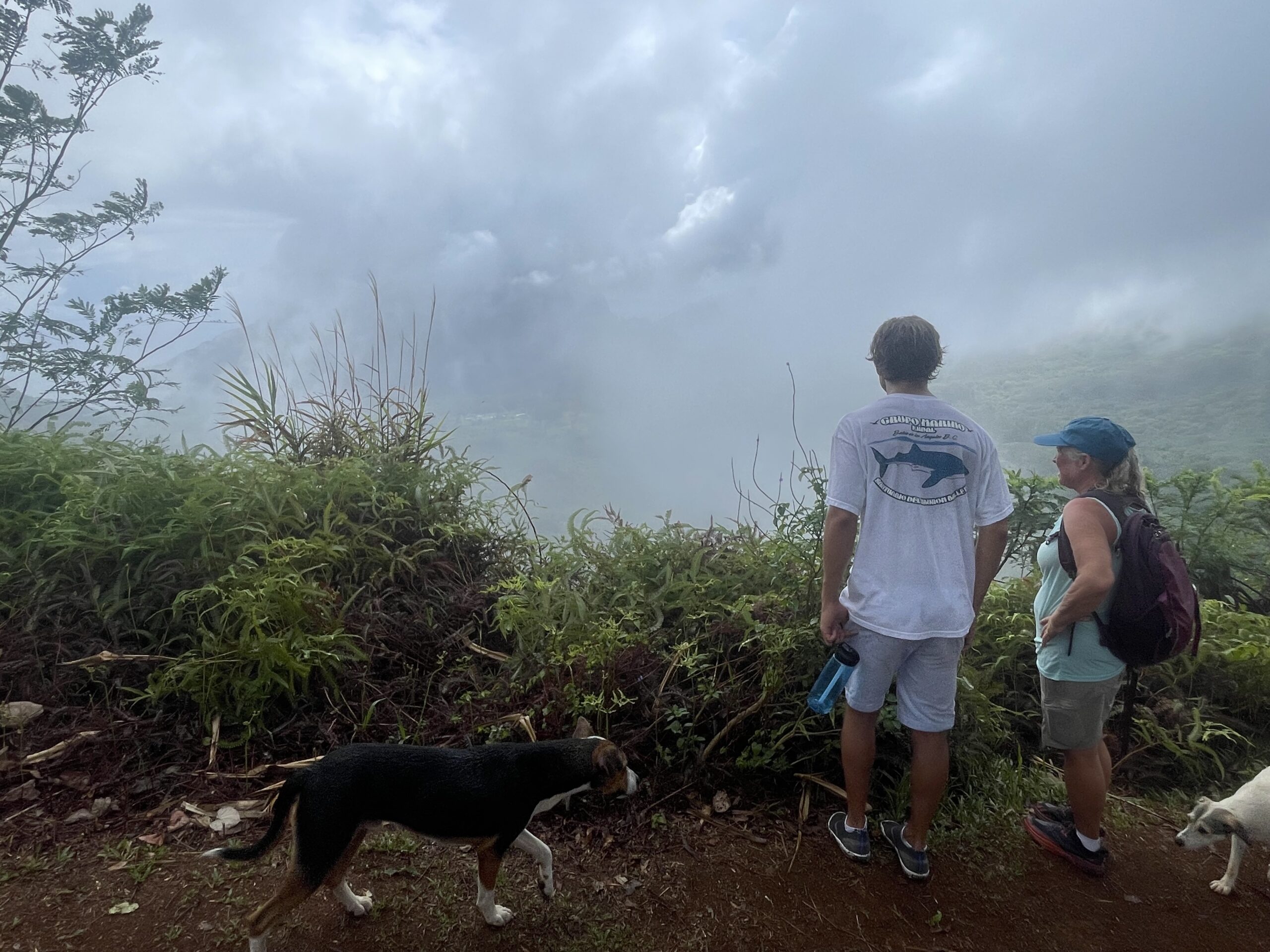
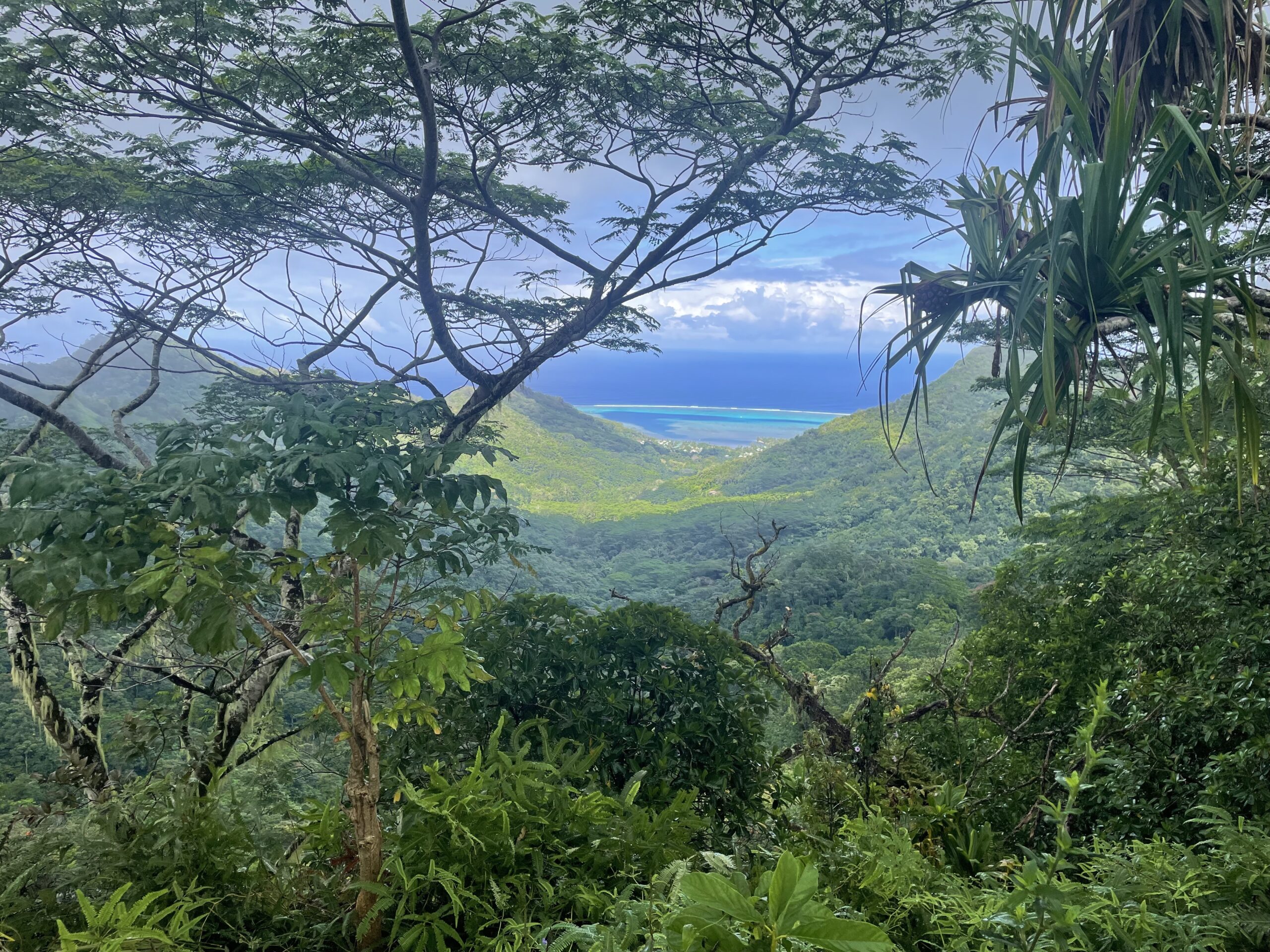
The next day, we took the rental car up to the Belvedere and hiked the three coconuts trail.
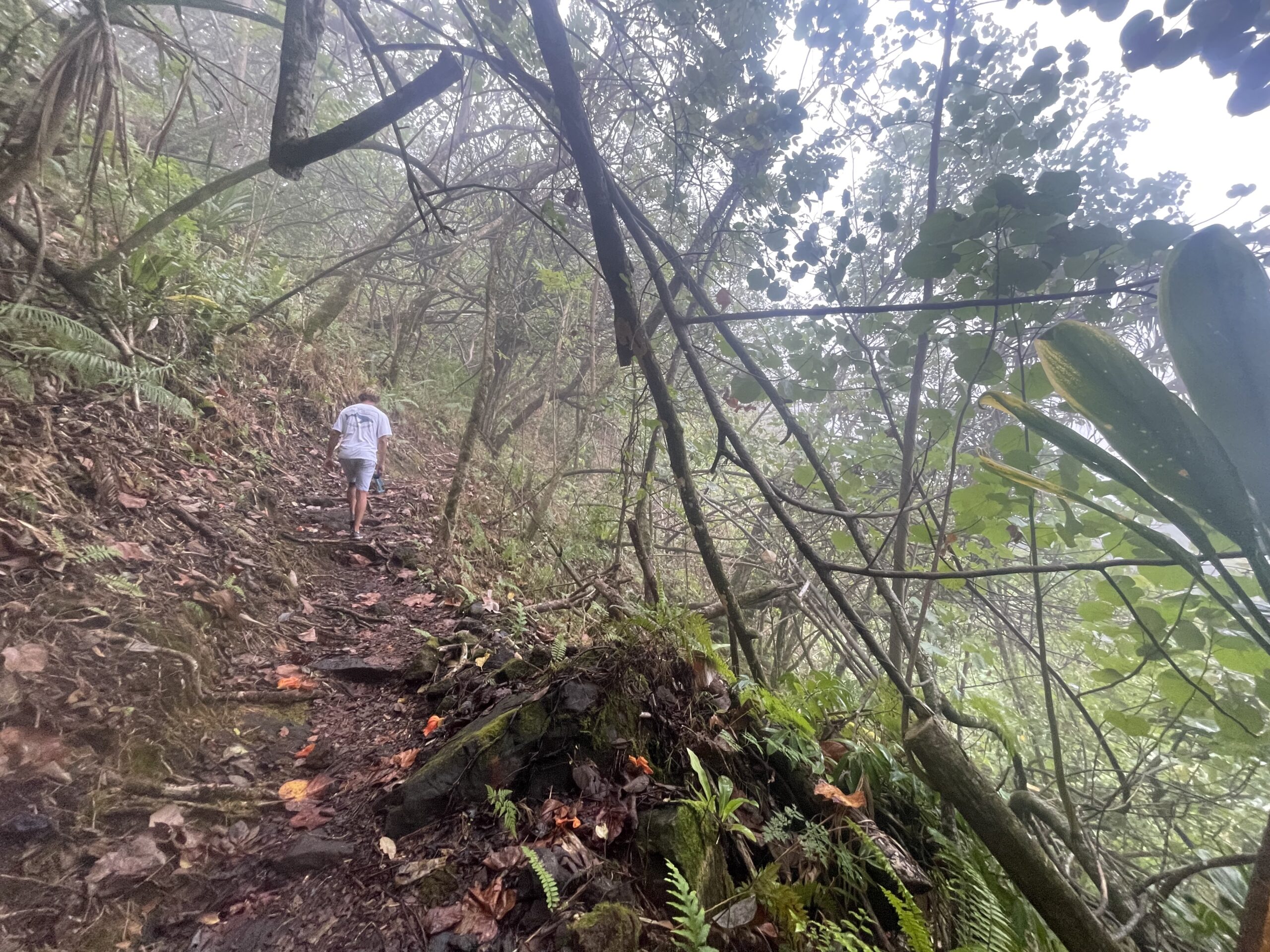
Hiking in Moorea
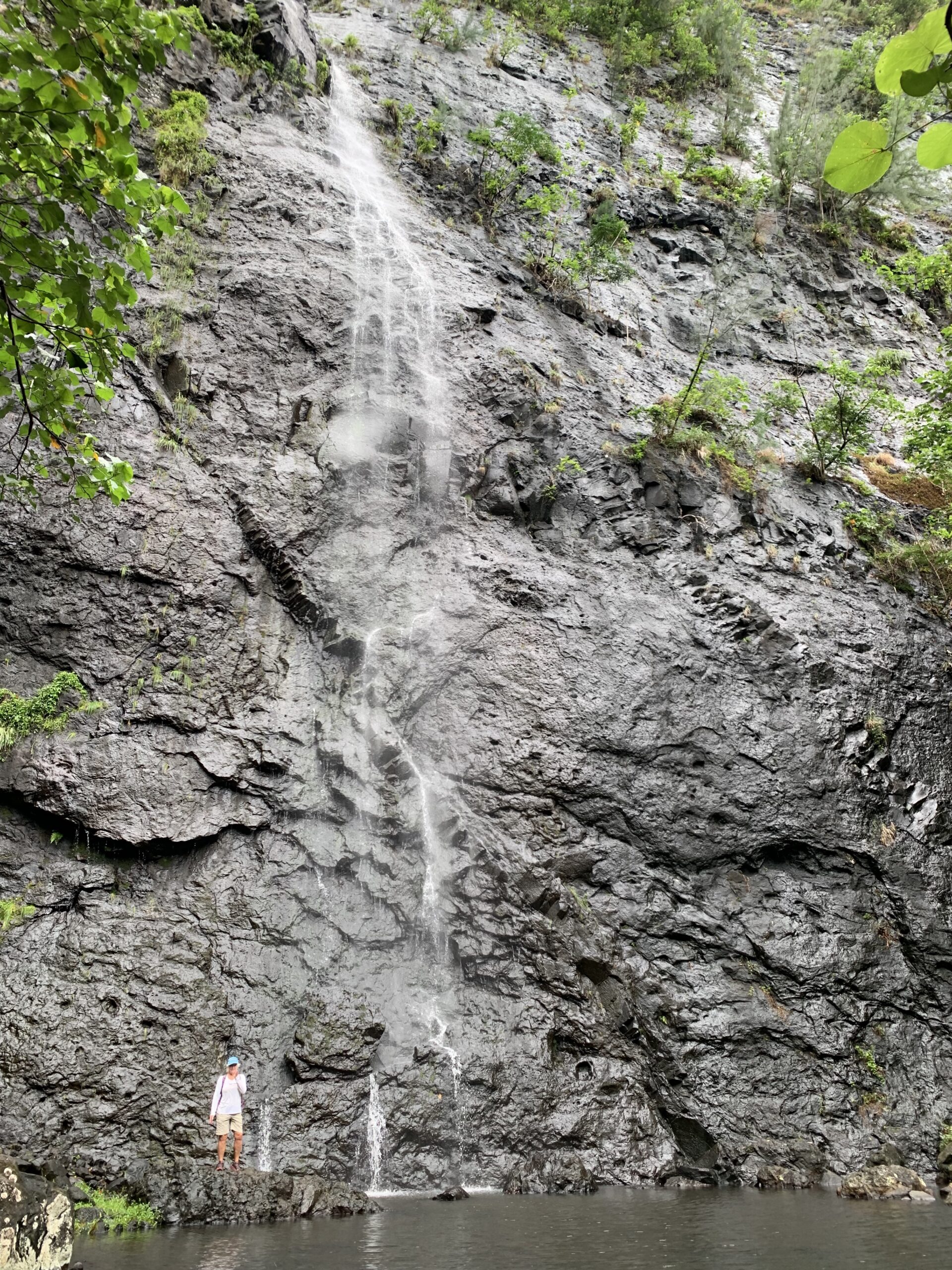
Afterwards we had lunch at my favorite taco truck but she had run out of the good food so I was a bit disappointed with the cuisine. On Wednesday we took the car around to the other side of the island, looking for waterfall hikes and an illusive steep hike that Trevor and Johno wanted to do. We found the waterfall hikes but never found the steep hike.
Waterfall hike in Moorea
Afterward, we had lunch at the Polynesia hotel in Cooks Bay and then returned the rental car.
Johno and Trevor enjoying a soak and a beer in Moorea
On my own for a few days after Gabe left, I did some laundry by hand, dropped off some laundry at Fakarava Yacht Services, defrosted the freezer and otherwise prepared for new crew. My brother-in-law, Pat, arrived with his friend Bill on Tuesday, June 6. We had lunch at the Havaiki Lodge and then spent one night in the rolly anchorage in front of Rotoava. We then pulled up anchor and motored to Hirifa against winds in the teens. It was flat there and we had a good night.
First-day lunch at Havaiki Lodge
Pat and Bill brought a variety of parts for repairs. One was a new hose and nozzle for the stern shower, which Bill and I installed. They also brought a new in-line fuse holder for the refrigeration system and they installed that. The next project was a rebuild of the wind generator, using parts that Pat had procured. They worked on that for a few days, just trying to get out the bolts that held the unit together. The problem was that corrosion made it impossible to get the bolts out without breaking the heads. We finally established that it would need to be taken to a shop where the bolts could be drilled out. So, I ordered a new wind generator to be delivered with the next crew, and Pat packed the old one up to take back to California to work on.
While they worked on the wind generator, I changed the oil and oil filter in the diesel engine. We also tested all the solar panels to measure output, and found some of them quite lacking. (Add solar panels to the list of things to replace in New Zealand.) Pat and Bill also patched a hole in the dinghy and glued the oarlocks back on. (They had fallen off at some point.)
It was quite windy in Hirifa, but a better spot than anywhere else at the time. Bill and Pat did get out on the kayaks and we socialized a bit with some of the other boats. I kayaked over to a boat owned by Bernard, a former work colleague. It was a surprise to meet up with someone from that former context. (Thanks to our mutual friend, Denis, who knew we were in close proximity.)
After a few days in Hirifa, we went back to get groceries in Rotoava. That night was rolly with lots of lightning and rain. The next day we used the dinghy to get some fuel and then sailed back to Hirifa, arriving just before dark, and had a good night. The next day, Friday, June 16, we sailed over to the South Pass of Fakarava and picked up a mooring ball. The conditions at the pass were good so we snorkeled inside the pass. We were able to snorkel the pass a few times the next day as well. The South Pass is a highlight for most people who visit Fakarava, so I’m glad conditions allowed Pat and Bill to experience it.
Fakarava South Pass
The next morning, on Sunday, June 18, we left the anchorage at 6:00 a.m. and motored through the South Pass without incident. We motor sailed in reasonable seas up wind for most of the day. We were heading back to Tahanea, where Gabe and I had started the season. As we got closer to Tahanea, we were able to unfurl the jib and turn the motor off and enjoy a brisk beam reach to the entrance of the middle pass. We took the sails in before entering the pass and had a smooth downwind entrance with the motor. Once inside, we turned left and went to the anchorage near the east pass. We dropped anchor in 45 ft of water. It was a very calm night.
Video of the glassy, calm anchorage in Tahanea
The bottom where we anchored was very hard sand and it was difficult to get the anchor to set. We tried to re-anchor the next day but still weren’t happy with it. We were running the risk of catching on coral. The wind was non-existent so we figured we were secure in those conditions.
Exploring the motu
We took the dinghy ashore and walked around the motu. Then we snorkeled the east pass three times. There was a lot of current so we just dropped into the water and got pulled along. I held onto the dinghy as we went. The trips were fast but the view of the coral was great. Later Bill went exploring in the kayak, Pat painted and I swam
On Tuesday, we still had beautiful, flat conditions and I went up the mast to replace the VHF antenna with a spare. We then took the dinghy up to the west pass and snorkeled that. There was lots of coral and sea life.
After another calm night, we spent another good day in this spot. Tahanea is a very special atoll and it had mostly been too windy when Gabe and I were there. So, I was really happy to spend three idyllic days there, even though it was a relatively short time. The wind was shifting by Wednesday night and we made plans to leave. That night was very rolly, with winds out of the southeast.
The next morning, Thursday June 22, we got up at 4:00 a.m. but waited until it was almost light to exit the pass. We started trying to bring up the anchor at 5:30 a.m., but it took a long time to get it unstuck from a coral head. We finally exited the pass at 6:45 a.m, right before slack tide, with no issues.
Bill at the helm
We sailed fast on a broad reach with the jib up and some assistance from the motor, arriving at the Fakarava South Pass at 2:00 p.m., an hour after slack tide. Other boats had gone in ahead of us. But when we started in, we discovered big waves breaking across the pass. We stayed to the left and out of the breakers, but the swell lifted us high above the pass before dropping us down into it. It was a bit of a thrill. Once inside, the pass was calm and we proceeded to Hirifa. The night was windy but not rolly.
In the morning we pulled up the anchor and sailed back to the South Pass. It was really windy and we had some difficulty picking up the mooring ball, but Cain from Spirit of Argo helped us and all ended up well. It was a windy, rainy day on the mooring ball so we didn’t get to snorkel. We worked on boat projects. The next day, conditions weren’t much better but Bill and Pat did explore a bit in the kayaks.
Video of the conditions in the South Pass anchorage
On Sunday, June 25 we left the mooring ball and sailed back up to Rotoava on a beautiful beam reach. It took a long time to find a place to anchor but we finally ended up in front of the wharf.
Then on Monday, we rented bikes and road up past the airport and then down toward the south east before having lunch at a snack.
Pat and I riding bikes
After spending Tuesday on the boat, we went into town on Wednesday to shop because the supply boat had come in. As usual, it was quite a competition with the cruisers and locals to get provisions. We divided up and went to multiple stores, but came out successfully with hard-to-find items such as produce and yogurt and cheese. These shopping trips are a madhouse but also a chance to meet people from the other boats. We treated ourselves to a couple of meals of salads that day.
The market at the wharf, too bad no picture of the mad crunch of shoppers
Thursday was very windy and we stayed on the boat. Then on Friday we walked to Fakarava Yacht Services to drop off laundry and had lunch at the Fakarava Grill before putting Bill in a taxi to the airport in the early afternoon. We were sorry to see Bill go but I think he’d had a fun adventure. With the relentless wind continuing, Pat and I spent a few days cleaning and doing laundry and otherwise doing boat chores.
I’m sitting in the cockpit of Aldabra on Wednesday, May 31. We’re in the anchorage in front of Rotoava, the town on the atoll of Fakarava, population maybe 2000. The wind is coming from the southwest, bringing choppy waves that build from all the way across the lagoon (15 miles), and sitting on the boat is not very comfortable. It’s been windy and rainy for about twenty-four hours and probably won’t let up until tonight or tomorrow. Despite the conditions, Gabe flies out from here on Friday, so we need to stay put. I’ll be sorry to see him leave but I’m guessing he’s ready to get on with his summer plans. Cruising on a sailboat in the Tuamotus can mean long days of unfavorable weather, yet those are interspersed with moments of adventure on land, dramatic coral in the water and lots of wonderful people to meet. There are also many opportunities to fix things on the boat, especially after it had been sitting for a few months in Tahiti.
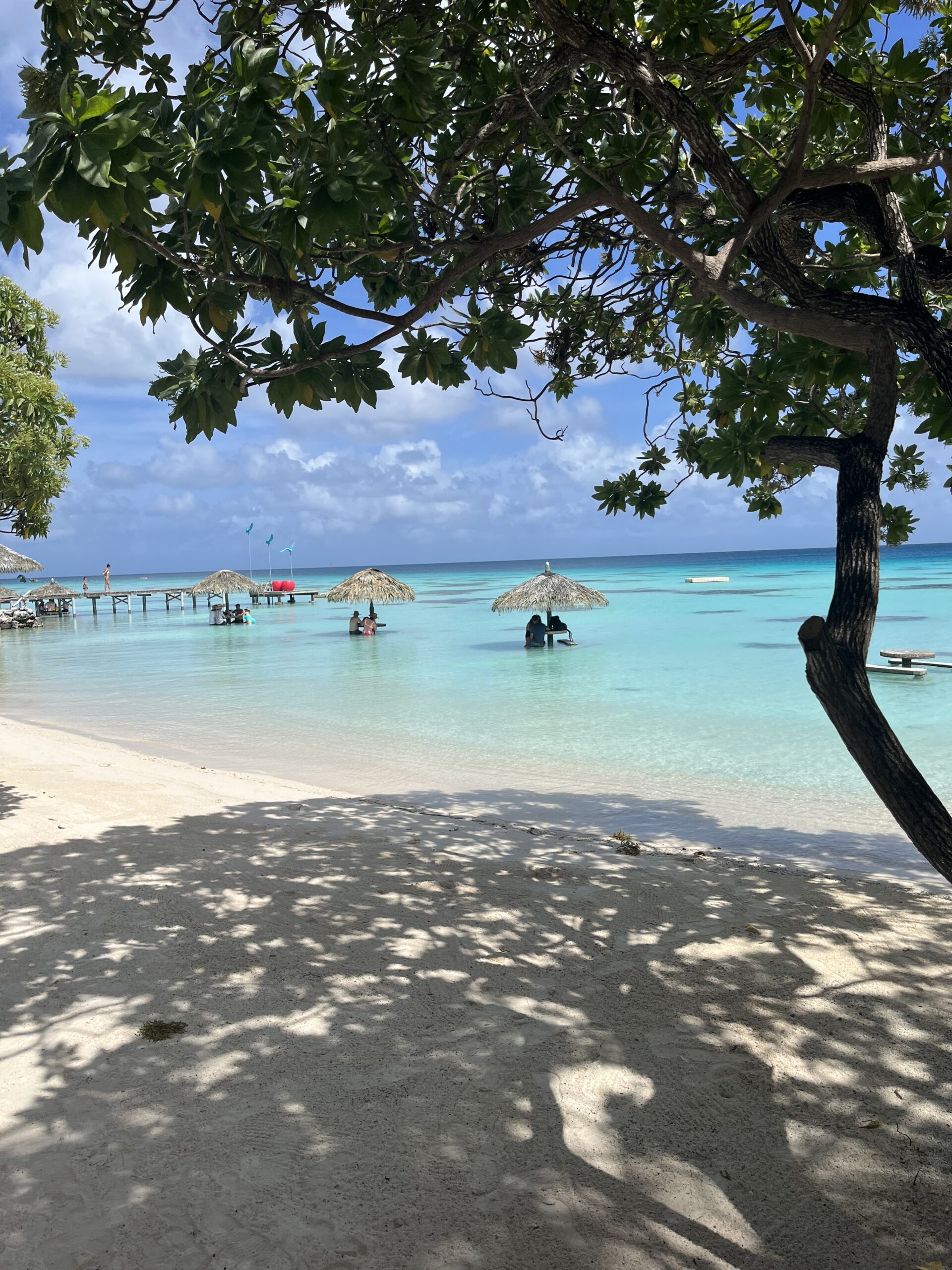
The Tuamotus are beautiful low-lying atolls that are made up of reefs that surround a lagoon. A few of these 76 atolls are inhabited with some infrastructure for locals and tourists. Others may have as little as a few subsistence farmers or fisherman. And still others are completely uninhabited. These atolls can be mostly submerged, or they can be made of motus, small islands that support the growth of some vegetation and people’s livelihoods. The people that live here mostly speak French and/or Tahitian, but those that work in stores or in tourism speak enough English to help me get by.
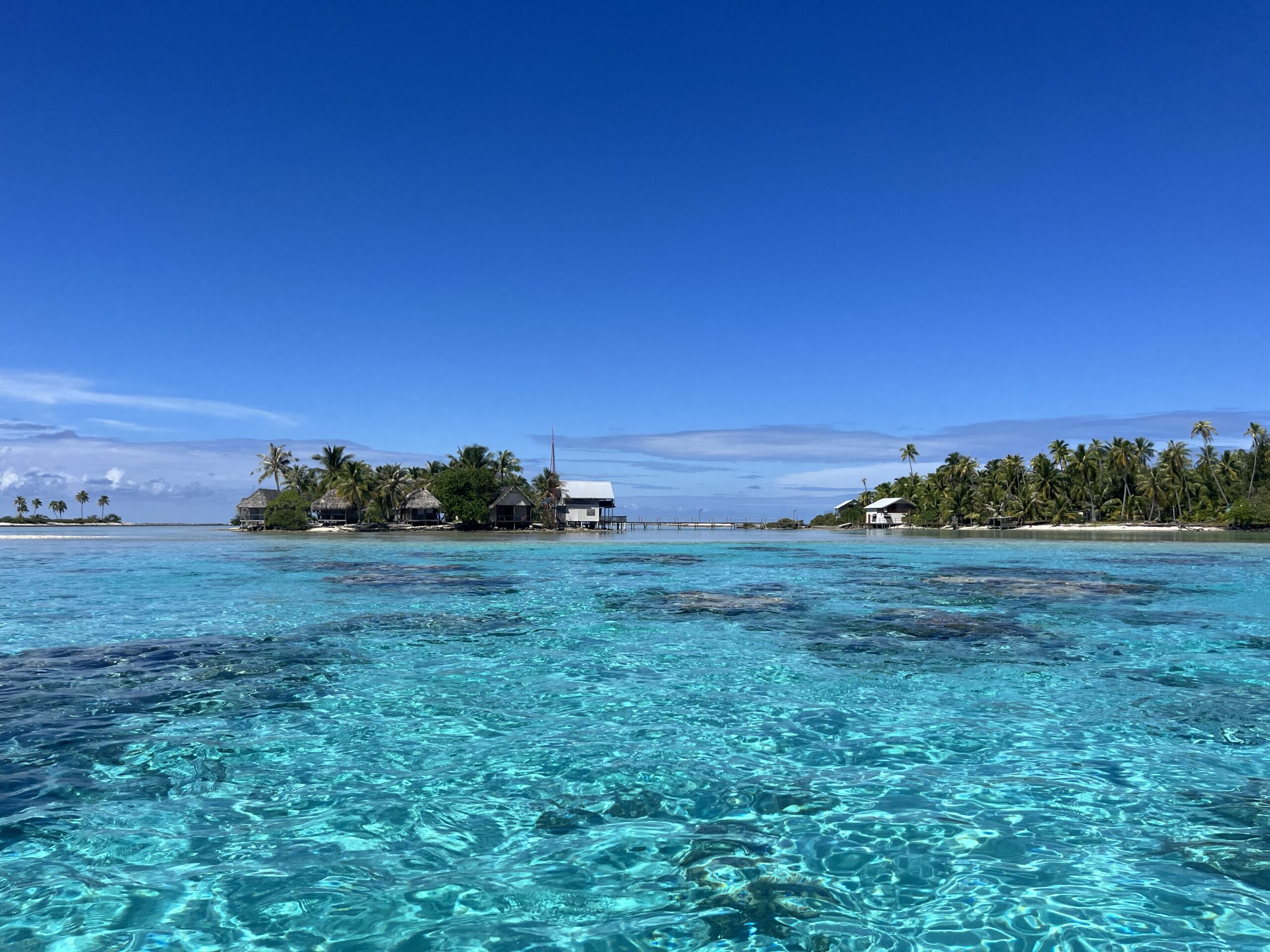
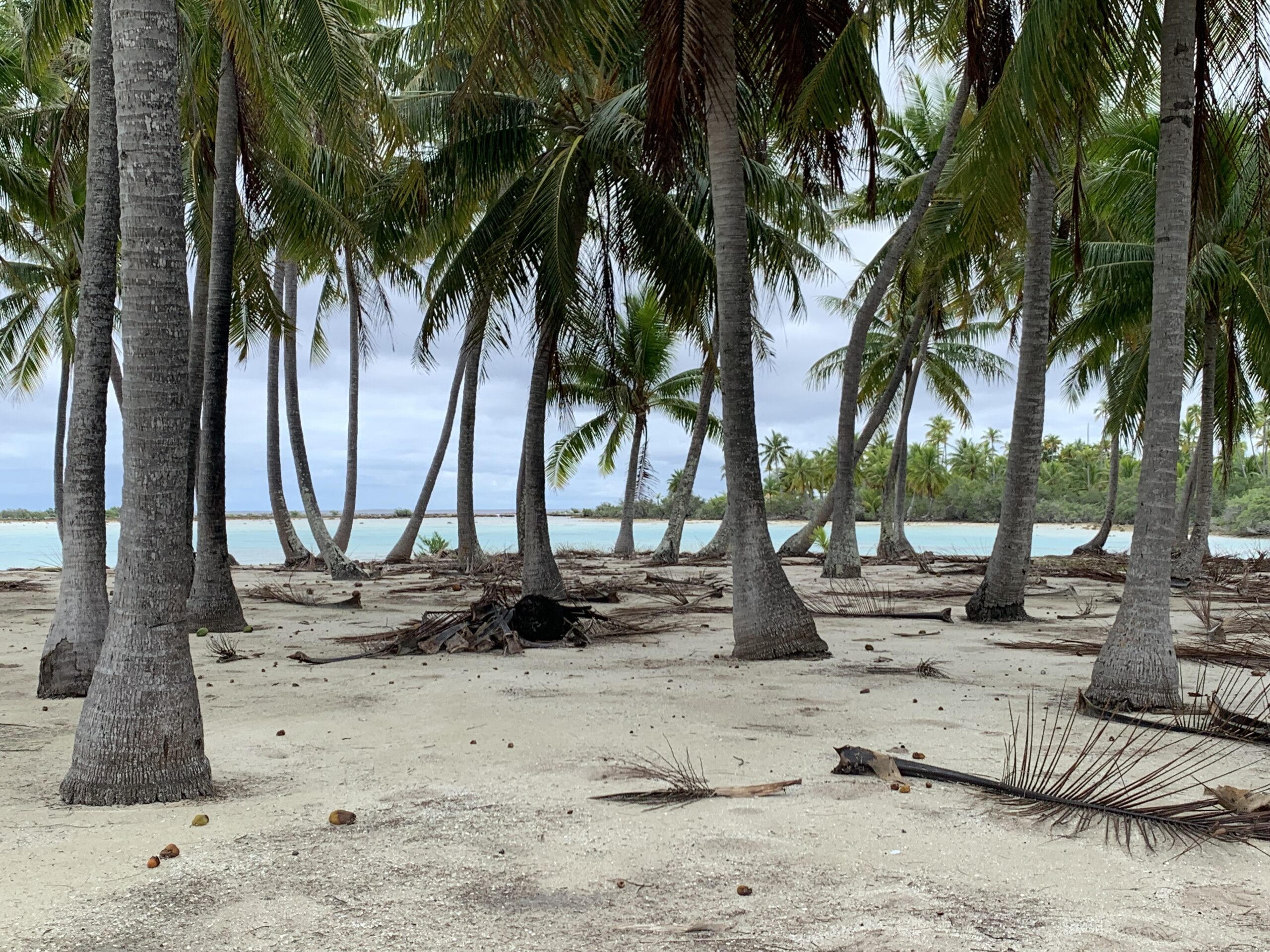
A typical motu viewed from inside the lagoon
Not all the atolls have passes that allow you to safely enter the lagoon. For those that do, one must navigate through the pass when the tides and winds are in your favor, otherwise it can be quite a ride. Once inside the lagoon, you have protection from the open seas, and often you have protection from the wind, but to transit from place to place you must safely navigate the coral heads (called bommies), which could be hidden right below the surface and severely damage the boat. To anchor, you must try to find a sandy patch and then use floats to lift the anchor chain over the bommies on the sea floor. Anchoring itself is quite a challenge and can take multiple attempts to get situated. Gabe has become masterful at diving down to the anchor to reposition it or the chain, in all kinds of adverse conditions.
So, what have we been doing since we left Moorea? Here’s the way-too-detailed recap.
Our first destination was Tahanea, an uninhabited atoll that is a sanctuary for nesting birds, and a well-liked destination for underwater exploration of the three passes that lead into the lagoon. Cruisers also go to Tahanea to kite board.
Our passage to Tahanea was mostly smooth. Having left Moorea on Wednesday, April 12 at 6:30 a.m., we motored-sailed in very light air on the nose for several hours. In the mid-afternoon, the wind came up and very quickly we had a squall with 28-knot winds and rain. With the full main and jib flying, and seas building, I had to hand steer for some of it because the autopilot was overpowered. At one point we just took the main down for a while. In the evening, we put it back up with the first reef in, and had some spells of a nice beam reach in 10-14 knot winds.
For most of the next day we motor sailed in light air. The autopilot got fussy at one point so we used the backup CPT autopilot for several hours. The next day, Friday, April 14, we arrived at the gap between Faaite and Tahanea and turned right to round Tahanea. There was no wind and the seas were glassy. We entered the middle pass shortly after noon with no issues even though it was an hour and a half after high slack tide. (It seems to be the case that the passes are far less challenging when there has been no wind and the seas are calm.)
Tahanea
We anchored just to the west of the middle pass. No boats were there at the time but two came in shortly afterward. It took more than one attempt to set the anchor down in sand instead of coral. We did our best and had a good night’s sleep that night. The next day we spent quite a bit of time trying to re-anchor. We had been rubbing on some coral at night and we wanted to get the anchor down in a better spot and float our chain above the coral heads. After a few attempts, we thought we had it right so we took the dinghy to shore to explore the nearby motu and snorkel a bit. That night we had lightning and rain. A boat from Slovenia, Timy, came in and anchored very close to us.
The next day, Peter and Natalie from Timy dove on their own anchor and then checked ours out. They discovered that we were caught on some coral so Peter helped Gabe get the chain off the coral. It was quite an operation and we were very grateful. They had just come from the Marquesas with one shroud not working to keep up their mast. They had rigged some lines for support but really needed to get to Tahiti to pick up the part they needed. We took over some coffee and chocolate and they gave us the password to their Starlink. Suddenly we were really happy that they were anchored so close to us.
While we were trying to re-anchor, the windlass was having trouble pulling up the chain. Gabe and I took the windlass apart and cleaned debris from it. The anchor chain had sat for several months in Port Phaeton and it had a lot of rust that was flaking off into the windlass. That day we stopped by and met the folks on another nearby boat, Agape, who are from the U.S. but have been in the Tuamotus for a few years. We also met Greg and Robin on Salty Dancer, who are from Oregon.
On Monday, Gabe and I took the dinghy to the west pass to see if we could snorkel in it. It seemed a bit rough so we backtracked and snorkeled east of the pass. While doing so, Gabe got stung by a jelly fish and had a rather severe reaction, which fortunately subsided in a few hours. The winds picked up from the east in the afternoon and we had a windy night.
While we were anchored, I was slowly working on the stuffing box that is connected to the prop shaft. It was dripping a lot and I thought it might be why the bilge was filling with water more than it should. After putting some Gibbs penetrant on it and then later some vinegar, I got the nut to move and then tightened it a bit. While I was doing that, I realized that a part on the water pump had a crack in it and fresh water was spurting out and going into the bilge every time we used the water pump. I replaced that part, which slowed down water entering the bilge.
The next issue to address was that the wind generator was making a strange noise and was vibrating. Plus, the controller box was getting hot. We tied off the wind generator until we could troubleshoot the issue.
On Wednesday, Gabe and I took the dinghy back to the west pass but it was windy and rainy and we aborted the attempt to snorkel. We ran into Greg and Robin on Salty Dancer and invited them over for sundowners for that evening. In the afternoon, we tightened the hex bolts on the wind generator but didn’t fix the problem. I cracked the nose cone trying to put it back on. Fixing the crack with epoxy didn’t help so we were resigned to not using the wind generator until we could get new parts. That afternoon we took the dinghy to a different motu and explored. Then had a nice visit with Greg and Robin that evening.
By Thursday, the wind was out of the north in the mid-teens and the anchorage was uncomfortable. I started taking inventory of issues on the boat. With the wind generator out of commission, we had to run the motor each night to keep up with the refrigeration. Then the nozzle for the stern shower cracked. We tried to fix it without success so we started taking showers using a jug, which has worked pretty well. Then I noticed a slight drip out of the housing for the watermaker’s carbon filter, but I could not unscrew the housing, so the drip is just going to have to persist. I also noticed that the alternator belt started making a screeching sound. There was a lot of black just around the belt so we replaced it easily.
On Friday, we continued our repairs and tried cleaning the boat bottom, but the seas were just too rough to accomplish much and the day was otherwise uneventful.
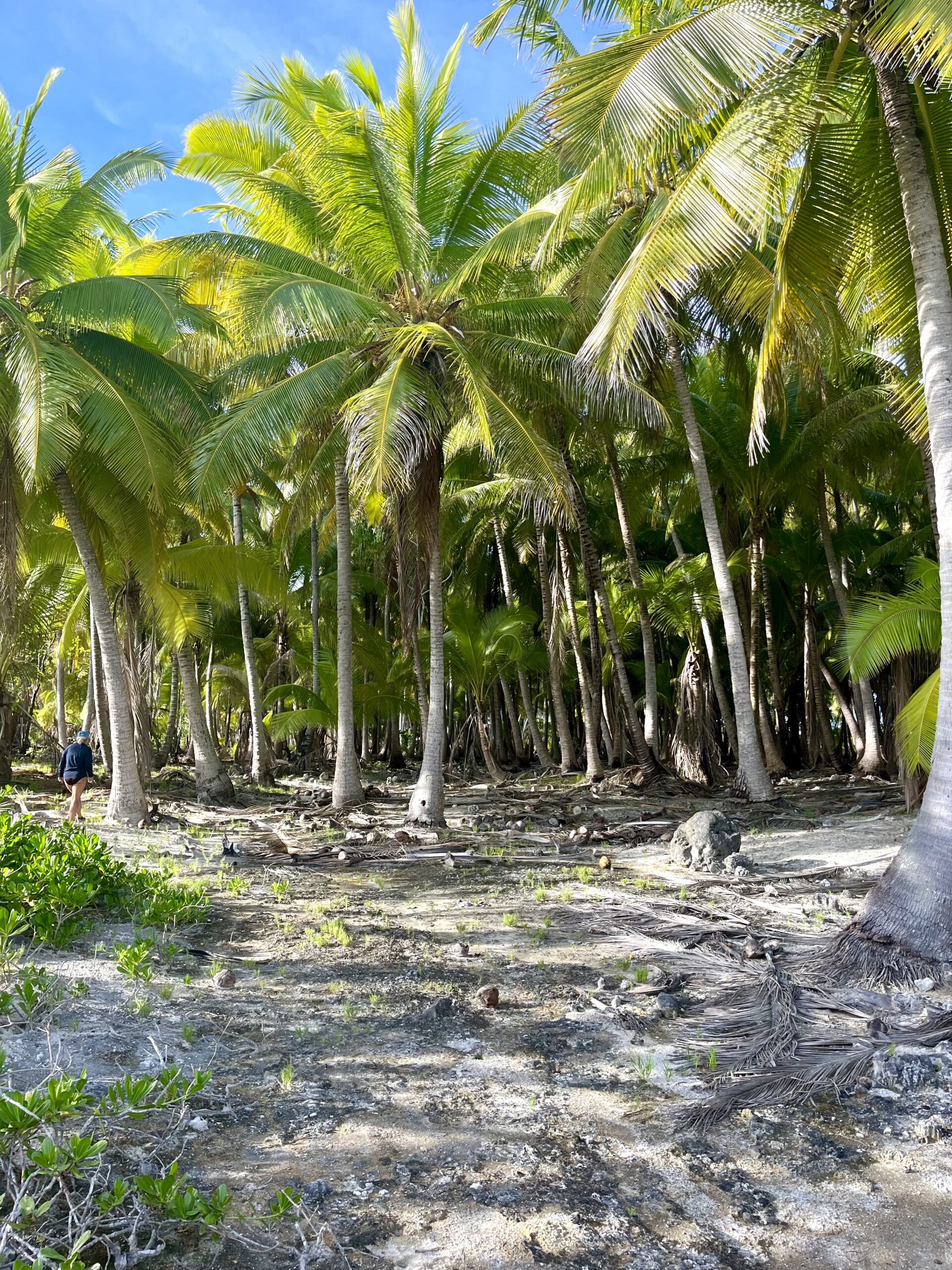
With the wind and seas still rough, we took the dinghy on Saturday over to the east side of the middle pass and explored that motu, both on land and in the water. On the ocean side, the “land” was a large expanse of dead coral. On the lagoon side, we saw coconut palms and other vegetation. It was a bit of a challenge getting back to the boat in the dinghy as we fought standing waves across the pass. The unfavorable conditions kept us uncomfortably on the boat on Sunday. Finally on Monday the winds let up a bit. We pulled up anchor and headed down to the southeast corner of the atoll. The winds lightened up so much that we motored the whole way and ran the watermaker. We anchored before noon and floated our chain. We were the only boat there and enjoyed snorkeling near shore along a wall of vibrant coral.
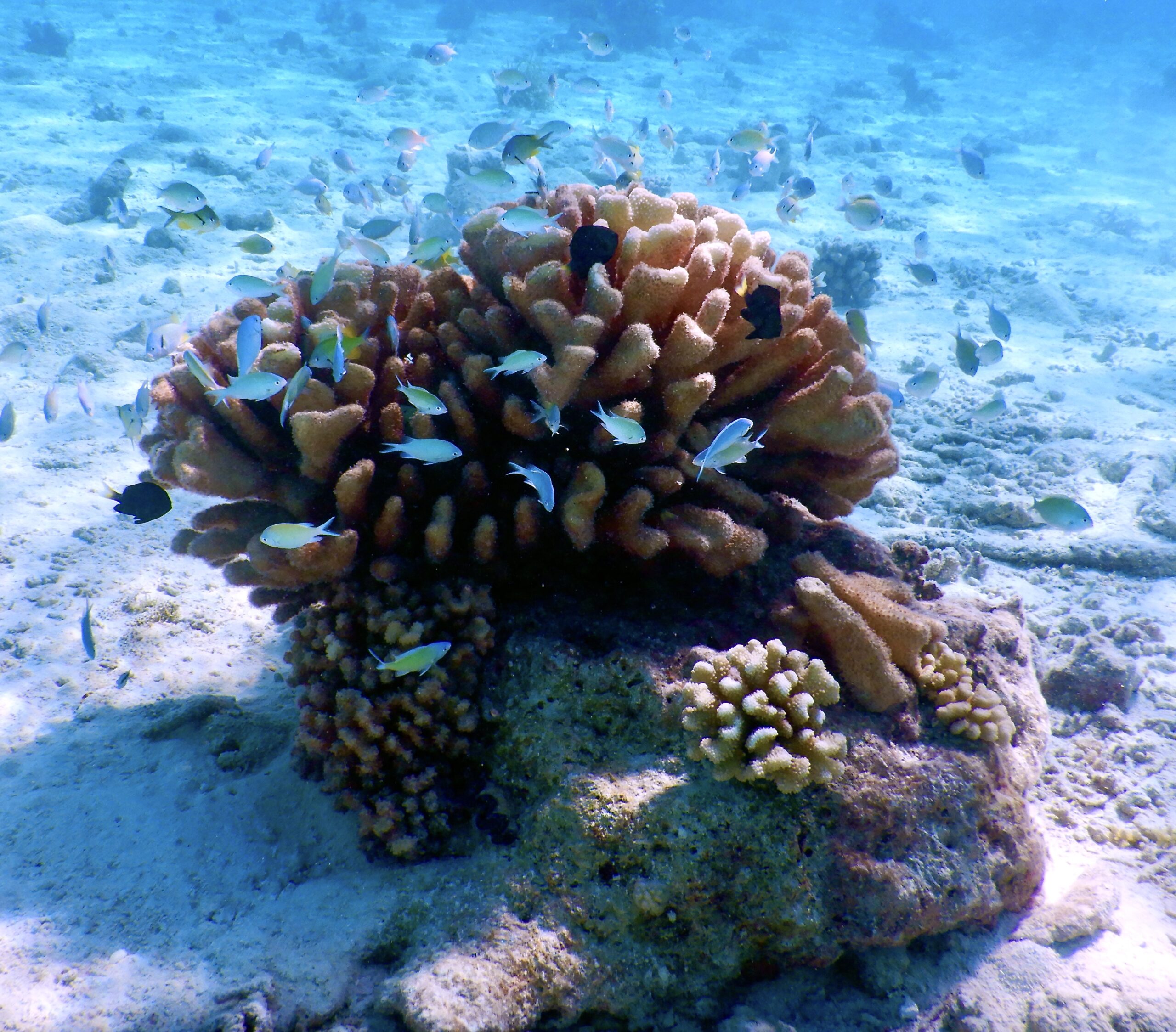
It would have been nice to stay where we had successfully anchored, but we wanted to take advantage of a small weather window to go to a famous bird motu on the west side of the atoll. Other cruisers refer to it as the Number 7 anchorage because the reef looks like a 7 from the air. We got there and anchored in front of the motu and snorkeled from the boat to shore. We walked the perimeter of the motu to keep from disturbing the nesting birds. We saw lots of boobies nesting and some terns. We waded across a channel to another motu and met a Tuamotu Sandpiper that was quite friendly. It’s probably why its numbers are diminishing. I was sorry that we weren’t banned from those motus. The last thing those birds need is people hanging around. We snorkeled back to the boat and passed over a really rich coral habitat with lots of fish. Probably the first really good habitat we’d seen since arriving in Tahanea.
These and many of the photos here courtesy of Gabe Ares
That night was windy and choppy and not a good place to remain. So the next morning we pulled up anchor and returned to the southeast corner. When we arrived, there were several boats there and more showing up. It seemed to be a pack of family boats, headed by a large German catamaran called Moin. They shared all kinds of activities and even had their own dedicated radio channel. One night the kids all had a sleepover on the beach without the parents. They called it “Survivor Island.” We never found out how that went. The next night they had a bonfire on the beach and invited the non-kid boats. We went and enjoyed meeting several of their delegation.
While we were at the southeast anchorage, we walked around the motu in front of us. We got a bit lost in the bush and ended up circumnavigating the motu because we couldn’t find a way to cut through the jungle in the center. We also got the kayaks out and kayaked to the motu just to the east. On the way back we stopped by a boat that had just come in, Chip and Kristina on Second Set.
Exploring the motu in Tahanea
Back on the boat we discovered that one of the two feed pumps for the watermaker wasn’t working. Upon closer investigation, we discovered that it was leaking salt water into the bilge. We replaced it with the spare pump and it seems to have solved the problems with water in the bilge.
During this time, a big wave event was occurring in French Polynesia. The water was so high coming toward the atolls that huge waves were crashing on the reefs and several of the passes in the atolls were temporarily closed. The spray from the waves could be seen from miles away. Then, on Tuesday, May 2, we downloaded weather and saw that big winds might be coming from the southeast. It would mean that we might be confined to that anchorage for more than another week. Returning to our first anchorage wasn’t really an option because it would be uncomfortable. We really wanted to snorkel at least one of the passes, but it wouldn’t be feasible for the foreseeable future. Another option was to proceed to Fakarava. We had been without Internet for quite some time. If we were going to be pinned down by winds, at least we would have service in Fakarava.
We thought we might be able to snorkel one pass that day and then exit the pass in the evening and do an overnight sail to Fakarava. But when we got to the side of the atoll with the passes, it was clear that we weren’t going to be able to snorkel a pass. The winds were in the high teens, low twenties. We had to anchor somewhere so we could take the motor off the dinghy and secure it to the big boat. So, we anchored near the northwest pass long enough to do that. Then, instead of waiting for evening, we would exit the pass in the early afternoon and sail to the north Fakarava pass because we would get to the south pass too early. A very large National Geographic exploration ship went out of the pass at slack tide. We should have called them for a report but didn’t. Instead, we followed them out, about 45 minutes later, and had a very lively exit. We were motoring against large standing waves that were crashing over the top of us. The effects of the earlier wave event were still apparent. Once we got out, we had big seas for quite awhile as we headed toward Fakarava, and Gabe was out of seasickness meds.
Fakarava
We sailed with just the jib to the Fakarava north pass. The winds were inconsistent so sometimes we moved along quite well and other times we turned on the motor to help with speed and to charge the batteries that were being drained by the autopilot. We saw sunrise as we were approaching the north side of the atoll and entered the pass about 8:00 a.m., an hour and a half before slack. We were unsure if slack tide was going to come according to the tables anyway because of the unusual wave event. We had significant current against us and it felt like we were just sitting in the pass for an eternity as we made 1-2 knots progress into the atoll. Salty Dancer was just leaving the anchorage as we arrived so we said our goodbyes over the radio. We anchored in front of the town, Rotoava, spending the rest of the day on the Internet and recovering from the high waves during the sail. I ordered a lot of parts that my bother-in-law, Pat, can bring when he comes in June.
On Thursday, May 4, after a good night’s sleep (I stayed up all night on the passage), we got up early and put the dinghy in the water. We went to shore and disposed of our trash and our recycling. We talked to the guy at the fuel dock about hours and bought a couple of groceries. The supply boat had just come in but it didn’t bring any produce. We then headed over to Fakarava Yacht Services to drop off a butane tank for a refill, along with a couple of bags of laundry. Then we went to one more grocery store (for beer) and then headed over to the Havaiki Lodge for lunch – burgers. We then spent a windy afternoon on the boat.
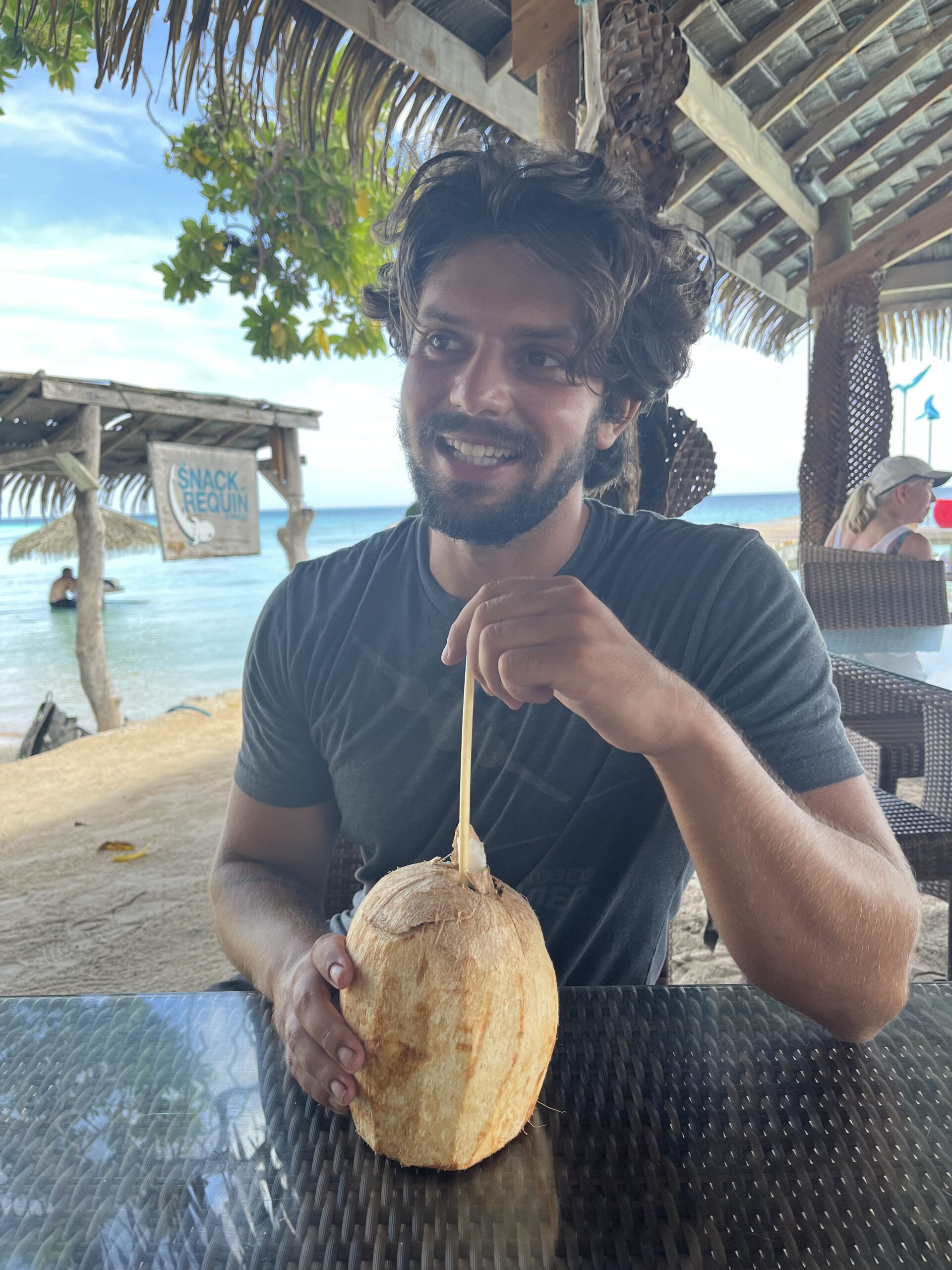
Gabe enjoying coconut water before lunch at Havaiki Lodge
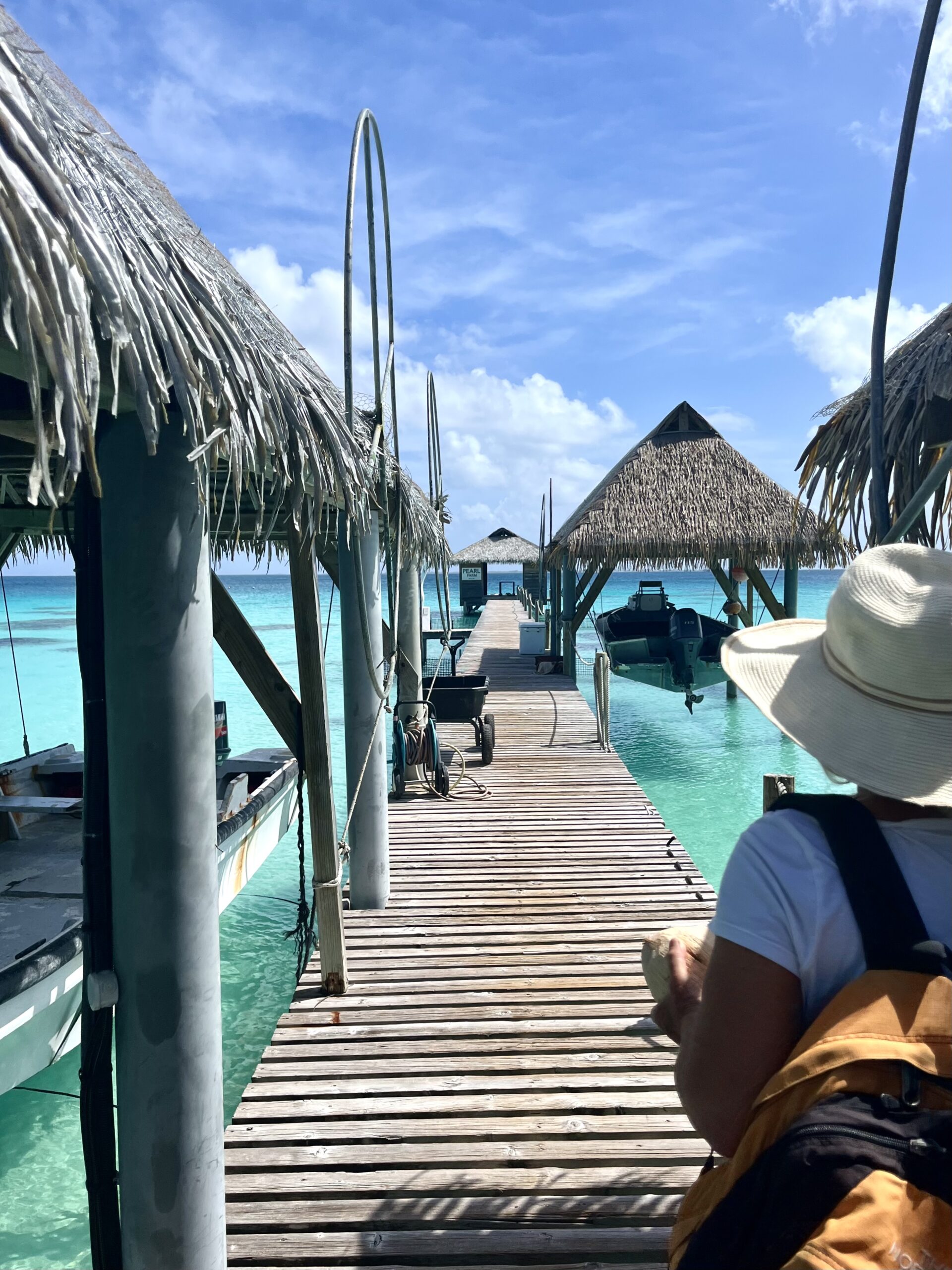
The next day we went to the pearl farm tour at the Havaiki Lodge, where Gabe bought an oyster with a pearl.
Lunch spot at the Havaiki LodgeDock at the Havaiki Lodge
Then we got 4 jerry cans filled with diesel and headed over to the Rotoava Grill for lunch. We met Kaitlin and Tommy from Southern Cross while at lunch. They are from Tennessee, which was fun for Gabe.
Looking out at the boats from our favorite lunch spot, the Rotoava Grill
On Saturday, May 6, we picked up our laundry and butane tank from Fakarava Yacht Services. We then went back to the boat, put the dinghy up, pulled up the anchor and headed halfway down the atoll to a deserted anchorage near a reef. We spent the night, snorkeled the next morning and then continued traveling to the south pass anchorage. We picked up an available mooring ball in the early afternoon and then snorkeled near the boat.
The south pass area of Fakarava is amazing. The water is crystal clear and there are large swaths of healthy coral on the lagoon side of the pass and in the pass. On Monday, we snorkeled on the lagoon side of the pass and then inside the pass itself before having lunch at the restaurant of a local dive hostel. In the afternoon, Gabe worked on cleaning Aldabra’s prop.
Crystal clear water at the south pass of Fakarava
In terms of issues, the Internet went down for a few days and we noticed that the fridge was having trouble getting cold. We transferred frozen food from the Engels to the freezer and put important cold food in the Engels.
On Tuesday, we snorkeled in the south pass in the morning and then headed over to the southeast Fakarava anchorage, Hirifa. We wanted to get there in anticipation of significant wind expected from the southeast. That night, as we sat on the boat, several giant manta rays would circle the boat upside down, then do a somersault. They stayed at the boat for a few hours while we watched.
Wednesday, May 10, started out calm. We took the dinghy over to say hello to Chip and Kristina on Second Set and then went ashore to explore. While we were ashore, a squall came up and we headed back to the boat. Over the course of the afternoon and night, the wind and rain kept building. At about 3:00 in the morning we both heard a big sound, as if the anchor had popped and hit coral. At first we just monitored the situation from the cockpit. The winds were between 40 and 60 knots and the lightning was exploding all around us. We noticed that we were near another boat and thought they had dragged their anchor. But in truth, we had dragged and we were dangerously close to them. We turned on the motor and used it to keep away from the other boat – Pura Vida. But every time we had a lull in the wind, Gabe would go up to the bow to first take the snubber off and then slowly pull up the chain. It took a while but he eventually got the anchor up. We then went outside of the anchorage and motored around in circles until dawn, about an hour and a half. Then we went back and re-anchored.
We had a quiet, uneventful Thursday. Then, on Friday morning, the wind shifted from southeast to northwest. Now we had waves building as we faced away from the shore. We didn’t realize that all the hobby horsing made the snubber come off the chain. As a result (because the windlass clutch had come loose), we had about 100-150 feet of chain pay out, and now we were too close to other boats once again. We didn’t know that the clutch was loose, all we knew was that the windlass wasn’t picking up the chain. So we were using a halyard and the snubber, alternately, to pull up the chain. Peter from Pura Vida came over to help. He drove the boat while I pulled up chain and Gabe was in the water directing us around coral hazards. We finally got enough chain up to stay in place. A short while later, Greg from Escape Velocity, who had watched us try to pull up the chain without the windlass, came over and asked if he could look at our windlass. He tightened the clutch and helped us replace the broken spring and everything worked! What a relief. My back was rather sore for a few days but I was so grateful that the windlass was operational.
On Sunday, we put the dinghy on the boat and headed back to Rotoava, motoring against medium winds all the way. Once we anchored, Chip and Kristina paid us a visit so we could compare notes on all that happened during the storm. (Lots of boats had issues that night and one went up on the reef.) Then, we made phone calls. It was Mother’s Day and my mother’s birthday.
The next day we put dock lines and fenders on the boat and headed over to the fuel dock to fill up with diesel and gasoline. Our anchor spot was taken while we were away so we picked up a mooring ball and then went to the Havaiki Lodge for lunch. We met Glenn and Oana from Cloudy Bay there and had a chat. When we returned, we got kicked off our mooring ball and then searched for a new place to anchor, which was becoming more difficult because the anchorage was filling up in anticipation of the supply boat’s arrival.
On Tuesday, Gabe and I rented bikes and rode to the north end of the atoll and then back south. We had lunch at the Havaiki Lodge again and saw Cloudy Bay along with another boat we had seen in Hirifa. We later met Katie and Bill on Flite Deck, a boat I had seen in San Diego.
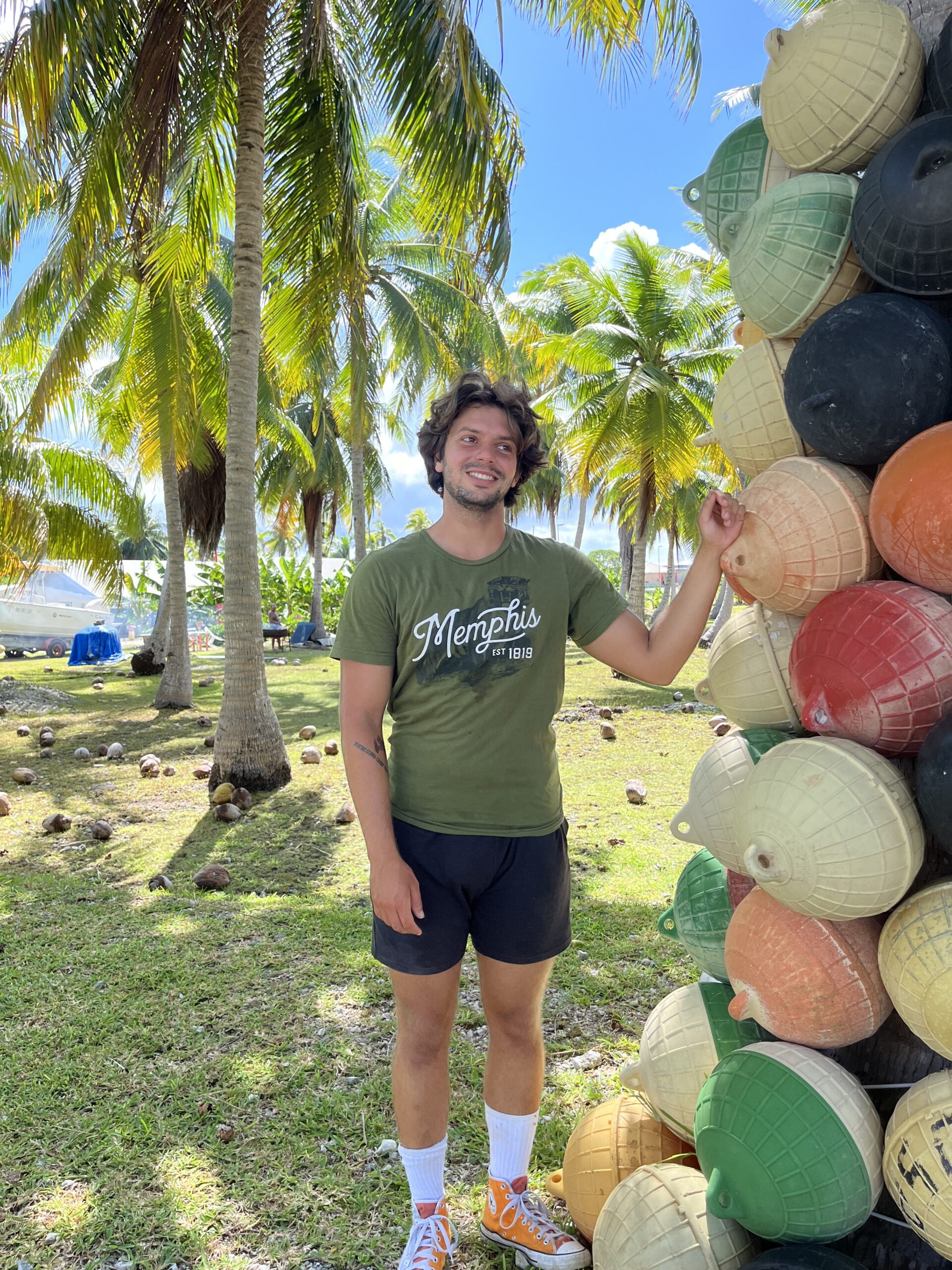
Stopping during the bike ride, admiring all the pearl farm floats that decorate this small resortPause during bike ride
On Wednesday, we had lunch at the Rotoava Grill with Chip and Kristina and saw Katie and Bill there as well. Then on Thursday the supply boat came in. We thought we would go to the stores in the afternoon, after the shelves had been restocked. But we decided to go in early to see if they had any eggs, which are sourced locally. As soon as we got to one store, we learned that they were just about to bring out the produce. So we were there to start grabbing apples and oranges and potatoes. I left Gabe there and walked up to the store at the fuel station. There was a huge crowd of people waiting to get in, many who had been waiting at the door for three hours. I joined them and about an hour later the doors opened and there was a mad rush. Gabe was there by then as well and we managed to get some limes, onions, tomatoes, oranges and apples. We were not aggressive enough to get cucumbers. It was a crazy melee but we felt successful. We capped the morning off with another lunch at the Rotoava Grill.
Toau
On Friday, May 19, we pulled up anchor and exited the Fakarava north pass around 9:00 a.m. without incident. Outside the pass, we put up the main and the jib and made our way on a reach in rather light air. We arrived at the Otugi pass on Toau in the mid-afternoon. We turned left and followed Moin to the southeast anchorage, picking up one of five mooring balls. Second Set was there anchored. And Moin anchored over near Auryn, a friend of theirs.
It was a very quiet night except for the happy voices of children playing on shore. Toau is an inhabited island but with very few families living there. The next day, Gabe and I took the dinghy over to a nearby motu. We snorkeled and walked around the motu and met the family on Auryn.
We would have liked to stay longer at this anchorage. But in looking at the weather, we had only a brief window to go up to the north anchorage, referred to as the false pass. We had read that it had great snorkeling and a very nice family to visit. So on Sunday, we got up early and motored to the Otugi pass. It was a tiny bit challenging getting out, but we exited and motored up and around to the top of the atoll. The entrance was easy and we picked up a mooring ball. Moin was there and hailed us on the radio. We put the dinghy in the water and went ashore to meet a couple who owned the motu, Valentine and Gaston. It was Sunday, so their day of rest, but we arranged for Aldabra and Moin to have lunch there the next day. Then Gabe bought a couple of pearls from Valentine and we went back to the boat to go snorkeling.
Before lunch on Monday, Gabe and I took the dinghy deeper inside the little bay and snorkeled. Then we headed to shore. Valentine and Gaston are very nice people and we enjoyed getting to know them, along with the family from Moin. They had a very engaging cat that several of us played with. And perhaps there are fleas because of the pets. I came away with dozens of bites, from head to toe.
Mindful of weather, Gabe and I got up early on Tuesday morning and left the anchorage at 5:30 a.m. We motored clockwise around the atoll. Once we cleared Toau and were between Toau and Fakarava, we got enough wind to sail for a couple of hours. We were early to enter the Fakarava north pass so we just sailed slowly, until the waves were too much for the light wind. At that point we started motoring again, arriving early at the pass with no ill effects. We went back to the Rotoava anchorage and anchored, but weren’t happy with our position relative to coral heads.
The supply boat was in on Wednesday so we went into town for groceries, without the mad rush of the week before. On the way back, we stopped and met Don and Gloria from Windswept, a Monterey boat that I have been in email contact with for the last couple of years. Then we went back to the boat and re-anchored, taking a lot of care to get it right because it will be in the same spot for more than a week, as Gabe prepares to fly out and I wait for Pat and Bill to arrive.
Early on Thursday morning, both our refrigerator and freezer went off at the same time. Not wanting food to spoil, Gabe and I got to troubleshooting with a sense of urgency. We called my friend Chris in Santa Cruz for advice and spoke to him multiple times as we investigated the failure. Eventually we found a blown 15 amp fuse and when we replaced it, both units started up. But the fuse holder was hot and charred, so we thought we should replace it. In doing so, I messed up the new fuse holder and we didn’t have another spare. So we tried to splice in a different kind of fuse holder. Unfortunately, nothing we did after that produced a positive result. Thinking it might be the splice, we redid it twice. Finally, Bill from Flite Deck came over and determined that the issue was with the wire that connected the fuse holder we were trying to use. Because that couldn’t be used, he took the fuse holder that I messed up and rehabilitated it well enough that it could be used temporarily. He then reconnected all the wires we had removed in our troubleshooting. By now it was early evening but we ended the day with cocktails and dinner on Bill and Katie’s boat.
On Friday morning, we went to shore to see if any of the stores had fuse holders. They didn’t, so I ordered some from West Marine that Pat can bring with him. Then we had lunch at the Rotoava Grill with Bill and Katie before starting to put the boat back together. (For any project, like one that takes place in the battery compartment, I have to take several bins out of their normal storage locations and put them in the cockpit or somewhere in the salon. I then have to take out various bags of tools. When a project is underway, you can’t walk anywhere on the boat.)
We finished putting bins back in place on Saturday morning and said goodbye to Flite Deck as they headed to Toau. The rest of Saturday was spent reading on the boat. The expected wind had come up and the anchorage was rolly and uncomfortable. Plus, we seemed to have run out of Internet data. Saturday night was quite windy although it was dropping off by Sunday morning.
On Sunday morning, we went to church and the singing was lovely. Then we came back to the boat for a lazy day of reading and writing, after replacing one of the head pumps, which was leaking, perhaps with a crack.
Monday was a holiday, but we did go to the Havaiki Lodge to inquire about a boat tour to the other side of the lagoon. We also met Scott and Tammy on Animal Cracker and Chris on Lightspeed. He is from Santa Cruz. Tuesday, yesterday, is when the wind and rain started, so we have been confined to the boat except for lunches on shore. The only thing I accomplished was to fix the dinghy pump, which we use daily. One of the air chambers on the dinghy has a hole in it. I need to work on that when we can be without the dinghy for a couple of days.
Post script. Gabe and I had been trying to go on a tour of the “Green Lagoon” on Fakarava but they weren’t running them because of weather. Finally, on the morning Gabe was leaving, we got to go on the tour. The first stop was the Green Lagoon, which was on the northwest side of the atoll between the out reef and the main lagoon.
Looking from the motu at the Green Lagoon to the main lagoon on FakaravaStanding on the motu next to the Green Lagoon
It is so nice to meet local people and to meet the other cruisers. I have mentioned some of those we’ve met, but not all. And there are so many more in each anchorage that we see and don’t meet. But even with the folks that we do become acquainted with, we spend very little time getting to know each other before we go our separate ways. I hope to see some people somewhere down the line, but we’re all on our individual journeys with varying timelines, so many of the acquaintances will be sadly fleeting.
One boat that we met last year in Fatu Hiva showed up quite surprisingly in Fakarava. We have a special place in our hearts for Alex and Yvette on Blue Beryl. Alex and his dad are on their way from Hiva Oa to Tahiti to install a new mast and rigging, and it was great to spend a bit of time with them, especially on Alex’s birthday. This should be the last time we see Blue Beryl with this modified mast and rig, which has been just enough to get them from the Marquesas to Tahiti. We look forward to seeing them back in the Tuamotus soon!
After nice visits with family and friends from November through January, I returned to Tahiti with brother-in-law Pat on February 1 to get Aldabra ready for another sailing season. We stayed in a house on the Port Phaeton lagoon and kayaked to the boat each day to work. We started work very early in the morning and were usually done before noon, in time to shower before hanging out on the deck with small projects or reading. During Pat’s two-week stay, this is what got done:
Lots of laundry
Interior and exterior boat cleaning
Rebuild of 3 head pumps
Removal of tricolor light from the top of the mast
Shorten boom topping lift at a chafe point
Rewire a solar panel connector
Patch bottom of dinghy
Install new hatch above salon
Patch crack on cockpit table
Repair of two jibs by local sailmaker
Replacement of spring in windlass
Disassembly of windlass, inspection and re-greasing
Servicing of five winches
Remove and dry out the items stored in the most forward compartment
Replace foam in a few of the cockpit cushions
Turn seacocks
Install new light for compass
Install new braided ground strap for SSB radio
Remove, clean and replace bolts for the rudder
Remove filter housing for watermaker, replace with new filter
Unstick a variety of zippers
View from the Port Phaeton house to the lagoon
After Pat left, I completed a bunch of sewing projects. I made new straps for the cockpit cushions and fixed mosquito netting screens. I also cleaned and sorted. A week later, my mom and my sister arrived. They hauled me up the mast so I could install the new tricolor they brought. I also replaced a seal on one of the hatches. And we picked up the two repaired jibs and brought them out to the boat in the kayak. After a few days, we closed up the boat in preparation for leaving it for a few more weeks. We then moved houses and spent the rest of our stay touring around Tahiti. We flew back to California on March 8th.
Looking out at Moorea from our second house in TahitiMy mom and Wendy as we toured around TahitiWent to Moorea for the day, this is looking out at the Cook’s Bay Anchorage
After spending three weeks acquiring more boat parts and visiting with my family, I got on another flight. This one was bound for San Francisco, where I met up with my new crew, Gabe Ares, before heading back to Tahiti.
Upon arrival in Tahiti, we picked up a rental car and an Internet box and headed to Port Phaeton. Marc, our boat caretaker gave us a ride to Aldabra. We then put the dinghy in the water, put the motor on the dinghy and ferried our luggage from the car to the boat.
That began the long, hot, process of putting the boat back in sailing condition. We accomplished a little bit each day:
Prepared the cabins for sleeping by removing all the gear that belongs above deck – jerry cans, cockpit cushions, blocks and lines, sails, etc.
Turned the galley from a workshop into a food-prep area and restarted refrigeration
Unpickled the watermaker and filled the water tank
Got the boat bottom cleaned by a local man, Tanui
Installed the lines and blocks for the davits
Provisioned and stowed all the provisions
Organized
Tested systems
Refueled
Did final laundry
In the middle of all these chores, we took the boat from Port Phaeton to the anchorage near Marina Taina. We did two runs to the grocery store. For one run we each pushed a cart from the store to the marina dock. The anchoring situation there was dicey, so as soon as we could, we took the boat over to Moorea, which is where we are now. We’re waiting for a weather window to head to Tahanea in the Tuamotus, which may begin on Wednesday, April 12. Once we leave here, we will be out of cell-phone and Internet range for a number of weeks because the islands we are targeting are mostly uninhabited.
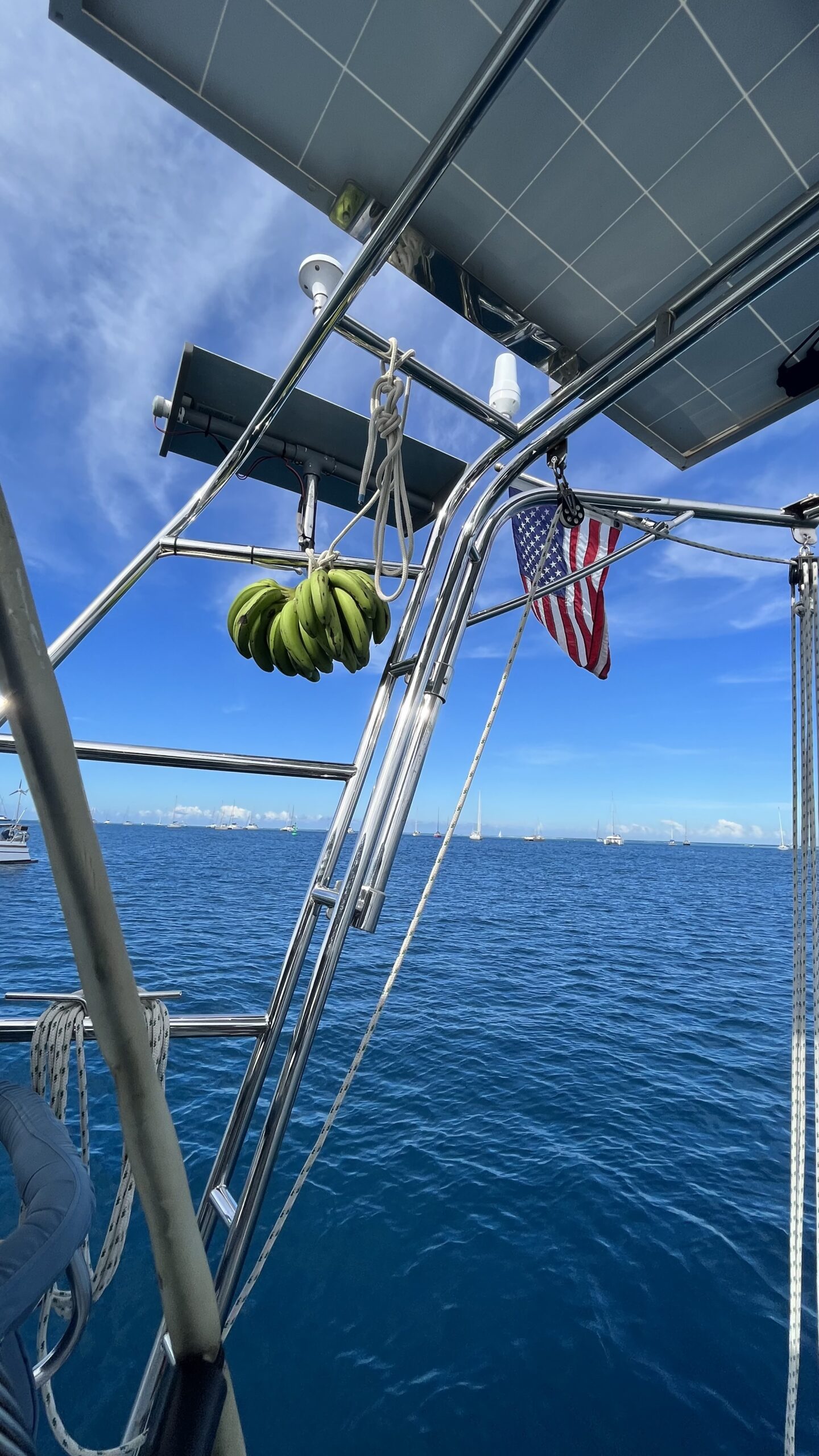
Gabe enjoying the waterfalls in TahitiLoaded up with bananas and ready to leave
Cyclone season in the South Pacific is from November to April. So my plan for this first season was to keep the boat in Tahiti. I had originally planned to keep the boat in Marina Papeete but the opportunity in Port Phaeton seemed worth trying. My sister Wendy and my brother-in-law Pat agreed to come back to Tahiti to help me with the decommissioning.
Wendy and Pat arrived in the early morning on Sunday, October 23. They took a taxi to Marina Taina and I picked them up at the dock. After they got settled on the boat, we returned to the marina for lunch (poisson cru) at La Casa Bianca. Later that evening we had sundowners on Rhapsody.
The next day was quite windy. We took the dinghy to the marina dock and walked to the Carrefour to buy a few provisions. Then we went back to the boat, pulled up anchor, and went to the nearby airport anchorage. The purpose of the move was to get a little closer to the Papeete pass to cut time off the trip to the boatyard, where we were to haul out for a couple of days. The anchorage was crowded and the conditions were rowdy, but we found a spot to fit in for one night. That night the wind howled. I didn’t turn on the instruments to measure the speed, but the wind generator was screaming so I knew it was probably well above 30 knots.
The next morning at the break of day it was still blowing over 20 knots but we picked up the anchor and started heading out of the Papeete pass and north toward the next pass. We were motoring against the wind but making decent headway. We went into the pass, turned right and started heading toward the Technimarine boatyard. They saw us as we arrived a half hour early and flagged us over to enter their slip in preparation for haulout.
The haulout and move into the yard went very well. The guys noticed spots under the keel and rudder that needed touchup. (We had touched bottom on the last trip to Moorea.) So while they focused on that, Pat and I worked on our initial purpose for the haulout, which was a broken thru-hull valve. We determined that the thru-hull itself did not need replacement so Pat removed the valve and replaced it with a new one. I went around to all the other valves and tested them, lubing the ones that needed it. I also cleaned the barnacles off the boat bottom, shaft and prop, greased the prop and put new zincs on the shaft and strut. Pat removed the speed/depth transducer, cleaned it up and replaced it. We removed the forward-scanning transducer, cleaned it up and left the blank in because we won’t need it until after cyclone season. We also took the windlass apart to inspect it, determinging that it has a broken spring that needs to be replaced. In the evenings we walked closer to downtown Papeete for restaurant meals before settling in for our boatyard slumber.
Wendy in the boatyardAldabra in the boatyardNancy in the boatyardEnjoying a restaurant meal
On Thursday, we splashed back into the water at 8:00 a.m. and headed out of the pass and over to Moorea, arriving in Cooks Bay before noon. The idea was to give Pat and Wendy a chance to explore Moorea before heading back over to Port Phaeton to decommission. But the weather didn’t invite a return crossing as soon as I had planned, so we tried to get work done while at anchor in Moorea. We did a nice hike in the rain at the park where the Belvedere lookout is, and we toured the island for a day in a rental car. We also walked around the east side of the bay a few times, stopping for lunch.
Anchored in Cooks BayAt the Belvedere LookoutRainy HikeLooking at Cooks Bay Through the RainDriving on the east side of Moorea with a view of Tahiti Lunch during our driving tour of Moorea, Poisson Cru
Otherwise, we did boat projects. We inspected the two jibs and put tape on the sacrificial cloth that covers the primary jib. (Both need to go in for repairs when I return.) Pat repaired a seam on the bottom of one of the kayaks. We removed everything from the most forward compartment in the bow, where some water had entered. We dried out the compartment and the gear before restowing it. We dried out the spinnaker, which had been stored on deck, and put it down below. Wendy polished all of the stainless steel railing. Pat worked on unclogging the aft shower sump, which had been draining too slowly. We hoisted the dinghy up on deck and cleaned the bottom. I mended the dinghy chaps.
After eight days in Moorea, we pulled up anchor on Friday morning, November 4. It wasn’t a good day to leave but I couldn’t see a better day in the forecast. The bay was calm, but once outside, we had 20+ knots of wind on the nose. We motored into the wind and seas, making less than 2 knots of headway. The first two or three hours were a slog but conditions did improve and we started to go a bit faster. We went into Papeete pass and then made our way down to the Taina anchorage, anchoring about 4:30 p.m.
The next morning, we left the anchorage at 6:00 a.m. and motored around the island to Port Phaeton. There was no wind and the seas were glassy until the last five miles. Then we got 20+ knots of wind on the nose and white-out rain as we made our way toward the pass and into the lagoon, picking up the mooring ball before noon.
Port Phaeton
The next day, Sunday, the real work began. Between rain squalls, we dried out the main and refolded it and dried out the jib, took it down, folded it and put it inside the boat. We took a lot of the hardware off the boat and covered anything we couldn’t remove. We washed the cockpit cushions, dried them out and put them down below, along with all the empty fuel jugs. Pat fixed a couple of hatch leaks.
On Monday, we took the bus on a two-hour trip to the airport and picked up a rental car. We then drove into the marine/industrial area to a marine store before heading back to Port Phaeton. Once there, we loaded up the car and headed a short distance away to do laundry. On Tuesday, I met with Marc Bordas who will be taking care of the boat during the next few months. Pat replaced the breaker for the bilge pump and then replaced the bilge pump itself. The next day, Wendy wiped down the interior walls with vinegar and I cleaned out the freezer/refrigerator boxes and threw out food. We cleaned the heads. We pickled the watermaker. We collapsed the bimini and zipped it into its cover. We tied a line around the main to keep it from catching air during high winds. In the past I’ve removed the dodger windows during hurricane season. This time, I left them intact, so we shall see what happens.
Finally on Thursday, we completed our packing, closed almost all the thru-hulls and put a variety of desiccants throughout the interior of the boat. They won’t keep moisture out of the boat but perhaps they’ll help prevent some of the mildew that will develop. I then discovered that the stern compartment with all the fishing gear was flooded, so we took all that gear out and tried to dry it and clean it up before putting it inside the boat. After shuttling Wendy and all our bags to shore to load the rental car, Pat and I returned to the boat, hoisted the dinghy motor onto the boat and then hoisted the dinghy onto the foredeck. We put its cover on and tied it down. With the boat completely closed up, we waited in the rain for Marc to pick us up in his dinghy. He shuttled us to shore and we left the boat in his care. He’ll open it up once a week when it’s not raining. And he’ll check the battery voltage and the bilge as well as the mooring lines.
Port Phaeton
After leaving the boat, Pat, Wendy and I drove to the Hilton Hotel near the airport and checked in with all the gear I was taking back with me. (I hate to leave my computers and electronics on the boat, so it all had to go to California.) We had a nice dinner and got to sleep in real beds. It was my first time sleeping off the boat in seven months. The next day we walked into town and back before taking some pool time.
Arriving at the hotelWendy and Pat in vacation mode
After another nice dinner and good sleep, we headed off in the early morning for the airport, turned in the rental car and boarded a plane. The plane made it part way to California before turning back for a medical emergency. We set off again five hours after our first departure, this time making it all the way to Los Angeles. I’ve never been through Immigration and Customs so fast in L.A. before, but it was a breeze. We then quickly got into a rental car and I slept all the way to Pat and Wendy’s house in Escondido.
So begins cyclone season. Monitoring the weather in Tahiti. Ordering boat parts. Visiting with family and friends. Squeezing in annual medical appointments. And planning the next season in French Polynesia.
On Thursday, October 6, I picked up the rental car again and headed toward the port of Papeete. I stopped by to see Michel at the Taina Chandlery and he fixed my butane hose so it would work. And I dropped off my empty butane tank to be filled at the Mobil station. Then I stopped at Technimarine to confirm a haul-out appointment. The next day, early, I headed to the airport to pick up Todd, Laura and their friend Jeff. I made them go with me back to the marina to give a package to Bob on Rhapsody, and then I dragged them to Nautisport to pick up my diving BC that was being repaired. We tried to have lunch at Point Venus but it was way too early, so we headed around the east side of Tahiti toward Port Phaeton. That night we had a very nice dinner at Terre-Mer, which you can see from the boat.
The next day was a tourist day, while we still had the rental car. We went to Teahapoo, home of the famous surf break, and then up to the Belvedere lookout on Tahiti Iti for a nice view of the intersection between the two halves of Tahiti. Lunch was a very nice one at Loula et Remy in Taravao. Jeff and Todd also looked at some of my small electrical/engine problems and came up with solutions.
Looking at the Teahapoo Break From Shore on Tahiti Iti
The next day we drove a long way up the west side of Tahiti to find the public beach (Plage Vaiava) where snorkeling was supposed to be good. The snorkeling wasn’t great, but we each had a nice swim before heading for lunch at Lani’s BBQ. Nice place. It was a Sunday, which may have explained the long wait for service.
On Monday, we stopped at Ace Hardware for a new switch for one of my lamps and then hiked to a waterfall on the east side of Tahiti. We then headed to downtown Papeete to see the market and had lunch at Jimmy’s, a couple of blocks away. When we returned to Port Phaeton, we did a shopping run at the Carrefour to load up for a sailing trip.
Jeff, Laura and Todd at the waterfallWaterfall hikeWaterfall hike
On Tuesday morning, we dropped off the rental car and then left the mooring ball at 8:00 a.m. We were through the pass by 9:00 a.m. Outside the reef, the seas and winds were calm and from behind us. But as we got closer to the rounding point on the southwest side, both seas and winds built significantly. We had winds in the mid-twenties and I had to hand steer to appease the autopilot. It was a bit rowdy for my guests, who are not sailors. But as we finally got near the pass south of Marina Taina, things calmed down and entry into the pass was benign. We found a spot near where Linda and I had anchored previously after trying to find a spot in front of the huts at the Intercontinental. We nearly hit a shallow reef before Todd managed to get my attention.
The next morning we got up early and got fuel at the fuel dock before heading to Moorea. The wind was light and on the nose so we motored the whole way. We first tried anchoring out in front of the town of Maharepa but it was very crowded and our spot was too shallow, so we moved well into Cook’s Bay, where it is plenty deep and there was plenty of room.
On Thursday, we took the dinghy to the dock near the Snack Rotui and started walking around the bay toward Maharepa. We passed the Allo Pizza restaurant, which looked good, and took a look the the place where cruise ships drop off their passengers for land tours. Then we kept walking around through and past the town. We ran into Andrew and Liane from Waveriders and all of us stopped at the Moz Cafe for refreshments. As we started back, we ran into Bob and Sarah on Rhapsody for a quick chat before finding a great snack truck. We had delicious fish tacos and poisson cru there before continuing our sojourn. The next stop was the hotel Kaveka, which has a very nice atmosphere and a very friendly staff. After a couple of beverages, we headed back to our part of the bay, picked up some things from the SuperU store and headed back to the boat. That night there was a nice fireworks show for the benefit of the cruise ships that were in the bay.
Friday was a rainy morning. Jeff went off in the kayak and Todd joined him in another kayak later. Meanwhile Laura and I took the dinghy out to the reef for some unimpressive snorkeling. On Saturday, we walked 4.5 miles from the bay up to the Belvedere lookout. There were far too many tourists there so we turned around after a quick look at the view and headed back to the boat. On Sunday, we picked up a rental car and drove all the way around Moorea, checking out the sites I hadn’t seen before. We stopped for beverages at the Hibiscus hotel and lovely Sunset restaurant and then headed over to the Tipaniers resort where we had lunch before going out on a whale watching trip.
The whale watching was exciting. The captain and guide would spot whales and then we follow the guide into the water and swim toward the whales. The first swim was really long and seemed ridiculous in that you can’t chase whales in rough water forever. We did see some, however. We then got back in the boat a few times so the boat could get us better positioned, and we went in again. Each time seeing whales. The best view was right above a mother and her baby. I’m not sure how much the whales liked to be harassed but the guide and the boat captain were very responsible in their approach.
Not a great shot, but a look at a whale we’re swimming withMother whale with nursing baby
After dropping off the car on Monday morning, we pulled up anchor and motored back to the Marina Taina anchorage on Tahiti. It was a day earlier than planned but the weather models were inconsistent and I was afraid that it could be a miserable trip on Tuesday and slightly less miserable on Monday. As it turned out, Monday was pretty calm and we motored the whole way. After relaxing for a bit, we put the dinghy in the water and I took Jeff to shore so he could go to a hotel. Todd and Laura and I joined him that evening for dinner at La Casa Bianca at the marina.
On Tuesday morning, Laura and I went to the marina and did four loads of laundry, which took forever to dry. I was so grateful that that task was done. After we returned to the boat, Todd and Laura packed up and I took them back to the marina to catch a cab to their hotel. Hopefully they enjoyed a nice resort afternoon before their early morning flight to Los Angeles.
Back on my own, I walked to the Mobil station to pick up my butane tank, which had been filled and was waiting for me. Then I headed back to the boat to relax and clean. It’s always a similar drill between guests. After getting the laundry done, I defrost and clean the three refrigeration/freezer boxes, re-organize the galley, clean the heads and tidy up. I also run the watermaker in 1-2 hour shifts when the sun is producing ample solar power. I did take an afternoon off to go over the Waveriders with the Rhapsody crew to play games. It was quite fun.