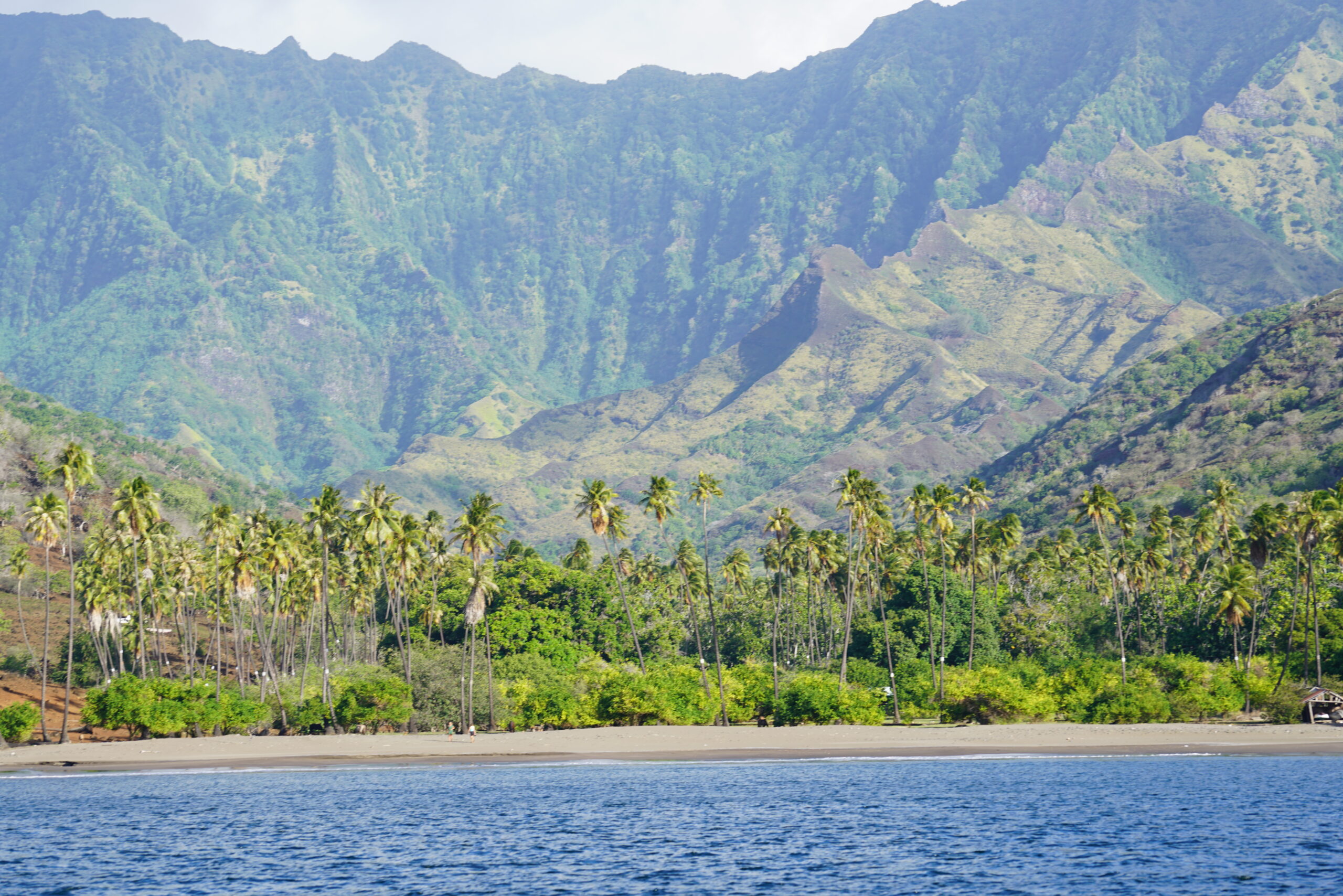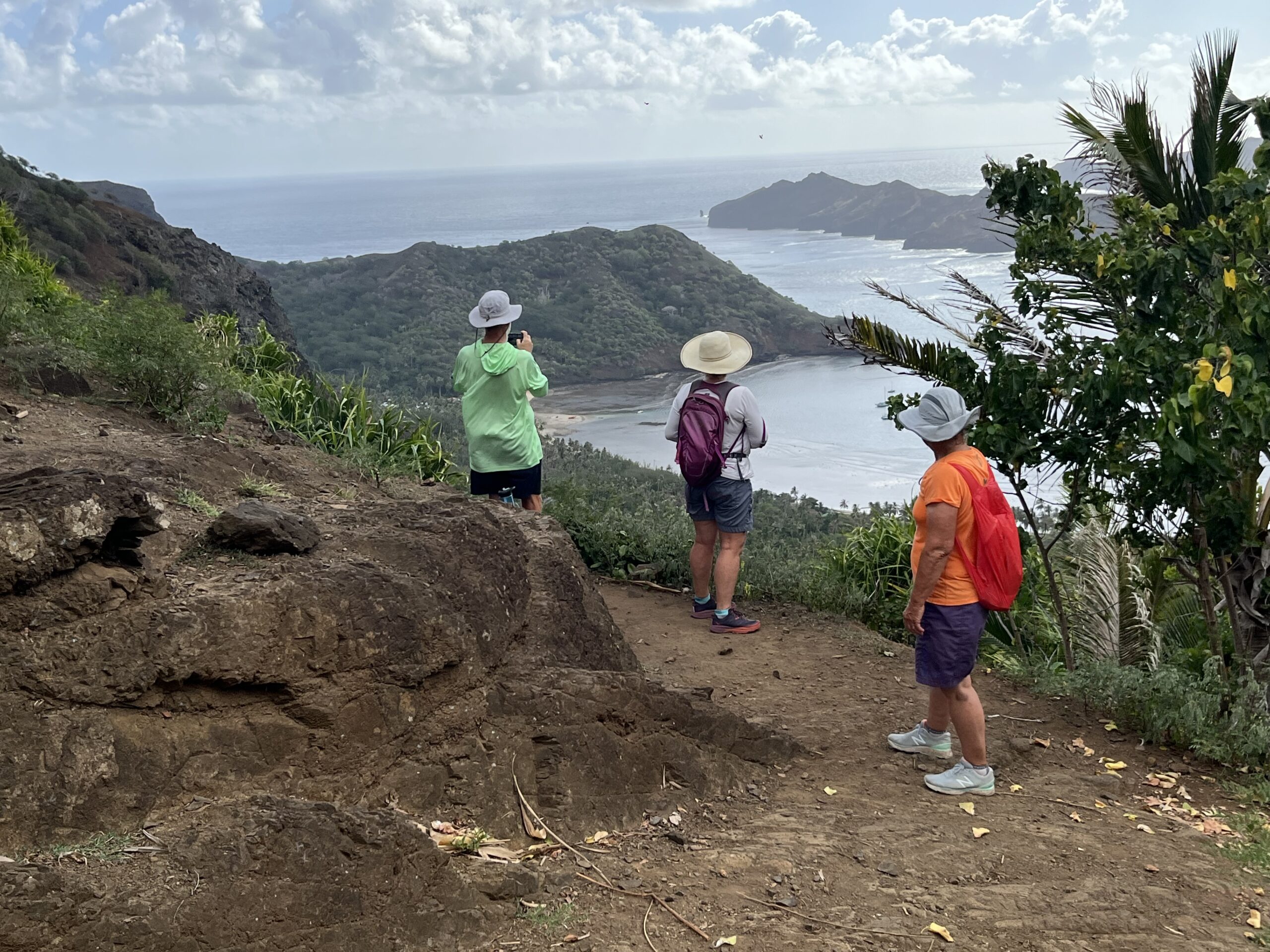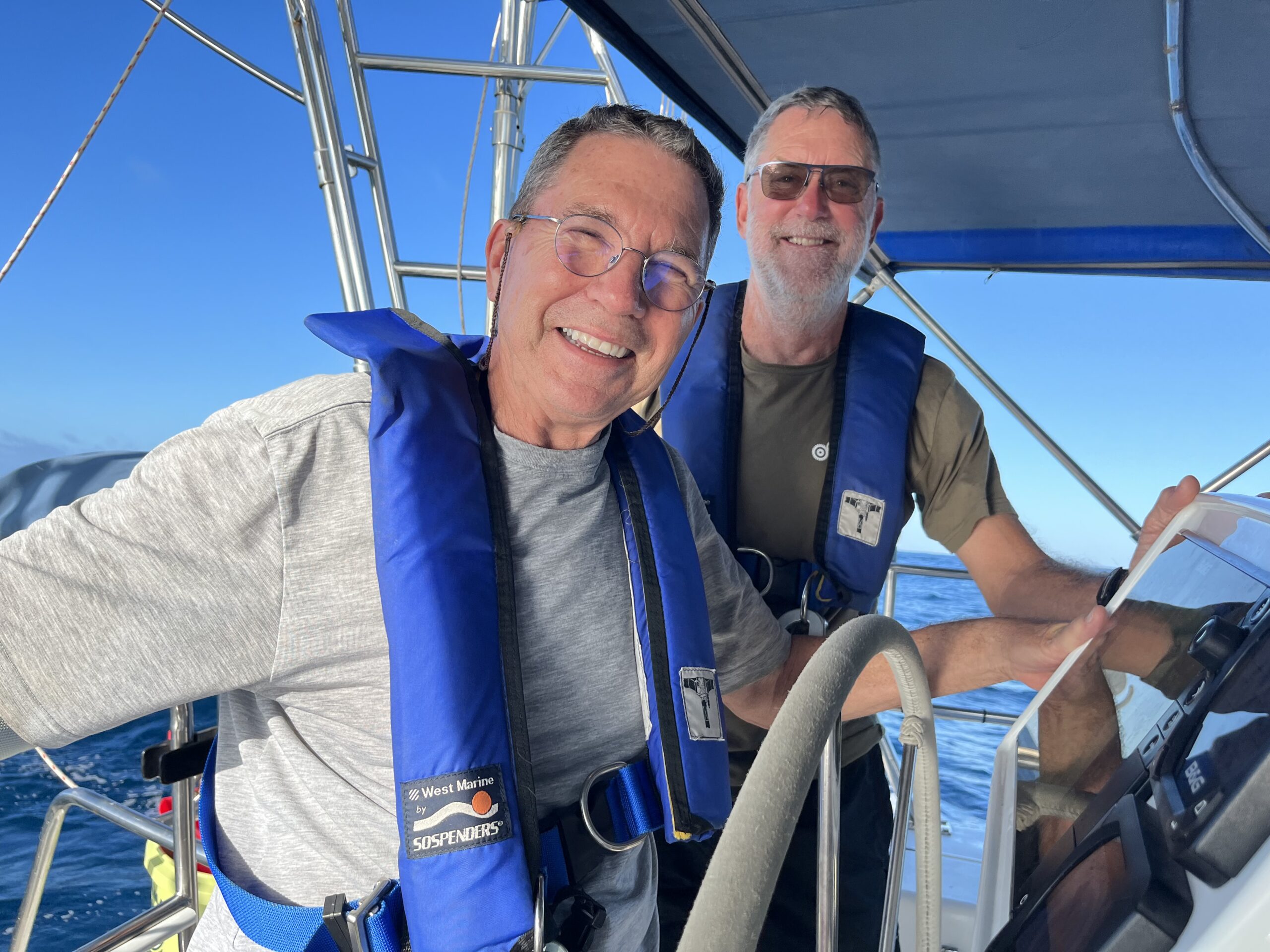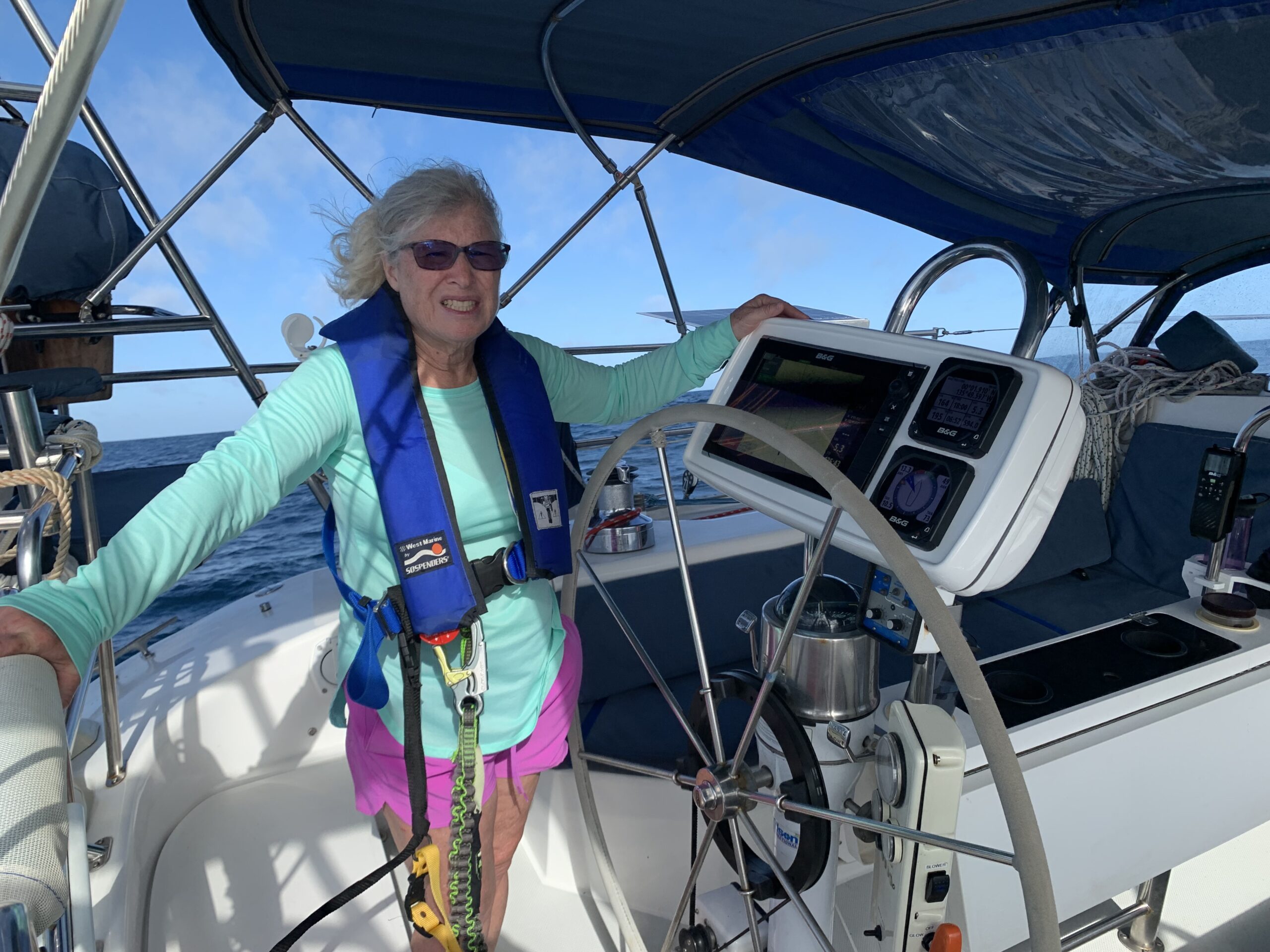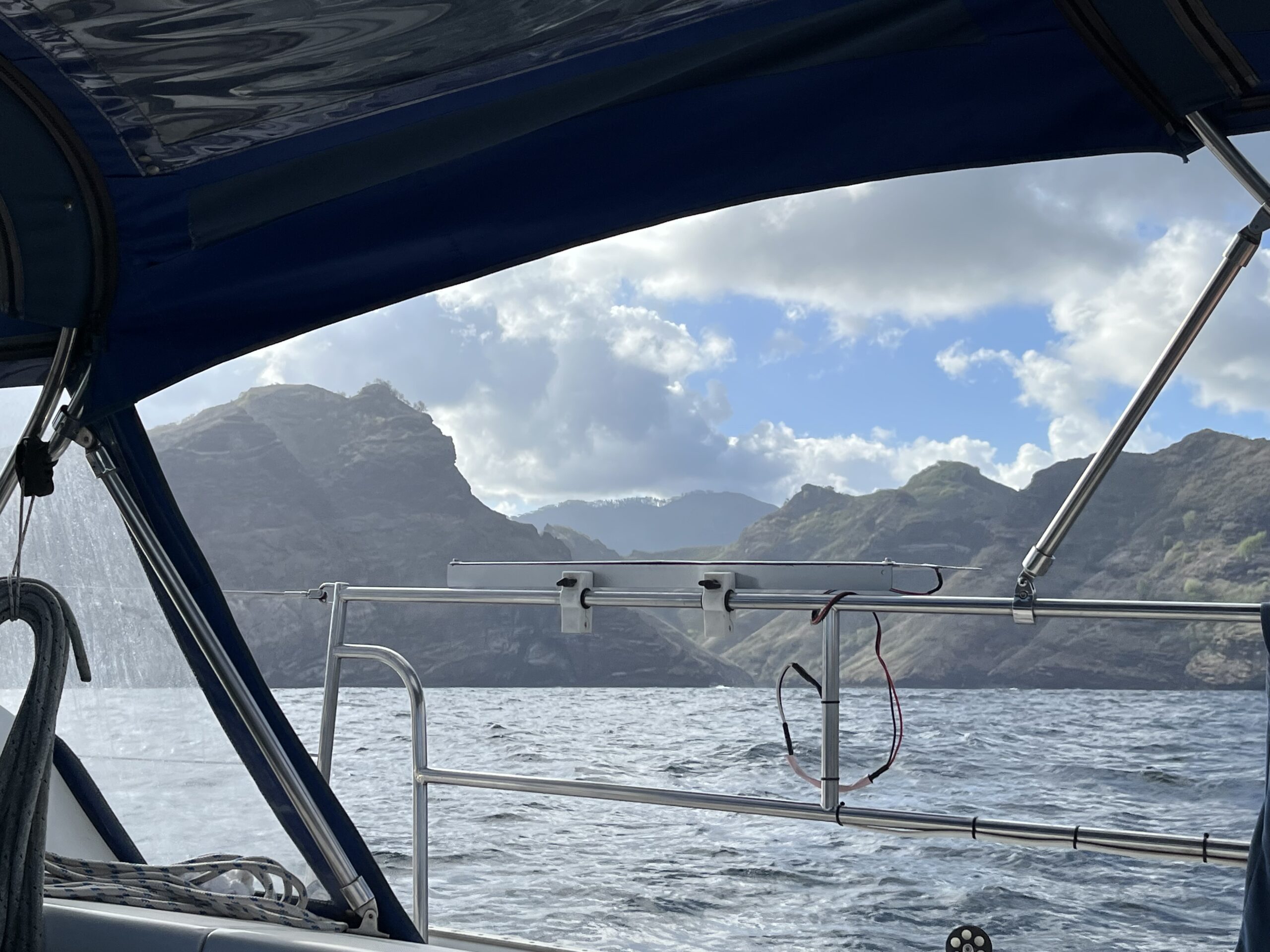
Heading for the Tuamotus, we left the Omoa anchorage on Fatu Hiva on Saturday night, July 9 at 10:30 p.m. We set our sails as soon as we cleared the island and then put a reef in the main. The winds were in the mid-teens and we moved along nicely above 7 knots. The moon was out and it was lovely. Sunday was nice, with winds between 9 and 12 knots, always on the beam. And Sunday night was a calm, pleasant sailing night. Monday brought about the same light winds and more sunshine. A pod of dolphins joined us briefly. It’s nice to have an uneventful, comfortable passage.
On Tuesday, the winds kept getting lighter. After trying the spinnaker, we sailed on the jib alone. Finally, in the gap between Raroia and Takume, we pulled in the jib and motored. Once we got near the pass at Raroia, we turned off the motor and bobbed for the rest of the night and into the morning, waiting for the right time to enter the pass. As I later figured out, I was reading the current tables wrong so we entered the pass at the wrong time. For our first entry into an atoll pass, it was a bit intense but otherwise fine.
Once we entered the pass, we went over and anchored in front of the village. It took us 2-3 hours to anchor because we were floating our chain for the first time. We had to find a sandy place for the anchor and then attach fenders to the chain to keep it from touching the coral on the sea floor.
As we were coming in, an armada of dinghies passed us on their way to drift snorkel the pass. Bob and Sarah from Rhapsody were among them. That night we met the rest of the armada. We went over for sundowners to Womble, a beautiful Seawind 1600 from the U.K, owned by Dale and Katrina with crew Jack and Etta. We also met Lance and Amy on Lorien, and Kate and Jim on Polaris. It was a very nice evening with good people. We had a little mini-emergency because Marshall fainted. But Dana, Dale and Katrina tended to his medical needs.
The next day was Bastille Day and on many islands in French Polynesia they celebrate. Raroia was not among them. It was a very windy day in the anchorage and some of us had to re-anchor in those conditions. We stayed on the boat. Rala also joined the rest of us, having come from the other side of the atoll.
The next day, Friday, July 15, most of the boats were headed to Makemo but we headed over to the other side of the atoll, first to the Kon Tiki monument and then to a beautiful, quiet anchorage on the northeast end. We explored on land a bit and otherwise hung out. The weather went from still to rain to wind.
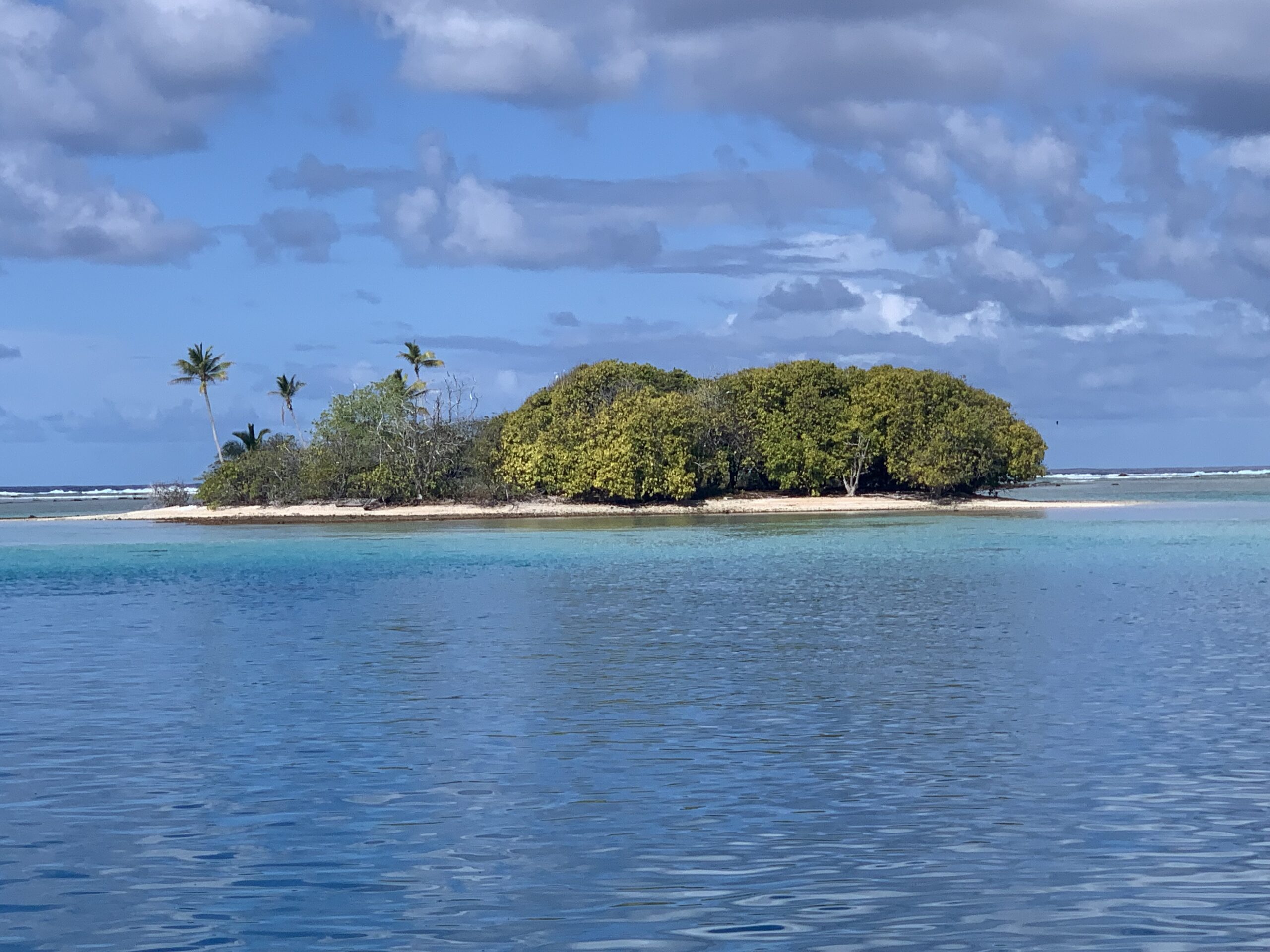
On Monday, July 18, we left the northeast anchorage at 8:00 a.m. and headed out of the pass. I still handn’t figured out that I was reading the current tables wrong, so we didn’t exit during slack tide, but it wasn’t too bad. We put the jib up and ran on a broad reach to Makemo. Dana caught a very large tuna and cleaned it with guidance from Johno. We arrived at 5:00 a.m. and waited until 6:30 a.m. to enter the pass, again at the wrong time, but it was fine. We anchored in front of the village, floating our chain. It took about an hour.
We went ashore and bought provisions, got money at the ATM and answered emails because we had a cell signal for the first time in many days. We had Dana’s tasty fish for dinner. The boats in the anchorage included Womble, Polaris, Rhapsody, Lorien, Rala and now Candine and Black Moon (who had been in Fatu Hiva with us). It felt like quite a community although of course we would all head off in different directions.
While we were in Raroia, Johno and Marshall had colds. We tested them for Covid and they were positive. It sort of explained why Marshall had fainted. I went around to as many of the boats as I could to let them know that we had exposed them. By the time we got to Makemo, some of the cruisers were symptomatic.
On Thursday, July 21, we motored to the Punaruku anchorage. It was a calm day inside the lagoon but there was a big south swell outside and you could see the waves breaking on the reef. We had a nice snorkel on the reef and a nice evening. After a gorgeous sunrise on Friday, we motored to the anchorage near the west pass, which we would not have done if it weren’t for OpenCPN and the satellite images that are integrated into the charts. We could see each bit of coral as we navigated into the anchorage. It was a fun place to snorkel for the day and a nice quiet night.
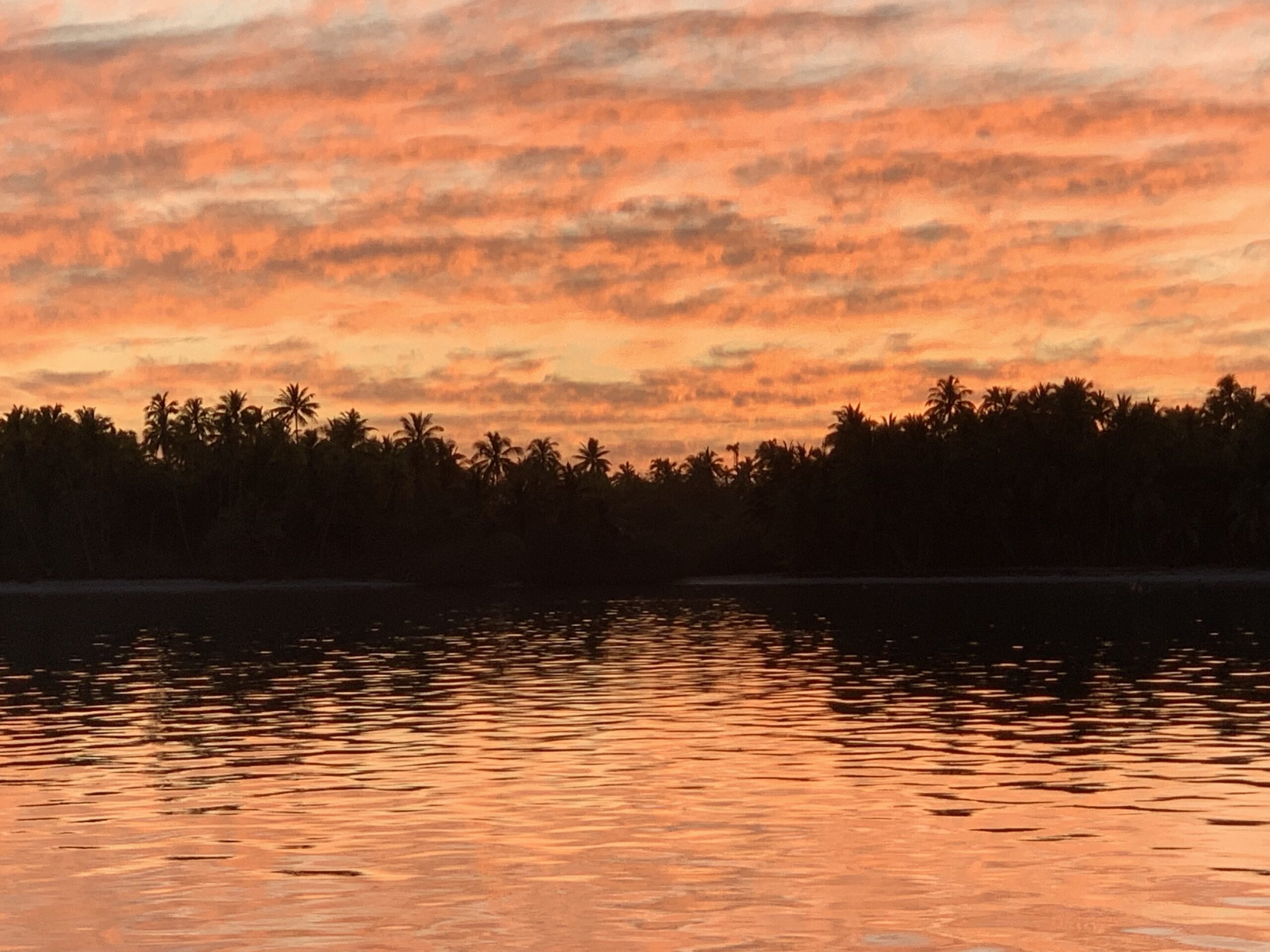
On Saturday, July 23, we left Makemo via the west pass (still at the wrong time) at 6:25 a.m. We sailed on a beam reach with 10-12 knots of wind from the north. It was a nice day of sailing. In the evening, the wind came up and we put two reefs in the main. We had 13-15 knots of wind and we were still going too fast to reach Fakarava. We arrived at the pass at 10:00 p.m., took down the sails and motored for four hours. Then we shut off the motor and floated around until sunrise. After that, we put the jib up and sailed around, killing time. We entered the south pass at 9:25 a.m., at the wrong time, and it was a bit hairy. There were a bunch of dive boats in the pass and they were yelling at us. I’m not sure what they were saying but I think they were chastising us. As we headed to the anchorage near the pass, it was really windy and it seemed imprudent to pick up a mooring ball there. We kept on going (which meant passing up the opportunity to snorkel the pass) and went to Hirifa.
For kite boarders, Hirifa is the spot. The wind seemed perfect and lots of boats had people kiting around the anchorage. For me it was just an overnight spot. We pulled up the anchor the next morning and headed toward the north side of the island, stopping for the night in an anchorage by ourselves. We had a nice snorkel and a quiet night.
The next day we proceeded to the village of Rotoava and anchored. Rala was there at anchor and Rhapsody was tied up at the wharf because their windlass had broken. We spent a week in that anchorage. Partly it was due to multiple days expected of high winds. We also were dropping Marshall off there so he could fly out. And it was a decent place to provision, ride bikes, eat at restaurants and tour a pearl farm. We hung out with Ian and Laura on Rala and saw Bob and Sarah on Rhapsody before they left for Tahiti. There wasn’t that much to do on Fakarava during super windy days, but Fakarava Yacht Services was a godsend to cruisers. We could get laundry done, use wifi, get cooking gas fill-ups and rent bikes. I discovered that I couldn’t take Marshall off the crew list in Fakarava so that would have to wait until Rangiroa.
On Monday, August 1, Rala and Aldabra went over to the anchorage near the north pass so we could get an early start going out of the pass the next morning. (I had finally figured out how to use the current tables properly.) We each picked up mooring balls but it was really windy, the seas were huge and choppy and the balls were very close to shore. If a ball had broken, we would have only seconds to start the motor and keep the boat off the shore. And the motor would be working very hard against the wind and seas. Both boats elected to go back to the village and anchor. We each had a somewhat peaceful night before an early morning departure back to the pass.
On Tuesday, August 2, Rala and Aldabra pulled up anchor at 6:00 a.m. and sailed to the pass. Because I finally had the timing right, it was very smooth. Outside the pass, the swell was a bit big and the winds were in the high teens. Headed for Rangiroa, we sailed on the jib alone on a broad reach, jibing every so often. Rala was sailing downwind so they had a much better angle and stayed ahead of us the whole time. At one point we ran the motor for an hour and a half to charge the batteries and they didn’t charge. Johno found a loose wire and reconnected it to the alternator and charging resumed. Whew!
To arrive at the pass in time, we motored for the last few hours and went through the pass as soon as we got there at 8:00 a.m., just behind Rala. We anchored in front of the Kia Ora hotel with several other boats, none of whom we knew. Rangiroa was to be the last stop for Dana and Johno, who were flying out on August 7.
As soon as we anchored, we went ashore to walk around. We ran into Ian and Laura at the pass, where people were watching dolphins surf the waves. They took us to a great little restaurant at the pension Relais Josephine where we could eat while watching the dolphins. We had a nice lunch before heading back to the boats for naps. Ian and Laura came over to Aldabra that night for sundowners.
I needed to get to the gendarmerie to take Marshall off the crew list. Google Maps said it was in the village of Avatoru. So the next morning, Dana and Johno and I took the dinghy the four miles to the village and beached it. It was a windy, wet ride and I was soaked from head to toe. We couldn’t find the gendarmerie and there was confusion among the locals about its location. We stopped by the mayor’s office to pay our cruiser’s tax and a very nice man explained where it was. We could walk 5 kilometers or take the dinghy. We elected to take the dinghy and found a little pass to tie up before walking a short distance to the gendarmerie.
We found it, but I don’t speak French and the staff didn’t speak English. We spent a lot of time on forms that I was pretty sure were not right. At the end, the woman sent me away without anything in hand. I asked if I should be signing something and she assured me that everything would go to Papeete and be just fine. But later that day I got an email from her saying that I needed to come back and sign a form.
After we left the gendarmerie, we ran into Ian and Laura, who were taking a bike ride. We stopped at a magasin before going back to the dinghy, and then we took the wet ride back to the boat, something I would rather not repeat.
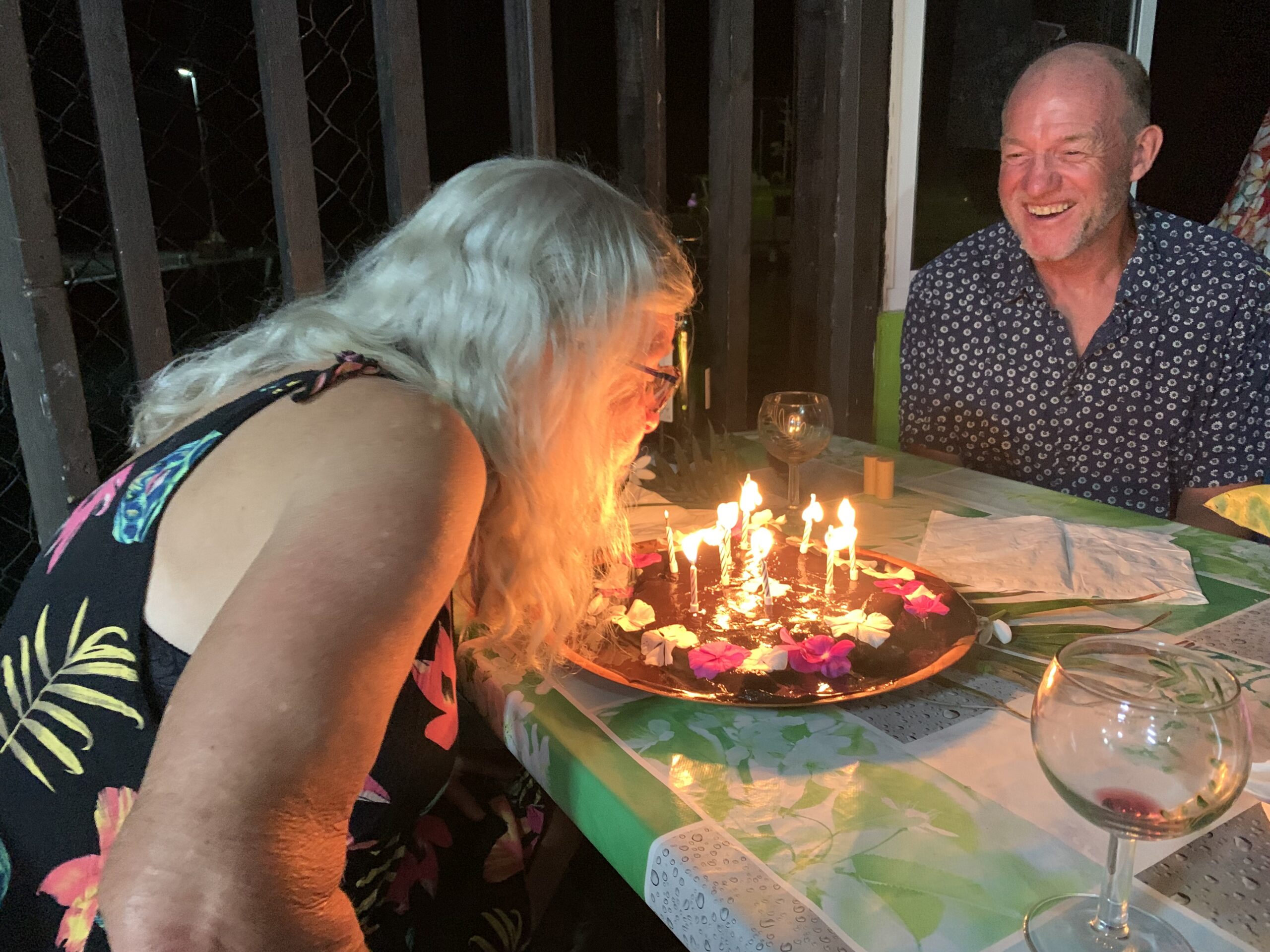
Dana and Johno banished me to the cockpit during the middle of the day so they could bake a birthday cake. Later, with Ian, we attempted to snorkel the pass by pulling our dinghies along with us as we drifted. But we were working against a current so we abandoned that and went over to the aquarium at the motu near the pass. The snorkeling was good there so we spent a bit of time before heading back to the boats to rinse off before dinner. The five of us had a nice birthday dinner at Snack Puna, which included a chocolate torte with trick candles that didn’t blow out.
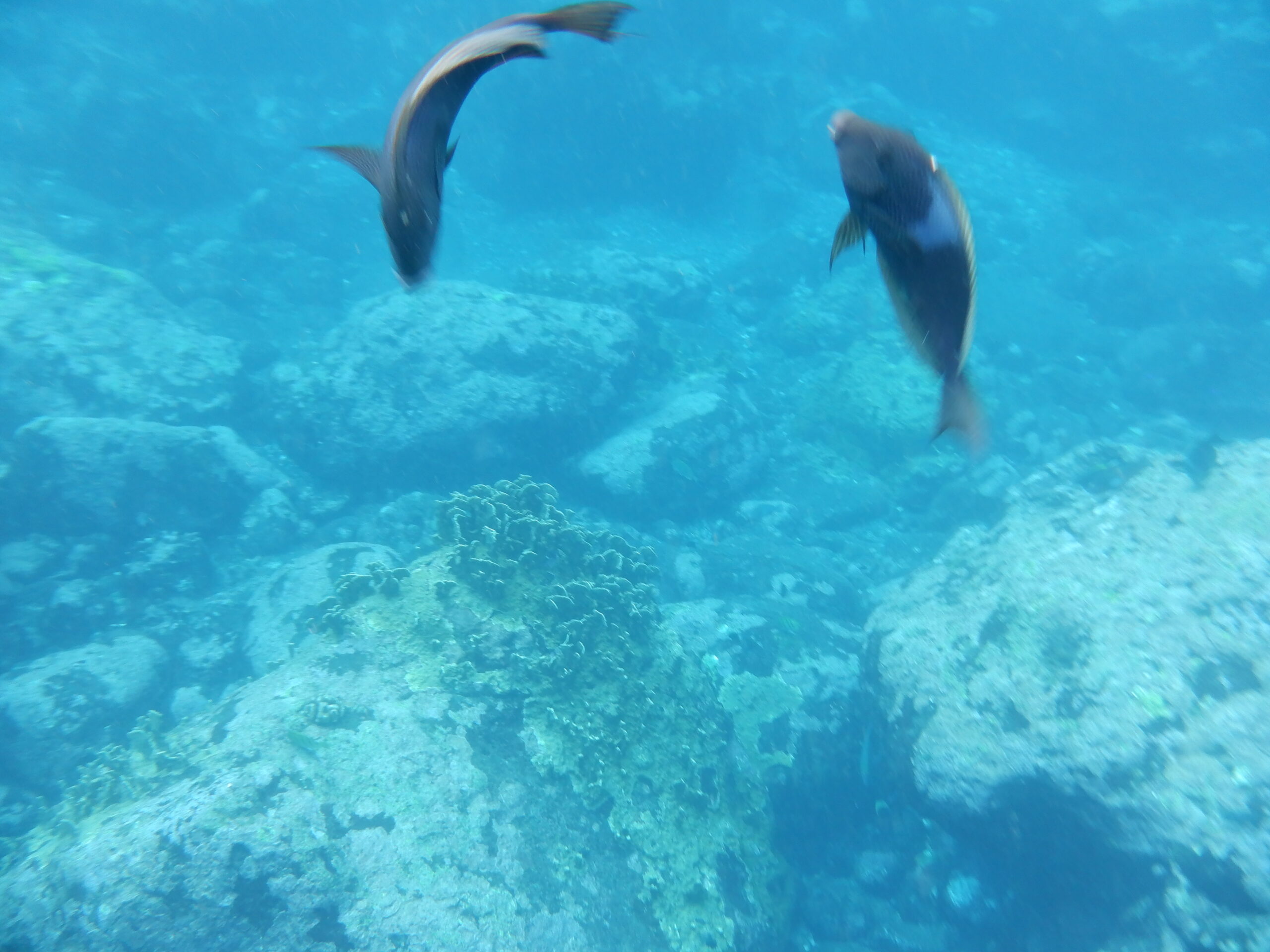
The next day, Friday, Dana and I joined Ian and Laura for two dives with Rangiroa Diving Centre. The first dive was a reef dive outside the pass on the east side. The second dive took us into the pass from the outside. We were hoping to see dolphins, which is a highlight of the dives here, but they didn’t appear. The second dive was a sunset dive and we did see a lot of fish, which had all come out of their holes in the reef to feed. When we got back to the boat, we were freezing and cold. Johno kindly whipped up a meal.
On Saturday, Johno and Dana and I went to shore in search of bikes, but the place was closed. We ended up taking the dinghy across the pass to explore the Tiputa village. We found a working ATM at the post office but not much else. Later we went snorkeling at the aquarium and then joined Ian and Laura at the Snack Puna for a last-night dinner.
On Sunday, Dana and Johno’s last day, we rode bikes to the Avatoru village and happened to find the gendarmerie open. I stopped in to sign the paper, which turned out not to be the right form. I finally got a form, officially stamped, that probably isn’t correct, but at least it shows I tried to sort it out. At the end of the motu, we checked out the Avatoru pass, which is wide and looked very tame. After spending the rest of the afternoon on the boat, I took the two of them to shore at 5:00 p.m. to catch their taxi to the airport. Sitting on that boat that evening, I could tell that no plane had come to whisk them away, but finally, a couple of hours late, it arrived and they took off.
With Dana and Johno’s departure, I was alone on the boat for the first time since April. I was ready to do some serious cleaning. But first, I got one more day of scuba diving in with Ian and Laura. We did two dives, basically in the same place as before, but we saw dolphins. They came and swam around us. We also saw a turtle that didn’t dart away. It let us gawk at it. And we saw lots of sharks and some big pelagic fish, along with beautiful reef fish. That night I had a lovely dinner on Rala with Ian and Laura.
On Tuesday, the taxi driver, Gilbert, took me to the gas station where I could buy gasoline and oil for the dinghy. I was also able to drop of my laundry at Addison’s house. I spent the rest of the afternoon cleaning.
On Wednesday morning, amidst much rain, Ian and Laura stopped by to tell me that one of the magasins had some fresh produce. So I hopped into the dinghy and went there to find some mangos and avocados. (I’d had only one avocado since arriving in French Polynesia.) Later that day I went back to get the laundry from Addison, who had managed to dry everything even during a big rainstorm. (It had rained so much the night before that the dinghy was completely filled while hanging on the davits. Had it been in the water, it probably would have sunk.)
Sadly, Ian and Laura left on Rala on Wednesday afternoon, headed for Moorea and then parts west and south. I’m not sure I will see them again anytime soon. But I really value the friendship.
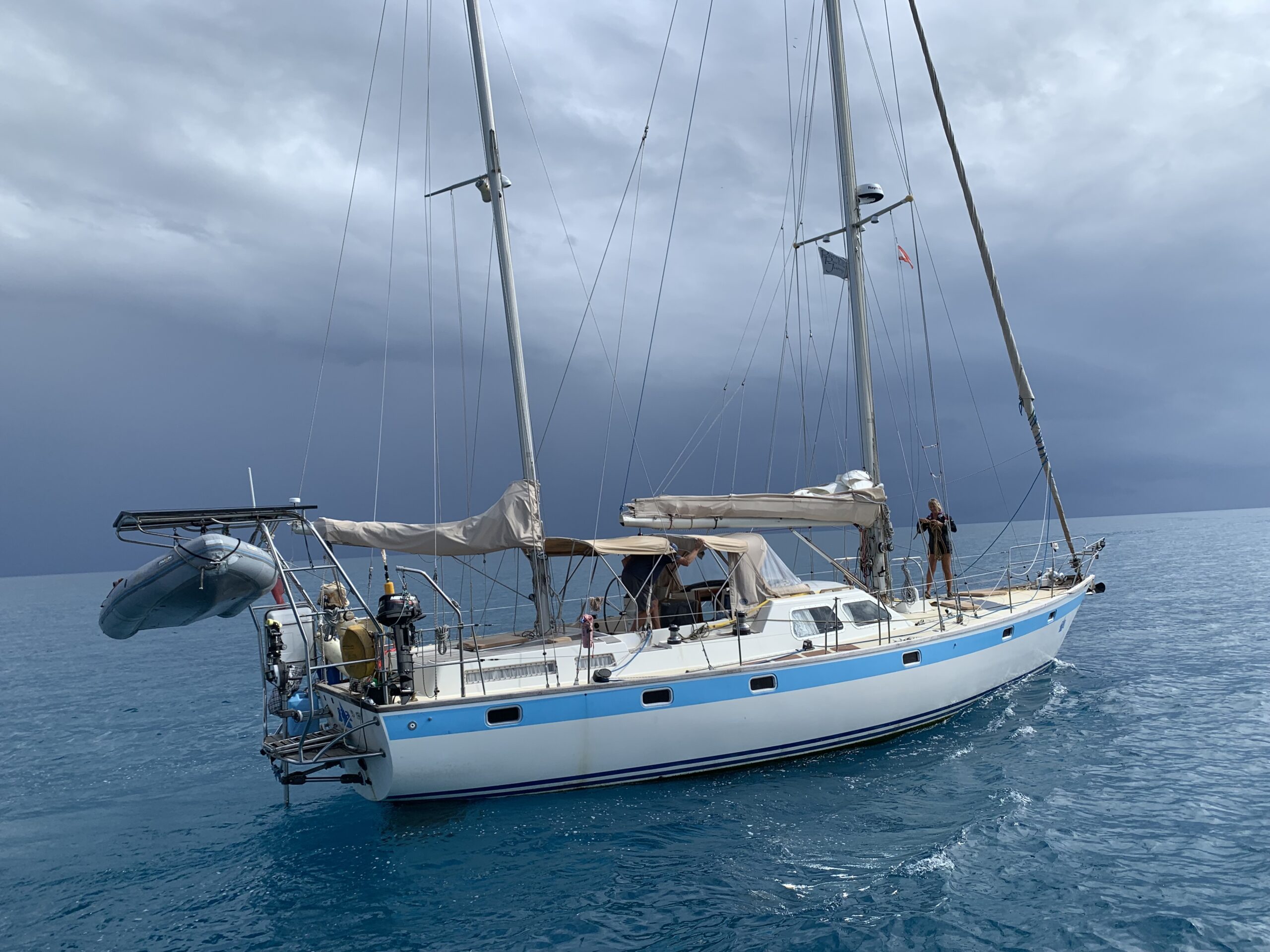
Alone on the boat and without anyone I know in the anchorage, I just puttered away on the boat, defrosting the freezer and fridge and cleaning the galley, cleaning the heads, the floors, the rugs. I re-glued a seal on one of the hatches, changed out the watermaker filters, cleaned the cockpit. Mixing the chores up with a bit of reading and writing, I’ll be ready when my sister and niece arrive in a few days.