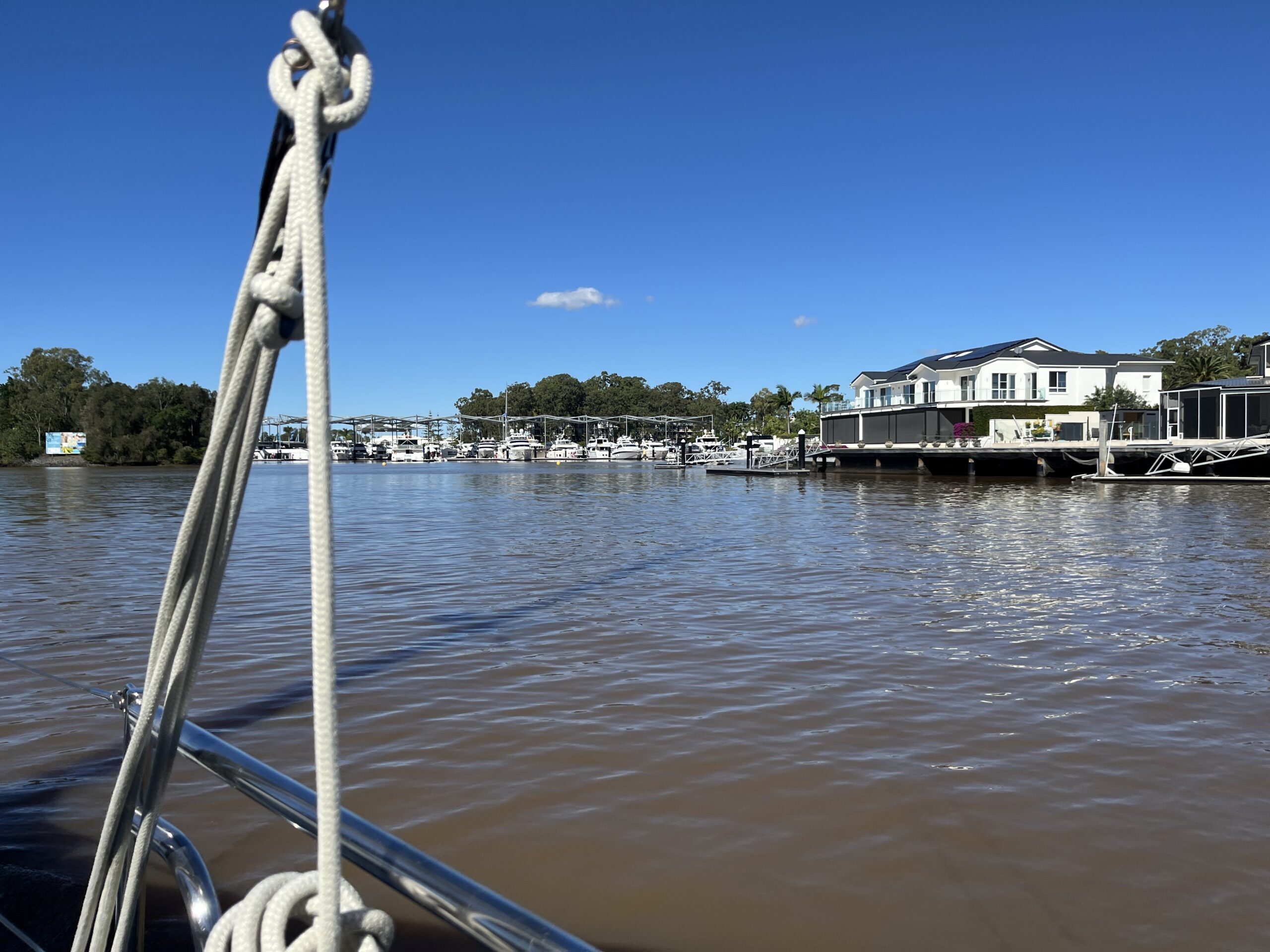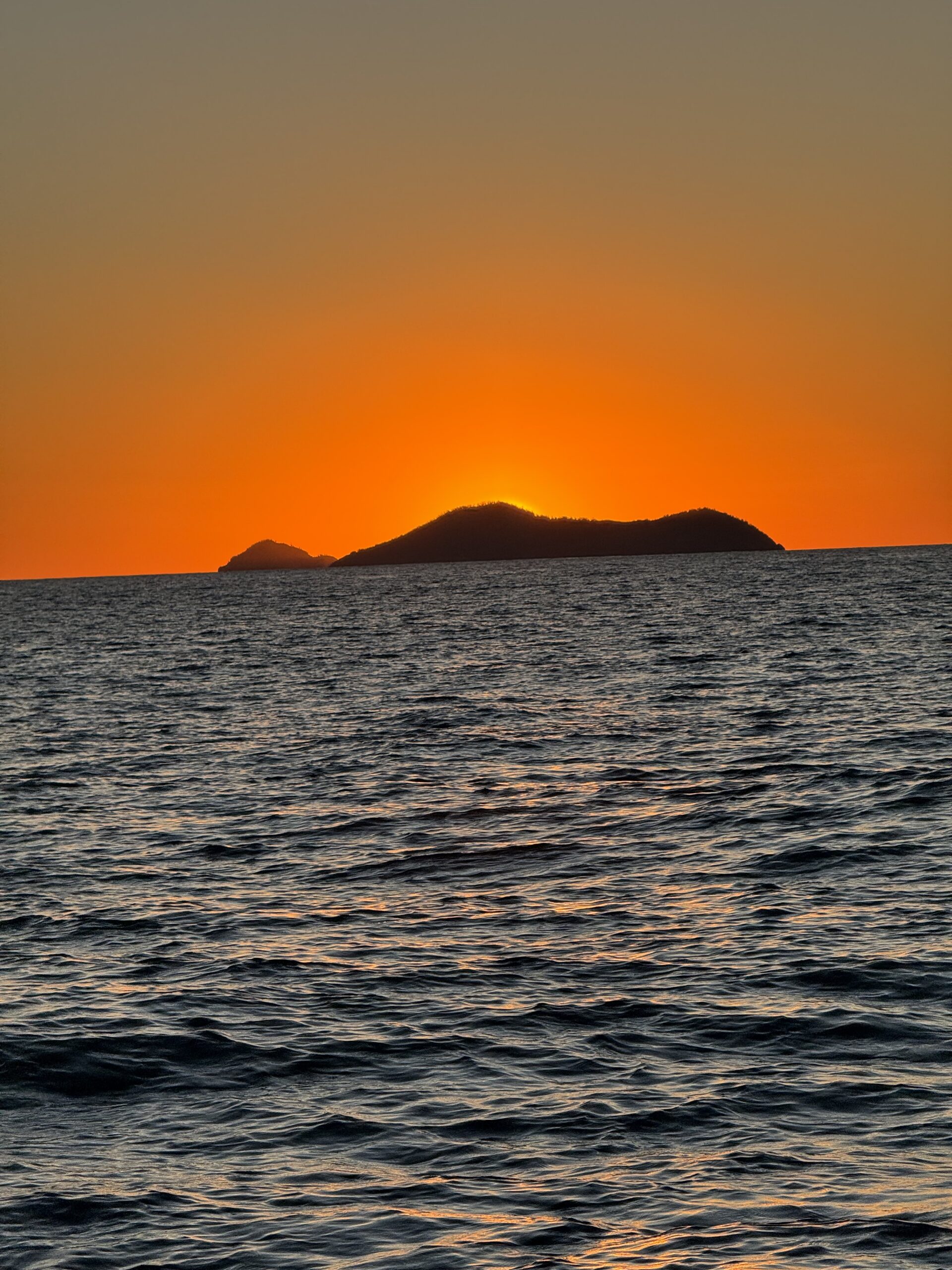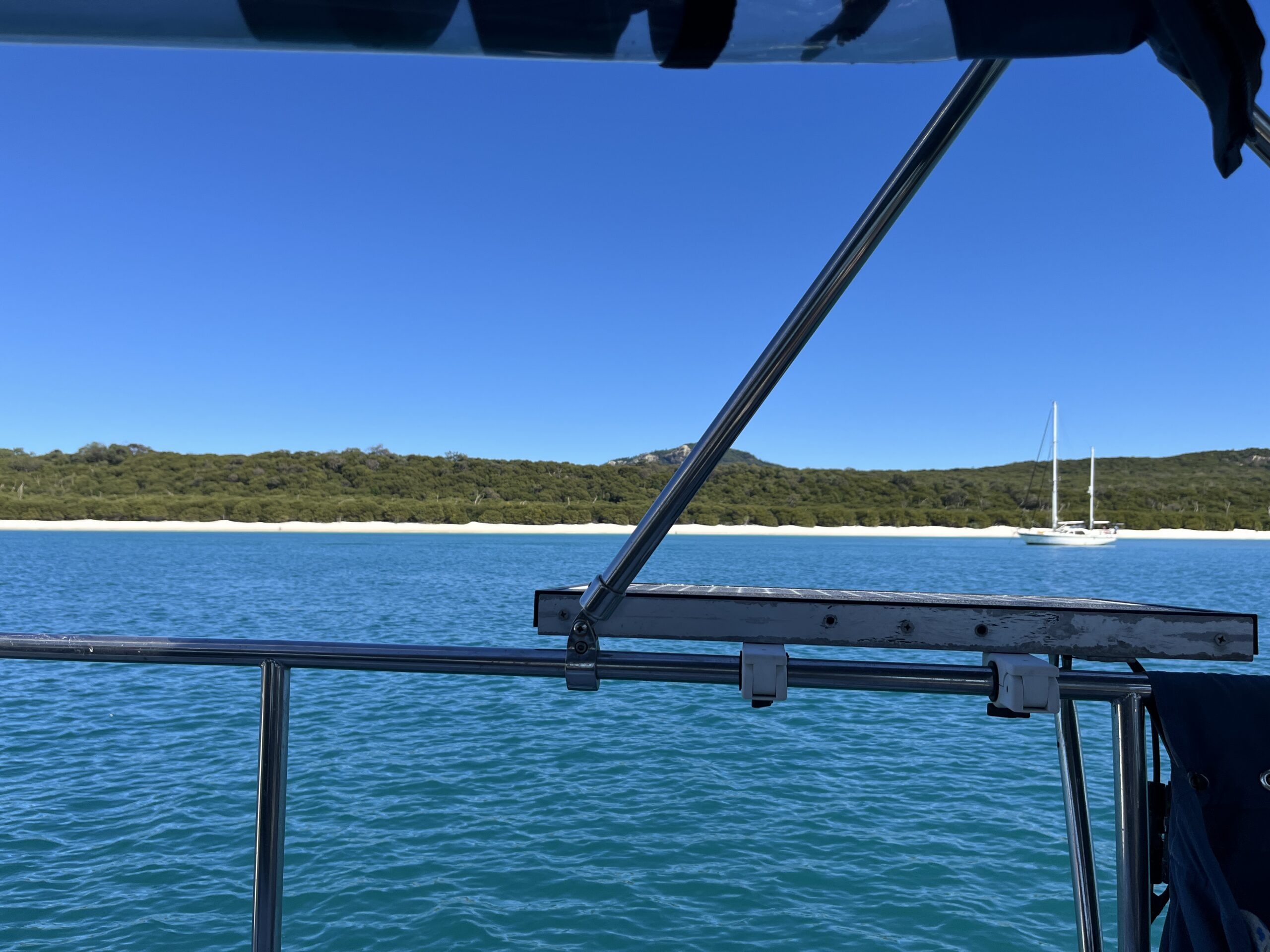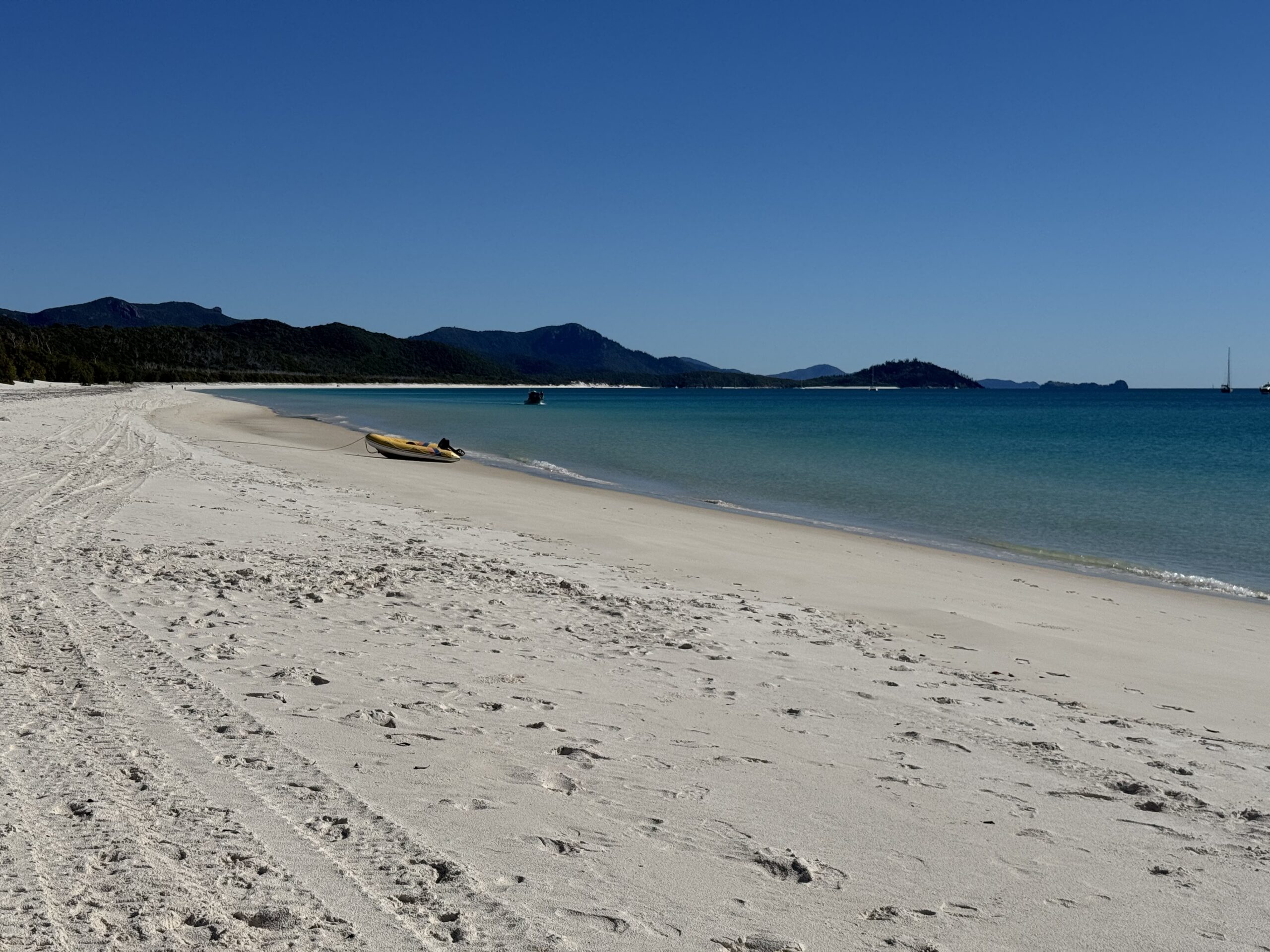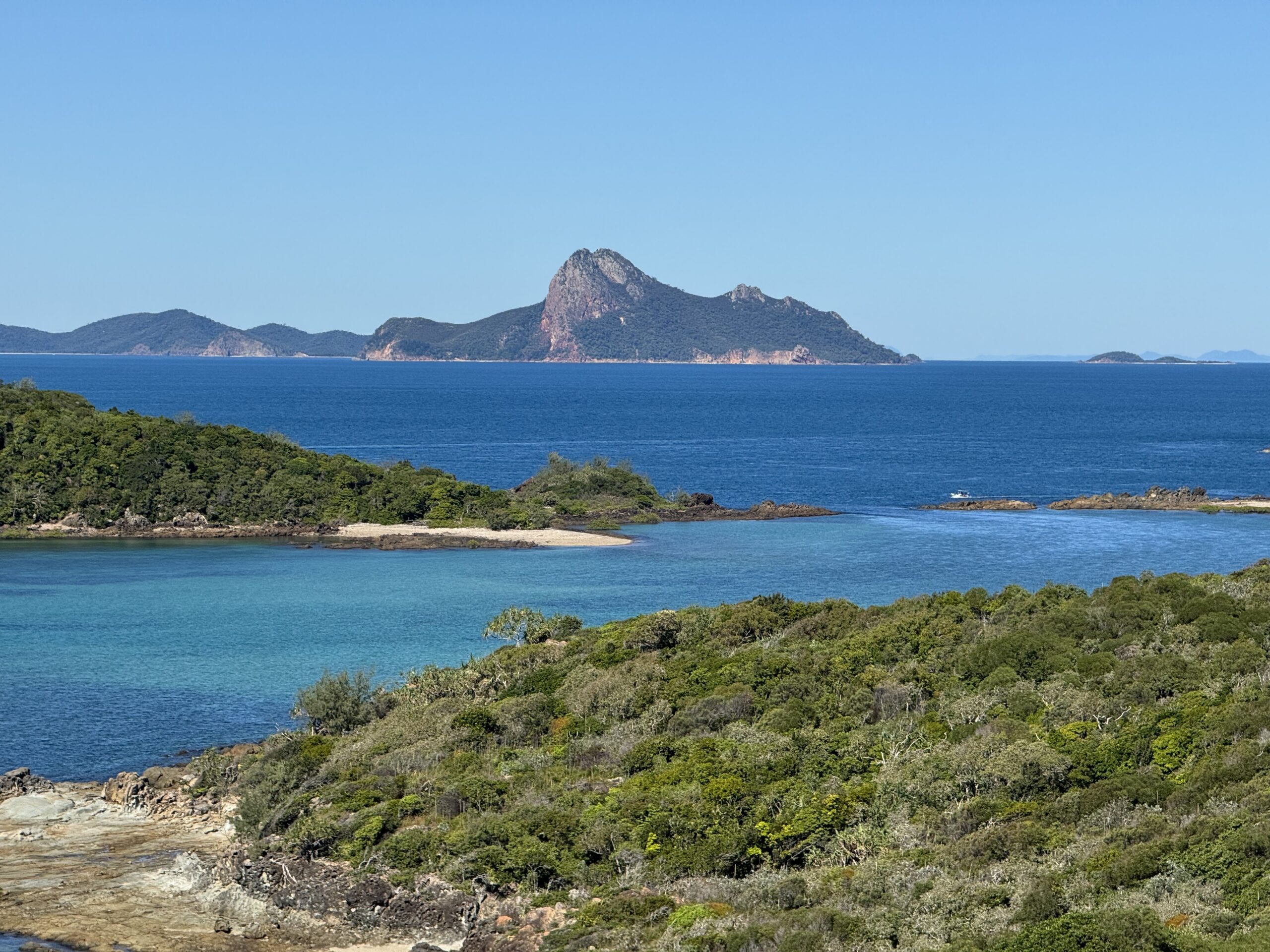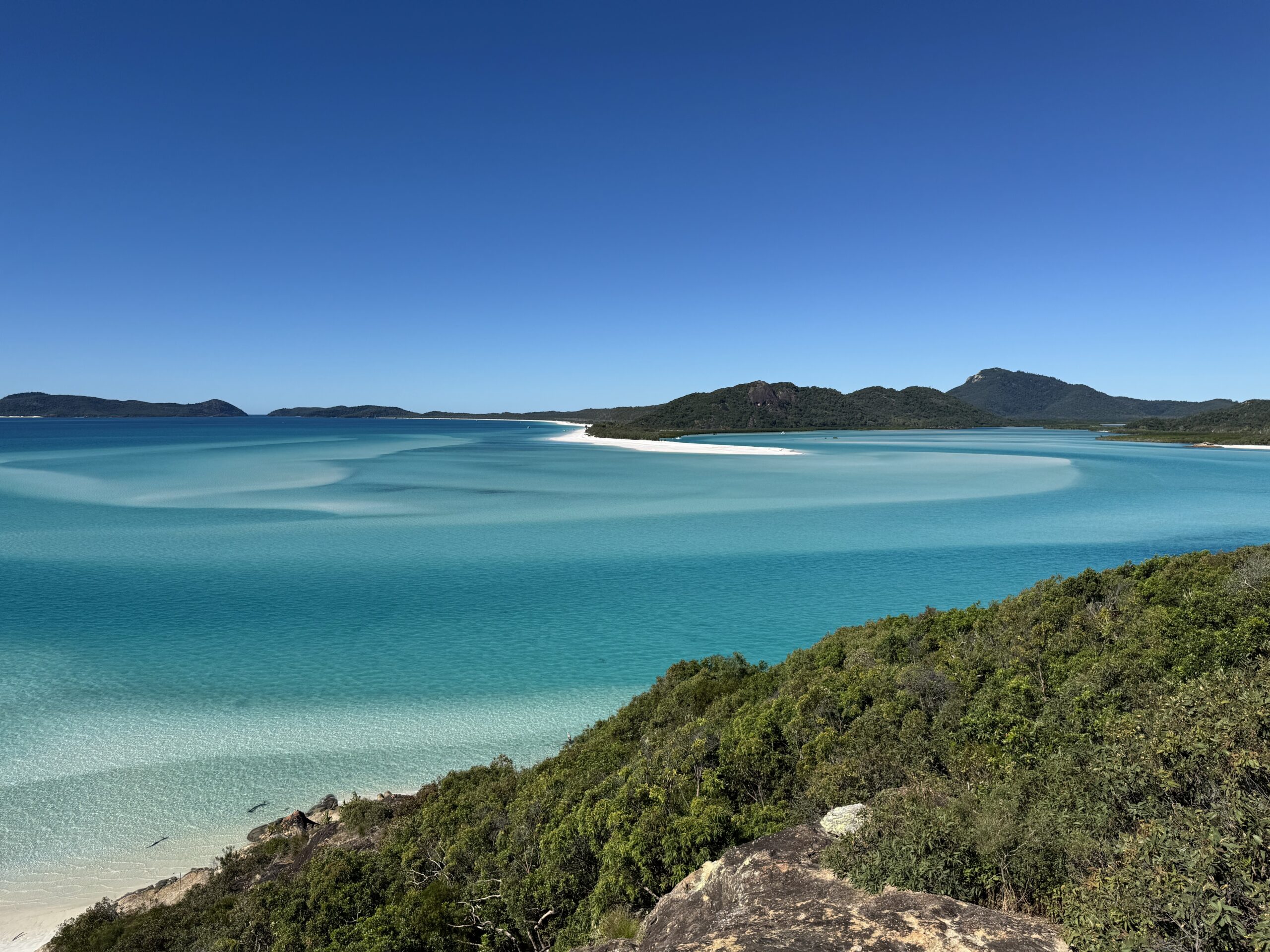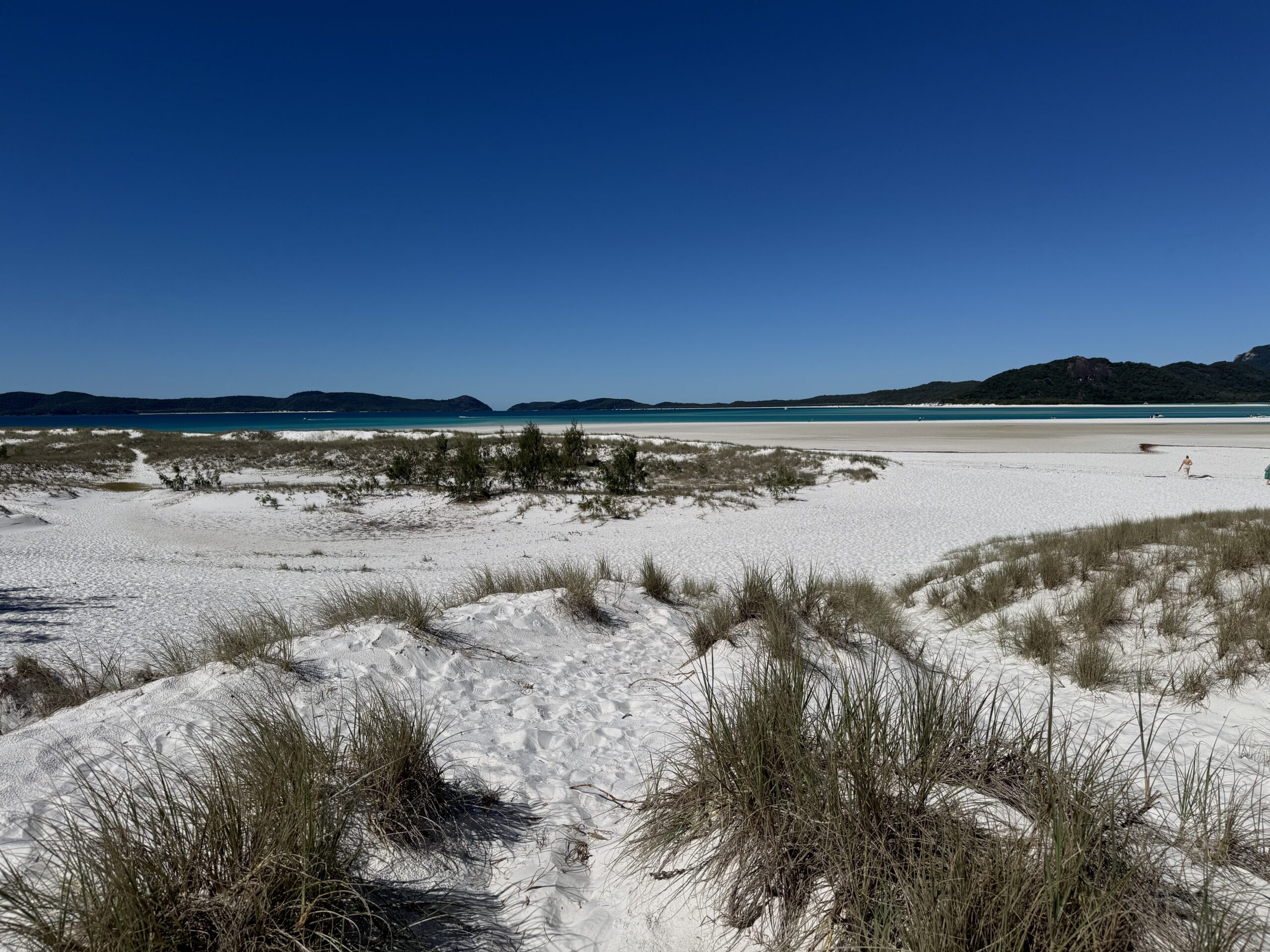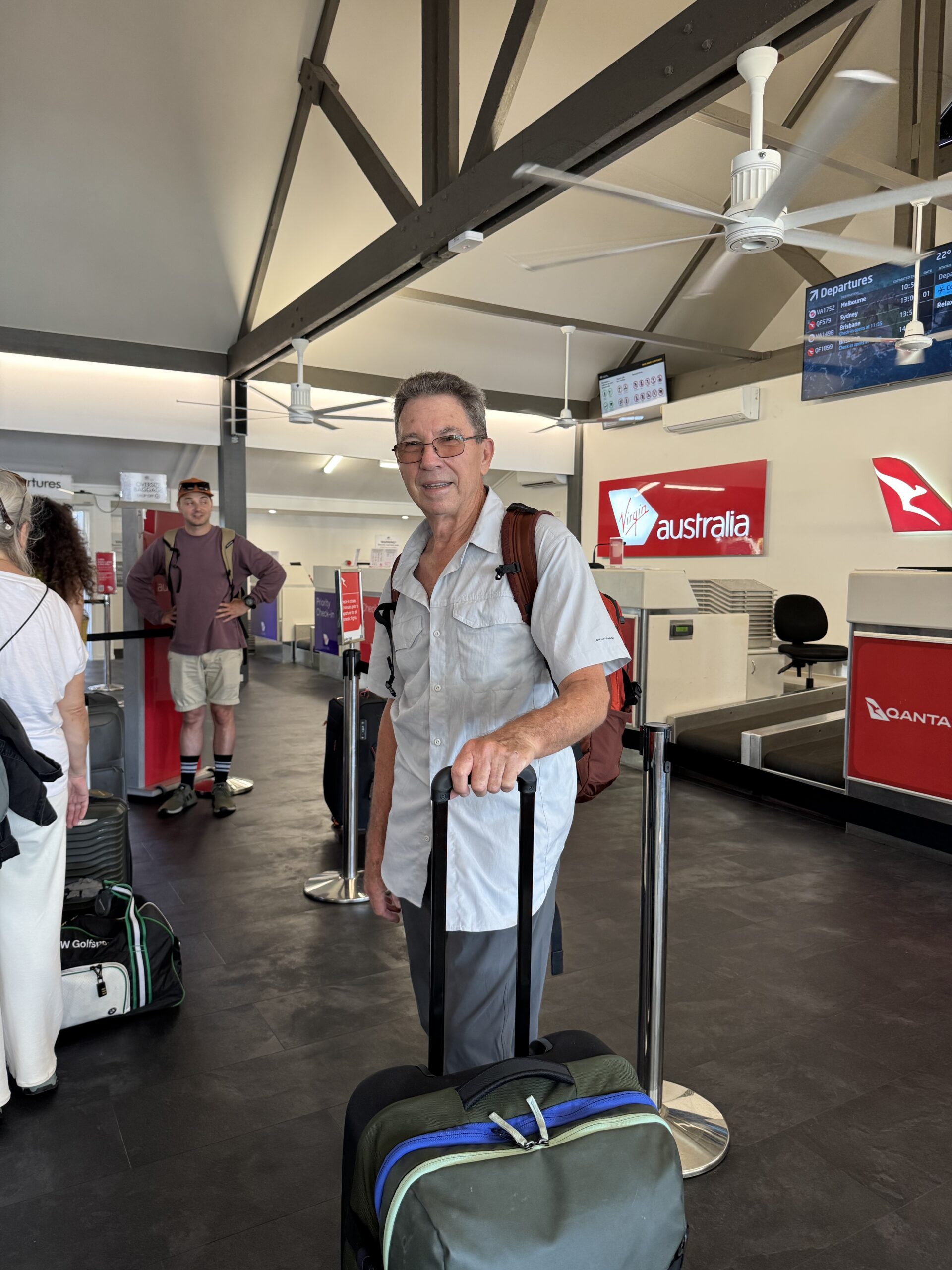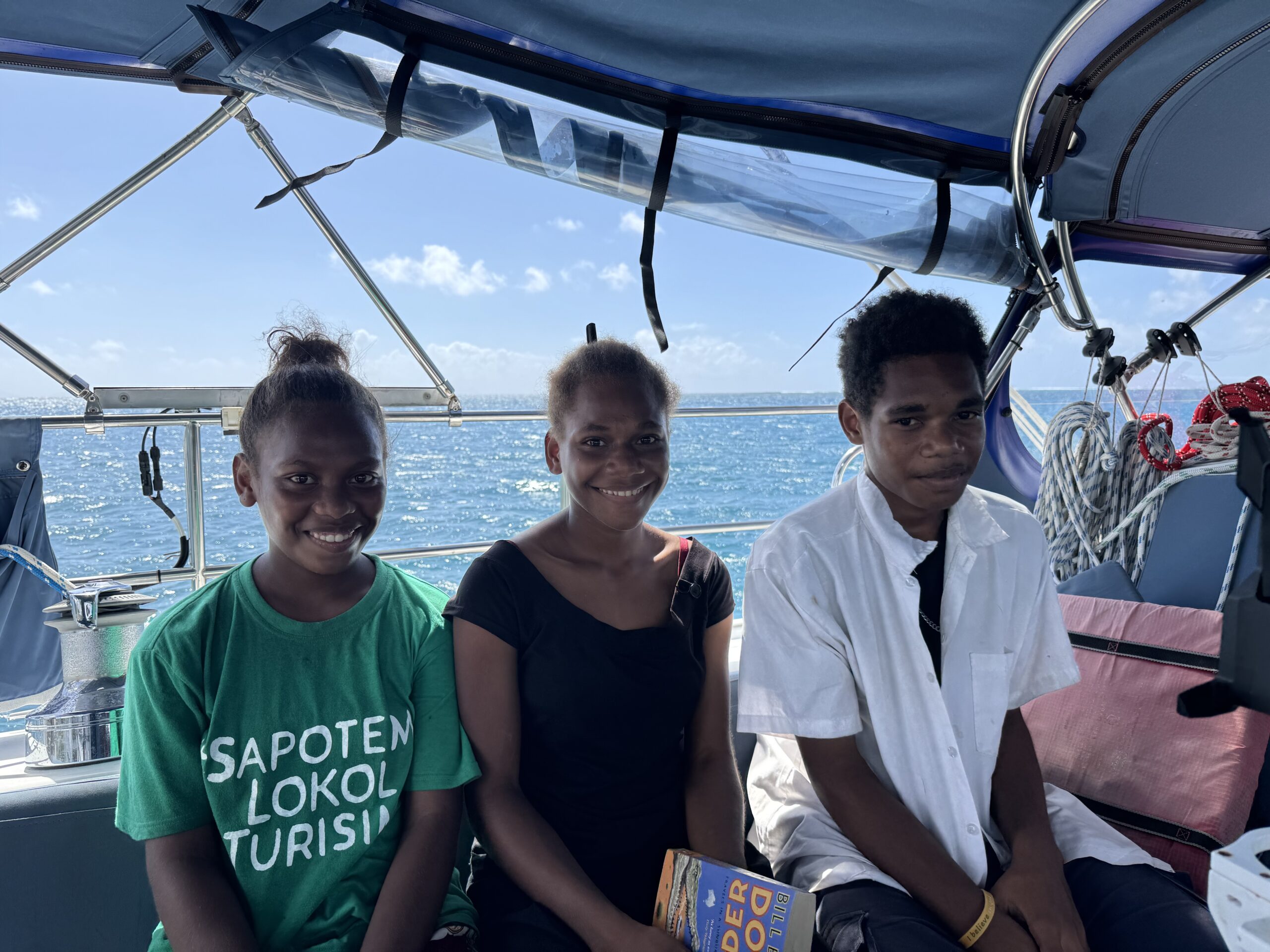
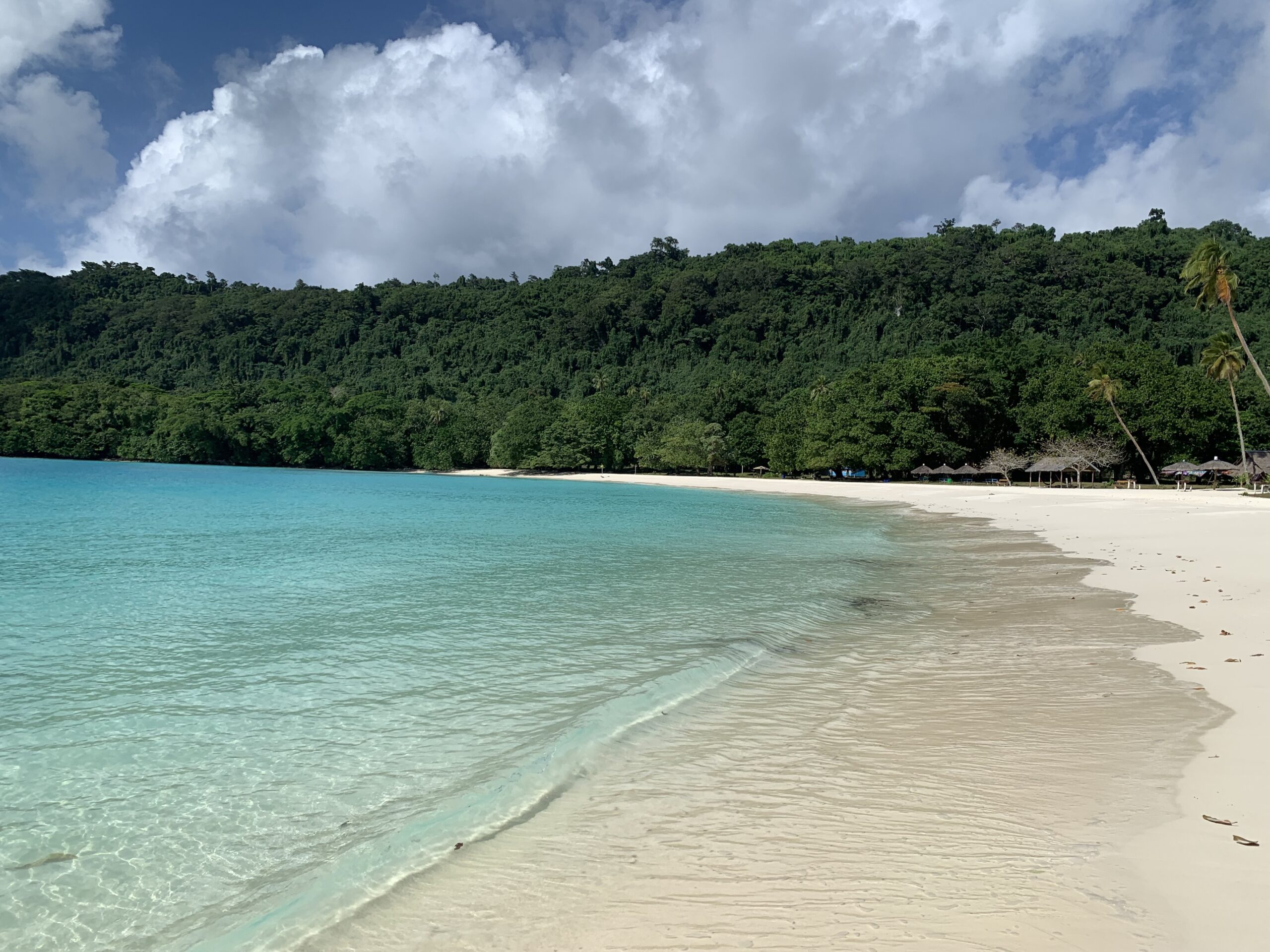
I returned to Australia on Tuesday, April 28 after a month in California, visiting friends in Santa Cruz and my family in San Diego. I hired a car and headed south from Brisbane to the Boat Works in Coomera. I brought with me a Clark Pump for the water maker and some other boat parts.
Once back on the boat, I started getting ready to recommission it. First task was to remove things stowed on my berth so I could sleep somewhere. Second was to turn on my Starlink service so I could have Internet. After that, it was a matter of unstowing things, hooking things back up, going to stores to buy provisions, getting diesel fuel and petrol, and picking up my propane tanks from the man who serviced them and then taking them to get filled.
Two days after my arrival I learned that I needed to leave the marina. My slip was reserved by someone else for the month of May. Rob, the marine mechanic who was working on my engine, put it back in working order so I could move the boat. Chloe at the Gold Coast City Marina helped me out with a slip. And Chris of Sea Spray, who had been the boat’s caretaker, helped me move it to the new marina.
I spent the three-day weekend getting final use of my rental car with errands and provisioning. I also installed the Clark Pump and some of the water maker components. Then on Tuesday, I drove up to the Brisbane airport, dropped off the rental car and met up with Pat, who had just flown in. We took the train back to Coomera and an Uber to the new marina.
On Tuesday, one of Rob’s guys, Scotty, worked on servicing the diesel motor. Then on Wednesday, Craig came to install the new membrane and high-pressure hoses for the water maker, and tested it. By Thursday morning, we were fully up and running with the water maker. All that’s left is to wait on parts that Rob’s team had removed for further attention.
It’s now Sunday, and we’ve missed one weather window as we wait on the conclusion of the motor maintenance. It’s important to get it done here because I know they will do it right, and I don’t know when my next chance will be for this level of professionalism with regard to engine repair and servicing.
While we wait, Pat has been doing his water coloring and some cooking. I’ve been doing some projects on the list. And we’ve been walking as much as we can. We’re both very ready to get started back up the coast of Eastern Australia to the Whitsundays, as soon as we have a working engine and a good weather window.
When I first arrived back in California, I wasn’t sure whether I would continue sailing in 2026 because my mother (95 years old) was having some health issues. But she bounced back spectacularly so I decided that 2026 was not the year to take a pause. The first step was to return to Australia in March to get work done on the boat. I flew back during the first week of March with my brother-in-law Pat and we were followed shortly afterward by Johno and my friend Anne Taber.
We had a comfortable house in Coomera, 10-15 minutes away from the boatyard and a big SUV to drive around in. When Pat and I first arrived, we went to the chandlery to see about the new Highfield dinghy I had ordered. It was sitting on the showroom floor waiting for us. And the guys at the chandlery let it stay there for a few days until the canvas maker (called a trimmer in Australia) had room in his shop for the dinghy to be delivered. He was going to make chaps for the dinghy and a cover for when the dinghy rides upside down on the foredeck during a passage.
Next, we spoke with Craig, our all-around guardian angel, who helped arrange the haulout and planned to work on the rudder. He also facilitated welding of the cracked stanchion and painting the boat bottom. Craig ended up doing so much more for us, but that was what we were first targeting.
Pat and I then spent some time working on the boat to prepare it for a haulout. We also sold the old dinghy. A couple of days after our arrival, Craig came to the boat to let us know that it was time to go over to the lifting bay where we would be hauled. We would stay in that bay while Craig dismantled the rudder and steering assembly and then we would be hauled out early the next morning. He helped cast off the lines and stayed on the dock while Pat and I backed out of the slip. The problem was that I had very little propulsion as I tried to back out into the river. The wind and the current were pushing me back into the fairway. So I tried going forward. Still no propulsion. As we drifted toward large powerboats in their berths, Pat and I prepared to fend off. Meanwhile, Craig could see we were in trouble and guided us toward a pontoon that had space for us. As Craig was flagging us toward the pontoon, two or three of the lift operators showed up out of nowhere to help. We eased alongside the pontoon and they helped us tie up. Then Craig went and brought his tender and tied up to Aldabra’s port side. One of the lift operators hopped on board and we backed out of the fairway, into the river, with Craig in his tender providing propulsion as I steered. Once out in the river, we were able to turn and go around to dock at the lifting bay, assisted by the other lift operators.
The prop full of barnacles
I could only imagine what would have happened if Craig and those guys had not been there. We would have been bouncing off million-dollar boats with no ability to maneuver, causing considerable damage to our boat and the others. And those guys just treated it like just another day in the boatyard. They were kind, patient and respectful. It was the beginning of a multitude positive experiences in the boatyard.
We were hauled out early the next morning and we could see that the prop was caked with barnacles, which is why we had no propulsion. I had commissioned a diver to keep the prop and the bottom clean while I was away, but he had not done so.
Once we were hauled out and the bottom was power washed, Aldabra was taken to her spot on the hard. The rudder was dropped and then the boat was put on the hardstands. Then the work began. Johno arrived the next day and Anne about a week later.
In the boatyard
We were on the hard for a bit less than two weeks. The tradespeople working on the boat were amazing – thorough, professional, timely, considerate. We never had to ask for anything to be done, they anticipated what needed to get done and did it. They all worked in coordination to maximize our time on the hard. And Johno, Pat and Anne were amazing. Here is what got done, while we were on the hard and during the partial week after we went back into the water:
Sold the old dinghy
New house batteries installed (Johno and Pat)
New pump installed for water cooling the refrigeration (Pat)
Two starboard windows removed and replaced (Integ Marine Windows)
Fiberglass prep prior to windows being replaced (Nancy and Pat)
A rudder bushing installed to eliminate play at the bottom of the rudder shaft (Craig, Shed i16))
Stanchion welded (Craig’s team)
Stanchion rebedded (Aldabra crew)
Boat bottom painted (Cas)
Fiberglass repair on bow (Craig)
Dinghy wheels installed on the new dinghy (Johno and Pat)
Chaps and dinghy cover designed and sewn (Bevan of Marine Canvas and Trimming)
Hoisting lines spliced onto new dinghy (Johno)
Stainless steel railing polished (Anne)
Two new toilets installed (the Aldabra crew)
New halyard installed and two halyards spliced onto shackles (Johno)
Dive tanks inspected and filled
Seals on two hatches replaced (Pat and Nancy)
Hinges on hatches serviced (Pat)
Propane tanks inspected and re-certified
New life jackets purchased and fitted with AIS modules
Aft holding tank removed, inspected and re-installed (Pat, Johno and Nancy)
Tools cleaned with phosphoric acid (Pat)
New step made for the side of the boat (Craig)
Windlass serviced (Pat)
Chain marked (Johno and Nancy)
All five winches serviced (Johno mostly)
Leaks in kayaks repaired (Anne and Pat)
New tell tails on jib (Johno)
Boat hull and topsides polished (Sea Spray)
New aft macerator pump installed (Pat and Johno)
Sea anchor inspected (Johno)
Suede chafe protection installed on spinnaker halyard (Nancy)
Clark pump for watermaker removed and inspected (Johno and Craig)
Charts for Indonesia installed (Nancy)
The bronze bushing for the rudder
Re-installing the rudder
Craig and Austin after successfully installing the rudder
While we were working on the boat, we took a couple of days off to hike in national parks that weren’t too far away. And we got some dinners out. All told, it was a very productive venture.
Anne on a hike in the rainforest
Looking through a waterfall at Johno and Pat
Enjoying the rainforest
The rainforest was just west of the Gold Coast cityscape
On Thursday, September 11, Jeff and I motored to Whitehaven Bay on the west side of Whitsunday Island. It is well known for its long white sand beach, very picturesque. It was still windy and we weren’t that motivated to put the dinghy in the water and go to shore. We scrubbed the boat bottom in the cold clear water.
The next day, expecting a wind shift, we moved in the morning across the bay to Haslewood Island and picked up a mooring ball. We took the dinghy to the beach for a walked to a lookout. The anchorage has a strong current running through it, and our mooring ball was pretty exposed. Toward the end of the day, a mooring ball opened up in a better spot, so we started moving over to it. On our way, the engine started overheating. Because of the strong current, we didn’t have much time to maneuver, so we kept the engine on and just barely got to the mooring ball and tied up. Fortunately we were able to change the alternator belt, and the engine was back in service with no issues.
Exploring Haslewood Island
On Saturday, we motored around to Tongue Bay and picked up a mooring ball. After lunch, we took the dinghy to shore and hiked along the ridge, with beautiful views of Whitsunday and Haslewood Islands. That night was windy and rolly. On Sunday, we moved to a different mooring ball that seemed less exposed, but we had a miserable day with wind, rain and gloom. The night was even worse and we got very little sleep due to big wind and waves.
From the lookout above Tongue Bay, Looking at Whitsunday and Haslewood Island
On Monday, September 15, we left the anchorage early and sailed downwind with the jib around to Sawmill Bay again. It took three hours in winds in the twenties. When we arrived in the anchorage, the water was flat but we still had wind. It was a decent night.
Having visited some of the highlights of the Whitsunday Islands (even though the conditions were not ideal) it was time to start our journey south, down the east coast of Australia. We had a deadline of November 1, but we didn’t know what to expect or how long it would take us. On Tuesday, September 16, we pulled up the anchor at 6:30 a.m. and motored south for seven hours against the wind and currents to Goldsmith Island. We anchored in Roylen Bay with three other boats. It was a quiet night with just a bit of wind.
The next day, we again pulled up anchor at 6:30 a.m. (I should mention here that departure timing was based on what we expected each day with regard to the strength and direction of both currents and wind, which fluctuated by time and location.) We motored for four and a half hours in less than ten knot of wind and flat seas to Keswick Island. We took a mooring ball in Homestead Bay off of St. Bees Island. We were the only boat. The winds were light but the current was strong. We had a calm night.
On Thursday, we left at 6:30 a.m. and sailed on a beam reach back to MacKay Harbor. We arrived about 10:00 a.m. and went directly to our assigned berth. We immediately dropped the dinghy and took our jerry cans over to the fuel dock to fill them up with diesel. Jeff then washed the boat while I went to do laundry, which provided a good opportunity to meet people and get advice.
The next day, we got a rental car and went to the local Cole’s supermarket for provisions. After putting the groceries away, we walked on the breakwater and cooked a bit. On Saturday, we left our berth at 6:00 a.m. in very light wind. We motored toward Curlew Island and arrived at 2:00 p.m. We had a quiet night. The next day, we left at 6:15 a.m. and motored with no wind to Hunter Island. We anchored in the south anchorage with three other boats. We took the dinghy to shore and walked along the beach. It’s a private island, so we couldn’t go inland past the high-tide mark. The island had huge tidal variations, five meters. We had a quiet night.
On Monday, we pulled the anchor up at 2:00 a.m. and motored to Island Head Creek on the Australian mainland. At times we had a favorable current and at times it was against us. We entered the mouth of the creek and were anchored by 10:15 a.m. High tide was at 10:30 a.m. Because the tidal shifts are so significant, you have to navigate these inland waterways during high tide and make sure you anchor in a spot that will have enough water under you during low tide. We had a lazy afternoon.
We were in this location for protection against a blow that we were expecting. On Tuesday, we hung out on the boat and fixed things. Gnats were a problem. The expected blow came on Wednesday and continued all day. At least the gnats weren’t as bad.
On Thursday, at 11:00 a.m., it was high tide so we could go back out into the ocean from Island Head Creek. We motored twenty miles to Freshwater Bay. We arrived at 3:00 p.m. and had a rolly night. On Friday, we left at 6:00 a.m. and motored farther south to Great Keppel Island. We anchored on the west side among a lot of boats. It’s a very touristy island and loud music blasted from the Hideaway Café until very late. On Saturday we started getting ready to go ashore about 9:00 a.m. The dinghy throttle got stuck and there wasn’t much we could do about it so we blew up the kayaks and went to shore. We took a four-hour hike on the island, going up to Mt. Wyndon and around and ending up back on the beach with the kayaks. We had lunch at the Hideaway before going back to the boat.
Sunday was a lazy day on the boat after Jeff looked more closely at the dinghy throttle. On Monday, we took the kayaks on a paddle to several nearby bays. The water was beautiful and many people did not let the cold deter them from swimming. Tuesday was a windy day and we stayed on the boat.
On Wednesday, October 1st, we left early and motored to Gladstone, back on the coast. We went through the north passage, which is marked, but it is still nerve wracking to wind your way through several miles of shallow water with sand bars on either side of you. We got to the marina about 3:00 p.m. After checking in and getting showers, we walked to town for dinner.
Sailing south along the coast toward Gladstone
On Thursday, we took the dinghy to a nearby ramp and hauled it to Ship and Sail, which is a combination chandlery and motor service shop. We had made arrangements with them in advance. They agreed to look at the throttle and do a full service on the dinghy motor.
For the next week, we were stuck in Gladstone, waiting on parts for the dinghy motor. (In the end, one part never arrived and I convinced them to make a gasket out of some material I had on the boat. It is still in use.) During our week in Gladstone, we worked on the boat, met people who gave us advice, walked, and had dinners out.
When we finally got the dinghy back on Thursday, October 9th, we left the marina at noon and motored through thirty miles of shallow, narrow channels to Pancake Creek. We arrived at 5:00 p.m. and anchored for the night, positioning ourselves to go offshore the next morning.
The next day we left at 3:00 a.m. and motor sailed out to Lady Musgrave Island by way of a shipping channel, arriving at high tide at 11:00 a.m. Somewhat like Minerva Reef, it is a mostly submerged atoll with one passage through the reef. I was really nervous about this little expedition, but we managed to get through the passage without incident, and traveling across the lagoon to anchor was not as dicey as it seemed. We got a mooring ball and then went to a small interior island for a walk before returning to the boat to work on the watermaker, which had been underperforming.
On Saturday, we did some weather and route planning for the next week, and then took the dinghy out to the pass to snorkel. It was cold and the current was strong. And we had to avoid power boats speeding through the pass. But it was beautiful. We then went to another spot on the reef and did some more snorkeling, followed by a quiet afternoon on the boat.
On Sunday, we left Lady Musgrave around noon, successfully navigating the passage once again. This was an overnight sail as we headed to Hervey Bay on the mainland. Arriving on Monday during a northerly, we couldn’t find any good anchorages on Frazer Island so we kept moving south inside the bay and anchored in front of Little Woody Island. It was in the middle of nowhere but it was flat and we had a good night.
On Tuesday, we left at noon to go through the shallow part of Great Sandy Straight (an inland waterway) during peak high tide. It was long and tedious but we got through without hitting the bottom. After we got through the shallow part, we anchored at Gary’s anchorage. It was confusing and dicey getting in, and the current was strong, and we had bugs. But it was otherwise fine.
We left the anchorage the next morning at 5:45 a.m. and inched our way out in to the main channel. It was still dicey but we made it without touching bottom. Then we motored south toward Wide Bay and anchored nearby in Pelican Bay. We stayed there until 3:00 p.m., unsure about whether we would be able to navigate through the Wide Bay passage out into the ocean. If we didn’t go that day, we might have had to wait for two weeks for the right conditions. At 3:00 p.m., we made the decision to go and followed another boat out. We had 12-16 knots of wind on the nose and the tide was still coming in even though it was supposed to be slack tide. The seas were about a meter and a half. It was slow going but otherwise uneventful, taking a couple of hours to get past the bar. Once we did, we turned south and headed toward Moreton Bay. We had the wind aft of the beam and seas between one and two meters. The current was in our favor and we went along at 7+ knots with a double-reefed main.
As we approached Moreton Bay in the early hours of Thursday morning, the winds got lighter and we slowed down. We had to dodge cargo ships as we got near the shipping channel. Once we got to the channel, and it started getting light enough to see what was going on, we sailed on the edges of the channel to Moreton Island. We arrived at about 10:00 a.m. and spent the day and night on the boat, catching up on sleep.
On Friday morning, we put the dinghy in the water and went over to snorkel on a popular wreck. We were once again in a very touristy spot but the water was beautiful and there were a lot of fish to see at the wreck. Afterward, we went back to the boat, put the dinghy back up on the davits and sailed downwind for four hours to St. Helena Island, which is a stone’s throw from the city of Brisbane. We anchored on the south side in preparation for a northerly that was starting to build. We stayed on the boat all day Friday and Saturday as the northerly blew. We expected a wind shift on Saturday night, which would move the boat onto a shallow reef, so at 4:30 p.m., we pulled up the anchor and went around to the western side of the island. The wind was still building out of the northwest. After we anchored, we were subjected to an intense lightning, wind and rain storm, which moved through without striking the boat. The wind shifted as expected at 10:30 p.m.
St. Helena Island is a national park that was once a prison. On Sunday, we took the dinghy ashore and hiked on the island. A lot of it is off-limits but it was a nice place to walk and we picked wild cherry tomatoes.
Walking around St. Helena Island
On Monday, we motored to Horseshoe Bay on the south end of Peel Island. It took three hours to get there at 4 knots. Winds were out of the northwest and it was a bit lumpy in the anchorage, which gets very crowded. On Tuesday, we took the dinghy ashore and went for a nice long walk. Still in Horseshoe Bay we stayed on the boat on Wednesday. On Thursday, in the late morning, we went north a bit to the Myora anchorage in preparation for expected high winds. They continued out of the north until early afternoon and then came on strong from the southeast, which is what we had expected. The winds were in the thirties all evening, calming to nothing in the middle of the night.
With the wind event over on Friday morning, we motored south to the north end of Russell Island. We found a very iffy place to anchor among a bunch of moored boats. We put the dinghy in the water and found a dock to tie up to. We went ashore and filled up a couple of diesel cans and then went to a store and bought groceries. Then we went back to the boat, pulled up the anchor and went around to the west side of Russell Island and anchored in Brown’s Bay. We had some wind but it was a comfortable night.
In an inland waterway again, managing through big tidal swings, we pulled up anchor at 10:45 a.m. and motored to Cabbage Point, then Jacobs Well and Talleen Island. It was shallow so we had to move through at high tide. We had intended to anchor a Jacobs Well but it was quite busy and I didn’t see an obvious spot. Tulleen seemed too shallow. So we continued up to Millionaire Row, which is on the west coast of South Stradbroke Island, and anchored among the power boats. It didn’t seem like they were used to seeing a deep-draft monohull. The wind died to nothing during the night.
On Sunday, we took the dinghy ashore to the spit and then went on a hike over to the ocean side of the island. We couldn’t find the trail so we bushwacked our way across lowlands and dunes before arriving at a beautiful long ocean beach. We walked along the beach and then followed some other people back over to the other side, arriving near where we had left the dinghy.
Walking the ocean side of South Stradbroke Island
After we got back to the boat, we decided to try going around to another anchorage to wait out another blow that we were expecting. The channel was marked and deep enough for us to get around to Perry’s. There was one trawler there. Toward the end of the day, we had an intense lightning, wind and rain storm, with the lightning sometimes striking very near the boat. The storm passed before dark and then we got mosquitoes.
It would have been nice to stay in this anchorage but we decided to keep moving. We left before noon, during high tide, and got through the shallows and near the mouth of the Coomera River that afternoon. We anchored in a place that was kind of exposed but the protected area was too shallow to enter. We had a very windy night.
We stayed in that anchor spot all day on Tuesday, a very rainy day. Then on Wednesday, we moved the boat down to the Curigee campground on South Stradbroke Island. It was more scenic and we could get off the boat. We walked over to the ocean side of the island and walked down to the Gold Coast Seaway. That evening, we watched some Wednesday night sailboat races as we sat on the boat. On Thursday, we did some chores and watched more racing.
Walking toward the Gold Coast Seaway
On Friday, October 31, we pulled up anchor and during high tide, motored six miles up the Coomera River to The Boat Works, our marina for the next 6 months. It was a bit nerve wracking because even at high tide, it was shallow in places. And we had to keep clear of other boats speeding up and down the narrow river. But we made it. We checked in and got showers and a good night’s sleep.
On Saturday, November 1, we began the process of decommissioning the boat for cyclone season. We pickled the watermaker, did laundry, and cleaned the boat inside and out, sorting things and stowing things. We met with the man who would be looking after the boat for six months. And we met with people who could help get things done on the boat before the next sailing season begins. We met with a diver who could keep the bottom clean. We met with windows specialists who could replace two leaky windows. And we met with an all-around specialist who could help fix an issue with the rudder along with welding the stanchion and getting the boat bottom painted.
Among our other chores, Jeff changed the oil in the motor and I took the top piece off the slider for the companionway, cleaned off all the silicon and re-calked it. It had started leaking and I had had enough of it. Then we put sails and canvas away, put the dinghy upside down on the deck, took hardware off the deck and stowed it down below. We closed thru hulls, turned everything off except a couple of cabin fans, installed the de-humidified, tossed food.
Finally, on November 10, we were done putting the boat away. It was raining quite a bit but we took an Uber to the Coomera train station and took a train to downtown Brisbane. We stayed the night in a nice apartment and had dinner in town. The next day, Jeff got an early flight to New Zealand for a few weeks of hiking. I got as far as halfway down the runway before the mid-morning flight was aborted. Because the plane had to be thoroughly checked out, they put us up in hotels that night and we successfully flew to San Francisco the next day. I then caught a flight to San Diego, in time for Thanksgiving and winter holidays with family.
Once Jeff and I got back to Port Vila, we started on preparation for the next passage. But a couple days into it, we had to take the opportunity to check out the celebration for Vanuatu’s 45th anniversary of independence. On Wednesday, July 30, we left the boat at 7:00 a.m. and started walking toward the center of town. We followed other people, many dressed in Vanuatu’s national colors, to a large park used for assemblies. The park was already crowded with stalls selling food, and families on blankets sharing picnics. We stood with others in a ring around what we thought would be the center of activity. After waiting for more than three hours, our patience was rewarded with speeches, pageantry, marching bands and parades of various military and youth groups. A big highlight was the colorful clothing worn by the various celebrants.
Waiting for the ceremony to begin
Parading
Marching band
The dresses!
For the next several days, we proceeded with chores, such as changing the oil in the diesel motor and filling up the propane tanks. Jeff worked on a project to add water-cooling to our air-cooled refrigeration system. We found a crack in a stanchion and shored it up with a support that would work until we could get it welded in Australia. We cleaned the boat inside and out and shopped and cooked. Jeff went up in the bosun’s chair to clean the shrouds. He also made a carrot cake for my birthday.
Jeff made a carrot cake for my birthday
Johno arrived on Monday, August 11 in the afternoon. We had been looking at weather and had not seen a window to leave for Australia, so we were looking at places to hang out while we waited. Then on Tuesday morning we unexpectedly saw an immediate window and decided to leave that afternoon. Johno wasn’t going to have time to acclimate or see any of Vanuatu. While the guys made final preparations to leave, I checked us out of the marina and out of the country.
We untied the dock lines shortly after 2:30 p.m. and headed out of the harbor. With no wind, we motored for about two hours. Then the wind came up enough to sail. It kept building into the teens. By midnight, it was in the twenties. We went 78 nautical miles in the first 12 hours and 165 miles in the first 24 hours, not bad.
For the next four days, we had nice wind and continued to make good progress. On Sunday, August 17, we had lighter winds and had to motor a lot. Then on Monday, we were back to sailing. You would think I would provide stories about these kinds of passages, but the truth is that during a passage, each of us does our watch and then sleeps until the next watch. The only other thing we do is eat. I also of course have to check weather forecasts every few hours.
On Tuesday, in the early evening, we approached the beginning of the Hydrographers Passage, a shipping lane that leads through the Great Barrier Reef to the east coast of Australia. We tried to time our entrance into the passage to optimize for currents, so we sailed around the area for a couple of hours. We may not have timed it quite right because shortly after our entry , we were motor sailing with 5 knots of current against us. It was eerie because it was dark except for a few beacons on islands that marked the borders of the channel. And for the longest time, the beacons didn’t change position relative to the boat. We also had to stay clear of large tankers or cargo ships that approached from ahead or behind us. Johno had the first watch and had the worst of the uncertainty about whether we were going to make it through the passage unscathed. Jeff’s watch followed with less current. By the time I came on watch, conditions had improved. We were even able to turn off the motor and sail.
After sailing half the next day, we determined that we wouldn’t make it into MacKay harbor in time if we didn’t motor sail, so we turned the motor back on to assist the sails. The rest of the trip toward MacKay harbor was in fairly shallow water. We saw lots of whales. We arrived at the harbor at 3:30 p.m. and went to the fuel dock, where international boats check in. The Australian Border Force team (Immigration and Customs) was able to clear us in right away. But the BioSecurity folks weren’t available so we were quarantined on the boat overnight. The next morning, we had a very pleasant session with the BioSecurity guy, which took a couple of hours but was very informative.
As soon as we cleared that hurdle, we were joined by Robert and Robyn Stynes. They live in Mooloolaba, Australia but were on a road trip and just happened to be in the area on that day. I met them in the 1990s when they were buddy boating with my friends Jim and Linda in the Indian Ocean. It was great to see them again. They helped us move the boat to our assigned marina berth and then they took us in their car to buy groceries and run errands. We had lunch together and then parted ways later that afternoon after celebrating together on the boat with champagne that Robyn had brought.
The next day, after a good night’s sleep, we started on the typical routine of doing projects and shopping for parts for projects. Jeff and Johno worked on running a new Starlink cable and Jeff worked more on the refrigeration cooling project. We continued with projects for another couple of days. We also met some nice local cruisers on the dock and they gave us advice on which islands to visit as we headed north toward the Whitsundays.
On Monday morning, August 25th, we left the berth at 8:30 a.m. and went to the fuel dock to fill up the diesel jerry cans. Then we motor sailed east to Scowfell Island. We picked up a mooring ball there and took the dinghy ashore for a walk. The anchorage was windy and the water was cold, so there wasn’t much to do.
Scowfell Island
The next day, after pondering our options, we motor sailed against the wind up to Brampton Island. We had got a late start so the anchorage was very full when we arrived. We anchored on the outside of the other boats. The next morning, we took the dinghy ashore and hiked on the island. We saw Blue Tiger butterflies and a Koala in a tree right off the trail. Upon returning to the boat around noon, we decided to continue moving north. We motored for three hours to Thomas Island. The preferred anchorage on the south was full so we went to the one next to it and were all by ourselves.
Blue Tiger Butterfly
Koala
View on Brampton
On Thursday morning, August 28, we took the dinghy to shore. Johno snorkeled in the cold water looking for lobsters while Jeff and I explored. That evening, while we hung out on the boat, a mother whale and her young one came into the anchorage and circled around it. The baby was having fun practicing breaching. Johno went back in the water once more looking for lobsters but didn’t find any.
On Friday morning, we moved the boat around to the north anchorage of Thomas Island, which was quite populated with boats. Jeff and Johno worked on fixing the foot switch for the windlass. It was a calm morning and we all swam in the cold water. The next morning, a big yacht left the anchorage, leaving a hole for us to move into. Then we took the dinghy to shore and walked across to the south side of the island. When we returned, we took the dinghy to an island in the middle of the anchorage and explored that a bit. Around noon, a big gusty wind began to blow and continued through Sunday night. We stayed on the boat all day on Sunday.
North side of Thomas Island
Johno checking out the view from Thomas Island
Jeff exploring Thomas Island
Aldabra at Thomas Island
Exploring the island in the middle of the anchorate on Thomas Island
On Monday morning, we went up to Sawmill Bay in Cid Harbor on the west side of Whitsunday Island. It was crowded in the anchorage because it was one of the few protected spots. Signs were posted warning people to stay out of the murky water because of bull sharks. We took the dinghy to shore and hiked up to Whitsunday Peak, enjoying a beautiful view of the Whitsunday Islands.
At the top of Whitsunday Peak
The next day, we went back south to Hamilton Island, which is a populated resort island, unlike the others we had visited so far. We stayed for three hours, buying some provisions and enjoying some ice cream. Then we traveled north again to the west side of Hook Island. We spent the night on a mooring ball. On Wednesday morning we went farther north around to Butterfly Bay on Hook Island. It was crowded and we didn’t get a great spot. We had a windy, rolly, uncomfortable night. The next morning, we pulled up anchor and took a mooring ball on the other side of the bay, which was much more comfortable. We swam there in the very cold water and then Jeff and Johno worked on fixing the wire to our GPS antenna, which had accidently been cut during work on the Starlink cable.
On Friday, September 5, we went back to Sawmill Bay to hunker down for an expected blow. We found a decent enough spot to anchor in the crowded bay and had a very windy day and night. It was windy again on Saturday but we took the dinghy ashore and walked the short distance to Dugong Bay. It was still windy on Sunday. We took the dinghy ashore and Jeff and Johno hiked to Whitsunday peak again while I hiked up for just an hour and then back down. We had another windy night. It was still windy on Monday. Jeff and Johno troubleshot some issues with the B&G network connections.
On Tuesday morning, September 9th, we motored back to Hamilton Island and settled into a marina berth. We went on a really nice walk to Passage Peak and then had showers and dinner. The next day, we filled up the diesel jerry cans and one propane tank. Then we had lunch and walked Johno to the airport. He flew to Sydney and then back to San Francisco the next day. We were sad to see him go.
View from the top of Passage Peak on Hamilton Island
On Saturday, July 19, we were finally able to leave Port Stanley. We had the anchor up at about 7:30 a.m., not sure of what conditions we would encounter once outside the protection of the bay. We put the mainsail up as we were heading east, and then turned south toward the tip of Malekula. We had to motor sail most of the way, but the seas weren’t horrible, even though there had been several days of wind. The wind was on the nose for most of the sail. We tacked out away from the island a couple of times to keep the main full. Finally, toward early afternoon, the wind was more on the beam and we could put the jib up and sail to the second entrance of the Maskelyne Islands. Once inside, we turned toward the west and would have had to jibe except that we opted to furl in the jib and lower the main instead. Then we pulled the jib back out and sailed downwind in light air for a bit. We finally gave up on that and motored through the reefs and around to the anchorage in front of Uliveo Island.
Three boats were already in the anchorage but it was getting late in the day so we went in to see if we could find a spot. After a couple of attempts, we successfully anchored a bit outside of the preferred area and somewhat close to the reef. We were expecting a wind shift and strong winds the next day, but found this acceptable for the night.
The next day, Jeff worked on the watermaker, swapping out one pump for a new one to see if we could correct the poor performance that we were experiencing. We also tightened the bolts on the rudder post. The rudder had been creaking and we hoped that this was the problem. Jerone from Fidelis, a Dutch boat, came over to welcome us into the anchorage. He told us about a guide they had used for snorkeling with dugongs. And he told us about a festival that would begin on Wednesday.
We contacted Philip, the guide for seeing the dugongs and he picked us up the next day at 9:00 a.m. with his buddies, Sam and Richard. We left the bay in their boat and went over to nearby Gaspard Bay to pick up the crews from Steel Away (Brent and Beth) and Iron Jack (Kent and Michele). I had met Kent and Michele in Suwarrow and then again in Fiji. We went outside the reef at the eastern entrance to the Maskelynes and were lucky enough to swim with a few dugongs. It rained all the way back to our anchorage and we were pretty cold. The guys wanted to hang out on the boat, but we were really too cold to be great hosts. It continued to rain for the rest of the day.
On Tuesday, Jeff removed the water hose that goes from the watermaker feedpump to the Clark Pump. A lot of air came out of the hose, and when he put it back on, the watermaker started working properly. I was quite relieved. Jeff also went up the mast to try to fiddle with the wind instrument, which has a bad bearing. But he couldn’t improve it, so we have to live with limited wind information until Johno gets here with a new bearing kit. Late that afternoon, we got the expected wind shift from the south and a huge increase in wind strength. As we sat monitoring the situation, the anchor dragged and we started getting too close to Fidelis. We pulled up the anchor, moved the boat and reset the anchor, happy that we were in a good spot for the night. Even so, I woke myself up every couple of hours during the night to check our position. At 2:00 a.m., a supply boat came into the anchorage and anchored rather skillfully in the middle of the four sailboats.
On Wednesday morning, the winds had calmed down a bit. We put the dinghy in the water and went to shore. We then walked over to a neighboring village, where the Canoe Race festival was to begin at 8:00 a.m. with an opening ceremony. We talked to various men about the villages and the festival. And we met the crews of the other three boats in the anchorage.
It appeared as though the festival was designed for the benefit of tourists, but we eight cruisers were the only attendees. All morning, we waited while they set up the outdoor stage and got themselves organized. In the late morning, they had us walk a distance from the stage and wait. Then they had us participate in a procession that led to the stage, where we sat with the officials. The villagers milled around while a pastor gave a sermon and a lady from the district tourism office gave a speech, and chastised the villagers for being so unprepared for the event.
After the opening event, we went with Kalo, who owns the Malog Bungalows. He hosted the cruisers for lunch at his place. Following lunch, we saw a demonstration of a wooden dugout canoe being made from a tree that the cruisers helped fell. Then we waited for another long spell until the tide came up enough for the canoe races to begin.
Building a Dugout canoe
The preparation for the races was chaotic and confused. There were multiple opinions about how to conduct the races and what the course was. Finally, they ran the three races, improving on the course setup after each race. The first race included 3 men in separate boats. The winner was in the best boat and seemed like a strong paddler. The runnerup was an older man with a lot of persistence. The third-place finisher was a younger man who seemed handicapped by a small boat. The second race was two boats with two girls in each boat. The race was hotly contested. The race was called for the two older girls but I would have called it a tie. The final race was three boats with three young boys in each boat. The first two finishers were quite close, but the last boat didn’t manage to finish. They were in that same same small boat that lost the first race, and they ended up in the water before arriving at the finish line.
The Girls’ Race
The great thing about these races is that it didn’t matter whether we were there. Everyone in the village was there watching and shouting. The zillions of little kids were having a great time watching from shore.
Jeff and I hurried back to the boat as soon as the races were over. I’m sure that there were other activities but I was worried about the battery voltage (unnecessarily). And, it had been a long day of sitting around waiting for things to happen.
On Thursday, the other three boats left the anchorage in the morning. We relocated Aldabra to the center of the bay, keeping us far away from the surrounding reefs. Then we took the dinghy to shore and walked back to the village hosting the festival. As we suspected, none of the morning activities took place because they really didn’t have any tourists to participate. One man told us that the program would resume in the afternoon. We told him that we would probably wait to come back the following day. Then we gave ourselves a tour of the island by walking around it on a path that led through old coconut plantations and the three villages. We ended up back at our dinghy and returned to the boat for the afternoon.
On Friday morning, we went back to shore and Philip, who organized our dugong trip, walked with us to the hosting village. We went first to the Malog Bungalows and talked with various people. The Kustom dancing was supposed to start at 9:30 a.m., but it kept getting delayed. Late in morning, we walked over to the showgrounds. While still waiting for the dancers, we saw demonstrations of sand art and of something akin to cat’s cradle. Finally the Kustom dancers from Lamap performed and they were great.
Creating Sand Art
Talent
Kustom Dancers from Lamap
After the dancing, we went back to the Malog Bungalows for lunch and then hung out there waiting for the next activity. Jeff went for a walk and I just talked to the different organizers. Later we went back to the showgrounds and saw a demonstration on building a fire and an acrobatic performance. I bought a bat carving from Pule, who lives in the village with his family but is actually a chief from Ambryn, who performs black magic. We waited until 4:00 p.m. for more dancing and more canoe races, but finally gave up and went back to the boat.
On Saturday morning, we moved Aldabra over to a nearby anchored behind Awei Island. We anchored in front of a tiny, one-family village with a lot of very happy, frolicking children. Their chief, Sofren, paddled by to say hello. We filled the diesel tank and did a few chores in preparation for sailing back to Port Vila. Jeff scrubbed the boat bottom and I chipped in a bit.
On Sunday, a little before 5:00 p.m., we pulled up the anchor and headed out of the pass and south toward the island of Efate, to Port Vila. We sailed upwind for most of the night, but we weren’t able to point high enough to reach Efate. At about 1:00 a.m., we had to furl in the jib and motor sail for a few hours so we could head toward the island. Around 6:00 a.m., we rounded the island and headed into Port Vila harbor, arriving around 8:00 a.m. We picked up a mooring ball to ready the boat to back into a mooring on the seawall. As soon as we were ready, a marina worker guided us in and we got ourselves settled.
When we left Pentecost Island on Tuesday, June 10, we motored and sailed east across to Crab Bay on Malekula Island. It’s a nature preserve with just enough room for two or three boats. It was beautiful and tranquil and looked like a good place to explore in kayaks, if we were to return later. RaLa arrived just before us, and after we were anchored, we went in their dinghy over to a nearby island to walk around and explore. The island is uninhabited but once housed an education center.
The next day, we left Crab Bay around 8:00 a.m. and motored in less than 5 knots of wind south to Gaspard Bay in the Maskelyne Islands at the southern tip of Malekula Island. The bay is known for dugongs. Ian and Laura saw some on their way in, but we did not. We took a dinghy ride looking for good snorkeling and then hung out in this tranquil anchorage for the day.
On Thursday, we motored with the mainsail up west over to Lonwolwol Bay on Ambryn Island. We anchored there with RaLa, Pole Pole and Alia Vita with plans to visit the village the next day to see Rom Dancing, the traditional dance performed by men on Ambryn, which is an island known for black magic. Late in the afternoon the anchorage got very rolly so we all pulled up our anchors and moved around the corner to Craig’s Cove, which was much calmer. Jeff and I had a hard time finding a suitable spot to anchor but we finally did. We then joined the other crews for a brief visit on Alia Vita.
The next day, Jesse’s son came in a boat to take us over to Lonwolwol to see the Rom dancing. On the way, a large pod of small dolphins, with several tiny babies, swam beside our little boat. It was amazing, especially when the babies jumped out of the water.
Dolphin Video Courtesy of Ian Redwood
Once back at Lonwolwol, we met Jesse and his family and had a look around his place. Part of it was right there behind the beach at the anchorage, but most of it was a short walk from there to the garden and homes of his extended family, right beside a lake created during a volcanic eruption. He had pictures of the before and after. There had been a large hospital built by missionaries, which was wiped out by the eruption. After the Rom dancing, we had lunch at Jesse’s place before his son took us back to our boats in Craig’s Cove. We all had drinks on Pole Pole that night. We said goodbye to RaLa, because there was a possibility that we wouldn’t see them for a long time.
Rom Dancing
Hanging out with the Rom Dancers
Jesse’s Organic Garden
On Saturday, June 14, Jeff and I got up at 6:00 a.m. and headed back over to Malekula Island and anchored in front of Wala Island. (RaLa headed to Epi Island on their way back to Port Vila and Pole Pole and Alia Vita head to Port Stanley on Malekula Island.) At Wala Island, we met Charlie and Elizabeth and their family, and got a tour of the village. We gave some rope and other items to the family.
Then next day, we got up at 6:00 a.m. again and had a nice sail to Luganville on Santo Island. We anchored in front of the Beachfront Resort around noon. After lunch, we went to shore to the resort to ask about dinner and to arrange for a taxi for the next day. We had dinner at the resort that evening.
On Monday, we took several jerry cans to shore and a taxi took us to fill them up with diesel fuel. After we took the fuel back to the boat, we returned to shore and the taxi took us back to town to shop for provisions. We went to the vegetable market and then to the LCM supermarket. We also went to the ATM for cash. After we returned to the boat and had lunch, we pulled up the anchor to look for a better spot. We were expecting a wind event the next day, and did not want to be in that anchorage. After looking around without finding a suitable anchorage, we went out of the harbor and north to Pelakula Bay, which was very protected. Rhapsody was there as well.
On Tuesday, June 17, Jeff and I went for a walk onshore. Later we all four went snorkeling. We joined Bob and Sarah on their boat for a visit after dinner. On Wednesday, we pulled up anchor and headed north to enter Peterson Bay to anchor in front of the Turtle Bay Resort. There is a very shallow pass to get in, so we had to time it for high tide. It was tricky because we probably had mere inches between the bottom and our keel.
The anchorage in front of the resort was nice and calm. Rhapsody came in right behind us and Monsoon, another U.S. boat with a family of four was also there. We took our laundry and garbage to the resort, and then had lunch there. It was good, and we went back for dinner.
The next day, Jeff and I rented kayaks from the resort and paddled across the bay to the Matevula River. We went up the river to the blue hole. We had lunch and swam and visited with other tourists. Dinner was at the resort again than night.
Paddling up the river
Rope swing at the Blue Hole
The next day, Jeff and I went out to the main road and flagged a car down.The two young men were from a northern village. One now works in Australia and was home on a break. The other works in Port Vila and came to see his brother. They took us into Luganville so we could go to Immigration to get a letter for Johno to enter the country without a return airline ticket. We walked to multiple offices before we got everything sorted. Then we walked to town. We visited the World War II museum and had lunch. Then we went to the vegetable market and the supermarket. With all of our supplies, we coaxed a taxi to take us back to the Turtle Bay Resort, about an hour drive.
When we got back to the boat, Rob and Frances were there on Alia Vita. We stopped by to say hello and they invited us to dinner. After putting our provisions away, we joined Rob and Frances for a very nice dinner and visit. We joined them the next night for dinner at the resort.
On Sunday, June 22, it was very windy, but we wanted to get back out of the pass during high tide and daylight. We had lunch with Bob and Sarah at the resort. Then we pulled up anchor to go through the shallow pass at high tide. Once again, we had mere inches under the keel. To add to the stress, the wind was blowing in the high teens/low twenties. After checking out a couple of possible anchorages, we went back south to Pelakula Bay, knowing that it would be a safe spot for the night.
On Monday, we got a slow start in the morning, and then motored north with the jib up to Hog Harbour. On the way up, the seas were big, so we were relieved that the anchorage was pretty calm, although a bit rolly at times during the night. The next day we put the dinghy in the water and went over to see Champagne Beach and then snorkeled at the nearby reef. Then we worked on the inner forestay, which needed some attention.
Champagne Beach Near Hog Harbour
On Wednesday, we motored a few miles north to Port Olry. The anchorage was very nice. The next day, we put the dinghy in the water and went to shore. We found a small modest resort on the beach for lunch and then walked into town. When we returned to the boat, we saw that a French catamaran, Tuvau, had joined us. We went to say hello and agreed to return later for sundowners. I spent some time scrubbing the waterline of the boat and then we joined Marc and Elizabeth for drinks at 6:00 p.m. We had a very nice visit.
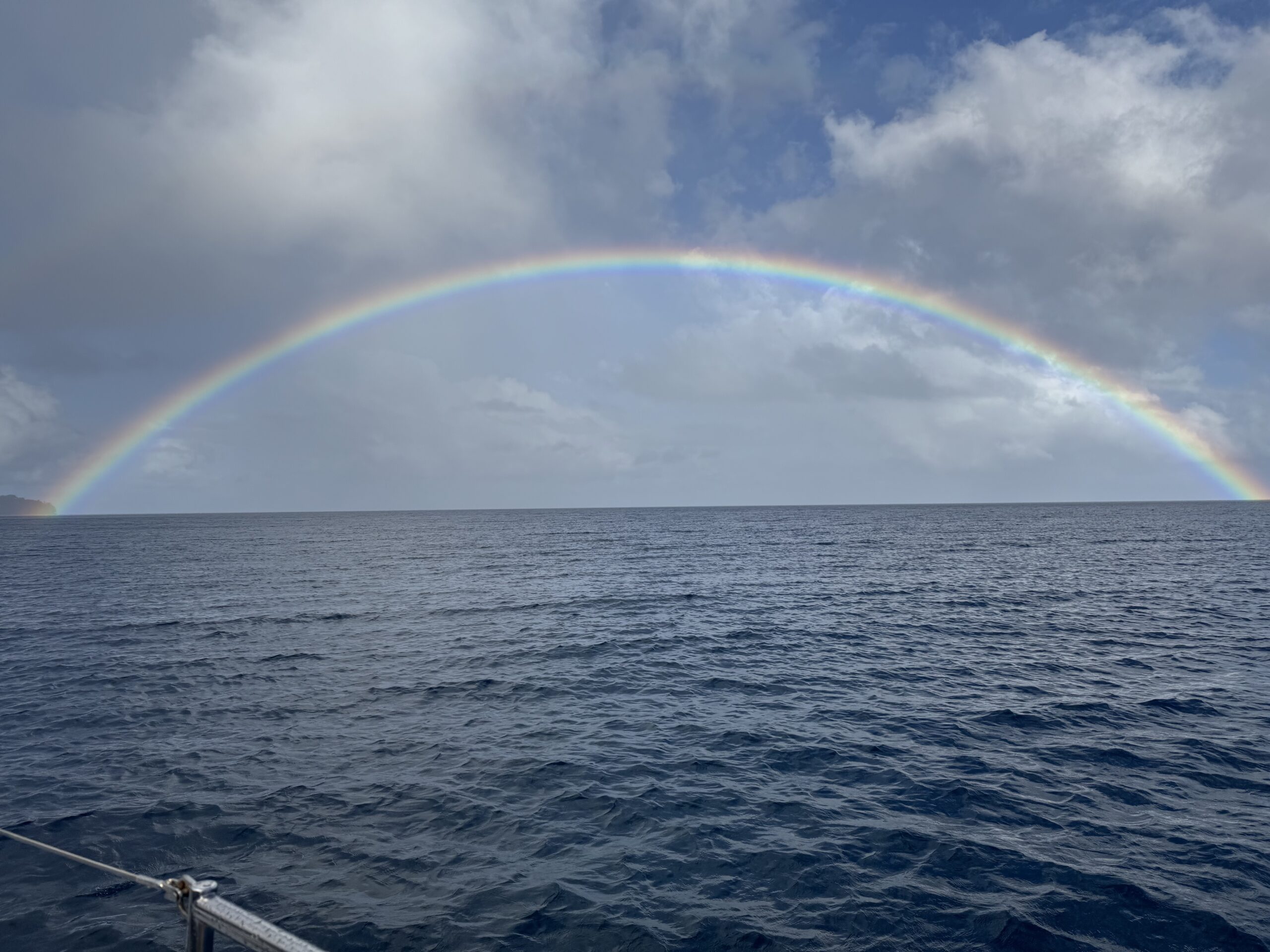
Rainbow in Port Olry
Lunch on shore in Port Olry
On Friday, June 27, we got up early and had the anchor up shortly after 6:00 a.m. We motored north for about ten miles before the wind came up. Then we had a lively sail to Gaua Island in the Banks group of islands. We were anchored by 3:00 p.m. in Lakona Bay. A couple of young men came out to greet us and we intended to visit the village the next day. But the anchorage was really rolly that night. So, the next day, we pulled up the anchor and motored a bit north to Bushman’s Bay, wish was much more comfortable.
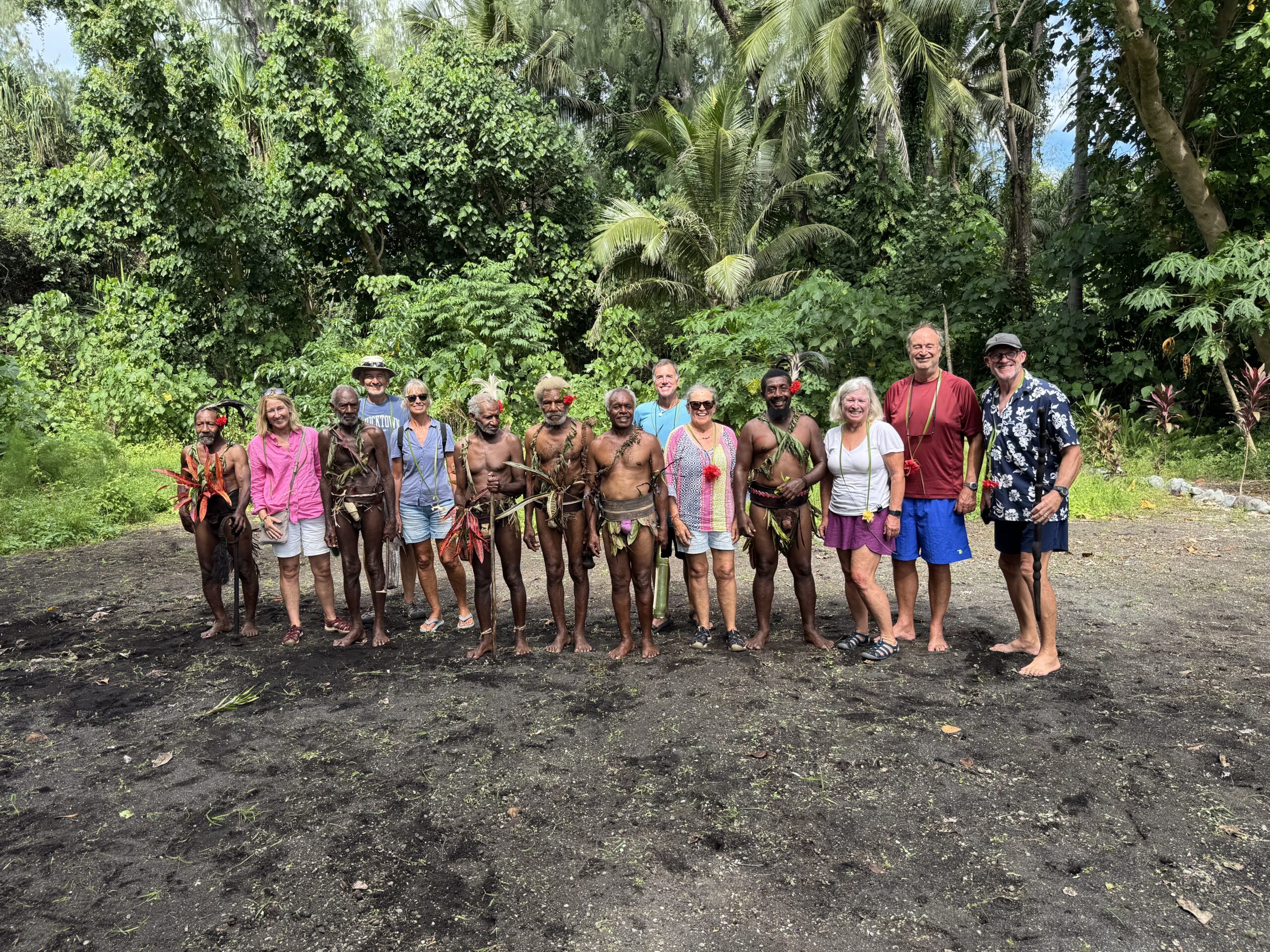
In Bushman’s Bay, a man paddled out to welcome us. Later other people paddled out with fruits and vegetables to trade. We stayed on the boat on Sunday because we didn’t want to intrude on their church and family time. But before we could go ashore on Monday, we found out that all the villagers were going around the corner to another village for a religious festival. So, we got in the dinghy and hurried to shore to meet the chief, Willy, before he left for the other village. Afterwards, we did some chores and snorkeled in the bay.
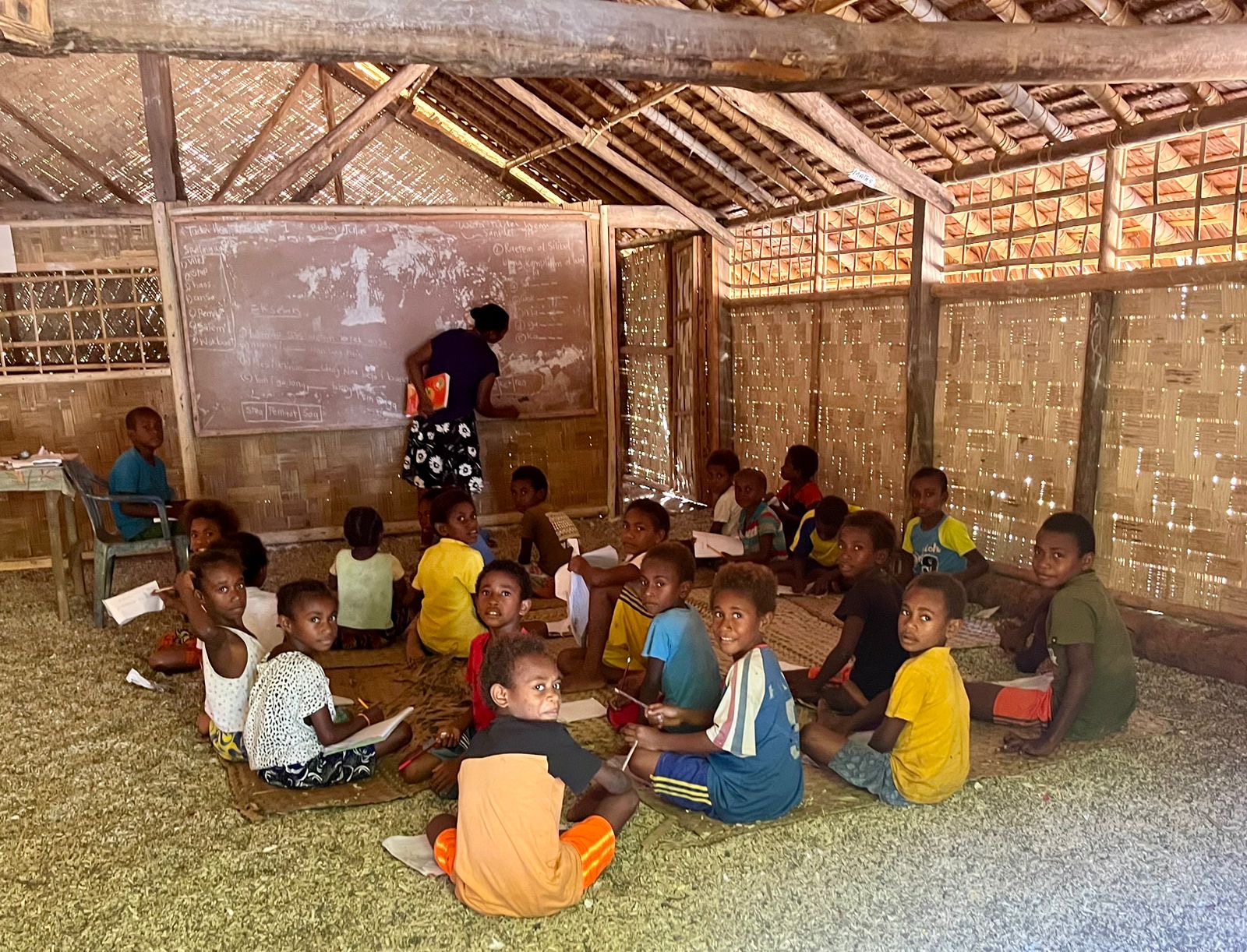
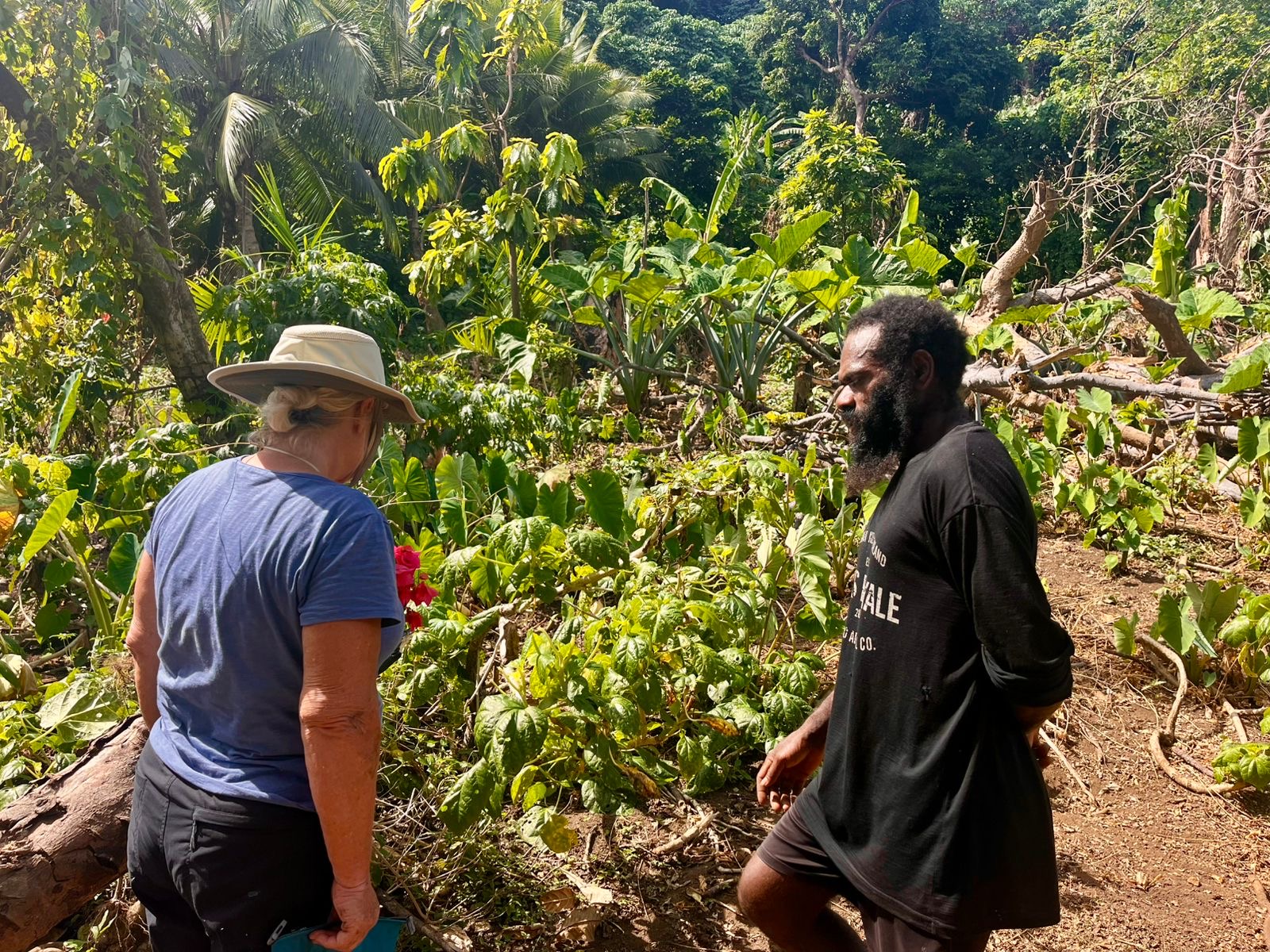
On Tuesday, we went ashore to meet up with Chief Willy. He showed us around the village and took us to the primary school. We gave him some rope and 3 gallons of petrol. He gave us a papaya. After the visit, we pulled up the anchor and went around to the next bay, Matanda Bay. Chief Michel greeted us in his canoe and guided us to a good anchor spot. Then we went ashore and he gave us a tour of his village, which consisted of his extended family only. He showed us his house and his garden and we met his family members. After we went back to the boat, we snorkeled on the reef and I scrubbed the bottom of the boat a bit.
Primary school class in Bushman’s Bay
That evening, Michel returned to see if we could charge his phone and to see if he could make a call. They do not have cell coverage in his village. He came back a bit later with some relatives. We tried making a call for them but were not successful. The next day, Michel came back out and we returned his uncharged phone. We promised that we would call his sister in Luganville when we got to the next village, Losalava. Then we pulled up the anchor and went to Losalava.
Touring Chief Michel’s Garden
The trip over to Losalava was against the wind in big seas. Fortunately, it was not a long way. We were going there because we thought it would be a good anchorage for weather that we were expecting. It was okay, but not really protected. We had several visitors that afternoon. Then, the next day, we went ashore, looking for the chief. He wasn’t around, but a group of kids took us around the village and showed us the new clinic that had just been completed. As we toured around, we finally did meet the chief, but he was really busy unloading building materials from a supply boat. We said hello and then continued. The three kids who acted as our guides asked if they could come out to the boat. So, we took them with us in the dinghy. We gave them water and cookies and Jeff gave them a tour of the boat. Before we took them back to shore, we gave them gifts (a book and perfume for the girls and juggling balls for the boy).
School kids visiting the boat in Losalava
We waited out the weather for the next couple of days, doing chores and some cooking. Our plan was to head north to the next two islands in the Banks group. But we finally realized that the weather was working against us and that we wouldn’t have reasonable passages to the other islands or comfortable stays once there. So, we decided to head back south again.
On Monday, July 7, we pulled up the anchor around 10:00 a.m. and headed back to Matanda Bay. We anchored briefly and Chief Michel’s brother paddled over. We told him about our phone call with his sister and asked him to tell Michel that we were leaving. Then we pulled up the anchor again and headed to Bushman’s Bay for the night.
After a quiet night in Bushman’s Bay, we got up at 6:00 a.m. and headed back to Santo Island. Once we got passed the shadow of Gaua Island, the wind came up and we had a lively sail back to the tip of Santo. Once inside the northern islands there, we lost our wind and finally had to motor back to Port Olry. Without even tidying up, we put the dinghy in the water and went to shore.
The restaurant we had visited previously wasn’t open, but we found the small Serenity Resort next door and had beers while we visited with the owner, Angelique. Then we found another place to get an early dinner before returning to the boat.
On Wednesday, we got up at 6:00 a.m. and motored to the center of the bay before putting up the mainsail. Then we motor sailed around to the south and down toward Luganville, in big seas and light winds. Toward the end of the trip, we were able to pull out the jib and turn off the motor and have a nice sail. We returned to the anchorage at the Beachfront Resort where several boats were already anchored. We had dinner that night at the resort.
On Thursday, we did chores. Then on Friday, we took our jerry cans to shore and, after some difficulty, got a taxi to take us to the vegetable market, the LCM supermarket and the gas station. We had dinner on shore again that night.
On Saturday, we woke up early again and had the anchor up by shortly after 6:00 a.m. We motored east and then south to Malekula Island. Eventually we had a good enough angle to sail, and we arrived in Port Stanley bay around 1:00 p.m. We tried three anchorages before settling on one that would only be suitable for the night. We were expecting a strong southerly wind and needed protection from it.
After a very calm night and leisurely morning (with some chores involved), the southerly wind arrived. We pulled up the anchor and went over to the anchorage in front of the village called Litslits. We were happy with the way the anchor set and the protection we were getting there.
On Monday, we remained in that anchorage. The wind was calm at first but then started blowing from the east. After puttering around on the boat, we pulled up the anchor and went over to the anchorage in front of Uri Island. It wasn’t really protected from the conditions. We had a windy night. On Tuesday, it was more of the same, too windy to go snorkeling and too windy to move south to another bay.
Wednesday, Thursday and Friday continued with winds in the high teens and choppy wind waves. There wasn’t really any better place to move to in Port Stanley and leaving the bay to go south would be very gnarly. Becoming more resigned to the fact that we were pinned down by weather, we entertained ourselves by polishing the stainless steel railings, cooking and reading. It’s very frustrating to be stuck on the boat without going ashore or getting into the water.
On Saturday, June 7, we pulled up the anchor at 10:00 a.m. for an overnight sail north to Pentecost Island. Pole Pole had arranged for a few boats to see land diving. The seas were big at first but gradually moderated. The wind was in the high teens and low twenties. We traveled at between 5 and 6.5 knots, mostly on a broad reach until we turned right at Ambryn Island to head into Wali Bay on Pentecost. At that point we could reach all the way to the bay. Approaching before daybreak, we slowed ourselves down to arrive in the daylight. Ral\La came in right behind us. Several catamarans from Australia were there, traveling in a flotilla. It made it a bit harder for the other boats in our group, Pole Pole, Alia Vita and Jiyu to find spots. But they did, and then the Australian catamarans left.
It was Jeff’s and Rowan’s birthday that day, so I baked a carrot cake before taking a nap. At the end of the day, all five boat crews gathered on Pole Pole for a wonderful dinner to celebrate the two birthdays.
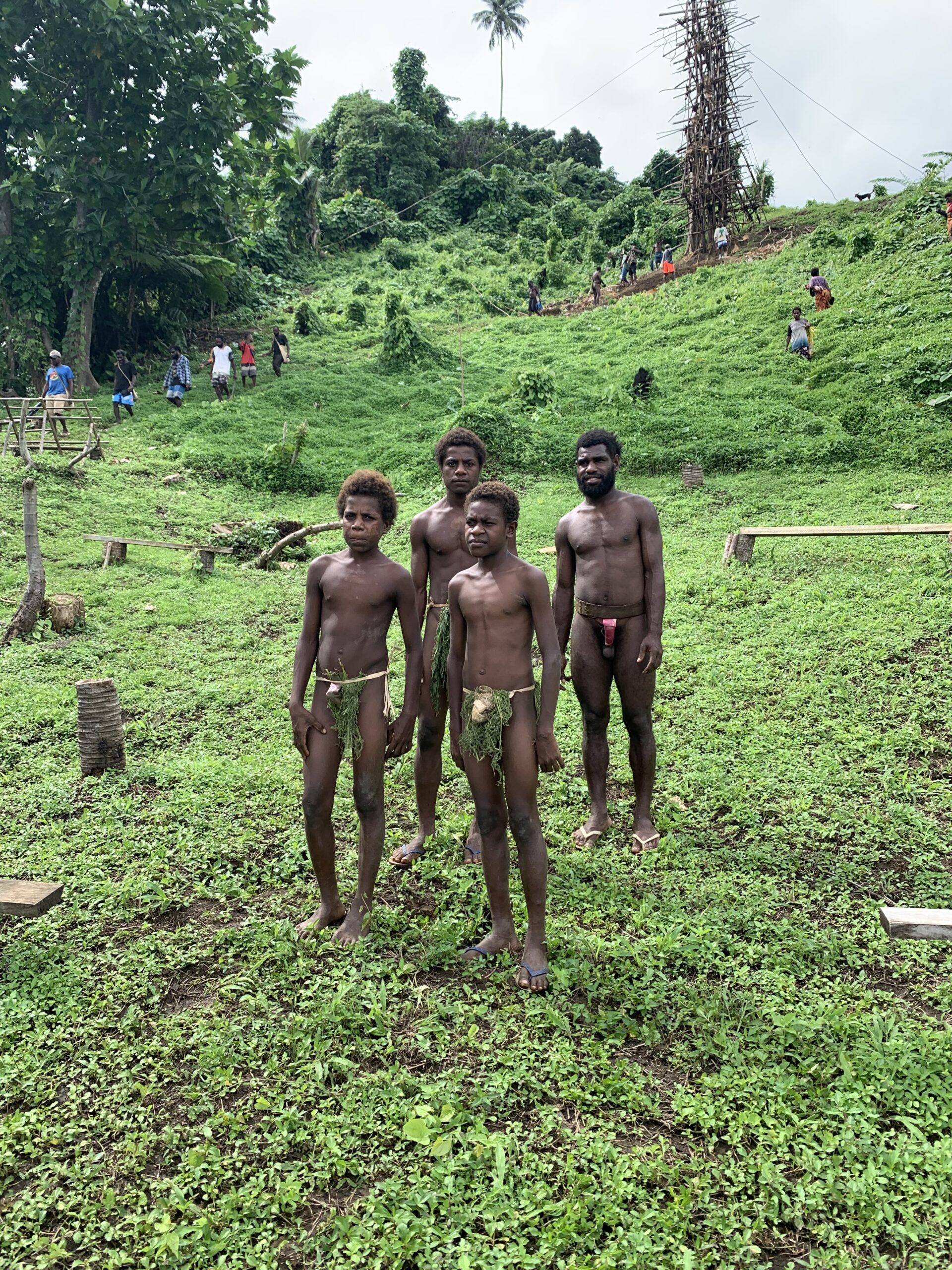
On Monday morning, we all went to shore to see the land diving. We were greeting by Eileen, who has taken over for her father as the host for land diving in Wali Bay. She offered us fruit and told us the history of land diving, which is only performed on Pentecost (and was the inspiration for bungee jumping). Her story was similar to what the museum guide in Port Vila told us. In a nutshell, a woman and her husband were arguing. She ran away from him and climbed a tree, then tied vines around her ankles. He followed her but did not tie any vines around his ankles. She jumped and so did he. She survived. In the pre-missionary days, it was women who re-enacted his, jumping from a tower. But after the missionaries arrived, they limited the ritual to only boys and young men, mostly as a rite of passage into manhood but also for the benefit of visitors. We were there at the very end of the season. Soon the vines would not be moist enough to provide elasticity.
After the introduction, we walked up a hill to a seating area below the tower, which had been built using the support of a tree. A group of adults and children were dancing and singing in support of the divers. All the male participants were wearing their traditional “kustom” clothing, which consists mostly of a penis sheath. We sat and watched the diving in astonishment, because the landings are not soft.
Getting ready for the dive
Land diving video courtesy of Rowan Gormley
The land divers
After the divers finished, we climbed into the back of a truck and were driven to a waterfall, where we could all frolic in the pools at the base of the falls.
The waterfall
We capped off the day with a bonfire on the beach, courtesy of Eileen, our host, and her husband.
On Monday, May 26, we left the Anatom anchorage about 4:30 p.m. with the spinnaker pole out on the port side. We pulled the jib out with the sheet running through the pole, and motored for about three hours before the wind came up. Then we put the other jib up, with the sheet through the end of the boom, and ran downwind for about 75 miles.
The next day, we continued running downwind, and it was a pretty pleasant sail. When the wind shifted, we took down the second jib and put up the main, thinking we could reach. But that didn’t last for long. We took down the main and ran with just the one jib on the pole. We were way ahead of schedule, so going at about 4-5 knots was good. We ran that way well into the night. Eventually the wind got stronger and we needed to furl in the jib, which meant taking it off the pole and putting the pole away.
During this second night, our wind-speed indicator quit working properly. It only intermittently provided the wind speed and angle. Also, a cast-aluminum fitting on the end of the boom sheared off, so we had to wrap the boom topping lift around the boom. The preventer was attached to the fitting that sheared off, so we moved it to a boom bale.
AT 8:30 on Wednesday morning, we arrived in Port Vila on the island of Efate. It’s the capital of Vanuatu. We had moderated our speed so we wouldn’t arrive before the marina opened at 8:00 a.m. A marina worked guided us in his tender. We picked up a mooring ball on the bow and then backed toward a seawall, where two other workers were ready to catch stern lines. They gave us a gangplank so we could walk from the stern of the boat to the seawall, which was right in front of the marina restaurant.
I put on some decent clothes, and with the paperwork in hand, walked across the gangplank to check in with the marina office. I was wearing flip flops with no traction and I promptly fell off the gangplank into the water. I held up the paperwork for Jeff to grab before it got wet. Then Jeff helped me climb back onto the boat. I changed shoes and walked to the marina office soaking wet. Several people watched this little fiasco with concern, and the marina staff worked with Jeff on making the gangplank more secure. Meanwhile, I nursed my several wounds from hitting the gangplank in a few different places as I fell.
After we checked in, I showered and changed clothes and we had lunch at the restaurant, not great food but very convenient. Then we started to get acquainted with Port Vila. We found the ATM, the Digicel phone office and the big supermarket.
On Thursday morning, we took our laundry to the marina office. Then I walked to the Digicel office to get a SIM card and phone number for Vanuatu. Next, I walked to the welder with the cast-aluminum cap that goes on the end of the boom, but it was a public holiday, so they were closed. When I got back, Jeff went up the mast to take down the wind indicator for inspection. After doing as much as he could to get it to move more freely, he went back up the mast to reinstall it. And I ordered a new bearing for it that Johno could bring when he arrives in August.
On Friday, I walked back to the welder to drop off the the cast-aluminum boom cap, and stopped for a few things at the supermarket. When I got back to the boat, we took 8 jerry cans over to the fuel dock to fill with diesel. Then I defrosted the freezer and cleaned the boat a bit. We picked up our laundry at the end of the day.
On Saturday, we defrosted both refrigerators and did other boat chores. Ian and Laura arrived from Erromango and we stopped at a nice little breakfast/lunch place behind the marina. We had dinner that night with RaLa and Rhapsody at Lalala, a restaurant that we had come to like very much.
The next day, Jeff made a broccoli salad and I made a black bean soup. Rhapsody and RaLa came over for dinner. After we ate, Jeff and I and Ian and Laura walked into town to the movie theater. We saw Mission Impossible, which was pretty bad, but it was fun to go to the movies.
On Monday, I went to the welder to pick up the boom cap. Back at the boat, we reinstalled it and it fit perfectly. Then we stood around the marina office for a long time, waiting for the Customs and Immigration officials to arrive to help us sort out some of our paperwork. The office had flagged an issue because the officials in Port Resolution had used the wrong process for our cruising permit. Once that was taken care of, Jeff and I joined Ian and Laura for lunch and then Ian and Laura and I caught a taxi to check out the marine chandlery. Finding very little of interest to us, we stopped in to see the diesel mechanic that Ian had been working with. I stayed a while and then got a taxi back to the marina on my own. While I was away, Jeff reinstalled the boom cap and reran the reefing lines.
The next day, Jeff pop riveted a new fitting on the boom for the preventer, so it didn’t have to be attached to the boom cap, which was not designed for that kind of stress. We did a few more chores, washed down the boat and had dinner with Ian and Laura.
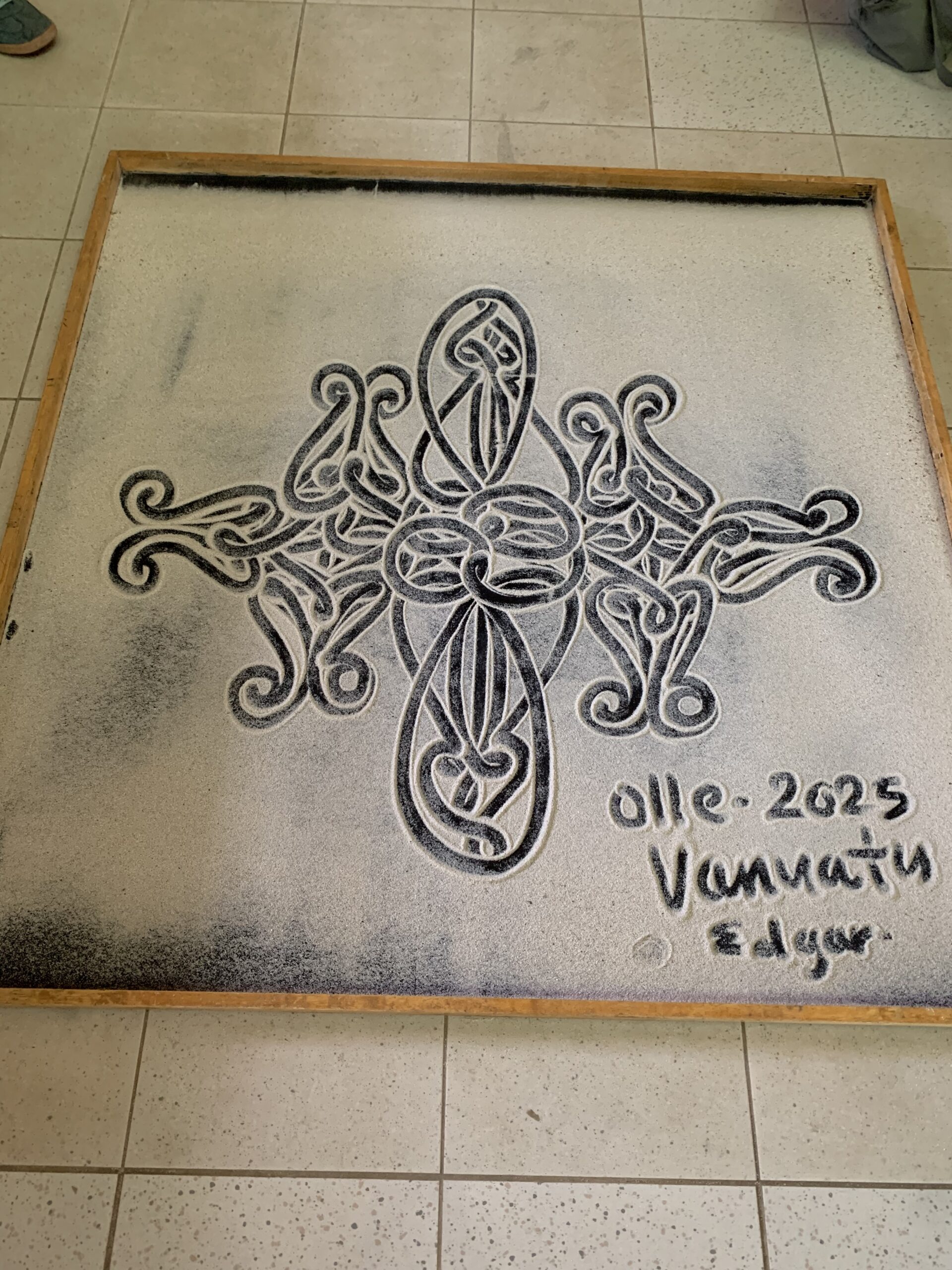
On Wednesday, we walked to the national museum. The guide demonstrated sand art, where he drew in the sand while telling a story. He also told us several Vanuatu origin stories and showed us around the museum. Afterwards, we walked to a fruit and vegetable market and then to the supermarket, getting final provisions so we could take off again.
An example of sand art. The guide drew this while telling us a story.
On Thursday, June 5th, we checked out of the marina and sailed out of Port Vila and around to the north side of Efate. RaLa and Pole Pole did the same. We ended up anchoring off of Lelepa Island. The snorkeling was good and we all gathered for tea on RaLa in the afternoon. At the end of the day, locals from the island came to tell us that we couldn’t anchor there. We protested that it was too late in the day for us to move. So we were all given permission to stay until the next morning.
On Friday morning, we got up reasonably early and pulled up anchor to go out the northern pass. As we exited the pass, we were hit with lots of wind and huge waves. It was hard to control the boat. RaLa was a head of us and anchored in a small bay. We motored around them and decided that it was too dicey to anchor there. We kept going around the top of Efate and found an anchorage that was better protected. RaLa arrived a bit later. Pole Pole also came around to that back but anchored in a different spot. We took RaLa’s dinghy to shore to walk around for a bit, then went back to our boats.
We arrived in Port Resolution on Tanna Island on Tuesday, May 20. Tanna is known for its active volcano, Mt. Yasur, so we made arrangements with a man by the name of Donovan to take us to the volcano on Wednesday evening.
Wednesday was Ian’s birthday, so when I awoke, I baked a chocolate cake for him and some vegan brownies that Bob and Sarah on Rhapsody could eat. Meanwhile, Jeff was troubleshooting our running lights and discovered that they had blown a fuse and when turned on used a staggering amount of amps – so he knew we had a short in the system. After a few explorations, he disconnected the compass light, which corrected the issue.
Ian and his birthday cake
In the middle of the afternoon, we all went over to RaLa for tea and birthday cake. After our little celebration, we went to shore to find Donovan. He had arranged for a friend to take us to the volcano in his truck. The road out of Donovan’s village was quite rough, but we soon reached a new paved road, in the process of completion by a Chinese enterprise. (We have heard that the Chinese are building roads in Vanuatu in exchange for fishing rights. And we saw huge Chinese fishing fleets near Vanuatu.)
Once on the smooth road, the trip to the volcano was easy. When we got to the volcano park, we paid our entry fees and then drove to the observation area. It was a pretty overcast day, and fog lay heavy over the caldera. But as the day turned to night, we could see small hot spots of red. And the volcano emitted very loud booms every so often. At one point, one of the hot spots erupted, venting a huge stream of red gas high into the air. I don’t have a picture of it.
At the volcano, video courtesy of Jeff Fredrick
We stayed at the volcano about an hour, breathing in the sulphury gases and chatting with the guides who worked there. Then we walked back to the truck for the ride back to the village.
On the ride up and back, Donovan was able to tell us his story. He lives in a very small village and they don’t have access to drinking water without walking quite a distance from the village, which is very hard for older and infirm people. Because he hasn’t been able to get any government assistance, Donovan has been building a solution on his own, funding it by taking people on treks up to the volcano. His solution is to dam a small river source and install pipes to move the water closer to the village.
Donovan also told us about the long-held beliefs about the volcano and how each of the hot spots was once a person. And when those people throw up stones, those stones can be used by some to change the course of nature.
On Thursday, Jeff and Ian and Laura and I went for a walk on the island. We ventured to a brackish watering hole where many women were washing clothes and children were playing. We then walked over to the windward side of the island. Jeff swam in the surf and we talked to a woman who ran a small backpacker resort. She told us that their village was completely out of water. Someone had broken the pump and they were waiting for someone to arrive from Australia to install a new pump.
Mama washing clothes, child enjoying the water
Jeff taking advantage of the beach on the windward side of Tanna
Talking to the manager of the little resort
All the other boats in the anchorage left, leaving just Aldabra and RaLa. Then Tanik, a boat from Israel, came to check in. That night, we went over to their boat for sundowners.
RaLa and Aldabra in Port Resolution
The next day, we got up very early, put the dinghy on the davits and pulled up anchor and started heading out of Port Resolution by 6:30 a.m. We motored part way around the island and then put up the main. But we still had to motor sail for a while before the wind came up. After using the motor for quite a distance, we were finally able to sail with main and jib, beating and reaching with winds in the high teens. That lasted until we arrived in the wind shadow of Anatom Island, at which point we came to a dead stop. We took the sails in and motored to the anchorage, right off of Mystery Island, arriving about 3:00 p.m. Rhapsody, RaLa and Pole Pole were already there. We went ashore to see if we could get some local currency from the bank and to arrange to hike to a waterfall. We all had drinks together that night on Pole Pole.
On Saturday, Ian and Laura, Sarah and Jeff and I went ashore to find the man who could guide us to the waterfall. We had thought someone had alerted him the night before, but that had not happened. Fortunately, his young cousin heard that we were looking for him and that cousin ran to his house to alert him. Meanwhile, we started walking in the direction of his house, which was about an hour walk. Ilisha intercepted us as we got near his house and guided us there. He showed us around his property, which was very well kept. He had put a lot of work into nice buildings and a large garden.
After hanging out at his place for a bit, we started our walk to the waterfall, along with Ilisha, his young daughter, his cousin Samuel and his young sister in law. It was a four-hour walk through a jungle path that hadn’t been cleared in a while. We did about twenty river crossings. The going was tough and slippery at times. Once at the waterfall, some of us plunged into the cold water and sat on boulders to have some lunch. Ilisha and the kids hunted for eel and shrimp and cooked them in bamboo.
Spear fishing for shrimp and eel
Sarah enjoying the waterfall
The return trip was shorter timewise, but it had started raining and the path was wet and slippery. I fell a few times, even though Samuel was generally by my side with a helping hand. Once back on the main path, we bid goodbye to Ilisha and walked with Samuel back to the village and to the dinghy on the beach. We were drenched and muddy but it had been a good adventure. We had gone 11 miles.
On Sunday, we tried washing our muddy clothes and shoes. Then Ian and I went to shore to give Ilisha some things we had promised him. He was very grateful for everything but mostly moved by a pair of shoes that Ian had given him. In the afternoon, we all walked around Mystery Island, which was abandoned for the moment. Three cruise ships had called in the last three days. The ships disgorge their passengers onto the island for the day. But no cruise ship was there that day so we had the place to ourselves for a quick circumnavigation.
Jeff in the soup pot on Mystery Island
On Monday, May 26, I stayed on the boat while Jeff and Ian and Laura went for a walk on the main island. I studied weather for a passage north. When Jeff returned, we discussed leaving for the passage at 5:00 p.m. that day. Later, Jeff and Ian and Laura attempted to snorkel off Mystery Island. It is supposed to be very good, but it was really windy and choppy. When they returned without much success, Ian and Laura had decided to leave as well. We were heading to Port Vila on the Island of Efate. They were headed to Dillon’s Bay on Erromango. Some weather was coming and we each made individual decisions about where we wanted to be in the weather. Rhapsody decided to stay until they could get some good snorkeling in.
On Saturday, May 17, at 7:30 a.m., we left the Denarau Marina in western Fiji, bound for Vanuatu. We motored out of the Navula Pass with the main up. We motored for a couple more hours after exiting the pass. Once we left the wind shadow of Viti Levu, we turned off the motor and sailed on a broad reach on the rhumbline, with one reef in the main at first and a second reef put in before dark. The waves were 2-3 meters. The wind in the high teens and twenties. During the night, we got pushed more to the south to avoid having to jibe. Also during the night, a booby bird crash landed into the cockpit, right next to where I was sitting at the helm. I shrieked before I realized what it was. It used its wings to slowly climb out of the hole between two rails, then stood stunned on the BBQ. I nudged it to fly before I realized that it was injured. The next morning I found blood all over the BBQ cover and parts of the cockpit. I just hoped it wasn’t too badly injured.
On Sunday, conditions were improved but the waves were still big. We continued to be forced more south. Because we were on such a broad reach and the waves were so big, the jib kept collapsing. So we put the spinnaker pole up and ran the jib sheet through it, which helped the jib keep its shape. The wind was in the high teens and low twenties.
On Monday, May 19, the wind and the seas moderated. We pulled down the main and put up a second jib, with the sheet running through the back of the boom, which allowed us to run downwind. That meant that we no longer needed to worry about the main accidentally jibing and we could point more toward our destination. However, by that evening, we didn’t have enough wind. We had to take the second jib down and motor sail with the regular jib on the pole. When we turned on the motor, we also changed navigation lights, only to discover that the running lights weren’t working. We would troubleshoot them later, but for the night, we used our masthead tricolor, as if we were powered by sails alone.
On Tuesday, after motoring all night, we arrived in Port Resolution on Tanna Island in Vanuatu. It was mid-morning. Rhapsody, who left Denarau right after we did, was already in the anchorage. And RaLa, who left Vuda Marina a couple of hours behind us, entered the anchorage about an hour ahead of us. There were more than ten boats in the anchorage that had already checked in, many of whom had come up from New Zealand.
We had prior approval to check into Port Resolution, and the officials were there. They radioed us to come ashore, so we put the dinghy in the water and headed to the beach. All three boats checked in rather quickly. The officials were very friendly, giving the impression that they liked their jobs and that they liked having the yachts visit.
One doesn’t get much sleep on a passage, so after tidying up the boat and having beers on RaLa, we turned in early for a good night’s sleep.